
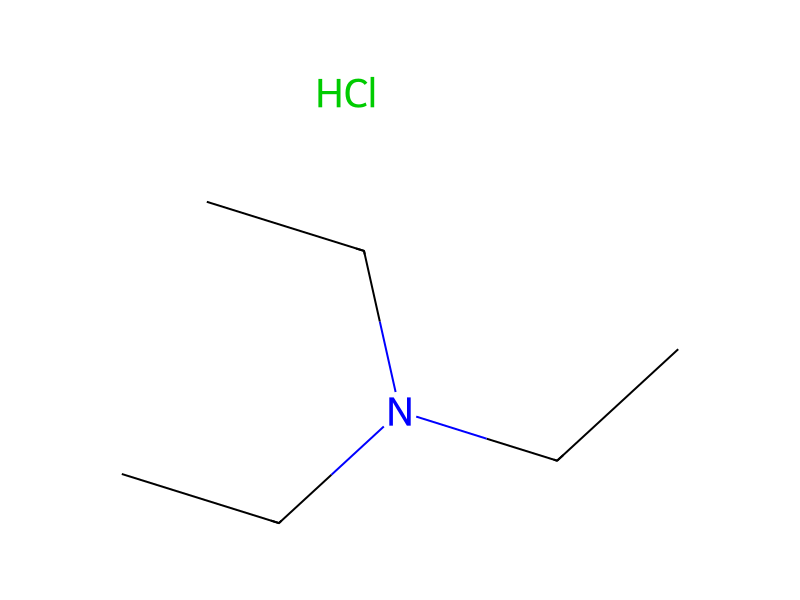
Basic information
- Standard SMILES
CCN(CC)CC.Cl- InChIKey
ILWRPSCZWQJDMK-UHFFFAOYSA-N- Molecular formula
- C6H16ClN
- Average molar mass
- 137.65 g/mol
- Monoisotopic mass
- 137.0971272
Names & identifiers
- Preferred name
- Triethylamine hydrochloride
- IUPAC
- N,N-diethylethanamine;hydrochloride
Names & synonyms
TRIETHYLAMINE HYDROCHLORIDE554-68-7Triethylammonium chlorideTRIETHYLAMINE HClEthanamine, N,N-diethyl-, hydrochlorideTriethylamine monohydrochlorideTriethylamine, hydrochlorideAmine, triethyl, hydrochloride0NX3818GCWNSC-30600Ethanamine, N,N-diethyl-, hydrochloride (1:1)DTXSID8060292
Show more names
RefChem:6324DTXCID2041884209-067-2triethylaminehydrochlorideN,N-diethylethanamine;hydrochlorideMFCD00012500HSDB 5689N,N-diethylethanamine hydrochloride
Database identifiers
- CAS
554-68-7- PubChem CID
- 11130
- ChEMBL
CHEMBL4446875- UNII
- 0NX3818GCW
- EC Number
- 209-067-2
Properties
Computed structural properties
- Topological polar surface area
- 3.2 Ų
- Hydrogen bond donors
- 1
- Hydrogen bond acceptors
- 1
- Rotatable bonds
- 3
- Heavy atoms
- 8
- Formal charge
- 0
- Complexity
- 25
Experimental & physicochemical properties
Density1.0689 g/cu cm 21 °C
Color/Form
Crystals from alcohol
Hexagonal crsystals from alcohol
Solubility
In water, 1X10+6 mg/L at 25 °C
Soluble in 0.7 parts water
Very soluble in ethanol, chloroform
Soluble in alcohol, chloroform; very slightly soluble in benzene. Practically insoluble in ether
Boiling Point245 °C (sublimes)
DecompositionWhen heated to decomposition it emits toxic vapors of /nitrogen oxides, HCl, chloride anione/
Melting Point260 °C (decomposes)
Vapor Pressure0.0000138 [mmHg]
Physical DescriptionSolid; [HSDB] White crystalline powder; [MSDSonline]
Stability/Shelf LifeStable under recommended storage conditions.
Safety & regulation
GHS classification
GHS Classification
This chemical does not meet GHS hazard criteria for 21.4% (37 of 173) of reports.
Danger
H314 (11%): Causes severe skin burns and eye damage [Danger Skin corrosion/irritation];H315 (67.6%): Causes skin irritation [Warning Skin corrosion/irritation];H319 (67.6%): Causes serious eye irritation [Warning Serious eye damage/eye irritation];H335 (76.9%): May cause respiratory irritation [Warning Specific target organ toxicity, single exposure; Respiratory tract irritation]
P260, P261, P264, P264+P265, P271, P280, P301+P330+P331, P302+P352, P302+P361+P354, P304+P340, P305+P351+P338, P305+P354+P338, P316, P319, P321, P332+P317, P337+P317, P362+P364, P363, P403+P233, P405, and P501 (click each P-code to see the statement)
Aggregated GHS information provided per 173 reports by companies from 15 notifications to the ECHA C&L Inventory. Each notification may be associated with multiple companies.;Reported as not meeting GHS hazard criteria per 37 of 173 reports by companies.;There are 14 notifications provided by 136 of 173 reports by companies with hazard statement code(s).;Information may vary between notifications depending on impurities, additives, and other factors. The percentage value in parenthesis indicates the notified classification ratio from companies that provide hazard codes. Only hazard codes with percentage values above 10% are shown. For more detailed information, please visit ECHA C&L website.
Hazard information
Regulatory Information
Chemical: Ethanamine, N,N-diethyl-, hydrochloride
Status: Active Update: 10-01-2022 https://echa.europa.eu/registration-dossier/-/registered-dossier/18983
Triethylammonium chloride: Does not have an individual approval but may be used under an appropriate group standard
Hazards SummaryEmergency treatment: Triethylamine; [HSDB] An irritant; [MSDSonline] See Triethylamine.
Toxic Combustion ProductsSpecial hazards arising from the substance or mixture: Carbon oxides, nitrogen oxides (NOx), hydrogen chloride gas.
Hazard Classes and CategoriesSkin Corr. 1B (11%);Skin Irrit. 2 (67.6%);Eye Irrit. 2 (67.6%);STOT SE 3 (76.9%)
Shipment Methods and Regulations
No person may /transport,/ offer or accept a hazardous material for transportation in commerce unless that person is registered in conformance ... and the hazardous material is properly classed, described, packaged, marked, labeled, and in condition for shipment as required or authorized by ... /the hazardous materials regulations (49 CFR 171-177)./
Hazardous Reactivities and IncompatibilitiesIncompatible materials: Strong oxidizing agents.
Safety & protection
Fire Fighting Procedures
Suitable extinguishing media: Use water spray, alcohol-resistant foam, dry chemical, or carbon dioxide.
Wear self contained breathing apparatus for fire fighting if necessary.
Storage ConditionsKeep container tightly closed in a dry and well-ventilated place. Hygroscopic.
Cleanup Methods
ACCIDENTAL RELEASE MEASURES: Personal precautions, protective equipment and emergency procedures: Use personal protective equipment. Avoid dust formation. Avoid breathing vapors, mist or gas. Ensure adequate ventilation. Evacuate personnel to safe areas. Avoid breathing dust. Environmental precautions: Do not let product enter drains. Methods and materials for containment and cleaning up: Pick up and arrange disposal without creating dust. Sweep up and shovel. Keep in suitable, closed containers for disposal.
Disposal Methods
SRP: Recycle any unused portion of the material for its approved use or return it to the manufacturer or supplier. Ultimate disposal of the chemical must consider: the material's impact on air quality; potential migration in air, soil or water; effects on animal, aquatic and plant life; and conformance with environmental and public health regulations. If it is possible or reasonable use an alternative chemical product with less inherent propensity for occupational harm/injury/toxicity or environmental contamination.
Product: Offer surplus and non-recyclable solutions to a licensed disposal company. Contact a licensed professional waste disposal service to dispose of this material; Contaminated packaging: Dispose of as unused product.
Preventive Measures
ACCIDENTAL RELEASE MEASURES: Personal precautions, protective equipment and emergency procedures: Use personal protective equipment. Avoid dust formation. Avoid breathing vapors, mist or gas. Ensure adequate ventilation. Evacuate personnel to safe areas. Avoid breathing dust. Environmental precautions: Do not let product enter drains.
Precautions for safe handling: Avoid contact with skin and eyes. Avoid formation of dust and aerosols. Provide appropriate exhaust ventilation at places where dust is formed. Normal measures for preventive fire protection.
Appropriate engineering controls: Handle in accordance with good industrial hygiene and safety practice. Wash hands before breaks and at the end of workday.
Gloves must be inspected prior to use. Use proper glove removal technique (without touching glove's outer surface) to avoid skin contact with this product. Dispose of contaminated gloves after use in accordance with applicable laws and good laboratory practices. Wash and dry hands.
SRP: Local exhaust ventilation should be applied wherever there is an incidence of point source emissions or dispersion of regulated contaminants in the work area. Ventilation control of the contaminant as close to its point of generation is both the most economical and safest method to minimize personnel exposure to airborne contaminants. Ensure that the local ventilation moves the contaminant away from the worker.
Personal Protective Equipment (PPE)
Eye/face protection: Safety glasses with side-shields conforming to EN166. Use equipment for eye protection tested and approved under appropriate government standards such as NIOSH (US) or EN 166(EU).
Skin protection: Handle with gloves.
Body Protection: Impervious clothing. The type of protective equipment must be selected according to the concentration and amount of the dangerous substance at the specific workplace.
Respiratory protection: For nuisance exposures use type P95 (US) or type P1 (EU EN 143) particle respirator. For higher level protection use type OV/AG/P99 (US) or type ABEK-P2 (EU EN 143) respirator cartridges. Use respirators and components tested and approved under appropriate government standards such as NIOSH (US) or CEN (EU).
Toxicology
InteractionsIncreases in antibacterial and antifungal properties in vitro, due to the triethylammonium chloride complexation of N-substituted N'-cyano-O-(triphenylstannyl)isoureas, are discussed.
Toxicity Summary
IDENTIFICATION AND USE: Triethylamine hydrochloride forms hexagonal crystals. It used in preparation of quaternary ammonium compounds. HUMAN EXPOSURE AND TOXICITY: There is no data available. ANIMAL STUDIES: The hemolytic actions of some short-chain alkylamine hydrochlorides were studied. Tertiary salts such as triethylamine hydrochloride produced incomplete hemolysis of dog erythrocytes in vitro, whereas primary salts produced complete hemolysis.
Non-Human Toxicity Excerpts
/ALTERNATIVE and IN VITRO TESTS/ The hemolytic actions of some short-chain alkylamine hydrochlorides were studied. Tertiary salts such as triethylamine hydrochloride produced incomplete hemolysis of dog erythrocytes in vitro, whereas primary salts produced complete hemolysis. The decreased activity was attributed to the increased bulkiness and lipophilicity of successively alkyl-substituted amine cations. In each group of salts, the hemolytic activity increased with increased alkyl chain length.
Antidote and Emergency Treatment
Immediate first aid: Ensure that adequate decontamination has been carried out. If patient is not breathing, start artificial respiration, preferably with a demand-valve resuscitator, bag-valve-mask device, or pocket mask, as trained. Perform CPR as necessary. Immediately flush contaminated eyes with gently flowing water. Do not induce vomiting. If vomiting occurs, lean patient forward or place on left side (head-down position, if possible) to maintain an open airway and prevent aspiration. Keep patient quiet and maintain normal body temperature. Obtain medical attention. /Organic bases/amines and related compounds/
Basic treatment: Establish a patent airway (oropharyngeal or nasopharyngeal airway, if needed). Suction if necessary. Watch for signs of respiratory insufficiency and assist ventilations if necessary. Administer oxygen by nonrebreather mask at 10 to 15 L/min. Monitor for pulmonary edema and treat if necessary ... . Monitor for shock and treat if necessary ... . Anticipate seizures and treat if necessary ... . For eye contamination, flush eyes immediately with water. Irrigate each eye continuously with 0.9% saline (NS) during transport ... . Do not use emetics. For ingestion, rinse mouth and administer 5 mL/kg up to 200 mL of water for dilution if the patent can swallow, has a strong gag reflex, and does not drool. Administer activated charcoal ... . Cover skin burns with dry sterile dressings after decontamination ... . /Organic bases/amines and related compounds/
Advanced treatment: Consider orotracheal or nasotracheal intubation for airway control in the patient who is unconscious, has severe pulmonary edema, or is in severe respiratory distress. Positive-pressure ventilation techniques with a bag-valve-mask device may be beneficial. Consider drug therapy for pulmonary edema ... . Monitor cardiac rhythm and treat arrhythmias as necessary ... . Start IV administration of D5W TKO /SRP: "To keep open", minimal flow rate/. Use 0.9% saline (NS) or lactated Ringer's (LR) if signs of hypovolemia are present. For hypotension with signs of hypovolemia, administer fluid cautiously. If patient is unresponsive to these measures, vasopressors may be helpful. Watch for signs of fluid overload ... . Administer 1% solution methylene blue if patient is symptomatic with severe hypoxia, cyanosis, and cardiac compromise not responding to oxygen. ... . Treat seizures with diazepam (Valium) or lorazepam (Ativan) ... . Use proparacaine hydrochloride to assist eye irrigation ... . /Organic bases/amines and related compounds/
Regulatory information
Regulatory Information
Chemical: Ethanamine, N,N-diethyl-, hydrochloride
Status: Active Update: 10-01-2022 https://echa.europa.eu/registration-dossier/-/registered-dossier/18983
Triethylammonium chloride: Does not have an individual approval but may be used under an appropriate group standard
Chemistry & industry
Uses & manufacturing
UsesUsed to make quaternary ammonium compounds; [HSDB]
General Manufacturing Information
Ethanamine, N,N-diethyl-, hydrochloride (1:1): ACTIVE
By using trimethylamine hydrochloride and triethylamine hydrochloride, it was determined that the stimulant action of nicotine in the brain paralleled the nicotine effect in the ganglia of rabbits.
Related reactions
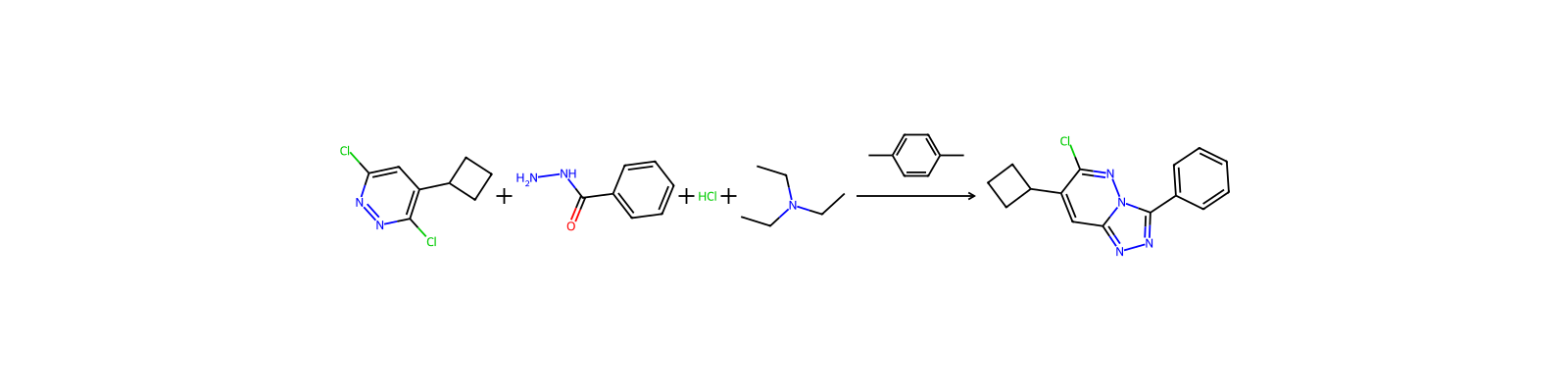
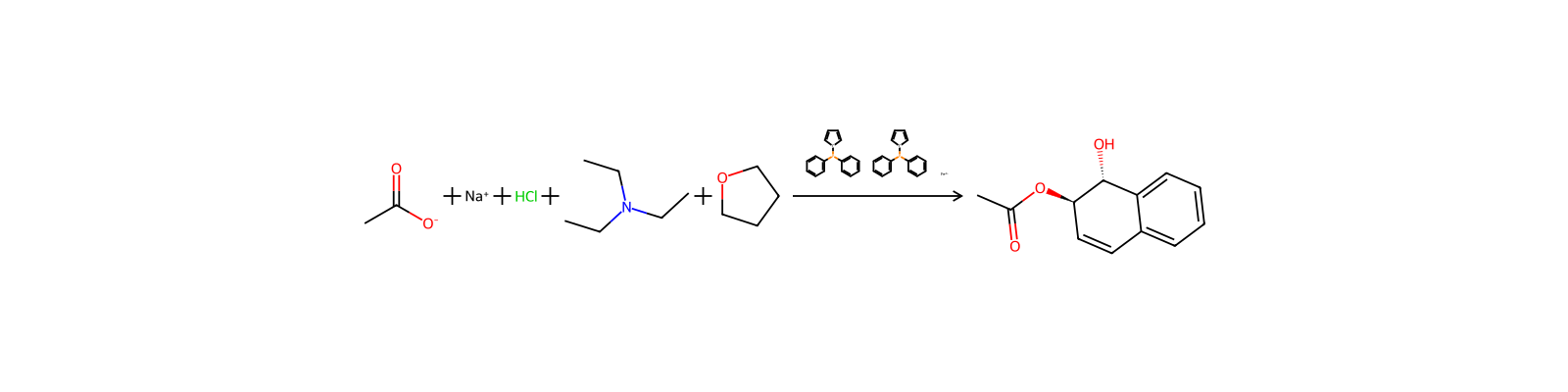
548 records





Linked notes
Loading…