
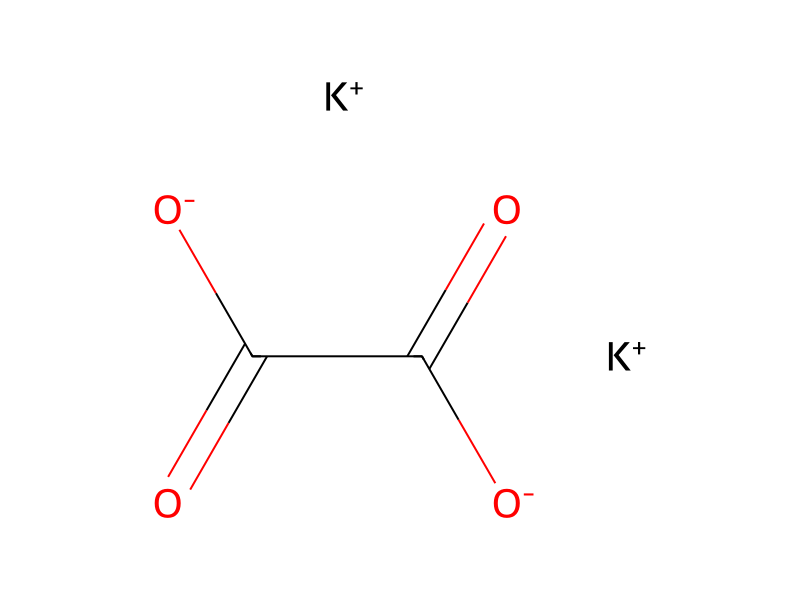
Basic information
- CAS
583-52-8- Standard SMILES
O=C([O-])C(=O)[O-].[K+].[K+]- InChIKey
IRXRGVFLQOSHOH-UHFFFAOYSA-L- Molecular formula
- C2K2O4
- Average molar mass
- 166.22 g/mol
- Monoisotopic mass
- 165.90707145
Names & identifiers
- Preferred name
- Dipotassium Oxalate
- IUPAC
- dipotassium;oxalate
- English name
- Potassium oxalate
- Molecular formula
- C2K2O4
- Molecular weight
- 166.22
Names & synonyms
Potassium oxalateDipotassium oxalate583-52-8Ethanedioic acid, dipotassium saltPotassium neutral oxalateoxalic acid dipotassium saltLC7F2W7I5BEthanedioic acid, potassium salt (1:2)KALI OXALICUMOXALIC ACID, DIPOTASSIUM SALTEthanedioic acid potassium salt (1:2)DTXSID6060393
Show more names
DIPTASSIUMOXALATEipotassium,oxalatedipotassiumethanedioatepotassiumneutraloxalateOxalic acid dipotassiumpotassiumoxalate(k2c2o4)oxalicacid,dipotassiumsaltPotassium Oxalate Anhydrous
RefChem:57878DTXCID7042358209-506-8Potassiumoxalatedipotassium;oxalateMFCD00012464dipotassium,oxalatedi-potassium oxalate
Database identifiers
- CAS
583-52-8- PubChem CID
- 11413
- DTXSID
DTXSID6060393- UNII
- LC7F2W7I5B
- EC Number
- 209-506-8
- Nikkaji
- J441C
Properties
Computed structural properties
- Topological polar surface area
- 80.3 Ų
- Hydrogen bond donors
- 0
- Hydrogen bond acceptors
- 4
- Rotatable bonds
- 0
- Heavy atoms
- 8
- Formal charge
- 0
- Complexity
- 60
Experimental & physicochemical properties
Density2.08 @25 °C
Physical DescriptionColorless odorless solid; Efflorescent in warm dry air; [Merck Index] White crystals or chunks; [Integra MSDS]
Physicochemical properties
- Density
- 2.13 · 2.13
- solubility
- 2 O · slightly soluble in H2O
- color
- white pwd
- Odor
- odorless
- Water Solubility
- 392 g/L · 392g/L at 20℃
- Cosmetics Ingredients Functions
- ANTICORROSIVECHELATING
- InChI
- InChI=1S/C2H2O4.2K/c3-1(4)2(5)6;;/h(H,3,4)(H,5,6);;/q;2*+1/p-2
- InChIKey
- IRXRGVFLQOSHOH-UHFFFAOYSA-L
- SMILES
- C([O-])(=O)C([O-])=O.[K+].[K+]
- CAS DataBase Reference
- 583 · 583-52-8(CAS DataBase Reference)
- FDA UNII
- 7 F2W7I5B · LC7F2W7I5B
- EPA Substance Registry System
- Ethanedioic acid, potassium salt (1:2) (583-52-8)
- Symbol(GHS)
- 7 · GHS07
- Signal word
- Warning
- Hazard statements
- 312 · H312-H302-H319
- Precautionary statements
- 264 · P264-P270-P301+P312-P330-P501-P280-P302+P352-P312-P322-P363-P501-P264-P280-P305+P351+P338-P337+P313P
- TSCA
- TSCA listed
- REACH Registrations
- Active
Safety & regulation
GHS classification
GHS Classification
Warning
H302+H312 (42%): Harmful if swallowed or in contact with skin [Warning Acute toxicity, oral; acute toxicity, dermal];H302 (100%): Harmful if swallowed [Warning Acute toxicity, oral];H312 (100%): Harmful in contact with skin [Warning Acute toxicity, dermal];H319 (60.7%): Causes serious eye irritation [Warning Serious eye damage/eye irritation]
P264, P264+P265, P270, P280, P301+P317, P302+P352, P305+P351+P338, P317, P321, P330, P337+P317, P362+P364, and P501 (click each P-code to see the statement)
Aggregated GHS information provided per 300 reports by companies from 5 notifications to the ECHA C&L Inventory. Each notification may be associated with multiple companies.;Information may vary between notifications depending on impurities, additives, and other factors. The percentage value in parenthesis indicates the notified classification ratio from companies that provide hazard codes. Only hazard codes with percentage values above 10% are shown. For more detailed information, please visit ECHA C&L website.
Hazard information
Regulatory Information
Chemical: Ethanedioic acid, dipotassium salt
Status: Active Update: 08-10-2021 https://echa.europa.eu/registration-dossier/-/registered-dossier/22576
Ethanedioic acid, dipotassium salt: Does not have an individual approval but may be used under an appropriate group standard
Other Safety InformationIMAP assessments - Ethanedioic acid, dipotassium salt: Environment tier I assessment;IMAP assessments - Oxalic acid soluble salts: Human health tier II assessment
Hazards Summary
Occurs as the monohydrate; Poisonous; [Merck Index] Dust is irritating to eyes, nose, and throat; Inhalation may cause systemic poisoning; Ingestion may cause cardiovascular collapse and delayed neuromuscular symptoms; [CHRIS] Caused arrhythmias and shock in women at lowest lethal dose of 1000 mg/kg; [RTECS] May cause severe irritation or burns to skin; May cause burns or injury to eyes; A nose, throat, and respiratory tract irritant; Heavy inhalation exposure may cause coughing, difficulty breathing, and chest pains; Chronic overexposure may lead to kidney injury; Toxic by ingestion and inhalation; Targets kidneys and nervous system; [Integra MSDS]
Hazard Classes and Categories
Acute Tox. 4 (100%);Acute Tox. 4 (100%);Eye Irrit. 2 (60.7%)
Acute toxicity - category 4;Acute toxicity - category 4;Eye damage - category 1;Skin irritation - category 2;Specific target organ toxicity (single exposure) - category 3;Specific target organ toxicity (repeated exposure) - category 2
Acute toxicity (Oral) - Category 4
Safety & protection
Protective Action Criteria (PAC)
9.5 [mg/m3]
100 [mg/m3]
630 [mg/m3]
Toxicology
Adverse EffectsDermatotoxin - Skin burns.
Regulatory information
Regulatory Information
Chemical: Ethanedioic acid, dipotassium salt
Status: Active Update: 08-10-2021 https://echa.europa.eu/registration-dossier/-/registered-dossier/22576
Ethanedioic acid, dipotassium salt: Does not have an individual approval but may be used under an appropriate group standard
Safety data
- tsca
- TSCA listed
- Signal word
- Warning
- Symbol(GHS)
- GHS07
- Hazard statements
- H312-H302-H319
- REACH Registrations
- Active
- Precautionary statements
- P264-P270-P301+P312-P330-P501-P280-P302+P352-P312-P322-P363-P501-P264-P280-P305+P351+P338-P337+P313P
Chemistry & industry
Pharmacology
FDA Pharmacological Classification
KALI OXALICUM
Osmotic Laxative [EPC]; Potassium Compounds [CS]; Potassium Salt [EPC]; Increased Large Intestinal Motility [PE]; Osmotic Activity [MoA]; Inhibition Large Intestine Fluid/Electrolyte Absorption [PE]
MeSH Pharmacological ClassificationMaterials that add an electron to an element or compound, that is, decrease the positiveness of its valence. (From McGraw-Hill Dictionary of Scientific and Technical Terms, 5th ed)
Uses & manufacturing
Uses
Used to bleach straw and to prevent in vitro blood coagulation; [Merck Index] Used in photography and to remove textile stains; [Hawley]
Photographic Processing [Category: Other];Textiles (Printing, Dyeing, or Finishing) [Category: Industry]
Household ProductsInformation on 2 consumer products that contain Dipotassium Oxalate in the following categories is provided:;• Home Maintenance
Use ClassificationCosmetics -> Chelating
General Manufacturing InformationEthanedioic acid, potassium salt (1:2): ACTIVE
Applications
UsesPotassium oxalate is a white crystal or powder made by neutralizing oxalic acid with potassium carbonate. It is soluble in water 1:3 but not in alcohol. Potassium oxalate was used as an early developer for gelatin plates but is best known as the developer for platinum prints.
UsesCleaning and bleaching straw, removing stains in photography; in vitro blood anticoagulant; also in analytical chemistry.
General DescriptionPotassium oxalate, K2C204, H20, is odorless, efforescent, water-soluble, colorless crystals that decompose when heated. Sinks in and mixes slowly with water. Used in analytical chemistry and photography, and as a bleach and oxalic acid source.
Preparation methods
PreparationOxalic acid is the main raw material for the preparation of potassium oxalate. It is prepared by reacting potassium carbonate with oxalic acid. The reaction equation is: K₂CO₃ + H₂C₂O₄ = K₂C₂O₄ + CO₂↑ + H₂O.
Upstream & downstream products
Upstream raw materials
Downstream products
Suppliers87 total
湖北万得化工有限公司15377098680 15377098680 · [email protected]
Hebei Chuanghai Biotechnology Co., Ltd+86-17732866630 · [email protected]
Hebei Zhuanglai Chemical Trading Co Ltd+86-16264648883 · [email protected]
山东泰诚生物科技有限公司18769832557 18769832557 · [email protected]
天津市光复科技发展有限公司022-85689490 13132141716 · [email protected]
武汉鹏垒生物科技有限公司15871464247 · [email protected]
天津市恒兴化学试剂制造有限公司022-26772349 15822233318 · [email protected]
江苏艾康生物医药研发有限公司025-66061636 19370895928 · [email protected]
河北创海生物科技有限公司+86-86-13131129325 · [email protected]
武汉吉业升化工有限公司027-83360216 18040558719 · [email protected]
Dayang Chem (Hangzhou) Co.,Ltd.+86-0571-88938639 17705817739 · [email protected]
山东中图化工有限公司17864755731 · [email protected]
河北枫嘉新材料科技有限公司+86-0311-87836622 +86-18712993135 · [email protected]
广东百科试剂有限公司13532366769 13686183698 · [email protected]
山东信恒化工有限公司15269160602 15269160602
北京华威锐科化工有限公司0757-86329057 18934348241 · [email protected]
济南源茂化工有限公司15665725027 18854103888 · [email protected]
武汉吉业升化工有限公司15387013945 · [email protected]
湖北兴琰新材料科技有限公司13129948835 · [email protected]
湖北长耀生物科技有限公司17683887209 17683887209 · [email protected]
武汉吉业升化工有限公司13545274181 · [email protected]
武汉丰泰威远科技有限公司+86-27-8746-5837 +86-18627785180 · [email protected]
山东信恒化工有限公司152-15269160605-0605 15269160605 · [email protected]
武汉丰泰威远科技有限公司027-87465837 19945049750 · [email protected]
武汉贝乐叶生物医药科技有限公司15871353653 18086118076 · [email protected]
孝感深远化工有限公司15527621225; 15527621225 · [email protected]
广东大小化工有限公司1866-171603 18666171603 · [email protected]
Hebei Zhuanglai Chemical Trading Co.,Ltd13343047651 · [email protected]
武汉吉业升化工有限公司027-13545242311 13545242311 · [email protected]
广东元丰化学试剂有限公司0751-2829979 13376591640 · [email protected]
上海遐瑞医药科技有限公司+86 21 61551611
广东顺奥化学试剂有限公司19928586137 · [email protected]
江阴市贝壳化学有限公司15312220685 · [email protected]
武汉吉业升化工有限公司15927657268 · [email protected]
北京环宇世纪化学科技有限公司hysj_bj.com
HBCChem, Inc.+1-510-219-6317 · [email protected]
日照力德士化工有限公司010-51268198 · [email protected]
广拓化学(上海)有限公司021-60899189-8001 18918189673 · [email protected]
上海麦克林生化科技股份有限公司15221275939 15221275939 · [email protected]
武汉贝乐叶生物医药科技有限公司18086118078 · [email protected]
长沙晶康新材料科技有限公司0733-0731-85118349 18229890050 · [email protected]
海南瀚海致远生物科技有限公司18171012772 · [email protected]
郑州九亿时光新材料有限公司+86-15225627621 +86-13213167925 · [email protected]
HANGZHOU LEAP CHEM CO., LTD.+86-571-87711850 +86-15355479329 · [email protected]
湖北世腾化工科技有限公司18971850150 19086915685 · [email protected]
武汉吉业升化工有限公司13343438917 · [email protected]
武汉吉业升化工有限公司15927120776 · [email protected]
韶关新润合生物科技有限公司19022763608 19022763608 · [email protected]
武汉吉业升化工有限公司15307169873 · [email protected]
陕西缔都医药化工有限公司029-029-81120477 17792793610 · [email protected]
Related reactions
4 records


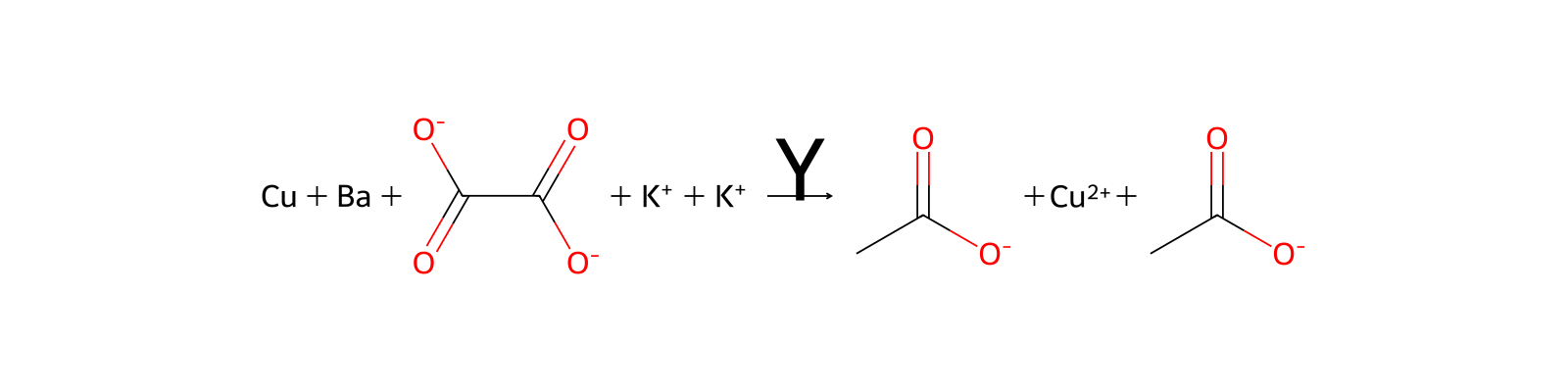
Compound notes
Loading…