HomeMCPWorkbenchSkills
HomeWorkbenchNotificationsMe
llms.txt · MCP GuidePrivacy Policy · Terms of Service · Supportv1.8.3
  1. Home
  2. /Compound

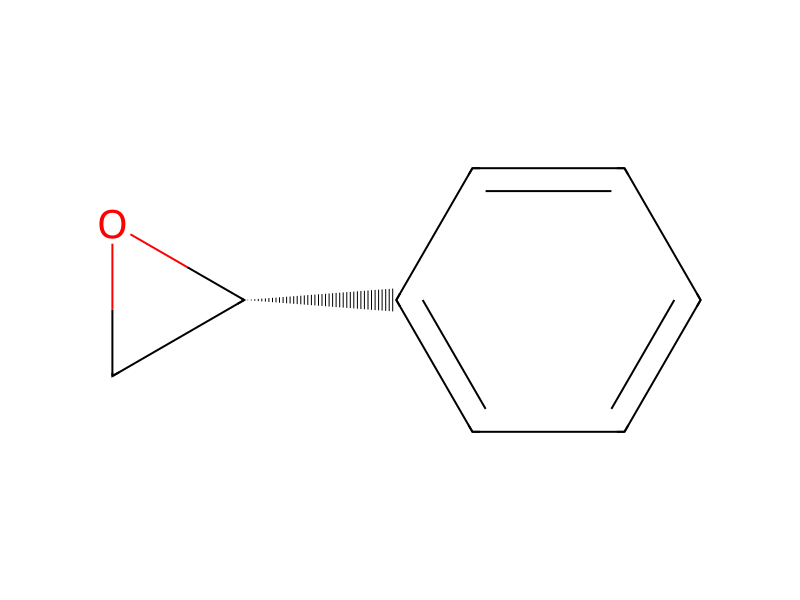
(+)-Styrene oxide

HCID 114705
New reaction
Print
Basic informationOverviewNames & identifiersPropertiesSafety & regulationChemistry & industryRelated reactionsCompound notes
Substructure searchFind similar structures

Basic information

CAS
20780-53-4
Standard SMILES
c1ccc([C@@H]2CO2)cc1
InChIKey
AWMVMTVKBNGEAK-QMMMGPOBSA-N
Molecular formula
C8H8O
Average molar mass
120.15 g/mol
Monoisotopic mass
120.05751487

Overview

(R)-styrene oxide is the (R)-enantiomer of styrene oxide. It is an enantiomer of a (S)-styrene oxide.

Names & identifiers

Preferred name
(+)-Styrene oxide
IUPAC
(2R)-2-phenyloxirane
English name
(R)-Styrene oxide
Molecular formula
C8H8O
Molecular weight
120.15

Names & synonyms

(R)-Styrene oxide20780-53-4(2R)-2-phenyloxiraneR-Phenyloxirane(R)-(+)-Styrene oxideR-STYRENE OXIDE(R)-(Epoxyethyl)benzeneOxirane, phenyl-, (2R)-Styrene oxide, (R)-0HB27D5MRWCHEBI:45389DTXSID401349483
Show more names
CgHgO(r)-benzen(R)-EPOXYSTYROL2-phenylethen-1-one(R)-2-phenyl-oxirane(r)-(+)-epoxystyrene(R)-STYRENE OXIDE 98%
(+)-styrene oxideRefChem:889336DTXCID701778495606-637-6(R)-2-phenyloxirane(R)-PhenyloxiraneOxirane, 2-phenyl-, (2R)-MFCD00066210

Database identifiers

CAS
20780-53-4
PubChem CID
114705
DTXSID
DTXSID401349483
ChEMBL
CHEMBL1235743
ChEBI
CHEBI:45389
UNII
0HB27D5MRW
EC Number
606-637-6
Nikkaji
J471.947F

Properties

Computed structural properties

XLogP
1.6
Topological polar surface area
12.5 Ų
Hydrogen bond donors
0
Hydrogen bond acceptors
1
Rotatable bonds
1
Heavy atoms
9
Formal charge
0
Complexity
94.7

Experimental & physicochemical properties

DrugsPharmaceuticals -> Listed in ZINC15
SpringerMaterials PropertiesOptical coefficient

Physicochemical properties

Melting point
-37 °C · -37 °C
alpha
-21 · -21 º (c=5, chloroform 23 ºC)
Boiling point
194 °C · 194 °C
Density
1.05 · 1.05
refractive index
1.54 · 1.54
Flash point
77 °C · 77 °C
storage temp.
2 · 2-8°C
solubility
Chloroform
form
clear liquid
color
Colorless to Light yellow to Light orange
optical activity
20 · [α]20/D +33°, neat
explosive limit
22 % · ~22%

Safety & regulation

Safety information is for reference only and does not replace the supplier’s Safety Data Sheet (SDS), applicable regulations, or professional assessment.

GHS classification

GHS Classification · 6 items

Danger

H312 (98.2%): Harmful in contact with skin [Warning Acute toxicity, dermal]

P203, P264+P265, P280, P302+P352, P305+P351+P338, P317, P318, P321, P337+P317, P362+P364, P405, and P501 (click each P-code to see the statement)

Aggregated GHS information provided per 57 reports by companies from 6 notifications to the ECHA C&L Inventory. Each notification may be associated with multiple companies.

Danger

H312: Harmful in contact with skin [Warning Acute toxicity, dermal]

Hazard information

Regulatory Information · 2 items

Chemical: Oxirane, phenyl-, (R)-

(R)-Styrene oxide: Does not have an individual approval but may be used under an appropriate group standard

Other Safety InformationIMAP assessments - Phenyloxirane and its isomers: Human health tier II assessment
Hazard Classes and Categories · 2 items

Acute Tox. 4 (98.2%)

Acute toxicity - category 4

Safety data

F
10
wgk
3
rtecs
CZ9625010
ridadr
2810
hs_code
2910900090
risk_code
45-21-36
Signal word
Danger
Symbol(GHS)
GHS07,GHS08
hazard_code

Chemistry & industry

Pharmacology

MeSH Pharmacological Classification · 2 items

Substances that increase the risk of NEOPLASMS in humans or animals. Both genotoxic chemicals, which affect DNA directly, and nongenotoxic chemicals, which induce neoplasms by other mechanism, are included.

Chemical agents that increase the rate of genetic mutation by interfering with the function of nucleic acids. A clastogen is a specific mutagen that causes breaks in chromosomes.

Applications

UsesMain metabolite of Styrene (S687790), catalyzed by epoxide hydrolase.

UsesIt is used to produce a homologated epoxide as part of a synthetic approach to (+)-allosedamine. It is the main metabolite of styrene, catalyzed by epoxide hydrolase.

Preparation methods · 1 item

Preparation(R)-2-hydroxy-2-phenylethylmethanesulfonic acid (1.4 g) and 28% sodium methoxide (1.25 g) were added to methanol (10 ml) and stirred at room temperature for 1 hour. The reaction mixture was neutralized, concentrated, and then ethyl acetate and water were added to the residue. The organic layer was collected by separation, washed with saturated sodium chloride aqueous solution, and then dehydrated and dried with magnesium sulfate. The desiccant was filtered off, and the solvent was distilled off under reduced pressure. The resulting oily substance was then distilled under reduced pressure to give a colorless oily compound (R)-Styrene oxide (0.7 g, 90.0%).

Upstream & downstream products

Upstream raw materials

1,2-Ethanediol, 1-phenyl-, 2-methanesulfonate, (1R)-1,3-Dioxolan-2-one, 4-phenyl-, (4R)-

Related reactions

29 records
New reaction record
HRID 54869 reaction equation
HRID 54869As reactant
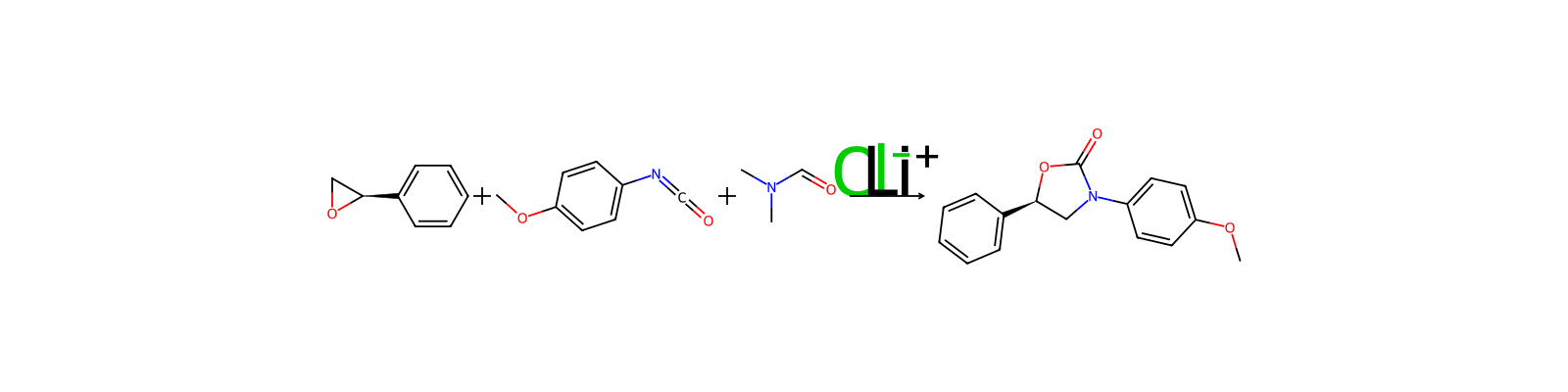
HRID 226279 reaction equation
HRID 226279As reactant
HRID 231167 reaction equation
HRID 231167As product
HRID 275451 reaction equation
HRID 275451As reactant
HRID 374536 reaction equation
HRID 374536As reactant
HRID 392933 reaction equation
HRID 392933As reactant
HRID 495690 reaction equation
HRID 495690As reactant
HRID 496421 reaction equation
HRID 496421As reactant
PreviousPage 1 of 4

Compound notes

On this pageBasic informationOverviewNames & identifiersPropertiesSafety & regulationChemistry & industryRelated reactionsCompound notes
Water Solubility
insoluble
BRN
1984 · 1984
InChI
1S/C8H8O/c1-2-4-7(5-3-1)8-6-9-8/h1-5,8H,6H2/t8-/m0/s1
InChIKey
AWMVMTVKBNGEAK-QMMMGPOBSA-N
SMILES
C1O[C@@H]1c2ccccc2
CAS DataBase Reference
20780 · 20780-53-4(CAS DataBase Reference)
FDA UNII
0 HB27D5MRW · 0HB27D5MRW
NIST Chemistry Reference
Benzene, (epoxyethyl)-, (R)-(20780-53-4)
Comptox DTXSID
401349483 · DTXSID401349483
UNSPSC Code
12352005 · 12352005
NACRES
22 · NA.22
Symbol(GHS)
7 · GHS07,GHS08
Signal word
Danger
Hazard statements
312 · H312-H319-H350
Precautionary statements
201 · P201-P280-P302+P352+P312-P305+P351+P338-P308+P313
Hazard Codes
T
Risk Statements
45 · 45-21-36
Safety Statements
53 · 53-45
RIDADR
2810 · 2810
WGK Germany
3 · 3
RTECS
9625010 · CZ9625010
F
10 · 10
HazardClass
6.1 · 6.1
PackingGroup
III
HS Code
2910900090 · 2910900090
Storage Class
6.1 C · 6.1C - Combustible acute toxic Cat.3toxic compounds or compounds which causing chronic effects
Hazard Classifications
4 DermalCarc · Acute Tox. 4 DermalCarc. 1BEye Irrit. 2
T
safety_code
53-45
hazard_class
6.1
Storage Class
6.1C - Combustible acute toxic Cat.3toxic compounds or compounds which causing chronic effects
packing_group
III
Hazard statements
H312-H319-H350
Hazard Classifications
Acute Tox. 4 DermalCarc. 1BEye Irrit. 2
Precautionary statements
P201-P280-P302+P352+P312-P305+P351+P338-P308+P313
Carbamic acid, N-[(2S)-2-hydroxy-2-phenylethyl]-, phenylmethyl ester
alpha-(bromomethyl)benzyl alcohol
(S)-N-Boc-2-hydroxy-2-phenylethylamine
(S)-2-Chloro-1-phenyl-ethanol
(R)-2-Chloro-1-phenylethanol
(+/-)-2-Chloro-1-phenylethanol
(1S)-2-bromo-1-phenyl-ethanol
(S)-Styrene oxide
(S)-(+)-1-Phenyl-1,2-ethanediol
(R)-(-)-1-Phenyl-1,2-ethanediol
Benzyl carbamate

Additional notes

DefinitionChEBI: The (R)-enantiomer of styrene oxide.