
Triphenylbismuth
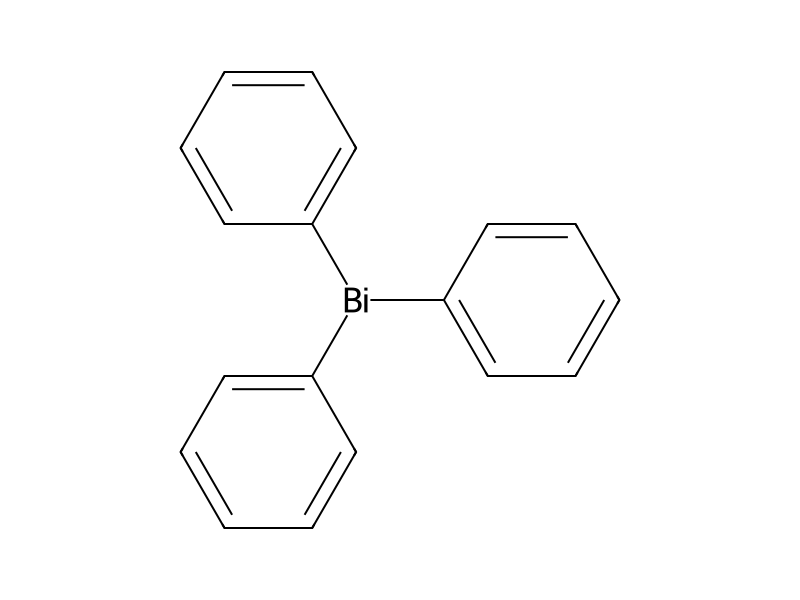
Basic information
- CAS
603-33-8- Standard SMILES
c1cc[c]([Bi]([c]2ccccc2)[c]2ccccc2)cc1- InChIKey
ZHXAZZQXWJJBHA-UHFFFAOYSA-N- Molecular formula
- C18H15Bi
- Average molar mass
- 440.3 g/mol
- Monoisotopic mass
- 440.09777
Overview
structure given in first source
Names & identifiers
- Preferred name
- Triphenylbismuth
- IUPAC
- triphenylbismuthane
- English name
- Triphenylbismuth
- Molecular formula
- C18H15Bi
- Molecular weight
- 440.29
Names & synonyms
Triphenylbismuth603-33-8TriphenylbismuthineTriphenyl bismuthBISMUTHINE, TRIPHENYL-AerotexTrifenylbismutinDTXSID6042498Triphenyl bismuthinePh3BiNSC-465R18732F41W
Show more names
TPB(C6H5)3Bitriphenyl-bismuthinTriphenylbismuth,99%Triphenylbismuth,98%
DTXCID4022498RefChem:191900210-033-4triphenylbismuthaneBismuth triphenylBismuth, triphenyl-Caswell No. 896triphenylbismuthin
Database identifiers
- CAS
603-33-8- PubChem CID
- 11774
- DTXSID
DTXSID6042498- UNII
- R18732F41W
- EC Number
- 210-033-4
- Nikkaji
- J42.067K
Properties
Computed structural properties
- Topological polar surface area
- 0 Ų
- Hydrogen bond donors
- 0
- Hydrogen bond acceptors
- 0
- Rotatable bonds
- 3
- Heavy atoms
- 19
- Formal charge
- 0
- Complexity
- 202
Experimental & physicochemical properties
Chemical ClassesMetals -> Metals, Organic Compounds
Vapor Pressure0.000034 [mmHg]
Physical Description
CBI
Solid; [Merck Index] White to off-white powder; [Alfa Aesar MSDS]
Physicochemical properties
- Melting point
- 78 · 78-80 °C
- Boiling point
- 310 °C · 310°C
- Density
- 1 · 1,585 g/cm3
- refractive index
- 1.704 · 1.7040
- Flash point
- 242 °C/14mm · 242°C/14mm
- storage temp.
- Inert atmosphere,Room Temperature
- solubility
- Chloroform (Slightly), DMSO (Slightly), Methanol (Slightly)
- form
- crystal
- color
- white
- Specific Gravity
- 1.585 · 1.585
Safety & regulation
Safety information is for reference only and does not replace the supplier’s Safety Data Sheet (SDS), applicable regulations, or professional assessment.
GHS classification
GHS Classification
This chemical does not meet GHS hazard criteria for 2.1% (1 of 47) of reports.
Warning
H302 (95.7%): Harmful if swallowed [Warning Acute toxicity, oral]
P261, P264, P270, P271, P280, P301+P317, P302+P352, P304+P340, P317, P321, P330, P362+P364, and P501 (click each P-code to see the statement)
Aggregated GHS information provided per 47 reports by companies from 5 notifications to the ECHA C&L Inventory. Each notification may be associated with multiple companies.
Hazard information
Regulatory Information
Hazard Traits - Bioaccumulation; Environmental Persistence
Bismuthine, triphenyl- is listed on the EPA's Chemical Data Reporting (CDR) system. Manufacturers and importers of Bismuthine, triphenyl- are required to report information about their production and use of this chemical to the EPA under the Toxic Substances Control Act (TSCA). (40 eCFR Part 711)
Bismuthine, triphenyl-: Does not have an individual approval but may be used under an appropriate group standard
Hazards SummaryMay cause irritation; Harmful by ingestion; [Alfa Aesar MSDS] See Triphenylantimony.
Hazard Classes and CategoriesAcute Tox. 4 (95.7%)
Safety data
- wgk
- 3
- tsca
- TSCA listed
- rtecs
- EB2980000
- hs_code
- 2931900090
- risk_code
- 20/21/22
- Signal word
- Warning
Chemistry & industry
Uses & manufacturing
UsesUsed as a radiopacifying agent in dental resins and medical devices, polymerization catalyst, and in organic synthesis; [Merck Index]
U.S. Production2023: <50,000 lb
Industry UsesOther
General Manufacturing Information
All Other Chemical Product and Preparation Manufacturing
Bismuthine, triphenyl-: ACTIVE
Applications
UsesTriphenylbismuth, as an volatile organometallic used in the preparation of thin films of superconducting oxides by CVD. It is also added to the fuel of rocket as cruing agent. It acts as a solidifying catalyst for butyl hydroxyl propellants.
Preparation methods
PreparationTriphenylbismuth is conveniently prepared by reaction of Phenylmagnesium Bromide with BiCl3 in ether.
Upstream & downstream products
Upstream raw materials
Downstream products
Related reactions
7 records


Compound notes
Loading…