
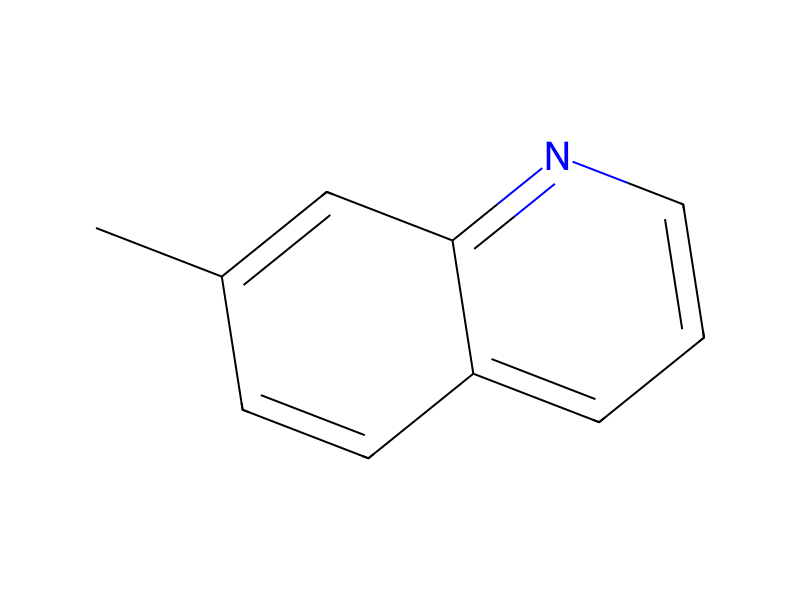
Basic information
- CAS
612-60-2- Standard SMILES
Cc1ccc2cccnc2c1- InChIKey
KDYVCOSVYOSHOL-UHFFFAOYSA-N- Molecular formula
- C10H9N
- Average molar mass
- 143.18 g/mol
- Monoisotopic mass
- 143.07349929
Overview
7-methylquinoline appears as clear yellow liquid or oil. (NTP, 1992)
Names & identifiers
- Preferred name
- 7-Methylquinoline
- IUPAC
- 7-methylquinoline
- English name
- 7-Methylquinoline
- Molecular formula
- C10H9N
- Molecular weight
- 143.19
Names & synonyms
7-METHYLQUINOLINE612-60-2m-ToluquinolineQuinoline, 7-methyl-CCRIS 2895DTXSID5025657EINECS 210-316-2UNII-EOW995K43CNSC 65665BRN 0110317EOW995K43CAI3-00850
Show more names
7-methyquinoline7-Methylchinolin7-methyl-quinolin7-Methylquinolinol7-MethylquiuolineQuinolinol,7-methyl-7-Methylquinoline>
NSC-65665METHYLQUINOLINE, 7-DTXCID0056575-20-07-00402 (Beilstein Handbook Reference)mToluquinolineQuinoline, 7methylRefChem:106391210-316-2
Database identifiers
- CAS
612-60-2- PubChem CID
- 11927
- DTXSID
DTXSID5025657- ChEMBL
CHEMBL1322524- UNII
- EOW995K43C
- EC Number
- 210-316-2
- Nikkaji
- J842G
Properties
Computed structural properties
- XLogP
- 2.5
- Topological polar surface area
- 12.9 Ų
- Hydrogen bond donors
- 0
- Hydrogen bond acceptors
- 1
- Rotatable bonds
- 0
- Heavy atoms
- 11
- Formal charge
- 0
- Complexity
- 133
Experimental & physicochemical properties
Chemical ClassesNitrogen Compounds -> Quinolines
SpringerMaterials PropertiesBoiling point
LogP2.47
Density1.0609 at 68 °F (NTP, 1992) - Denser than water; will sink
Solubilityless than 1 mg/mL at 68 °F (NTP, 1992)
Flash Point230 °F (NTP, 1992)
Boiling Point484.7 to 486.5 °F at 760 mmHg (NTP, 1992)
Melting Point95 to 100 °F (NTP, 1992)
Physical Description
7-methylquinoline appears as clear yellow liquid or oil. (NTP, 1992)
Clear yellow liquid; mp = 35-38 deg C; [CAMEO] Viscous liquid; [Alfa Aesar MSDS]
Physicochemical properties
- Melting point
- 35 · 35-37 °C(lit.)
- Boiling point
- 258 °C · 258 °C(lit.)
- Density
- 1.061 · 1.061
- refractive index
- 1.607 to · 1.6070 to 1.6210
- Flash point
- 230 °F · >230 °F
- storage temp.
- Room Temperature
- solubility
- Chloroform (Slightly), Methanol (Slightly)
- pka
- 5.44 · 5.44±0.14(Predicted)
- form
- Viscous Liquid
- color
- Off-White to Pale Beige Low-Melting
- Water Solubility
- 0.1 g/100 · <0.1 g/100 mL at 20 ºC
- BRN
- 110317 · 110317
- Stability
- Stable. Incompatible with strong oxidizing agents, strong acids. May be light sensitive.
- InChI
- 1S/C10H9N/c1-8-4-5-9-3-2-6-11-10(9)7-8/h2-7H,1H3
- InChIKey
- KDYVCOSVYOSHOL-UHFFFAOYSA-N
- SMILES
- Cc1ccc2cccnc2c1
- CAS DataBase Reference
- 612 · 612-60-2(CAS DataBase Reference)
- FDA UNII
- 995 K43C · EOW995K43C
- NIST Chemistry Reference
- 7 · Quinoline, 7-methyl-(612-60-2)
- EPA Substance Registry System
- 7 · 7-Methylquinoline (612-60-2)
- UNSPSC Code
- 12352100 · 12352100
- Symbol(GHS)
- 7 · GHS07
- Signal word
- Warning
- Hazard statements
- 315 · H315-H319-H335
- Precautionary statements
- 501 · P501-P261-P271-P264-P280-P302+P352-P337+P313-P305+P351+P338-P362+P364-P332+P313-P304+P340+P312-P403+P233-P405
- target organs
- Respiratory system
- PPE
- 95 · dust mask type N95 (US), Eyeshields, Gloves
- Hazard Codes
- Xi
- Risk Statements
- 37 · 37/38-41
- Safety Statements
- 26 · 26-39
- WGK Germany
- 3 · 3
- RTECS
- 560000 · VC0560000
- TSCA
- TSCA listed
- HS Code
- 29334900 · 29334900
- Storage Class
- 11 · 11 - Combustible Solids
- Hazard Classifications
- 1 Skin · Eye Dam. 1Skin Irrit. 2STOT SE 3
Safety & regulation
GHS classification
GHS Classification
Danger
H315 (100%): Causes skin irritation [Warning Skin corrosion/irritation]
P261, P264, P264+P265, P271, P280, P302+P352, P304+P340, P305+P351+P338, P305+P354+P338, P317, P319, P321, P332+P317, P337+P317, P362+P364, P403+P233, P405, and P501 (click each P-code to see the statement)
Aggregated GHS information provided per 45 reports by companies from 5 notifications to the ECHA C&L Inventory. Each notification may be associated with multiple companies.
Hazard information
DOT LabelCorrosive
Fire HazardsThis chemical is combustible. (NTP, 1992)
Health HazardsSYMPTOMS: This compound may be absorbed through the skin and it causes skin irritation. The vapor or mist is irritating to the eyes, mucous membranes and upper respiratory tract.
Hazards SummaryA skin irritant; Vapor or mist causes eye, mucous membranes, and upper respiratory tract irritation; May be absorbed through skin; [NTP] An irritant; Risk of irreversible adverse health effects; [Alfa Aesar MSDS] See Quinoline.
Reactive GroupAmides and Imides
Reactivity Profile
7-METHYLQUINOLINE may be sensitive to exposure to light. May react vigorously with strong oxidizing agents and strong acids (NTP, 1992). Neutralizes acids in exothermic reactions to form salts plus water. May be incompatible with isocyanates, halogenated organics, peroxides, phenols (acidic), epoxides, anhydrides, and acid halides. Flammable gaseous hydrogen may be generated in combination with strong reducing agents, such as hydrides.
Air and Water ReactionsInsoluble in water.
Hazard Classes and CategoriesSkin Irrit. 2 (100%)
Safety & protection
Fire FightingFires involving this material can be controlled with a dry chemical, carbon dioxide or Halon extinguisher. (NTP, 1992)
First Aid
EYES: First check the victim for contact lenses and remove if present. Flush victim's eyes with water or normal saline solution for 20 to 30 minutes while simultaneously calling a hospital or poison control center. Do not put any ointments, oils, or medication in the victim's eyes without specific instructions from a physician. IMMEDIATELY transport the victim after flushing eyes to a hospital even if no symptoms (such as redness or irritation) develop.
Nonfire Spill Response
SMALL SPILLS AND LEAKAGE: If you spill this chemical, FIRST REMOVE ALL SOURCES OF IGNITION. Then, use absorbent paper to pick up all liquid spill material. Your contaminated clothing and absorbent paper should be sealed in a vapor-tight plastic bag for eventual disposal. Solvent wash all contaminated surfaces with 60-70% ethanol followed by washing with a soap and water solution. Do not reenter the contaminated area until the Safety Officer (or other responsible person) has verified that the area has been properly cleaned.
Isolation and EvacuationExcerpt from ERG Guide 154 [Substances - Toxic and/or Corrosive (Non-Combustible)]:
Personal Protective Equipment (PPE)
RECOMMENDED RESPIRATOR: Where the neat test chemical is weighed and diluted, wear a NIOSH-approved half face respirator equipped with an organic vapor/acid gas cartridge (specific for organic vapors, HCl, acid gas and SO2) with a dust/mist filter. (NTP, 1992)
Safety data
- PPE
- dust mask type N95 (US), Eyeshields, Gloves
- wgk
- 3
- tsca
- TSCA listed
- rtecs
- VC0560000
- hs_code
- 29334900
- risk_code
- 37/38-41
- Signal word
- Warning
- Symbol(GHS)
- GHS07
- hazard_code
- Xi
- safety_code
- 26-39
- Storage Class
- 11 - Combustible Solids
- target organs
- Respiratory system
- Hazard statements
- H315-H319-H335
- Hazard Classifications
- Eye Dam. 1Skin Irrit. 2STOT SE 3
- Precautionary statements
- P501-P261-P271-P264-P280-P302+P352-P337+P313-P305+P351+P338-P362+P364-P332+P313-P304+P340+P312-P403+P233-P405
Chemistry & industry
Uses & manufacturing
General Manufacturing InformationQuinoline, 7-methyl-: ACTIVE
Applications
Uses7-methylquinoline has been bioassayed as tumor initiator on the skin of Sencar mice.
General Description7-Methylquinoline is a reagent used in the preparation of diarylmethylpiperazines as potent opioid receptor agonists with improved side effects. Also used in the preparation of novel pyrazine compounds derived from 2-phenylquinolin-7-yl which act as potent insulin-like growth factor-I receptor inhibitors.
Upstream & downstream products
Upstream raw materials
Downstream products
Suppliers100 total
国药集团化学试剂有限公司86-21-63210123 · [email protected]
梯希爱(上海)化成工业发展有限公司021-67121386 · [email protected]
阿诺西(上海)生物技术有限公司400-1107768 15058188853 · [email protected]
上海阿拉丁生化科技股份有限公司400-6206333 13167063860 · [email protected]
上海策嵘生物科技有限公司[email protected]
Changzhou Carman Chemical Co., Ltd.15061933924
BAYNOE CHEM CO.,LTD+86-21-34783353 +8615000719740 · [email protected]
上海麦克林生化科技股份有限公司021-50706066 15221275939 · [email protected]
INTATRADE GmbH+49 3493/605464 · [email protected]
河北创海生物科技有限公司+86-86-13131129325 · [email protected]
河北展药生物科技有限公司15369953316 +8615369953316 · [email protected]
Dayang Chem (Hangzhou) Co.,Ltd.+86-0571-88938639 17705817739 · [email protected]
河北枫嘉新材料科技有限公司+86-0311-87836622 +86-18712993135 · [email protected]
科瑞迪化学400-821-5857 021-64326257 · [email protected]
Syntechem Co.,Ltd[email protected]
上海迈瑞尔生化科技有限公司4006356688 18621169109 · [email protected]
宇瑞(上海)化学有限公司02150456736 18602143071 · [email protected]
江苏普乐司生物科技有限公司0513-66017706 18551496367 · [email protected]
阿法埃莎(中国)化学有限公司400-6106006 · [email protected]
安耐吉化学&3A(安徽泽升科技股份有限公司)400-0056266 · [email protected]
常州福盟生物科技有限公司0519-89882557 13912311481
上海瀚鸿科技股份有限公司021-54306202 13764082696 · [email protected]
上海景颜化工科技有限公司13817811078 · [email protected]
武汉市皇臻生物化工有限公司13795480948 · [email protected]
山东西亚化学有限公司13355009207 13355009207 · [email protected]
玛雅试剂+86 (573) 82222445 (0)18006601000 452520369 · [email protected]
四川库利南科技有限公司400-1166-196 18981987031 · [email protected]
武汉爱瑞克科技有限公司027- 51832457 94518350
艾科试剂4008-755-333 18080918076 · [email protected]
上海思域化工科技有限公司86-21-34053660 · [email protected]
赛默飞世尔科技(中国)有限公司800-810-5118 · [email protected]
北京伊诺凯科技有限公司400-810-7969 010-59572699 · [email protected]
TCI AMERICA800-4238616 · [email protected]
TOKYO CHEMICAL INDUSTRY CO., LTD.03-36680489 · [email protected]
TCI Europe320-37350700 · [email protected]
越林试剂021-62960152 · [email protected]
上海睿升化工科技有限公司+86-021-50935922
北京京土恒盛化工科技有限公司00-13911456598 13911456598 · [email protected]
北京环宇世纪化学科技有限公司hysj_bj.com
北京阳光福润科技有限公司010-57495520 13521095525 · [email protected]
安徽科迪达化工有限公司0554-2106669 · [email protected]
上海石洋化工有限公司021-56795766 · [email protected]
上海御略医药科技有限公司021-60345187 13671753212 · [email protected]
上海嵩爰化工科技有限公司010-1234567 18521000990 · [email protected]
Changzhou Fullone Chemical Co., Ltd.+86-13328197671 +86-13861172460 · [email protected]
Sigma-Aldrich西格玛奥德里奇(上海)贸易有限公司021-61415566 800-8193336 · [email protected]
九鼎化学(上海)科技有限公司4009209199 · [email protected]
常州捷展化工技术有限公司15861130028 · [email protected]
常州达沃生物科技有限公司0519-85165530 13921030872 · [email protected]
嘉兴市德亿化工有限公司0573-85866609 13325730825 · [email protected]
Related reactions
23 records


Compound notes
Loading…