Basic information
- Standard SMILES
CN(C)C(=O)N(C)C- InChIKey
AVQQQNCBBIEMEU-UHFFFAOYSA-N- Molecular formula
- C5H12N2O
- Average molar mass
- 116.16 g/mol
- Monoisotopic mass
- 116.094963
Overview
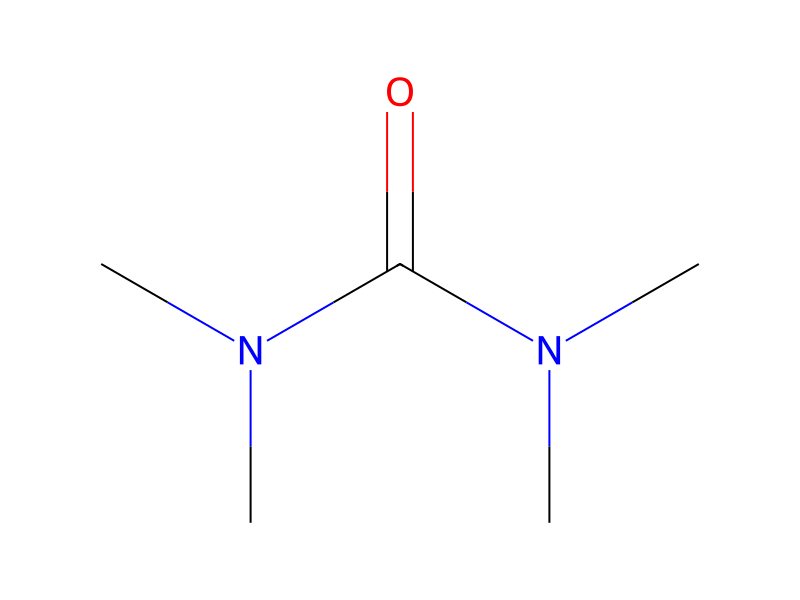
1,1,3,3-tetramethylurea is a member of the class of ureas that is urea substituted by methyl groups at positions 1, 1, 3 and 3 respectively. Metabolite observed in cancer metabolism. It has a role as a human metabolite.
Names & identifiers
- Preferred name
- Tetramethylurea
- IUPAC
- 1,1,3,3-tetramethylurea
- English name
- 1,1,3,3-Tetramethylurea
- Molecular formula
- C5H12N2O
- Molecular weight
- 116.16
Names & synonyms
1,1,3,3-TetramethylureaTETRAMETHYLUREA632-22-4TemurUrea, tetramethyl-N,N,N',N'-TetramethylureaTetramethylureeUrea, 1,1,3,3-tetramethyl-NSC-914882O1EJ64031DTXSID1060893CHEBI:84278
Show more names
tetramethyl-ureOlaparib Impurity 381,1,3,3-tetramethyl-ure((CH3)2N)2CO
RefChem:188798DTXCID1043750211-173-9TMUurea, N,N,N',N'-tetramethyl-Tetramethyl UreaNSC 91488BRN 0773898
Database identifiers
- CAS
632-22-4- PubChem CID
- 12437
- DTXSID
DTXSID1060893- ChEMBL
CHEMBL11949- ChEBI
CHEBI:84278- UNII
- 2O1EJ64031
- EC Number
- 211-173-9
- Nikkaji
- J6.897G
Properties
Computed structural properties
- XLogP
- 0.2
- Topological polar surface area
- 23.6 Ų
- Hydrogen bond donors
- 0
- Hydrogen bond acceptors
- 1
- Rotatable bonds
- 0
- Heavy atoms
- 8
- Formal charge
- 0
- Complexity
- 78.4
Experimental & physicochemical properties
Chemical ClassesNitrogen Compounds -> Urea Compounds
SpringerMaterials PropertiesSchoenflies notation
LogP
log Kow = 0.19
0.19
OdorFAINT, PLEASANT
Density0.9687 @ 20 °C/4 °C
Color/FormLIQUID
Solubility
MISCIBLE WITH WATER, PETROLEUM ETHER, ALL COMMON SOLVENTS
SLIGHTLY SOL IN ALCOHOL
water solubility = 1X10+6 mg/l
Flash PointABOUT 75 °C
Boiling Point176.5 °C
Melting Point-1.2 °C
Vapor Pressurevaopr pressure = 13.9 mm Hg @ 71 °C
Refractive IndexINDEX OF REFRACTION: 1.4493 @ 25 °C/D
Physicochemical properties
- Melting point
- 1 °C · −1 °C(lit.)
- Boiling point
- 177 °C · 177 °C(lit.)
- Density
- 0.968 g/mL · 0.968 g/mL at 20 °C(lit.)
- refractive index
- 20 · n20/D 1.451(lit.)
- Flash point
- 150 °F · 150 °F
- storage temp.
- Inert atmosphere,Room Temperature
- solubility
- Miscible with water, petroleum ether and common solvents.
- form
- Liquid
- pka
- 2 · 2.0(at 25℃)
- color
- Clear colorless to pale yellow
- PH
- 5 · 5-8 (25℃, 1M in H2O)
- Relative polarity
- 5 · 5
- Odor
- faint pleasant odor
- Water Solubility
- 2 O: · H2O: 1 M at 20 °C, miscible
- Merck
- 14 · 14,9230
- BRN
- 773898 · 773898
- Dielectric constant
- 24.46 · 24.460000000000001
- InChI
- 1S/C5H12N2O/c1-6(2)5(8)7(3)4/h1-4H3
- InChIKey
- AVQQQNCBBIEMEU-UHFFFAOYSA-N
- SMILES
- CN(C)C(=O)N(C)C
- CAS DataBase Reference
- 632 · 632-22-4(CAS DataBase Reference)
- EWG's Food Scores
- 1 · 1
- FDA UNII
- 2 O1EJ64031 · 2O1EJ64031
- NIST Chemistry Reference
- Urea, tetramethyl-(632-22-4)
- EPA Substance Registry System
- Tetramethylurea (632-22-4)
- UNSPSC Code
- 12352100 · 12352100
- NACRES
- 24 · NA.24
- Symbol(GHS)
- 5 · GHS05,GHS07,GHS08
- Signal word
- Danger
- Hazard statements
- 302 · H302-H315-H318-H360D
- Precautionary statements
- 202 · P202-P280-P301+P312-P302+P352-P305+P351+P338-P308+P313
- PPE
- Eyeshields, Faceshields, Gloves, type ABEK (EN14387) respirator filter
- Hazard Codes
- Xn,T
- Risk Statements
- 22 · 22-61
- Safety Statements
- 53 · 53-45
- RIDADR
- 1993 · NA 1993 / PGIII
- WGK Germany
- 3 · 3
- RTECS
- 2625000 · YU2625000
- F
- 3 · 3-10
- TSCA
- TSCA listed
- HazardClass
- CBL
- HS Code
- 29241900 · 29241900
- Storage Class
- 6.1 C · 6.1C - Combustible acute toxic Cat.3toxic compounds or compounds which causing chronic effects
- Hazard Classifications
- 4 OralEye · Acute Tox. 4 OralEye Dam. 1Repr. 1BSkin Irrit. 2
- Hazardous Substances Data
- 632 · 632-22-4(Hazardous Substances Data)
- Toxicity
- 50 i.v · LD50 i.v. in rats: 1.1 g/kg (Lüttringhaus, Dirksen)
- Excepted Quantities
- Non-Hazardous
Safety & regulation
GHS classification
GHS Classification
Danger
H302 (97.4%): Harmful if swallowed [Warning Acute toxicity, oral]
P203, P264, P270, P280, P301+P317, P318, P330, P405, and P501 (click each P-code to see the statement)
Aggregated GHS information provided per 116 reports by companies from 8 notifications to the ECHA C&L Inventory. Each notification may be associated with multiple companies.
Danger
H227: Combustible liquid [Warning Flammable liquids]
Hazard information
Regulatory Information
Chemical: Urea, tetramethyl-
Tetramethylurea: Does not have an individual approval but may be used under an appropriate group standard
Fire PotentialFIRE HAZARD: MODERATE, VIA HEAT, FLAME & OXIDIZERS.
Hazards Summary
Teratogenic effects observed in mice dosed by SC injection; IV doses of 150 mg/kg daily for five days produced weight loss in dogs, monkeys, and mice; [HSDB] A strong skin irritant, but not a sensitizer in guinea pigs; Temporary kidney injury and possible liver injury observed in two week feeding study of male rats at 450 mg/kg; [EPA] Causes general anesthesia and somnolence in IP lethal-dose study of mice; [RTECS] Teratogenic effects and fetal loss observed in studies of rodents; No human data on reproductive or lactation effects; [REPROTOX] An irritant; [Alfa Aesar MSDS]
Special ReportsREVIEW OF PREPN, MFR, PROPERTIES AND USE AS SOLVENT AND AS REAGENT: LUTTRINGHAUS, DIRKSEN, AGNEW CHEM INT ED 3, 260 (1964).[The Merck Index. 9th ed. Rahway, New Jersey: Merck & Co., Inc., 1976., p. 1190]
Hazard Classes and Categories
Acute Tox. 4 (97.4%)
Flammable liquids - Category 4
Safety & protection
Fire Fighting ProceduresFOAM, MIST, SPRAY, DRY CHEMICALS.
Toxicology
Interactions
MIXING TETRAMETHYLUREA WITH MINERAL OIL INCREASED MATERNAL TMU TOXICITY WHEN APPLIED TO SKIN OF RATS.
TETRAMETHYL UREA WAS CAPABLE OF ENHANCING THE TOXICITY OF MORPHINE AND CHLORPROMAZINE IN DOGS, MONKEYS, AND MICE.
TETRAMETHYLUREA LOWERED YIELDS AND/OR INCIDENCES OF TUMORS PROMOTED BY RETINYL ACETATE OR CROTON OIL AFTER INITIATION BY 7,12-DIMETHYLBENZ(A)ANTHRACENE. TOPICAL APPLICATION OF INDUCERS MIGHT HAVE THERAPEUTIC POTENTIAL IN EPIDERMAL CARCINOMA.
Adverse EffectsNeurotoxin - Other CNS neurotoxin
Non-Human Toxicity Excerpts
ONE SC INJECTION OF 5.6 OR 8.6 MMOL TETRAMETHYLUREA/KG OR REPEATED DAILY ADMIN OF 0.9 AND 1.7 MMOL/KG TO PREGNANT MICE HAD A TERATOGENIC EFFECT ON EMBRYOS. GREATEST EFFECT WAS BY SINGLE DOSES ON 8TH OR 11TH DAY OF GESTATION. WHEN GIVEN ON 8TH DAY IT PRODUCED MOSTLY CRANIAL EFFECTS & ON 22ND DAY PAW MALFORMATIONS.
TETRAMETHYLUREA WAS APPLIED TO SKIN OF RATS & RABBITS DURING ORGANOGENESIS. SLIGHT TERATOGENIC EFFECTS WERE DEMONSTRATED.
TETRAMETHYLUREA 150 MG/KG IV ACUTELY OR DAILY FOR 5 DAYS WAS NOT LETHAL & CAUSED ONLY WEIGHT LOSS IN DOGS, MONKEYS, & MICE. DOSES HIGHER THAN 100 MG/KG CAUSED HYPOTENSION IN DOGS.
Toxicity DataLCLo (rat) = 312 ppm/4h
Safety data
- F
- 3-10
- PPE
- Eyeshields, Faceshields, Gloves, type ABEK (EN14387) respirator filter
- wgk
- 3
- tsca
- TSCA listed
- rtecs
- YU2625000
- ridadr
- NA 1993 / PGIII
- hs_code
- 29241900
- Toxicity
- LD50 i.v. in rats: 1.1 g/kg (Lüttringhaus, Dirksen)
- risk_code
- 22-61
- Signal word
- Danger
- Symbol(GHS)
- GHS05,GHS07,GHS08
- hazard_code
- Xn,T
- safety_code
- 53-45
- hazard_class
- CBL
- Storage Class
- 6.1C - Combustible acute toxic Cat.3toxic compounds or compounds which causing chronic effects
- Hazard statements
- H302-H315-H318-H360D
- Excepted Quantities
- Non-Hazardous
- Hazard Classifications
- Acute Tox. 4 OralEye Dam. 1Repr. 1BSkin Irrit. 2
- Precautionary statements
- P202-P280-P301+P312-P302+P352-P305+P351+P338-P308+P313
- Hazardous Substances Data
- 632-22-4(Hazardous Substances Data)
Chemistry & industry
Uses & manufacturing
Uses
Used as solvent and reagent; [Merck Index]
SOLVENT & REAGENT
U.S. Exports
(1972) No Data
(1975) No Data
U.S. Imports
(1972) No Data
(1975) No Data
U.S. Production
(1972) PROBABLY GREATER THAN 4.54X10+5 GRAMS
(1975) PROBABLY LESS THAN 4.54X10+5 GRAMS
Methods of ManufacturingPREPN: LAWSON, CROOM, J ORG CHEM, 28, 232 (1963).
General Manufacturing InformationUrea, N,N,N',N'-tetramethyl-: ACTIVE
Applications
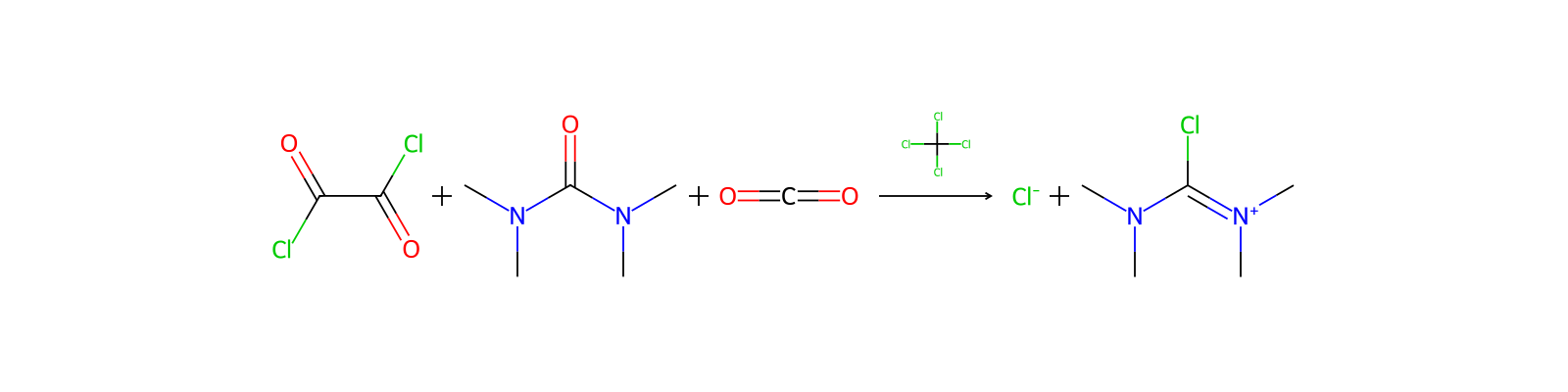
UsesTetramethylurea is used as a solvent in dyestuff industries, in condensation reaction and intermediates in surfactant. It is utilized for base catalyzed isomerization and alkylation hydrocyanation due to its low permittivity. It reacts with oxalyl chloride to prepare tetramethyl chloroformamidinium chloride, which is used for the conversion of carboxylic acids and dialkyl phosphates to anhydrides and pyrophosphates respectively.
Preparation methods
PreparationThe reaction of dimethylamine with phosgene in the presence of e. g. 50 % sodium hydroxide solution and subsequent extraction with 1,2-dichloroethane yields tetramethylurea in 95% yield.
Upstream & downstream products
Upstream raw materials
Downstream products
Suppliers50 total
梯希爱(上海)化成工业发展有限公司021-67121386 · [email protected]
上海阿拉丁生化科技股份有限公司400-6206333 13167063860 · [email protected]
武汉卓元易创科技有限公司13476791851 13476791851 · [email protected]
江苏星科元信息科技有限公司400-605-7200 15335295587
T&W GROUP021-61551611 13296011611 · [email protected]
石家庄苏瑞化工有限公司15833970389 15833970389 · [email protected]
韶远科技(上海)有限公司021-50795510 4000665055 · [email protected]
科瑞迪化学400-821-5857 021-64326257 · [email protected]
Syntechem Co.,Ltd[email protected]
上海迈瑞尔生化科技有限公司4006356688 18621169109 · [email protected]
武汉易泰科技有限公司上海分公司18930552037 · [email protected]
阿法埃莎(中国)化学有限公司400-6106006 · [email protected]
安耐吉化学&3A(安徽泽升科技股份有限公司)400-0056266 · [email protected]
北京绿百草科技发展有限公司010-61136123 · [email protected]
上海瀚鸿科技股份有限公司021-54306202 13764082696 · [email protected]
上海柯维化学技术有限公司021-64609169 18901607656 · [email protected]
武汉丰泰威远科技有限公司027-87465837 19945049750 · [email protected]
孝感深远化工有限公司15527621225; 15527621225 · [email protected]
山东西亚化学有限公司13355009207 13355009207 · [email protected]
玛雅试剂+86 (573) 82222445 (0)18006601000 452520369 · [email protected]
四川库利南科技有限公司400-1166-196 18981987031 · [email protected]
天津希恩思生化科技有限公司400 638 7771 · [email protected]
河南多贝化工有限公司0370-2785118 17550508557 · [email protected]
斯百全化学(上海)有限公司021-021-021-67601398-809-809-809 15221380277 · [email protected]
艾科试剂4008-755-333 18080918076 · [email protected]
上海思域化工科技有限公司86-21-34053660 · [email protected]
赛默飞世尔科技(中国)有限公司800-810-5118 · [email protected]
北京伊诺凯科技有限公司400-810-7969 010-59572699 · [email protected]
江苏艾康生物医药研发有限公司025-66113011 13913916777 · [email protected]
上海健超生物科技有限公司150-2103-5486 18017383231 · [email protected]
TOKYO CHEMICAL INDUSTRY CO., LTD.03-36680489 · [email protected]
深圳振强药物研发有限公司0755-66853366 13670046396 · [email protected]
上海将来实业股份有限公司400-0066400 13621662912 · [email protected]
上海将来实业股份有限公司021-61552785 · [email protected]
安徽科迪达化工有限公司0554-2106669 · [email protected]
日照力德士化工有限公司010-51268198 · [email protected]
郑州鸿晟医药科技有限公司0371-0371-13526885213 15637198702 · [email protected]
美岚实业(上海)有限公司021-58958189 · [email protected]
上海爱蝶实业有限公司021-58957966 18930537195 · [email protected]
成都零六生物科技有限公司400-1166-196 13458535857 · [email protected]
广拓化学(上海)有限公司021-60899189-8001 18918189673 · [email protected]
雷丁试剂0510-85629785 18013409632 · [email protected]
上海麦克林生化科技股份有限公司15221275939 15221275939 · [email protected]
杭州杰恒化工有限公司0571-87396432 · [email protected]
上海永叶生物科技有限公司86-021-61559134 15921386130 · [email protected]
上海有朋化工有限公司021-69005955 13701776567 · [email protected]
北京海力扬化学科技有限公司13718199399 · [email protected]
北京欣赛维化学科技有限公司010-56218822 13717722232 · [email protected]
四川海诺威科技有限公司13708085536 13708085536 · [email protected]
上海凯赛化工有限公司021-33516722 13701817765 · [email protected]
Additional notes
DefinitionChEBI: 1,1,3,3-tetramethylurea is a member of the class of ureas that is urea substituted by methyl groups at positions 1, 1, 3 and 3 respectively. Metabolite observed in cancer metabolism. It has a role as a human metabolite.
Related reactions
56 records




Linked notes
Loading…