Carbon Dioxide → [Chloro(dimethylamino)methylidene]-dimethylazanium chloride
Reaction equation
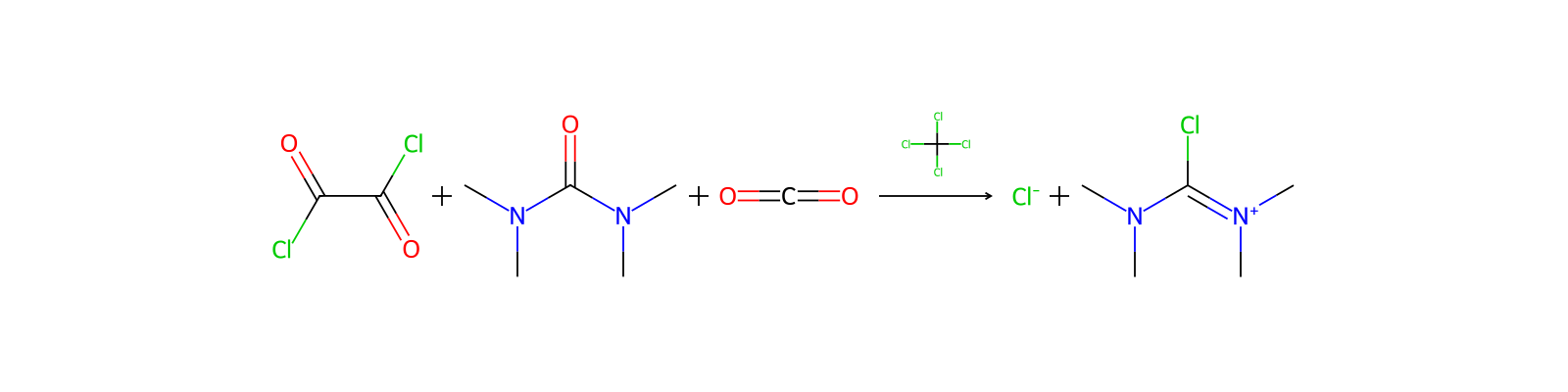
C(Cl)(=O)C([Cl:4])=O.[CH3:7][N:8]([CH3:14])[C:9](=O)[N:10]([CH3:12])[CH3:11].C(=O)=O>C(Cl)(Cl)(Cl)Cl>[Cl-:4].[CH3:7][N:8]([CH3:14])[C:9]([Cl:4])=[N+:10]([CH3:12])[CH3:11]Participants
5
Reactant 3

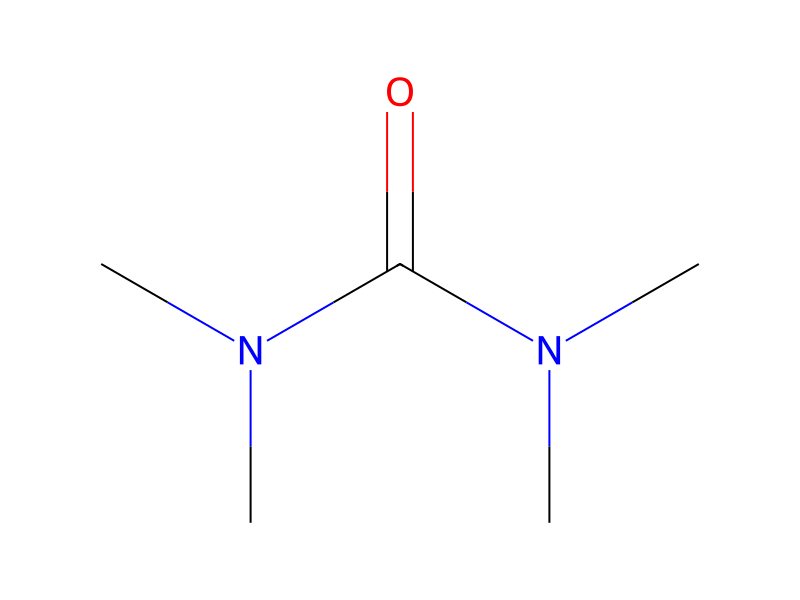

Product 1

Reagents, catalysts & solvents 1

Procedure
A solution of 3.2 ml (0.037 mol) of oxalyl chloride in 30 ml of anhydrous carbon tetrachloride is added dropwise to a solution of 4.4 ml (0.037 mol) of tetramethylurea in 20 ml of anhydrous carbon tetrachloride with stirring. The reaction medium is maintained at reflux, with continued stirring, until the evolution of gases (CO and CO2) formed by the reaction has ceased. The CCl4 is then eliminated by distillation at atmospheric pressure. Tetramethylchloroformamidinium chloride is obtained in the form of a white solid (6.23 g). This solid is placed in solution at O° C. in 40 ml of anhydrous acetonitrile.