

Basic information
- Standard SMILES
Clc1ccc(I)cc1- InChIKey
GWQSENYKCGJTRI-UHFFFAOYSA-N- Molecular formula
- C6H4ClI
- Average molar mass
- 238.45 g/mol
- Monoisotopic mass
- 237.90463
Names & identifiers
- Preferred name
- 1-Chloro-4-iodobenzene
- IUPAC
- 1-chloro-4-iodobenzene
- English name
- 1-Chloro-4-iodobenzene
- Molecular formula
- C6H4ClI
- Molecular weight
- 238.45
Names & synonyms
1-Chloro-4-iodobenzeneBenzene, 1-chloro-4-iodo-EINECS 211-305-5NSC 328624-Chloro-1-iodo-benzeneDTXSID1060928pChloroiodobenzenepIodochlorobenzene4chloroiodobenzene4IodochlorobenzeneBenzene, 1chloro4iodoRefChem:75419
Show more names
P-IODOCHLOROBENZENE4-chloroiodineoro-4-iodobenzeneChloro-4-iodobenz1-Chloro-4-iodobenzep-chlorophenyliodidep-iodophenylchloride
DTXCID0044070211-305-5GWQSENYKCGJTRI-UHFFFAOYSA-NInChI=1/C6H4ClI/c7-5-1-3-6(8)4-2-5/h1-4637-87-64-CHLOROIODOBENZENEp-Chloroiodobenzene4-Iodochlorobenzene
Database identifiers
- CAS
637-87-6- PubChem CID
- 12510
- DTXSID
DTXSID1060928- UNII
- NTZ94E8MNN
- EC Number
- 211-305-5
- Nikkaji
- J6.918C
Properties
Computed structural properties
- XLogP
- 3.6
- Topological polar surface area
- 0 Ų
- Hydrogen bond donors
- 0
- Hydrogen bond acceptors
- 0
- Rotatable bonds
- 0
- Heavy atoms
- 8
- Formal charge
- 0
- Complexity
- 66
Physicochemical properties
- Melting point
- 53 · 53-54 °C(lit.)
- Boiling point
- 226 · 226-227 °C(lit.)
- Density
- 1.886 · 1.8860
- Flash point
- 227 °F · 227 °F
- storage temp.
- Keep in dark place,Sealed in dry,Room Temperature
- solubility
- Chloroform (Slightly, Heated), Methanol (Slightly, Heated)
- form
- Crystalline Powder or Crystals
- color
- Off-white to light beige
- Sensitive
- Light Sensitive
- BRN
- 1634414 · 1634414
- Henry's Law Constant
- 6.9 · 6.9×10-3 mol/(m3Pa) at 25℃, Ebert et al. (2023)
- InChI
- InChI=1S/C6H4ClI/c7-5-1-3-6(8)4-2-5/h1-4H
- InChIKey
- GWQSENYKCGJTRI-UHFFFAOYSA-N
- SMILES
- C1(Cl)=CC=C(I)C=C1
- CAS DataBase Reference
- 637 · 637-87-6(CAS DataBase Reference)
- NIST Chemistry Reference
- 1 · Benzene, 1-chloro-4-iodo-(637-87-6)
- EPA Substance Registry System
- 1 · Benzene, 1-chloro-4-iodo- (637-87-6)
- UNSPSC Code
- 12352100 · 12352100
- NACRES
- 22 · NA.22
- Symbol(GHS)
- 7 · GHS07
- Signal word
- Warning
- Hazard statements
- 302 · H302+H312+H332
- Precautionary statements
- 261 · P261-P264-P280-P301+P312-P302+P352+P312-P304+P340+P312
- PPE
- 95 · dust mask type N95 (US), Eyeshields, Gloves
- Hazard Codes
- Xn,Xi
- Risk Statements
- 20 · 20/21/22-36/37/38
- Safety Statements
- 36 · 36/37-24/25
- WGK Germany
- 3 · 3
- TSCA
- TSCA listed
- HazardClass
- IRRITANT
- HS Code
- 29039990 · 29039990
- Storage Class
- 11 · 11 - Combustible Solids
- Hazard Classifications
- 4 DermalAcute · Acute Tox. 4 DermalAcute Tox. 4 InhalationAcute Tox. 4 Oral
Safety & regulation
Safety data
- PPE
- dust mask type N95 (US), Eyeshields, Gloves
- wgk
- 3
- tsca
- TSCA listed
- hs_code
- 29039990
- risk_code
- 20/21/22-36/37/38
- Signal word
- Warning
- Symbol(GHS)
- GHS07
- hazard_code
- Xn,Xi
- safety_code
- 36/37-24/25
- hazard_class
- IRRITANT
- Storage Class
- 11 - Combustible Solids
- Hazard statements
- H302+H312+H332
- Hazard Classifications
- Acute Tox. 4 DermalAcute Tox. 4 InhalationAcute Tox. 4 Oral
- Precautionary statements
- P261-P264-P280-P301+P312-P302+P352+P312-P304+P340+P312
Chemistry & industry
Applications
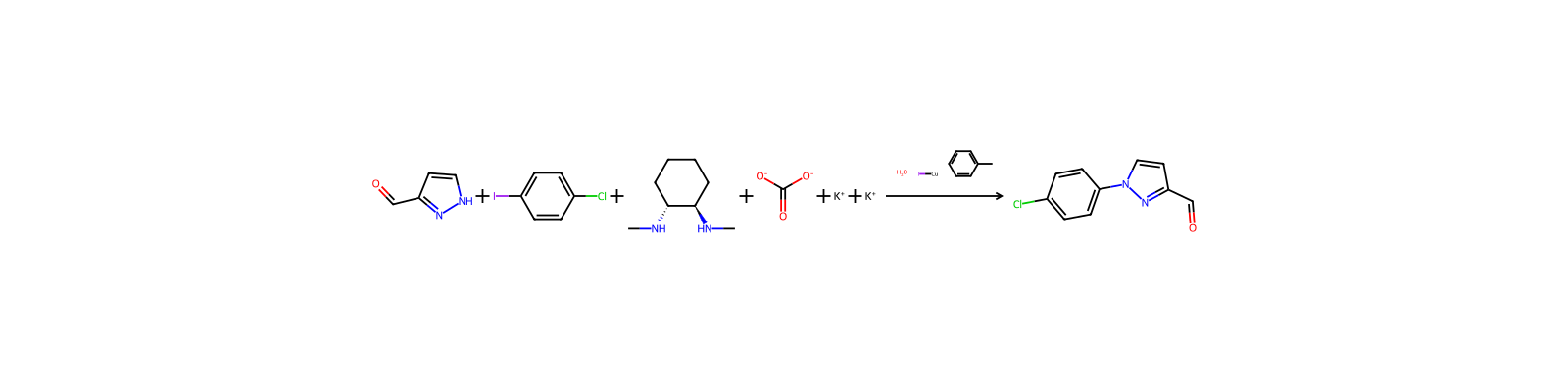
Usessuzuki reaction
Uses4-Chloroiodobenzene is used as a reagent in the synthesis of Clothiapine (C588550); an atypical antipsychotic of the dibenzothiazepine chemical class that has shown efficacy in treatment-resistant schizophrenic patients.
Preparation methods
PreparationThe methods for synthesizing 1-Chloro-4-iodobenzene reported in the literature are mainly as follows: (1) p-iodoaniline is used as a raw material and then chlorinated and deamined. p-iodoaniline is expensive and the overall yield is low. (2) p-chloroaniline is used as a raw material and azidation and iodomethane are used to obtain the product. In this process, the operation of aryl azidoalkane is dangerous and can easily cause explosion, which is not conducive to industrial production. (3) p-chloroaniline is used as a raw material and diazotization and iodation are used to obtain the product. Due to the large number of by-products, column chromatography separation is required, and the operation is complicated and not easy to industrialize.
Upstream & downstream products
Upstream raw materials
Downstream products
Suppliers50 total
国药集团化学试剂有限公司86-21-63210123 · [email protected]
梯希爱(上海)化成工业发展有限公司021-67121386 · [email protected]
衢州润东化工有限公司0570-8789886 18892685668 · [email protected]
上海阿拉丁生化科技股份有限公司400-6206333 13167063860 · [email protected]
T&W GROUP021-61551611 13296011611 · [email protected]
科瑞迪化学400-821-5857 021-64326257 · [email protected]
Syntechem Co.,Ltd[email protected]
上海迈瑞尔生化科技有限公司4006356688 18621169109 · [email protected]
宇瑞(上海)化学有限公司02150456736 18602143071 · [email protected]
武汉易泰科技有限公司上海分公司18930552037 · [email protected]
阿法埃莎(中国)化学有限公司400-6106006 · [email protected]
安耐吉化学&3A(安徽泽升科技股份有限公司)400-0056266 · [email protected]
石家庄斯迪亚诺精细化工有限公司0311-89250318 13582355795 · [email protected]
武汉凯威斯科技有限公司86-027-67849912 · [email protected]
常州安轩化工有限公司13912302692 · [email protected]
上海瀚鸿科技股份有限公司021-54306202 13764082696 · [email protected]
上海景颜化工科技有限公司13817811078 · [email protected]
嘉兴市艾森化工有限公司0573-85285100 18627885956 · [email protected]
北京绿人科技有限责任公司010- 89781189-8112 18511583708
上海隆盛化工有限公司58099637 13585536065 · [email protected]
上海攀鸿化工科技有限公司021-56491756 13512199871 · [email protected]
山东西亚化学有限公司13355009207 13355009207 · [email protected]
玛雅试剂+86 (573) 82222445 (0)18006601000 452520369 · [email protected]
瀚商化工科技有限公司021-50521775 15800962688
上海耐士化工科技有限公司400-188-0725 +86 21 34310725 13611771617
天津希恩思生化科技有限公司400 638 7771 · [email protected]
上海思域化工科技有限公司86-21-34053660 · [email protected]
赛默飞世尔科技(中国)有限公司800-810-5118 · [email protected]
北京伊诺凯科技有限公司400-810-7969 010-59572699 · [email protected]
上海特伯化学科技有限公司+86-21-60341587 · [email protected]
江苏艾康生物医药研发有限公司025-66113011 13913916777 · [email protected]
TCI AMERICA800-4238616 · [email protected]
TOKYO CHEMICAL INDUSTRY CO., LTD.03-36680489 · [email protected]
TCI Europe320-37350700 · [email protected]
上海贤鼎生物科技有限公司4009209199 · [email protected]
深圳康特腾科技有限公司86-0755-86635001 · [email protected]
越林试剂021-62960152 · [email protected]
上海睿升化工科技有限公司+86-021-50935922
苏州安尼康药物研发有限公司0512-69369885 · [email protected]
Clearsynth Labs Limited+91-22-26355700 · [email protected]
上海倍卓生物科技有限公司021-61119791,13386096464 · [email protected]
上海洪创医药科技有限公司18151128828 · [email protected]
北京环宇世纪化学科技有限公司hysj_bj.com
上海将来实业股份有限公司400-0066400 13621662912 · [email protected]
上海将来实业股份有限公司021-61552785 · [email protected]
南京克迪特贸易有限公司025-52164950 · [email protected]
HBCChem, Inc.+1-510-219-6317 · [email protected]
上海石洋化工有限公司021-56795766 · [email protected]
成都零六生物科技有限公司400-1166-196 13458535857 · [email protected]
上海创赛科技有限公司400-6087598 15021221957 · [email protected]
Related reactions
638 records






Linked notes
Loading…