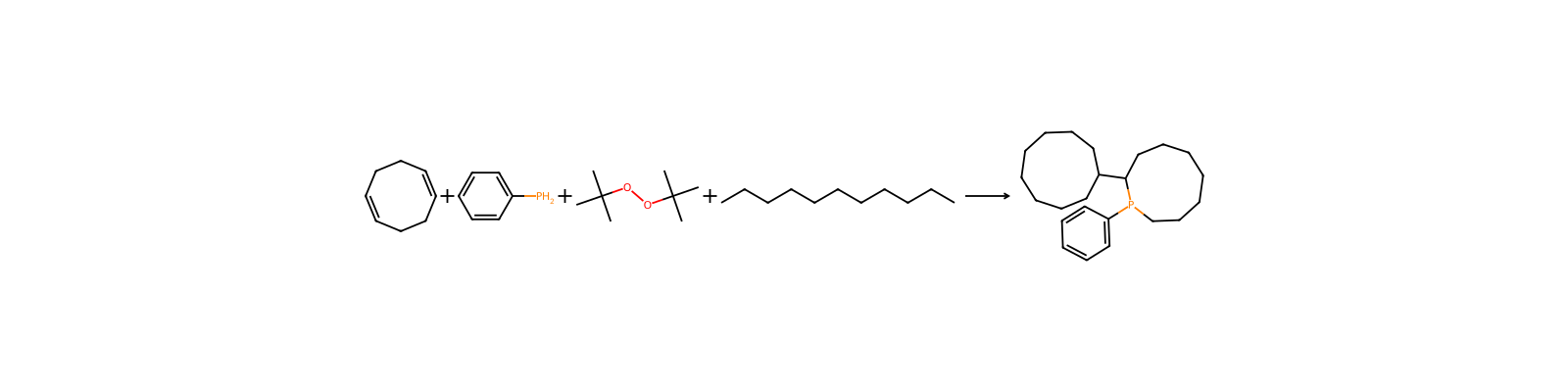
HRID 5640As reactant

638-21-1Pc1ccccc1RPGWZZNNEUHDAQ-UHFFFAOYSA-NPhenylphosphine can cause male reproductive toxicity according to an independent committee of scientific and health experts.
638-21-1DTXSID70732241.001 at 59 °F (NTP, 1992) - Denser than water; will sink
Specific gravity @ 15 °C = 1.001
Relative density (water = 1): 1.00
1.001 at 59 °F
1.001 @ 16°C
(59 °F): 1.001
less than 1 mg/mL at 70 °F (NTP, 1992)
Sol in alkali; very sol in alcohol and ether
Insoluble in water
Solubility in water: none
Insoluble
320 to 322 °F at 760 mmHg (NTP, 1992)
160.5 °C
160 °C
320 °F
320 °F
3.79 (NTP, 1992) - Heavier than air; will sink (Relative to Air)
Relative vapor density (air = 1): 3.8
3.79
Safety information is for reference only and does not replace the supplier’s Safety Data Sheet (SDS), applicable regulations, or professional assessment.
Danger
H250 (100%): Catches fire spontaneously if exposed to air [Danger Pyrophoric liquids]
P210, P222, P231, P233, P261, P262, P264, P264+P265, P270, P271, P280, P301+P316, P302+P335+P334, P302+P352, P304+P340, P305+P351+P338, P316, P319, P321, P330, P332+P317, P337+P317, P361+P364, P362+P364, P370+P378, P403+P233, P405, and P501 (click each P-code to see the statement)
Aggregated GHS information provided per 43 reports by companies from 3 notifications to the ECHA C&L Inventory. Each notification may be associated with multiple companies.
Danger
H227: Combustible liquid [Warning Flammable liquids]
Hazard Traits - Reproductive Toxicity
Phenylphosphine: Does not have an individual approval but may be used as a component in a product covered by a group standard. It is not approved for use as a chemical in its own right.
Flash point data are not available for this chemical, but it is probably combustible. (NTP, 1992)
Combustible. Gives off irritating or toxic fumes (or gases) in a fire.
High concentration of the substance may ignite spontaneously on contact with air.
It is pyrophoric in air.
A respiratory irritant with a repulsive odor; Phenylphosphine causes anemia and severe testicular degeneration in rats inhaling 2.2 ppm for 90 days. The acute toxicity of inhaled phenylphosphine is about 1/4 that of phosphine. Animals exposed to 2.2 ppm for 4 weeks have reversible hemolytic anemia. [ACGIH] A skin, eye, and respiratory tract irritant; [ICSC]
PHENYL PHOSPHINE is a reducing agent. They slowly generate flammable or noxious gases in contact with water. Phosphides react quickly upon contact with moisture or acids to give the very toxic gas phosphine; phosphides also can react vigorously with oxidizing materials. In general, materials in this group are incompatible with oxidizers such as atmospheric oxygen. They are violently incompatible with acids, particularly oxidizing acids.
Fires involving this compound should be controlled with a dry chemical, carbon dioxide or Halon extinguisher. (NTP, 1992)
Use foam, dry powder.
Fresh air, rest. Refer for medical attention.
Rinse and then wash skin with water and soap.
First rinse with plenty of water for several minutes (remove contact lenses if easily possible), then refer for medical attention.
Refer for medical attention .
EYES: First check the victim for contact lenses and remove if present. Flush victim's eyes with water or normal saline solution for 20 to 30 minutes while simultaneously calling a hospital or poison control center. Do not put any ointments, oils, or medication in the victim's eyes without specific instructions from a physician. IMMEDIATELY transport the victim after flushing eyes to a hospital even if no symptoms (such as redness or irritation) develop.
(General first aid procedures)
Evacuate danger area! Consult an expert! Chemical protection suit including self-contained breathing apparatus. Remove all ignition sources. Ventilation. Collect leaking liquid in sealable containers. Absorb remaining liquid in sand or inert absorbent and remove to safe place.
SMALL SPILLS AND LEAKAGE: If you spill this chemical, FIRST REMOVE ALL SOURCES OF IGNITION. Then, use absorbent paper to pick up all liquid spill material. Your contaminated clothing and absorbent paper should be sealed in a vapor-tight plastic bag for eventual disposal. Solvent wash all contaminated surfaces with 60-70% ethanol followed by washing with a soap and water solution. Do not reenter the contaminated area until the Safety Officer (or other responsible person) has verified that the area has been properly cleaned.
SRP: The most favorable course of action is to use an alternative chemical product with less inherent propensity for occupational exposure or environmental contamination. Recycle any unused portion of the material for its approved use or return it to the manufacturer or supplier. Ultimate disposal of the chemical must consider: the material's impact on air quality; potential migration in soil or water; effects on animal, aquatic, and plant life; and conformance with environmental and public health regulations.
Evacuate danger area! Consult an expert! Personal protection: chemical protection suit including self-contained breathing apparatus. Remove all ignition sources. Ventilation. Collect leaking and spilled liquid in sealable containers as far as possible. Absorb remaining liquid in sand or inert absorbent. Then store and dispose of according to local regulations.
SRP: Contaminated protective clothing should be segregated in such a manner so that there is no direct personal contact by personnel who handle, dispose, or clean the clothing. Quality assurance to ascertain the completeness of the cleaning procedures should be implemented before the decontaminated protective clothing is returned for reuse by the workers. Contaminated clothing should not be taken home at end of shift, but should remain at employee's place of work for cleaning.
SRP: The scientific literature for the use of contact lenses in industry is conflicting. The benefit or detrimental effects of wearing contact lenses depend not only upon the substance, but also on factors including the form of the substance, characteristics and duration of the exposure, the uses of other eye protection equipment, and the hygiene of the lenses. However, there may be individual substances whose irritating or corrosive properties are such that the wearing of contact lenses would be harmful to the eye. In those specific cases, contact lenses should not be worn. In any event, the usual eye protection equipment should be worn even when contact lenses are in place.
The worker should wash daily at the end of each work shift.
Work clothing that becomes wet or significantly contaminated should be removed and replaced.
The substance can be absorbed into the body by inhalation.
inhalation, ingestion, skin and/or eye contact
Cough. Shortness of breath. Sore throat.
Redness. Pain.
Redness. Pain.
In Animals: blood changes, anemia, testicular degeneration; loss of appetite, diarrhea, lacrimation (discharge of tears), hind leg tremor; dermatitis
/SIGNS AND SYMPTOMS/ Symptoms of phosphine intoxication in the adults /after an accidental exposure aboard a ship/ included shortness of breath, cough, and pulmonary irritation, nausea, headache, jaundice, and fatigue. The highest concentrations of phosphine (20-30 ppm) were measured in a void space on the main deck near the air intake for the ship's ventilation system. In some of the living quarters, /phosphine/ levels of 0.5 ppm were detected. /Phosphine/
/LABORATORY ANIMALS: Acute Exposure/ A 4-hour LC50 of phenylphosphine for rats was reported as 38 ppm. The signs of intoxication include hyperemia of the ears, excessive salivation, lacrimation, face-pawing, and dyspnea. No effects attributable to phenylphosphine were found in any of the tissues examined. The acute toxicity of inhaled phenylphosphine was one-quarter as potent on a molar basis as compared with phosphine gas.
/LABORATORY ANIMALS: Subchronic or Prechronic Exposure/ Groups of rats were exposed 4-hours per day, five days per week for 10 exposures at 0 or 7.6 ppm. Decreased weight gain was observed in the phenylphosphine-exposed rats; weight gain returned to normal during a 14-day recovery period. The exposed rats showed signs of mild respiratory irritation similar to those observed in the acute studies. Histopathological examination showed increased hematopoiesis in extramedullary portions of the spleen. A transient dermatitis around the mouth and the feet appeared after conculsion of the phenylphosphine exposure.
/LABORATORY ANIMALS: Subchronic or Prechronic Exposure/ In a 90-day inhalation study, rats (male and female) and beagle dogs were exposed to phenylphosphine 6-hours a day, 5 days per week at approximate average concentration of 0, 0.6, or 2.2 ppm. After 1 month, signs of intoxication in rats recorded at 0.6ppm were hypersensitivity to sound and touch and mild hyperemia; there was no decrease in body weight gain compared to controls at this time or during any other period of the entire 90-day exposure. Mild dermatitis occurred near the end of exposure. ... anemia, reduced hemoglobulin, and hematocrit appeared to develop upon exposure to 2.2 ppm. These changes were completely reversed 4 weeks after termination of exposure...
/LABORATORY ANIMALS: Developmental or Reproductive Toxicity/ Rats that inhaled 2.2 ppm phenylphosphine for 90 days developed severe testicular degeneration. The testicular degeneration did not return to to normal during a 69-day post-exposure observation period. Dogs that inhaled 2.2 ppm developed mild testicular degeneration compared with that observed in the rats. The testicular degeneration induced in dogs by inhaled phenylphosphine was reversible (unlike that in rats).
Basic treatment: Establish a patent airway. Suction if necessary. Watch for signs of respiratory insufficiency and assist ventilations if necessary. Administer oxygen by nonrebreather mask at 10 to 15 L/min. Monitor for pulmonary edema and treat if necessary ... . Monitor for shock and treat if necessary ... . Anticipate seizures and treat if necessary ... . /Phosphine and Related Compounds/
Advanced treatment: Consider orotracheal or nasotracheal intubation for airway control in the patient who is unconscious or in respiratory arrest. Positive pressure ventilation techniques with a bag valve mask device may be beneficial. Monitor cardiac rhythm and treat arrhythmias if necessary ... . Start an IV with D5W /SRP: "To keep open", minimal flow rate/. Use lactated Ringer's if signs of hypovolemia are present. Watch for signs of fluid overload. Consider drug therapy for pulmonary edema ... . For hypotension with signs of hypovolemia, administer fluid cautiously. Consider vasopressors for hypotension with a normal fluid volume. Watch for signs of fluid overload ... . Treat seizures with diazepam ... . Use proparacaine hydrochloride to assist eye irrigation ... . /Phosphine and Related Compounds/
Maintain open airway and assist ventilation if necessary. Administer supplemental oxygen, and treat noncardiogenic pulmonary edema if it occurs. treat seizures and hypotension if they occur. Patients with a history of of significant phosphine inhalation or phosphine ingestion should be admitted and observed for 48 to 72 hours for delayed onset of pulmonary edema. Intravenous magnesium has been used to treat cardiac arrhythmias otherwise unresponsive to treatment. In severe poisoning adrenal function may be compromised and intravenous hydrocortisone should be considered, especially if hypotension dose not respond to iv fluids and vasopressors.
Used as chemical intermediates; produced when phenylphosphinates are heated above 200 degrees C. [ACGIH]
Phenylphosphine may be used as an intermediate or a chemical reagent.
Usessuzuki reaction
UsesExposure to phenylphosphine may occur when phenylphosphinates (used as catalysts and antioxidants) are heated above 200°C, yielding phenylphosphonic acid derivatives and phenylphosphine.
UsesIt is mainly used as a precursor to other organophosphorus compounds. It can function as aligandin coordination chemistry. Phenylphosphine also have uses in polymer synthesis.
General DescriptionClear colorless liquid.
PreparationPhenylphosphine can be produced by reducing dichlorophenylphosphine with lithium aluminum hydride in ether: LiAlH4 + 2C6H5PCl2 → 2C6H5PH2 + Li+ + Al3+ + 4Cl− This reaction is performed under a nitrogen atmosphere to prevent side reactions involving oxygen.


