
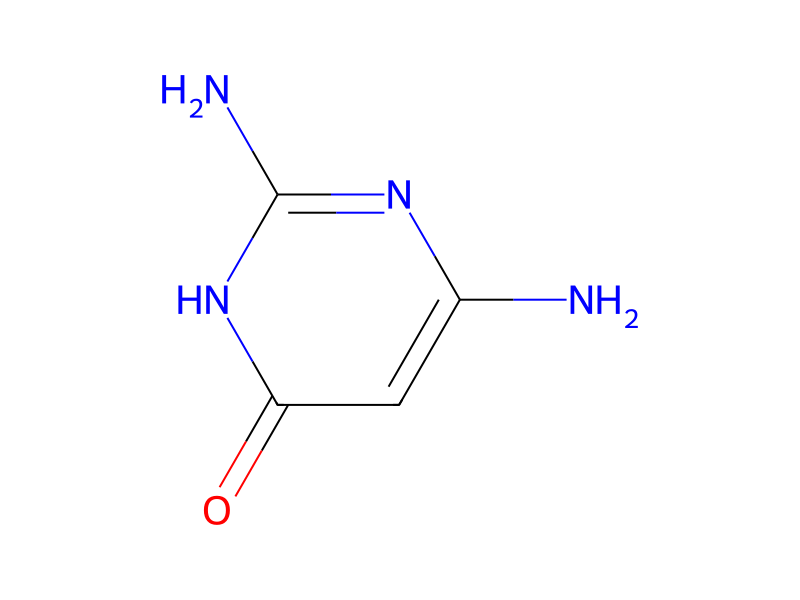
Basic information
- Standard SMILES
Nc1cc(=O)[nH]c(N)n1- InChIKey
SWELIMKTDYHAOY-UHFFFAOYSA-N- Molecular formula
- C4H6N4O
- Average molar mass
- 126.12 g/mol
- Monoisotopic mass
- 126.05416083
Names & identifiers
- Preferred name
- 2-Aminoisocytosine
- IUPAC
- 2,4-diamino-1H-pyrimidin-6-one
- English name
- 4-Pyrimidinol, 2,6-diamino- (9CI)
- Molecular formula
- C4H6N4O
- Molecular weight
- 126.12
Names & synonyms
2,4-Diamino-6-hydroxypyrimidine56-06-4100643-27-42,6-diaminopyrimidin-4(3H)-one143504-99-82,6-Diamino-1H-pyrimidin-4-one4(1H)-Pyrimidinone, 2,6-diamino-2,6-Diamino-4-hydroxypyrimidine2,6-Diamino-4(1H)-pyrimidinone2-Aminoisocytosine2,6-Diamino-4-pyrimidinol4(3H)-pyrimidinone, 2,6-diamino-
Show more names
Minoxidil Impurity F4-Pyrimidinol, 2,6-diamino-2,4-diaMino-6(1H)-pyriMidone4-Pyrimidinol, 2,6-diamino- (9CI)4-Pyrimidinol, 2,6-diamino- (9CI) ISO 9001:2015 REACH
2,6-Diamino-4(3H)-pyrimidinoneDTXSID4049038NSC 9302NSC 44914NSC 680818EINECS 200-254-4AI3-52085NSC-9302
Database identifiers
- CAS
100643-27-4、143504-99-8、56-06-4、6020-53-7- PubChem CID
- 135408763
- DTXSID
DTXSID4049038- ChEMBL
CHEMBL1255934- ChEBI
CHEBI:195830- UNII
- EDH7CNS75I
- EC Number
- 200-254-4、816-082-3
- Nikkaji
- J41.153A
Properties
Computed structural properties
- XLogP
- -1.8
- Topological polar surface area
- 93.5 Ų
- Hydrogen bond donors
- 3
- Hydrogen bond acceptors
- 3
- Rotatable bonds
- 0
- Heavy atoms
- 9
- Formal charge
- 0
- Complexity
- 205
Experimental & physicochemical properties
Melting Point286 °C
Physical DescriptionSolid
Physicochemical properties
- Boiling point
- 524 · 524.0±53.0 °C(Predicted)
- Density
- 1.599 · 1.599±0.06 g/cm3(Predicted)
- storage temp.
- Keep in dark place,Inert atmosphere,Room temperature
- pka
- 10.85 · 10.85±0.10(Predicted)
- InChI
- InChI=1S/C4H6N4O/c5-2-1-3(9)8-4(6)7-2/h1H,(H5,5,6,7,8,9)
- InChIKey
- SWELIMKTDYHAOY-UHFFFAOYSA-N
- SMILES
- C1(N)=NC(N)=CC(O)=N1
- FDA UNII
- 7 CNS75I · EDH7CNS75I
- Symbol(GHS)
- 7 · GHS07
- Signal word
- Warning
- Hazard statements
- 302 · H302
- Precautionary statements
- 280 · P280-P305+P351+P338
Safety & regulation
GHS classification
GHS Classification
This chemical does not meet GHS hazard criteria for 9.8% (12 of 123) of reports.
Warning
H400 (86.2%): Very toxic to aquatic life [Warning Hazardous to the aquatic environment, acute hazard];H410 (86.2%): Very toxic to aquatic life with long lasting effects [Warning Hazardous to the aquatic environment, long-term hazard]
P273, P391, and P501 (click each P-code to see the statement)
Aggregated GHS information provided per 123 reports by companies from 7 notifications to the ECHA C&L Inventory. Each notification may be associated with multiple companies.;Reported as not meeting GHS hazard criteria per 12 of 123 reports by companies.;There are 6 notifications provided by 111 of 123 reports by companies with hazard statement code(s).;Information may vary between notifications depending on impurities, additives, and other factors. The percentage value in parenthesis indicates the notified classification ratio from companies that provide hazard codes. Only hazard codes with percentage values above 10% are shown. For more detailed information, please visit ECHA C&L website.
Hazard information
Regulatory Information
Chemical: 4(3H)-Pyrimidinone, 2,6-diamino-;Specific Information Requirement: Obligations to provide information apply. These obligations are:;1. A person introducing this chemical must tell us in writing within 28 calendar days if any of the following circumstances have occurred in relation to their introduction (importation or manufacture):;a. the concentration of the chemical in PVC pipes exceeds 0.3%;b. significant migration rate occurs from PVC pipes into water (e.g. exceeding EFSA limit);2. A person who introduces this chemical must tell us in writing within 28 calendar days if they become aware of any of the following circumstances, namely, that since the assessment under the Industrial Chemicals (Notification and Assessment) Act 1989:;a. the function or use of the chemical has changed, or is likely to change, significantly;;b. the amount of the chemical being introduced has increased, or is likely to increase, significantly;;c. in the case of a chemical not manufactured, or proposed to be manufactured, in Australia at the time of the assessmentâit has begun to be manufactured in Australia;;d. the method of manufacture of the chemical in Australia has changed, or is likely to change, in a way that may result in an increased risk of an adverse effect of the chemical on occupational health and safety, public health or the environment;;e. additional information has become available to the person as to an adverse effect of the chemical on occupational health and safety, public health or the environment.
Regulation (EC) No 1935/2004 (amended)
Status: Active Update: 15-01-2016 https://echa.europa.eu/registration-dossier/-/registered-dossier/16733
2,6-diamino-4-pyrimidinol: Does not have an individual approval but may be used under an appropriate group standard
Hazard Classes and Categories
Aquatic Acute 1 (86.2%);Aquatic Chronic 1 (86.2%)
Skin Irrit. 2 (100%);Eye Irrit. 2 (100%);STOT SE 3 (100%)
Regulatory information
Regulatory Information
Chemical: 4(3H)-Pyrimidinone, 2,6-diamino-;Specific Information Requirement: Obligations to provide information apply. These obligations are:;1. A person introducing this chemical must tell us in writing within 28 calendar days if any of the following circumstances have occurred in relation to their introduction (importation or manufacture):;a. the concentration of the chemical in PVC pipes exceeds 0.3%;b. significant migration rate occurs from PVC pipes into water (e.g. exceeding EFSA limit);2. A person who introduces this chemical must tell us in writing within 28 calendar days if they become aware of any of the following circumstances, namely, that since the assessment under the Industrial Chemicals (Notification and Assessment) Act 1989:;a. the function or use of the chemical has changed, or is likely to change, significantly;;b. the amount of the chemical being introduced has increased, or is likely to increase, significantly;;c. in the case of a chemical not manufactured, or proposed to be manufactured, in Australia at the time of the assessmentâit has begun to be manufactured in Australia;;d. the method of manufacture of the chemical in Australia has changed, or is likely to change, in a way that may result in an increased risk of an adverse effect of the chemical on occupational health and safety, public health or the environment;;e. additional information has become available to the person as to an adverse effect of the chemical on occupational health and safety, public health or the environment.
Regulation (EC) No 1935/2004 (amended)
Status: Active Update: 15-01-2016 https://echa.europa.eu/registration-dossier/-/registered-dossier/16733
2,6-diamino-4-pyrimidinol: Does not have an individual approval but may be used under an appropriate group standard
Safety data
- Signal word
- Warning
- Symbol(GHS)
- GHS07
- Hazard statements
- H302
- Precautionary statements
- P280-P305+P351+P338
Chemistry & industry
Uses & manufacturing
General Manufacturing Information4(3H)-Pyrimidinone, 2,6-diamino-: ACTIVE
Applications
Uses4-Pyrimidinol, 2,6-diamino- (9CI) is mainly used in pharmaceutical research and development for impurity control and content determination of drugs such as minoxidil, and is also a key intermediate in the synthesis of pyrimidine drugs, pesticides and dyes.
Suppliers21 total
毕佳索(上海毕得医药科技股份有限公司)400-6005915 · [email protected]
上海腾准生物科技有限公司19821570922 · [email protected]
广东元丰化学试剂有限公司0751-2829979 13318593351 · [email protected]
上海健超生物科技有限公司15021035486 18081542813 · [email protected]
湖北扬信医药科技有限公司15347293736 · [email protected]
郑州安步防护用具有限公司+86-0371-88006763; +86-15988602810 · [email protected]
常州翔龙医药科技有限公司18915873328 18915873328 · [email protected]
深圳振强药物研发有限公司+86-0755-66853366 +86-13670046396 · [email protected]
坛墨质检科技股份有限公司19850211281 · [email protected]
成都卡麦尔医药科技有限公司028-67136579 15828051124 · [email protected]
四川普西奥标物科技有限公司13540909846 13882008651 · [email protected]
江苏艾康生物医药研发有限公司025-66113011 19370895928 · [email protected]
杭州凡达化工有限公司008657128800458 · [email protected]
南京克罗托鲁宁医药科技有限公司13382066392
苏州诺行贸易有限公司0512-65816829 18662214788 · [email protected]
武汉爱默尔特科技有限公司027-888-4366503 13986279625 · [email protected]
山西诺诚生物科技有限公司17835231871 · [email protected]
上海捷世凯生物科技有限公司021-57520305 13795461237 · [email protected]
广东翁江化学试剂有限公司0751-2815983 13927872582 · [email protected]
淄博航宇生物科技发展有限公司+86-0533-2185556 +86-15965530500 · [email protected]
广东胜克生化科技股份有限公司18925113981 18925113981 · [email protected]
Related reactions
9 records





Linked notes
Loading…