
HomeMCPWorkbenchSkills
HomeWorkbenchNotificationsMe
llms.txt · MCP GuidePrivacy Policy · Terms of Service · Supportv1.8.3
  1. Home
  2. /Compound

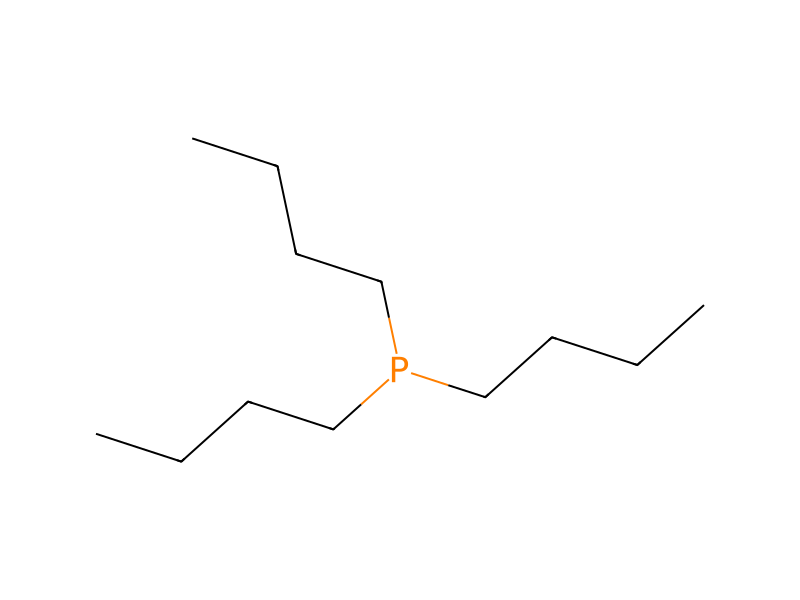
Tributylphosphine

HCID 13831
New reaction
Print
Basic informationOverviewNames & identifiersPropertiesSafety & regulationChemistry & industryRelated reactionsCompound notes
Substructure searchFind similar structures

Basic information

CAS
998-40-3
Standard SMILES
CCCCP(CCCC)CCCC
InChIKey
TUQOTMZNTHZOKS-UHFFFAOYSA-N
Molecular formula
C12H27P
Average molar mass
202.32 g/mol
Monoisotopic mass
202.18503786

Overview

Tributylphosphine is a colorless to yellowish liquid with a strong garlic-like odor. It is insoluble in water. It is liable to heat and ignite spontaneously in air. If involved in a fire phosphine gas, a highly flammable and toxic gas, will evolve. It is irritating to mucous membranes.

Names & identifiers

Preferred name
Tributylphosphine
IUPAC
tributylphosphane
English name
Tributylphosphine
Molecular formula
C12H27P
Molecular weight
202.32

Names & synonyms

TributylphosphineTributylphosphaneTri-n-butylphosphine998-40-3Phosphine, tributyl-Tris(butyl)phosphineTributylfosfinDTXSID90469980O52FJR7WNUN3254NSC-91700DTXCID7026998
Show more names
TBUPP(n-Bu)3cytop 340TributylphosphorusNSC 91700(n-C4H9)3PCYTOP(R) 340
RefChem:190921213-651-2tributyl phosphineTri-n-butyl phosphinetributyl-phosphaneMFCD00009462Bu3PPBu3

Database identifiers

CAS
998-40-3
PubChem CID
13831
DTXSID
DTXSID9046998
ChEMBL
CHEMBL3185473
UNII
0O52FJR7WN
EC Number
213-651-2
Nikkaji
J56.131B

Properties

Computed structural properties

XLogP
3.7
Topological polar surface area
0 Ų
Hydrogen bond donors
0
Hydrogen bond acceptors
0
Rotatable bonds
9
Heavy atoms
13
Formal charge
0
Complexity
72.1

Experimental & physicochemical properties

Chemical ClassesOther Classes -> Phosphorus Compounds
Density0.812 @25 °C
Boiling Point240 °C @760 [mm Hg]
Vapor Pressure16 [mm Hg] @121 °C
Physical Description · 3 items

Tributylphosphine is a colorless to yellowish liquid with a strong garlic-like odor. It is insoluble in water. It is liable to heat and ignite spontaneously in air. If involved in a fire phosphine gas, a highly flammable and toxic gas, will evolve. It is irritating to mucous membranes.

Liquid

Colorless to yellowish liquid with a strong odor like garlic; [CAMEO] Clear colorless liquid; [Sigma-Aldrich MSDS]

Physicochemical properties

Melting point
60 °C; · −60 °C; −76 °F; 213 K
Boiling point
240 °C; · 240 °C; 464 °F; 513 K (150 °C (302 °F; 423 K) at 50 mmHg)
Density
0.82 g/ml · 0.82 g/ml
vapor density
9 · 9 (vs air)
vapor pressure
1.9 Pa · 1.9Pa at 20℃
refractive index
1.46 · 1.46
Flash point
117 °C · 117 °C (243 °F; 390 K)
storage temp.
2 · 2-8°C
form
oily liquid
color
Colorless
Specific Gravity
0.82 · 0.820 (20/4℃)
Water Solubility
insoluble
Sensitive
Moisture Sensitive/Air Sensitive
BRN
1738261 · 1738261
Stability
Stable, but pyrophoric - spontaneously inflammable in air. Incompatible with oxidizing agents. Moisture sensitive.
InChI
1S/C12H27P/c1-4-7-10-13(11-8-5-2)12-9-6-3/h4-12H2,1-3H3
InChIKey
TUQOTMZNTHZOKS-UHFFFAOYSA-N
SMILES
CCCCP(CCCC)CCCC
CAS DataBase Reference
998 · 998-40-3(CAS DataBase Reference)
FDA UNII
0 O52FJR7WN · 0O52FJR7WN
NIST Chemistry Reference
Phosphine, tributyl-(998-40-3)
EPA Substance Registry System
Phosphine, tributyl- (998-40-3)
UNSPSC Code
41105323 · 41105323
NACRES
56 · NA.56
Symbol(GHS)
2 · GHS02,GHS05,GHS07,GHS09
Signal word
Danger
Hazard statements
251 · H251-H302-H314-H411
Precautionary statements
235 · P235-P273-P280-P301+P312-P303+P361+P353-P305+P351+P338
target organs
Respiratory system
PPE
Faceshields, Gloves, Goggles, type ABEK (EN14387) respirator filter
Hazard Codes
Xi,F,C,T
Risk Statements
36 · 36/38-34-21/22-17-11-37-36/37/38-61
Safety Statements
41 · 41-36/37/39-26-16-45-43-17-5-53
RIDADR
3254 · UN 3254
WGK Germany
3 · 3
RTECS
3270000 · SZ3270000
F
10 · 10-13-23
Autoignition Temperature
392 °F · 392 °F
TSCA
TSCA listed
HazardClass
4.2 · 4.2
PackingGroup
I
HS Code
2931900090 · 2931900090
Storage Class
6.1 C · 6.1C - Combustible acute toxic Cat.3toxic compounds or compounds which causing chronic effects
Hazard Classifications
3 Eye · Aquatic Chronic 3Eye Dam. 1Repr. 1BSkin Corr. 1ASTOT SE 3
REACH Registrations
Active
Excepted Quantities
Forbidden

Safety & regulation

Safety information is for reference only and does not replace the supplier’s Safety Data Sheet (SDS), applicable regulations, or professional assessment.

GHS classification

GHS Classification · 6 items

Danger

H226 (15.7%): Flammable liquid and vapor [Warning Flammable liquids]

P210, P222, P231, P233, P235, P240, P241, P242, P243, P260, P264, P264+P265, P270, P273, P280, P301+P317, P301+P330+P331, P302+P335+P334, P302+P352, P302+P361+P354, P303+P361+P353, P304+P340, P305+P354+P338, P316, P317, P321, P330, P362+P364, P363, P370+P378, P391, P403+P235, P405, P407, P410, P413, P420, and P501 (click each P-code to see the statement)

Aggregated GHS information provided per 287 reports by companies from 11 notifications to the ECHA C&L Inventory. Each notification may be associated with multiple companies.

Not Classified

Danger

Hazard information

Regulatory Information · 4 items

Chemical: Phosphine, tributyl-

Phosphine, tributyl- is listed on the EPA's Chemical Data Reporting (CDR) system. Manufacturers and importers of Phosphine, tributyl- are required to report information about their production and use of this chemical to the EPA under the Toxic Substances Control Act (TSCA). (40 eCFR Part 711)

REACH registered substance: Tributylphosphine (EC: 213-651-2)

Phosphine, tributyl-: Does not have an individual approval but may be used as a component in a product covered by a group standard. It is not approved for use as a chemical in its own right.

DOT LabelSpontaneously Combustible
Fire Hazards · 2 items

Excerpt from ERG Guide 135 [Substances - Spontaneously Combustible]:

· Flammable/combustible material.

Health Hazards · 2 items

Excerpt from ERG Guide 135 [Substances - Spontaneously Combustible]:

· Fire will produce irritating, corrosive and/or toxic gases.

Hazards Summary · 1 item

Pyrophoric; May ignite on contact with water or moisture; [CAMEO] Causes burns; [EPA OHM/TADS] Pyrophoric; Reacts violently with water; Causes burns and lachrymation; Inhalation may cause corrosive injuries to upper respiratory tract; Harmful by ingestion and skin absorption; [Sigma-Aldrich MSDS] See Triphenylphosphine and tert-Butylphosphine.

DOT ID and Guide3254 135
Reactive GroupAmines, Phosphines, and Pyridines
Reactivity AlertsHighly Flammable
Reactivity ProfileOrganophosphines, such as TRIBUTYLPHOSPHANE, are susceptible to partial oxidation by oxidizing agents, resulting in the release of phosphine oxides.
DOT Hazard Classification · 4 items

Tributylphosphane

UN3254

Div 4.2 Spontaneously combustible material (49 eCFR § 173.124)

PG I: the degree of danger presented by the material is great

Air and Water ReactionsHighly flammable. May ignite on contact with air or moist air. Insoluble in water.
Hazard Classes and Categories · 2 items

Flam. Liq. 3 (15.7%)

Pyrophoric liquids - Category 1

Safety & protection

Fire FightingExcerpt from ERG Guide 135 [Substances - Spontaneously Combustible]:
Accidental Release Measures · 2 items

· CALL 911. Then call emergency response telephone number on shipping paper. If shipping paper not available or no answer, refer to appropriate telephone number listed on the inside back cover.

· ELIMINATE all ignition sources (no smoking, flares, sparks or flames) from immediate area.

First Aid · 2 items

Excerpt from ERG Guide 135 [Substances - Spontaneously Combustible]:

General First Aid:

Exposure Control and Personal Protection· Wear positive pressure self-contained breathing apparatus (SCBA).
Nonfire Spill ResponseExcerpt from ERG Guide 135 [Substances - Spontaneously Combustible]:
Isolation and Evacuation · 2 items

Excerpt from ERG Guide 135 [Substances - Spontaneously Combustible]:

Immediate precautionary measure

Protective Action Criteria (PAC) · 3 items

2.3 [mg/m3]

25 [mg/m3]

150 [mg/m3]

Personal Protective Equipment (PPE)Excerpt from ERG Guide 135 [Substances - Spontaneously Combustible]:
Emergency Response Planning Guidelines· DO NOT USE WATER, CO2 OR FOAM ON MATERIAL ITSELF.

Toxicology

Adverse EffectsDermatotoxin - Skin burns.

Safety data

F
10-13-23
PPE
Faceshields, Gloves, Goggles, type ABEK (EN14387) respirator filter
wgk
3
tsca
TSCA listed
rtecs
SZ3270000
ridadr
UN 3254
hs_code
2931900090
risk_code
36/38-34-21/22-17-11-37-36/37/38-61
Signal word
Danger
Symbol(GHS)
GHS02,GHS05,GHS07,GHS09
hazard_code
Xi,F,C,T
safety_code
41-36/37/39-26-16-45-43-17-5-53
hazard_class
4.2
Storage Class
6.1C - Combustible acute toxic Cat.3toxic compounds or compounds which causing chronic effects
packing_group
I
target organs
Respiratory system
Hazard statements
H251-H302-H314-H411
Excepted Quantities
Forbidden
REACH Registrations
Active
Hazard Classifications
Aquatic Chronic 3Eye Dam. 1Repr. 1BSkin Corr. 1ASTOT SE 3
Autoignition Temperature
392 °F
Precautionary statements
P235-P273-P280-P301+P312-P303+P361+P353-P305+P351+P338

Chemistry & industry

Uses & manufacturing

Uses · 2 items

Used as a polymerization cross-linking catalyst, organic intermediate, and as a catalyst component for hydrogenation in the petroleum industry; [EPA OHM/TADS]

Petroleum Production and Refining [Category: Industry]

U.S. Production2023: 50,000 - <250,000 lb
Industry UsesIntermediate
General Manufacturing Information · 2 items

All Other Basic Organic Chemical Manufacturing

Phosphine, tributyl-: ACTIVE

Applications · 4 items

Uses1,4-addition catalyst; used with disulfides for the thioetherification of alcohols; acylation catalyst; used to prepare active esters.

Usessuzuki reaction

UsesTributylphosphine is usually used as catalyst for Domino reactions of activated conjugated dienes with β,γ-unsaturated-α-ketoesters, [3+2]-Cycloadditions,Umpolung addition reactions,Reductive carbonylation, Allylation reactions.

General DescriptionTributylphosphane is a colorless to yellowish liquid with a strong garlic-like odor. Tributylphosphane is insoluble in water. Tributylphosphane is liable to heat and ignite spontaneously in air. If involved in a fire phosphine gas, a highly flammable and toxic gas, will evolve. Tributylphosphane is irritating to mucous membranes.


Upstream & downstream products

Upstream raw materials

1-BromobutanePhosphorus trichlorideDiethyl etherMagnesium

Downstream products

ORNOPROSTILCyanomethylenetributylphosphoraneTri-n-butylphosphonium tetrafluoroborateCetyltributylphosphonium bromideTetrabutylphosphonium iodideHISHICOLIN PX-4MP1-Butyl-1-methylpiperidinium BromideDi-tert-butylphenylphosphineAcetic acid, 2-(tributylphosphoranylidene)-, methyl esterTributylphosphine selenideDibutylmethylphosphine oxide

Related reactions

2,474 records
New reaction record
HRID 486 reaction equation
HRID 486As catalyst
HRID 7304 reaction equation
HRID 7304As reactant
HRID 7476 reaction equation
HRID 7476As reactant
HRID 8142 reaction equation
HRID 8142As reactant
HRID 8144 reaction equation
HRID 8144As reactant
HRID 8147 reaction equation
HRID 8147As reactant
HRID 8149 reaction equation
HRID 8149As reactant
HRID 8280 reaction equation
HRID 8280As reactant
PreviousPage 1 of 310

Compound notes

On this pageBasic informationOverviewNames & identifiersPropertiesSafety & regulationChemistry & industryRelated reactionsCompound notes