
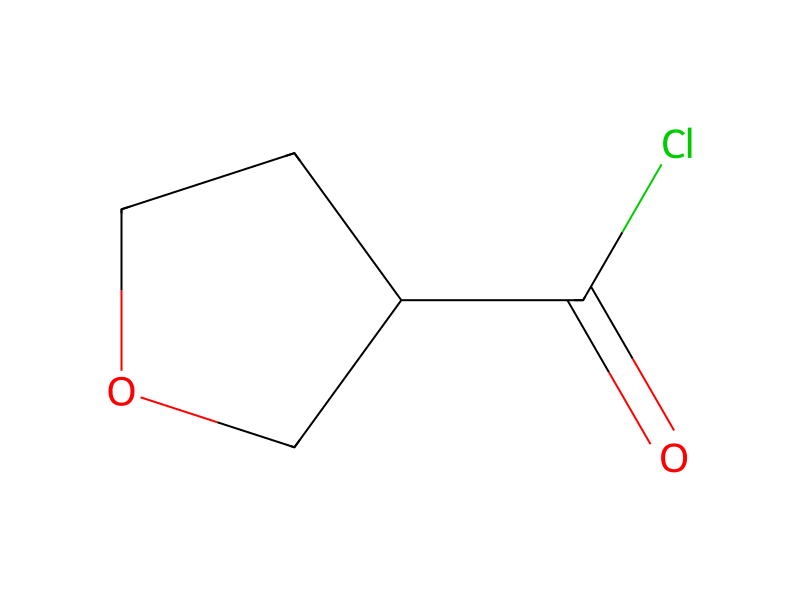
Basic information
- Standard SMILES
O=C(Cl)C1CCOC1- InChIKey
RVMFDSHMPBPWRK-UHFFFAOYSA-N- Molecular formula
- C5H7ClO2
- Average molar mass
- 134.56 g/mol
- Monoisotopic mass
- 134.0134572
Names & identifiers
- Preferred name
- Tetrahydrofuran-3-carbonyl chloride
- IUPAC
- oxolane-3-carbonyl chloride
- English name
- Tetrahydro-furan-3-carbonyl chloride
- Molecular formula
- C5H7ClO2
- Molecular weight
- 134.56
Names & synonyms
Tetrahydrofuran-3-carbonyl chlorideRefChem:897170692-545-169595-02-4oxolane-3-carbonyl chlorideTETRAHYDRO-FURAN-3-CARBONYL CHLORIDEMFCD066566963-(Chlorocarbonyl)tetrahydrofuran, 3-(chloroformyl)tetrahydrofuran3-tetrahydrofuroyl chlorideSCHEMBL231691DTXSID80554394RVMFDSHMPBPWRK-UHFFFAOYSA-N
Show more names
Tetrahydrofuran-3-carbonylchlorideUCA59502GEO-03833SBB0858763-Furancarbonyl chloride, tetrahydro-AKOS010530772(+/-) tetrahydro-3-furoic acid chloridePS-10940
Database identifiers
- CAS
69595-02-4- PubChem CID
- 14020412
- DTXSID
DTXSID80554394- EC Number
- 692-545-1
Properties
Computed structural properties
- XLogP
- 0.7
- Topological polar surface area
- 26.3 Ų
- Hydrogen bond donors
- 0
- Hydrogen bond acceptors
- 2
- Rotatable bonds
- 1
- Heavy atoms
- 8
- Formal charge
- 0
- Complexity
- 103
Physicochemical properties
- Boiling point
- 172.8 · 172.8±33.0 °C(Predicted)
- Density
- 1.27 · 1.270±0.06 g/cm3(Predicted)
- Symbol(GHS)
- 5 · GHS05,GHS07
- Signal word
- Danger
- Hazard statements
- 302 · H302-H314-H318
- Precautionary statements
- 280 · P280-P301+P312-P303+P361+P353-P304+P340-P305+P351+P338-P310
- HS Code
- 2932190090 · 2932190090
Safety & regulation
GHS classification
GHS Classification
Danger
H302 (66.7%): Harmful if swallowed [Warning Acute toxicity, oral];H312 (33.3%): Harmful in contact with skin [Warning Acute toxicity, dermal];H314 (100%): Causes severe skin burns and eye damage [Danger Skin corrosion/irritation];H318 (33.3%): Causes serious eye damage [Danger Serious eye damage/eye irritation];H332 (33.3%): Harmful if inhaled [Warning Acute toxicity, inhalation]
P260, P261, P264, P264+P265, P270, P271, P280, P301+P317, P301+P330+P331, P302+P352, P302+P361+P354, P304+P340, P305+P354+P338, P316, P317, P321, P330, P362+P364, P363, P405, and P501 (click each P-code to see the statement)
Aggregated GHS information provided per 3 reports by companies from 3 notifications to the ECHA C&L Inventory. Each notification may be associated with multiple companies.;Information may vary between notifications depending on impurities, additives, and other factors. The percentage value in parenthesis indicates the notified classification ratio from companies that provide hazard codes. Only hazard codes with percentage values above 10% are shown. For more detailed information, please visit ECHA C&L website.
Hazard information
Hazard Classes and CategoriesAcute Tox. 4 (66.7%);Acute Tox. 4 (33.3%);Skin Corr. 1B (100%);Eye Dam. 1 (33.3%);Acute Tox. 4 (33.3%)
Safety data
- hs_code
- 2932190090
- Signal word
- Danger
- Symbol(GHS)
- GHS05,GHS07
- Hazard statements
- H302-H314-H318
- Precautionary statements
- P280-P301+P312-P303+P361+P353-P304+P340-P305+P351+P338-P310
Chemistry & industry
Applications
UsesTetrahydrofuran-3-carbonyl chloride is a useful reactant for the synthesis of MCH1 receptor antagonist azetidinyl oxadiazole.
Upstream & downstream products
Upstream raw materials
Suppliers24 total
上海麦克林生化科技股份有限公司021-50706066 15221275939 · [email protected]
韶远科技(上海)有限公司021-50795510 4000665055 · [email protected]
海济医药科技(苏州)有限公司18012778619 · [email protected]
上海相辉医药科技有限公司13761987713; 13761987713 · [email protected]
赛默飞世尔科技(中国)有限公司800-810-5118 · [email protected]
阳谷荣科商贸有限公司15863541132 · [email protected]
九鼎化学(上海)科技有限公司4009209199 · [email protected]
许昌峰飞新材料科技有限公司19713077352; 19713077352 · [email protected]
南京世洲生物科技有限公司025-85563444 18351873721 · [email protected]
菏泽星达医药科技有限公司13583079096 · [email protected]
Capot Chemical Co.,Ltd.+86-(0)57185586718 +86-13336195806 · [email protected]
江苏艾康生物医药研发有限公司025-58851090 13913916777 · [email protected]
Accela ChemBio Inc.+1-858-6993322 +86-18019713315 · [email protected]
北京珐默兹医药科技有限公司15811073878 · [email protected]
上海锋基医药科技有限公司15555063509 · [email protected]
Alchem Pharmtech,Inc.8485655694 · [email protected]
山东煜昌药业有限公司531-87153728 13805401165 · [email protected]
上海捷世凯生物科技有限公司021-57520305 13795461237 · [email protected]
北京百灵威科技有限公司18210857532 18210857532 · [email protected]
烟台盛凯伦化学科技有限公司开发区第一分公司13356901049 · [email protected]
DAYANG CHEM (HANGZHOU) CO.,LTD+86-88938639 +86-17705817739 · [email protected]
上海盛袖生物科技有限公司13761144602 · [email protected]
珠海奥博凯生物医药技术有限公司400-0628126 · [email protected]
江苏药泽医药科技有限公司18550739526 · [email protected]
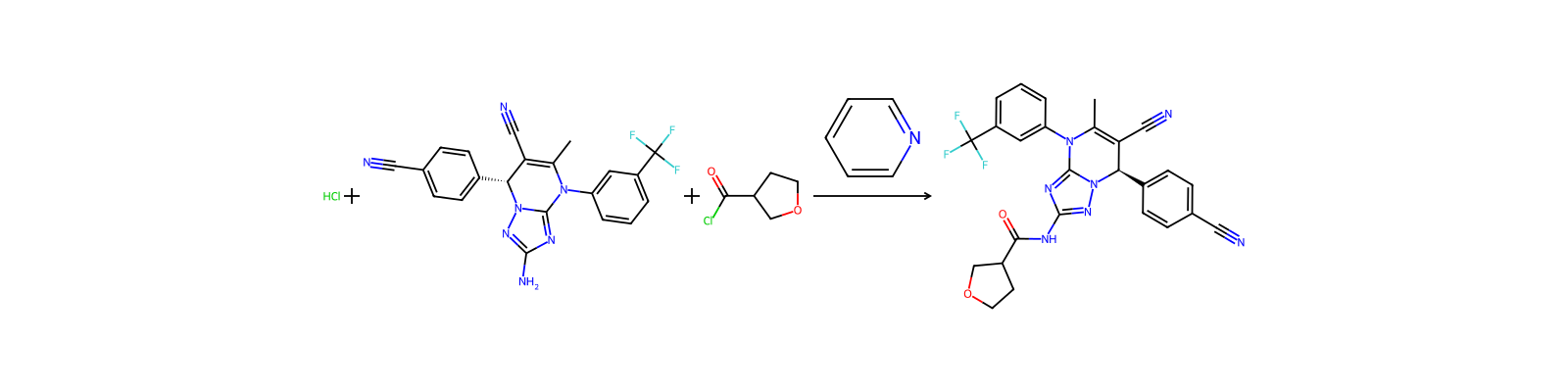
Related reactions
7 records


Linked notes
Loading…