
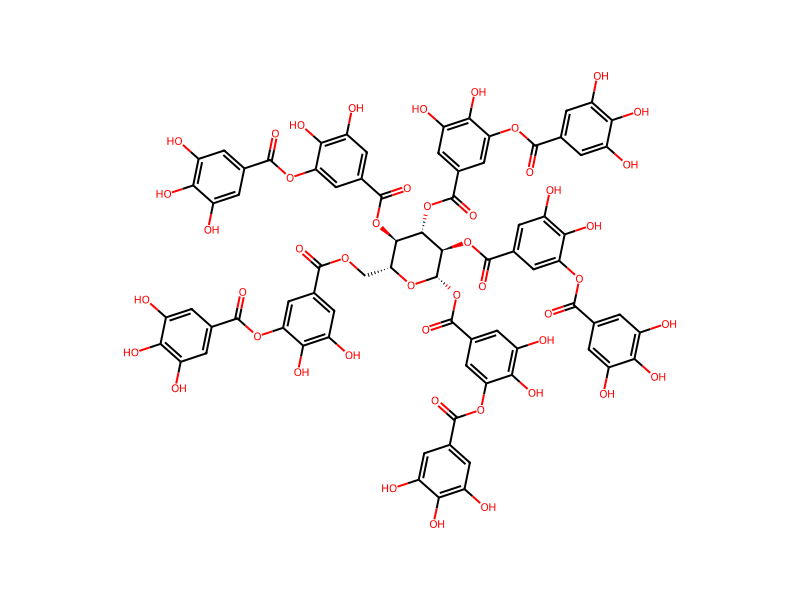
Basic information
- CAS
1401-55-4- Standard SMILES
O=C(OC[C@H]1O[C@@H](OC(=O)c2cc(O)c(O)c(OC(=O)c3cc(O)c(O)c(O)c3)c2)[C@H](OC(=O)c2cc(O)c(O)c(OC(=O)c3cc(O)c(O)c(O)c3)c2)[C@@H](OC(=O)c2cc(O)c(O)c(OC(=O)c3cc(O)c(O)c(O)c3)c2)[C@@H]1OC(=O)c1cc(O)c(O)c(OC(=O)c2cc(O)c(O)c(O)c2)c1)c1cc(O)c(O)c(OC(=O)c2cc(O)c(O)c(O)c2)c1- InChIKey
LRBQNJMCXXYXIU-PPKXGCFTSA-N- Molecular formula
- C76H52O46
- Average molar mass
- 1,701.2 g/mol
- Monoisotopic mass
- 1,700.17297418
Overview
Tannic acid is a light yellow to tan solid with a faint odor. Sinks and mixes with water. (USCG, 1999)
Names & identifiers
- Preferred name
- Tannic Acid
- IUPAC
- [2,3-dihydroxy-5-[[(2R,3R,4S,5R,6S)-3,4,5,6-tetrakis[[3,4-dihydroxy-5-(3,4,5-trihydroxybenzoyl)oxybenzoyl]oxy]oxan-2-yl]methoxycarbonyl]phenyl] 3,4,5-trihydroxybenzoate
- English name
- Tannic acid
- Molecular formula
- C76H52O46
- Molecular weight
- 1701.21
Names & synonyms
TANNIC ACIDGlyceriteGallotannic acidTannicum acidumFEMA No. 3042Asian holly oak nutgallAcide tanniqueAcid, tannicd'Acide tanniqueTannin from mimosaTannin from chestnutTannin from quebracho
Show more names
TANNINDIGALLIC ACIDTANNINUMFEMA 3042GERBSAURECHINESE TANNINTannic acid, βCHINESE GALLOTANNINTANNIC ACID, 25 G+100 ML H2OPENTA (M-DIGALLOYL) GLUCOSEN F
NSC-656273NSC-758670[2,3-dihydroxy-5-[[(2R,3R,4S,5R,6S)-3,4,5,6-tetrakis[[3,4-dihydroxy-5-(3,4,5-trihydroxybenzoyl)oxybenzoyl]oxy]oxan-2-yl]methoxycarbonyl]phenyl] 3,4,5-trihydroxybenzoateAcacia mollissima tanninSchinopsis lorentzii tanninCastanea sativa Mill tanninTannic acid (Quercus spp.)Chestnut tannin
Database identifiers
- CAS
1401-55-4、5424-20-4- PubChem CID
- 16129778
- DTXSID
DTXSID00892987- ChEMBL
CHEMBL506247- ChEBI
CHEBI:81066- EC Number
- 226-562-9
- Nikkaji
- J218.007C
Properties
Computed structural properties
- XLogP
- 6.2
- Topological polar surface area
- 778 Ų
- Hydrogen bond donors
- 25
- Hydrogen bond acceptors
- 46
- Rotatable bonds
- 31
- Heavy atoms
- 122
- Formal charge
- 0
- Complexity
- 3,570
Experimental & physicochemical properties
Chemical ClassesOther Classes -> Other Organic Compounds
CosmeticsAstringent
OdorFAINT CHARACTERISTIC ODOR
TasteASTRINGENT TASTE
Food AdditivesCOLOR OR COLORING ADJUNCT, FLAVOR ENHANCER, FLAVORING AGENT OR ADJUVANT, PH CONTROL AGENT, PROCESSING AID -> FDA Substance added to food
Densitygreater than 1 at 68 °F (USCG, 1999)
Flavoring AgentsEU Flavoring substances
Color/Form
YELLOWISH-WHITE TO LIGHT BROWN, AMORPHOUS, BULKY POWDER OR FLAKES, OR SPONGY MASSES
PALE YELLOWISH-BROWN
Solubility
VERY SOL IN ALCOHOL, ACETONE; INSOL IN ETHER, BENZENE, CHLOROFORM & CARBON DISULFIDE
1 G DISSOLVES IN 0.35 ML WATER, 1 ML WARM GLYCEROL; PRACTICALLY INSOL IN PETROLEUM ETHER, CARBON TETRACHLORIDE
Flash Point
390 °F
390 °F OC.
Human Drugs
FDA approved drugs -> Active ingredient
FDA approved drugs -> Active ingredient
Endocrine DisruptorsPotential endocrine disrupting compound
Physicochemical properties
- Melting point
- 218 °C · 218 °C(lit.)
- Density
- 2.12 · 2.12±0.1 g/cm3(Predicted)
- Flash point
- 198 °C · 198 °C
- storage temp.
- Keep in dark place,Sealed in dry,Room Temperature
- solubility
- 10 · DMSO:10.0(Max Conc. mg/mL);5.88(Max Conc. mM)PBS (pH:7.2):0.3(Max Conc. mg/mL);0.176(Max Conc. mM)
- form
- Solid
- pka
- 6 · 6.00±0.50(Predicted)
- color
- Off-white to light brown
- NCI Dictionary of Cancer Terms
- tannin
- FDA UNII
- 404 KO0584X · 404KO0584X
- Symbol(GHS)
- 7 · GHS07
- Signal word
- Warning
- Hazard statements
- 302 · H302-H315-H319-H335
- Precautionary statements
- 261 · P261-P301+P312-P302+P352-P304+P340-P305+P351+P338
- Safety Statements
- 24 · 24/25
- WGK Germany
- 2 · 2
- RTECS
- 5075000 · WW5075000
Safety & regulation
Safety information is for reference only and does not replace the supplier’s Safety Data Sheet (SDS), applicable regulations, or professional assessment.
GHS classification
GHS Classification
This chemical does not meet GHS hazard criteria for 17.6% (6 of 34) of reports.
Warning
H319 (82.4%): Causes serious eye irritation [Warning Serious eye damage/eye irritation]
P264+P265, P280, P305+P351+P338, and P337+P317 (click each P-code to see the statement)
Aggregated GHS information provided per 34 reports by companies from 2 notifications to the ECHA C&L Inventory.
Hazard information
Regulatory InformationRegulation (EC) No 1831/2003 (amended)
Fire HazardsSpecial Hazards of Combustion Products: Decomposes at 210 ° to carbon dioxide and pyrogallol, which can form irritating vapors. (USCG, 1999)
Fire PotentialSLIGHT, WHEN EXPOSED TO HEAT OR FLAME. SPONTANEOUS HEATING: NO.
Health HazardsInhalation causes irritation of nose and throat, coughing, and sneezing. Ingestion may cause gastric disturbance. Contact with eyes causes irritation. (USCG, 1999)
Hazards SummaryCommercial tannic acid (C76-H52-O46) usually contains about 10% water; [Merck Index] Corrosive to skin; [Quick CPC] A skin, eye, and respiratory tract irritant; [CAMEO]
Reactive GroupEsters, Sulfate Esters, Phosphate Esters, Thiophosphate Esters, and Borate Esters
Reactivity Profile
TANNIC ACID decomposes at 210 °C to carbon dioxide and pyrogallol, which can form irritating vapors (USCG, 1999). Incompatible with salts of heavy metals, alkaloids, gelatin, albumin, starch, oxidizing substances-e.g., permanganates, chlorates; lime water [Merck].
Air and Water ReactionsWater soluble. Gradually darkens on exposure to air and/or light
Hazard Classes and CategoriesEye Irrit. 2 (82.4%)
Safety & protection
Fire FightingFire Extinguishing Agents Not to Be Used: Water or foam may cause frothing.
First AidINHALATION: move to fresh air.
Fire Fighting ProceduresWATER.
Storage ConditionsKEEP WELL CLOSED & PROTECTED FROM LIGHT.
Personal Protective Equipment (PPE)Dust mask; goggles or face shield; protective gloves (USCG, 1999)
Toxicology
InteractionsAPPARENTLY DIETARY TANNIC ACID & TANNINS INCR REQUIREMENT FOR METHYL GROUP DONORS.
Adverse EffectsDermatotoxin - Skin burns.
Natural Pollution Sources
PRACTICALLY ALL WOOD & VEGETATION CONTAIN SOME FORM OF TANNIN IN LEAVES, TWIGS, BARK, WOOD OR FRUIT. ...BARK OF OAK, EUCALYPTUS, MANGROVE, HEMLOCK, PINE & WILLOW; WOOD OF QUEBRACHO, CHESTNUT & OAK; FRUITS OF TARA, MYROBALANS & DIVI-DIVI; LEAVES OF SUMAC & GAMBIER...ROOTS OF CANAIGRE & PALMETTO.
Human Toxicity Excerpts
IN AUTOPSIED HUMAN BURN CASES...OBSERVED LIVER NECROSIS ATTRIBUTABLE TO ABSORPTION OF TANNIC ACID THROUGH BURNED SKIN SURFACES.
MODERATELY TOXIC BY INGESTION & INHALATION.
GALLIC ACID DOES NOT PRODUCE LIVER DAMAGE, BUT MAY CAUSE DEATH FROM ACUTE RENAL FAILURE. THUS, HYDROLYSIS OF TANNIC ACID MAY ACCOUNT FOR HISTOLOGICAL CHANGES IN KIDNEY.
SUMMARY TOXICITY STATEMENT: ACUTE... HIGH VIA IV & SC. HIGH= CAPABLE OF CAUSING DEATH OR PERMANENT INJURY DUE TO EXPOSURES OF NORMAL USE; INCAPACITATING & POISONOUS; REQUIRES SPECIAL HANDLING.
For more Human Toxicity Excerpts (Complete) data for TANNIC ACID (6 total), please visit the HSDB record page.
Artificial Pollution Sources...NATURAL OCCURRENCE IN COFFEE AND TEA.
Non-Human Toxicity Excerpts
WHEN BURN-INDUCED ULCERS ON SKIN OF 20 WHITE RATS PAINTED DAILY WITH FRESH 5% AQ SOLN OF TANNIC ACID (USP), NO TUMORS WERE OBSERVED IN 11 ANIMALS SURVIVING 400 DAYS.
GROUP OF 30 MALE & 30 FEMALE YOUNG C3H/A MICE WAS INJECTED IM EVERY 2ND WK WITH 0.75 MG/KG BODY WT TANNIC ACID FOR 12 MO. ...ACID USED WAS NUT GALL TANNIC ACID... EXPT WAS TERMINATED AFTER 18 MO, 6 MO AFTER LAST INJECTION; NO LOCAL TUMORS WERE FOUND.
10% SOLN APPLIED TO CONJUNCTIVA CAUSES SLIGHT OR MILD REACTION, BUT PROLONGED APPLICATION HAS BEEN NOTED TO CAUSE DISCOLORATION.
TESTS INVOLVING LOCAL INJECTION OR APPLICATION TO CORNEAS DENUDED OF EPITHELIUM HAVE INDICATED THAT TANNIC ACID CAN PPT PROTEINS IN STROMA OF RABBIT CORNEAS & CAN CAUSE SOME INJURY EVEN @ NEUTRAL OR SLIGHTLY ALKALINE PH.
For more Non-Human Toxicity Excerpts (Complete) data for TANNIC ACID (16 total), please visit the HSDB record page.
Evidence for CarcinogenicityNo data are available in humans. Limited evidence of carcinogenicity in animals. OVERALL EVALUATION: Group 3: The agent is not classifiable as to its carcinogenicity to humans.
Safety data
- wgk
- 2
- rtecs
- WW5075000
- Signal word
- Warning
- Symbol(GHS)
- GHS07
- safety_code
- 24/25
- Hazard statements
- H302-H315-H319-H335
- Precautionary statements
- P261-P301+P312-P302+P352-P304+P340-P305+P351+P338
Chemistry & industry
Pharmacology
Mechanism of Action
Pharmaceutical grade tannic acid is generally considered to be pentadigalloylglucose. It has an astringent effect. When used internally, it dehydrates tissues when cause reduction in secretions. Externally, it works through formation of protective layer of harder and constricted cells. Tannic acid is thought to exert antiviral and antibacterial effects.
TANNIC ACID IN TEA ACCOUNTS FOR USE OF STRONG TEA IN UNIVERSAL ANTIDOTE, PRESUMABLY FOR DUAL PURPOSE OF PRECIPITATING TOXIC ALKALOIDS & OF HARDENING SURFACE OF GI MUCOSA & ITS MUCOUS LAYER.
Metabolism/Metabolites
Orally administered Tannic acid is hydrolysable tannin which releases gallic acid and other compounds upon decomposition.
YIELDS GALLIC ACID IN RATS; BLUMENBERG, FW, & KESSLER, FJ, ARZNEIMITTEL-FORSCH, 10, 742 (1960). /FROM TABLE/
Absorption, Distribution and Excretion
After ingestion it has poor bioavailability, due to large size, high affinity to bound to plasma proteins and low lipid solubility. Its main actions are due to local effects.
ERRATICALLY ABSORBED.
...ADMIN BY IP OR SC INJECTION TO RATS APPEARED IN LIVER 1 HR AFTER ADMIN & WAS CONCENTRATED IN NUCLEI AS EARLY AS 3 HR LATER.
...INCR CONCN OF TANNIC ACID IN BLOOD OF RABBITS & DOGS GIVEN...BY STOMACH TUBE, WITH MAX LEVEL AFTER 3 HR. ABSORPTION...FROM COLON, AS SHOWN BY RISING BLOOD LEVELS, WAS DEMONSTRATED IN RABBITS, SHEEP, GOATS, RATS & DOGS.
...SUFFICIENT TANNIC ACID MAY BE ABSORBED FROM GI TRACT, DENUDED SURFACES, & MUCOUS MEMBRANES TO CAUSE SEVERE CENTRALOBULAR NECROSIS OF LIVER.
Uses & manufacturing
Uses
Used as a dye mordant and to make ink, sizing paper, silk, and printed fabrics; Also used in tanning, rubber manufacturing, beer and wine clarifying, photography, and medicine (astringent and topical treatment of burns); Extracted from nutgall; Occurs in bark and fruit of many plants; [Merck Index] Also used in treatment of waste water and boiler water; [HSDB]
Sewer and Wastewater Treatment [Category: Industry]
MORDANT IN DYEING; MFR INK; SIZING PAPER & SILK; PRINTING FABRICS; TANNING; AS COAGULANT IN RUBBER MFR; WITH GELATIN & ALBUMIN FOR MFR OF IMITATION HORN & TORTOISE SHELL; CLARIFYING BEER OR WINE; IN PHOTOGRAPHY; MFR GALLIC ACID & PYROGALLOL; AS REAGENT IN ANALYTICAL CHEMISTRY
TO TREAT WASTE-WATER CONTAINING POLY(VINYL ALC)
IN TREATMENT OF WASTE-WATER
CHEMICALS (TANNATES, GALLIC ACID, PYROGALLIC ACID, HYDROSOLS OF THE NOBLE METALS); ALCOHOL DENATURANT; TEXTILES (MORDANT AND FIXATIVE); ELECTROPLATING; WRITING INKS; DEODORIZATION OF CRUDE OIL
U.S. Exports(1986) No Data
U.S. Imports(1984) 1.45X10+8 g/COMBINATIONS OF TANNIC ACID 50% OR OVER BY wt AS SPEC NATION FORMULARY AND AS NSPF/
U.S. Production(1986) No Data
Methods of Manufacturing
...PREPARED COMMERCIALLY IN US ALMOST ENTIRELY BY SOLVENT EXTRACTION FROM ALEPPO GALL-NUTS FROM EAST MEDITERRANEAN REGION & FROM TARA PODS FROM SOUTH AMERICA. ASIAN GALL-NUTS, LARGELY PRODUCT OF PEOPLES' REPUBLIC OF CHINA, ARE USED IN OTHER COUNTRIES.
...USUALLY OBTAINED FROM NUTGALLS, EXCRESCENCES ON YOUNG TWIGS OF VARIOUS SPECIES OF QUERCUS (OAK).
Formulations/Preparations
TANNIC ACID OF COMMERCE USUALLY CONTAINS ABOUT 10% WATER. ... IT IS PRODUCED FROM TURKISH OR CHINESE NUTGALL, FORMER CONTAINING 50-60%, LATTER ABOUT 70%.
TECHNICAL C.P.; N.F.; FLUFFY; F.C.C.
Household ProductsInformation on 1 consumer products that contain Tannic Acid in the following categories is provided:
Use Classification
Flavouring Agent -> FLAVOURING_AGENTFood Additives -> FILTERING_AID -> JECFA Functional Classes
Flavouring Agent -> FLAVOURING_AGENTFood Additives -> FILTERING_AID -> JECFA Functional Classes
Cosmetics -> Astringent
General Manufacturing Information
TANNINS MAY BE DIVIDED INTO 2 GROUPS: (A) DERIV OF FLAVANOLS, SO-CALLED CONDENSED TANNINS & (B) HYDROLYZABLE TANNINS (MORE IMPORTANT GROUP) WHICH ARE ESTERS OF SUGAR, USUALLY GLUCOSE, WITH ONE OR MORE TRIHYDROXYBENZENECARBOXYLIC ACIDS.
HYDROLYZABLE TANNINS ARE SUB-DIVIDED, ON BASIS OF PHENOLIC ACIDS WHICH THEY CONTAIN, INTO TWO GROUPS, GALLOTANNINS & ELLAGITANNINS.
SPECIFICATIONS FOR...COMMERCIAL GRADE...RESIDUE AFTER IGNITION, 1% MAX; LOSS ON DRYING, 8-12%; TANNIN, 86.1%; NON-TANNIN, 4.5%; INSOL MATERIALS, 0.4%, WATER, 9.0%; TOTAL SOLIDS, 91.0%; SOL SOLIDS, 95.0%.
TERM "TANNIN" WAS INTRODUCED IN 1796 BY SEQUIN TO DENOTE SUBSTANCES WITH CAPACITY TO CONVERT ANIMAL SKIN TO LEATHER. TANNINS OF VEGETABLE ORIGIN CONSTITUTE LARGE GROUP OF PHENOLIC COMPD... VARY FROM SIMPLE PHENOLS SUCH AS GALLIC ACID TO MACROMOLECULES WITH MOLECULAR WT OF BETWEEN 500 & 3000.
For more General Manufacturing Information (Complete) data for TANNIC ACID (10 total), please visit the HSDB record page.
Applications
DescriptionGallotannin is a polyphenol of gallic acid that has been found in various plants and has antioxidant, anti-inflammatory, antiviral, and antiproliferative biological activities. Gallotannin (1 μM) inhibits the intracellular production of reactive oxygen species (ROS) and DNA damage induced by phorbol 12-myristate 13-acetate (TPA; ) in human polymorphonuclear neutrophils (PMNs). It also decreases TPA-induced nitric oxide release by 90% from primary rat hepatocytes when used at a concentration of 0.5 mM. Gallotannin inhibits hepatitis C virus (HCV) entry into Huh7.5 human hepatoma cells (IC50 = 5.8 μM) and inhibits the proliferation of MDA-MB-231 and MCF-7 human breast cancer cells (IC50s = 2.5 and 4 μM, respectively). In a rat model of middle cerebral artery occlusion (MCAO), it increases superoxide dismutase (SOD1) protein levels and decreases the amount of proteins modified by malondialdehyde (MDA) in ischemic brain tissue when administered at a dose of 10 mg/kg.
UsesChinese gallotannin is a non-specific promiscuous α-amylase inhibitor with a Ki of 0.82 μg/mL for human salivary α-amylase. Chinese gallotannin can be used for the research of diabetes[1].
Suppliers26 total
湖北万得化工有限公司15377098680 15377098680 · [email protected]
上海腾准生物科技有限公司19821570922 · [email protected]
陕西缔都新材料有限公司029-63373950 17392216152 · [email protected]
Aladdin Scientific[email protected]
安耐吉化学&3A(安徽泽升科技有限公司)021-58432009 400-005-6266 · [email protected]
湖北成海化工有限公司027-59220433 18327245847 · [email protected]
天津普西唐生物医药科技有限公司010-60605840 · [email protected]
池州凯隆进出口贸易有限公司[email protected]
曼斯特(成都)生物科技有限公司18011593992 · [email protected]
北京华威锐科化工科技有限公司89508211 18501085097 · [email protected]
上海源叶生物科技有限公司13636370518 · [email protected]
上海陶术生物科技股份有限公司13564774135 · [email protected]
Shanghai Acmec Biochemical Technology Co., Ltd.+86-18621343501 · [email protected]
江苏艾康生物医药研发有限公司025-58859352 15955137747 · [email protected]
上海易恩化学技术有限公司400-400-1332688 18019345275 · [email protected]
上海吉至生化科技有限公司021-4009004166/18616739031 18616739031 · [email protected]
北京沃凯生物科技有限公司010-62971590 18548936886 · [email protected]
上海宏叶生物科技有限公司400-9205774 400-920-5774 · [email protected]
北京迈瑞达科技有限公司010-82387566 · [email protected]
安徽伟禾化工科技有限责任公司13505592528 13505592528
TargetMol中国(陶术生物)4008200310 15002144251 · [email protected]
SHANGHAI KEAN TECHNOLOGY CO., LTD.+8613817748580 · [email protected]
上海捷世凯生物科技有限公司021-57520305 13795461237 · [email protected]
上海阿摩尔生物科技有限公司13370042665 18916960931 · [email protected]
Dideu Industries Group Limited+8617392712697 · [email protected]
河南威梯希化工科技有限公司0371-55135753 18003832934 · [email protected]
Additional notes
DefinitionAny of several yellow organic compounds found in vegetable sources such as bark of trees, oak galls, and tea. They are used in tanning animal skins to make leather and as mordants in dyeing. Tannic acid (a type of tannin) is a white solid heterocyclic organic acid extracted from oak galls and used for making dyes and inks.
Definitiontannin: One of a group of complexorganic chemicals (see depsides) commonlyfound in leaves, unripe fruits,and the bark of trees. Their functionis uncertain though the unpleasanttaste may discourage grazing animals.Some tannins have commercialuses, notably in the production ofleather and ink.
Related reactions
6 records


Compound notes
Loading…