HomeMCPWorkbenchSkills
HomeWorkbenchNotificationsMe
llms.txt · MCP GuidePrivacy Policy · Terms of Service · Supportv1.8.0
  1. Home
  2. /Compound

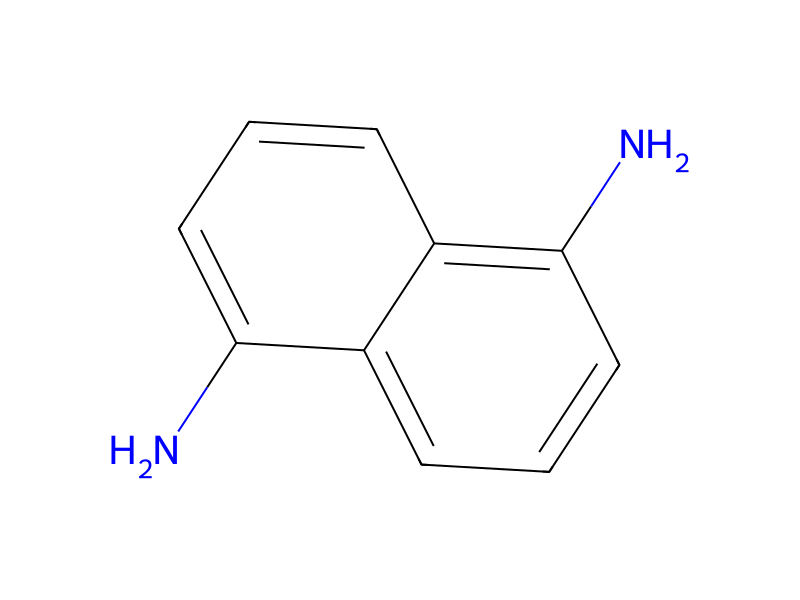
1,5-Diaminonaphthalene
HCID 16720
New noteNew reactionRequest quotes
Print preview
Basic informationOverviewNames & identifiersPropertiesSafety & regulationChemistry & industryRelated reactionsCompound notes
Substructure searchFind similar structures

Basic information

CAS
2243-62-1
Standard SMILES
Nc1cccc2c(N)cccc12
InChIKey
KQSABULTKYLFEV-UHFFFAOYSA-N
Molecular formula
C10H10N2
Average molar mass
158.2 g/mol
Monoisotopic mass
158.08439833

Overview

1,5-naphthalenediamine appears as colorless to pale purple crystals or lavender powder. (NTP, 1992)

Names & identifiers

Preferred name
1,5-Diaminonaphthalene
IUPAC
naphthalene-1,5-diamine
English name
1,5-Naphthalenediamine
Molecular formula
C10H10N2
Molecular weight
158.2

Names & synonyms

1,5-NAPHTHALENEDIAMINE2243-62-11,5-Diaminonaphthalene1,5-NaphthylenediamineNCI-C03021DTXSID302091613PD3J52LKNSC-401110DTXCID909161,5-DANRefChem:907019218-817-8
Show more names
Diaminonaphthalene1,5-Diaminonapthalene1,5-diaminenaphthaleneC.I.76595NSC 401110
naphthalene-1,5-diamine1,5-Napthalenediamine1,5-diaminonaphtaleneMFCD000040291,5-naphthylendiamin1,5-diamino naphthalene1,5-Naphthalene-di-aminenaphthalene, 1,5-diamino-

Database identifiers

CAS
2243-62-1
PubChem CID
16720
DTXSID
DTXSID3020916
ChEMBL
CHEMBL538965
ChEBI
CHEBI:53003
UNII
13PD3J52LK
EC Number
218-817-8
Nikkaji
J40.472A

Properties

Computed structural properties

XLogP
2.1
Topological polar surface area
52 Ų
Hydrogen bond donors
2
Hydrogen bond acceptors
2
Rotatable bonds
0
Heavy atoms
12
Formal charge
0
Complexity
140

Experimental & physicochemical properties

Chemical ClassesOther Classes -> Naphthalenes
SpringerMaterials Properties13C nuclear magnetic resonance spectrum
LogP · 3 items

log Kow = 0.89

1.48

0.89

Density · 3 items

1.4 (NTP, 1992) - Denser than water; will sink

1.4 g/cu cm @ 25 °C

1.4 g/cm³

Color/FormColorless prisms
Solubility · 5 items

less than 1 mg/mL at 68.9 °F (NTP, 1992)

Soluble in benzene and ethanol

In water, 380 mg/l @ 25 °C

... It is soluble in alcohol, ether, and chloroform.

Solubility in water, g/100ml at 20 °C: 0.004

Flash Point · 2 items

226 °C

226 °C

Boiling Point · 3 items

Sublimes (NTP, 1992)

Boiling point: sublimes

sublimes

Safety & regulation

Safety information is for reference only and does not replace the supplier’s Safety Data Sheet (SDS), applicable regulations, or professional assessment.

GHS classification

GHS Classification · 6 items

Warning

H351: Suspected of causing cancer [Warning Carcinogenicity]

P203, P273, P280, P318, P391, P405, and P501 (click each P-code to see the statement)

Warning

H302 (68.6%): Harmful if swallowed [Warning Acute toxicity, oral]

P203, P261, P264, P270, P272, P273, P280, P301+P317, P302+P352, P318, P321, P330, P333+P317, P362+P364, P391, P405, and P501 (click each P-code to see the statement)

Hazard information

Regulatory InformationREACH registered substance: 1,5-naphthylenediamine (EC: 218-817-8)
DOT LabelClass 9
Fire Hazards · 2 items

Flash point data for this chemical are not available. It is probably combustible. (NTP, 1992)

Combustible. Gives off irritating or toxic fumes (or gases) in a fire.

Health HazardsSYMPTOMS: This compound is an irritant.
Hazards SummaryDanger of cutaneous absorption; Danger of skin sensitization; [MAK] May cause skin sensitization; [ICSC] An irritant; [MSDSonline] See beta-Naphthylamine and alpha-Naphthylamine.
Reactive GroupAmines, Aromatic
EC ClassificationSymbol: Xn, N; R: 40-50/53; S: (2)-36/37-60-61
Special ReportsDHEW/NCI; Bioassay of 1,5-Naphthalenediamine for Possible Carcinogenicity (1978) Technical Rpt Series No. 143 DHEW Pub No. (NIH) 78-1398

Chemistry & industry

Uses & manufacturing

Uses · 5 items

Used to make polyurethane elastomers, dyes, and pharmaceuticals; Not commercially produced in the US; [HSDB]

ORGANIC SYNTHESIS

CHEM INT FOR 1,5-NAPHTHALENE DIISOCYANATE, FOR DYES

The major use of the compound is for the manufacture of 1,5-naphthalene diisocyanate, in the production of polyurethane elastomers. It is also used in the synthesis of dyes and pharmaceuticals.

Synthetic Polymer MALDI Matrix Compounds

U.S. Exports · 2 items

(1977) No Data

(1979) No Data

U.S. Imports · 2 items

(1977) No Data

(1979) 2.00X10+6 GRAMS (PRINCPL CUSTMS DISTS)

U.S. Production · 2 items

(1977) NOT PRODUCED COMMERCIALLY IN US

(1979) NOT PRODUCED COMMERCIALLY IN US

Methods of Manufacturing · 3 items

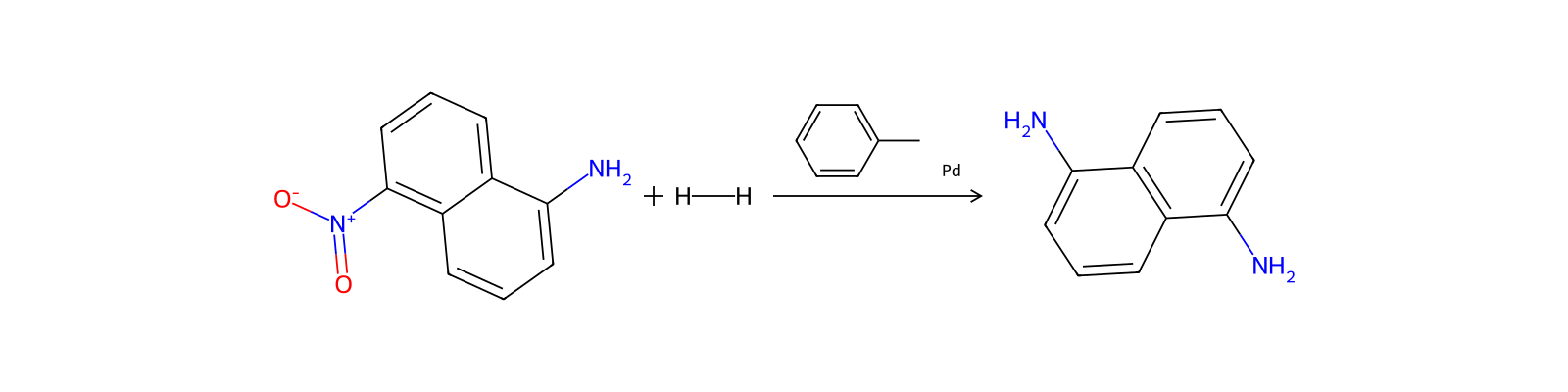
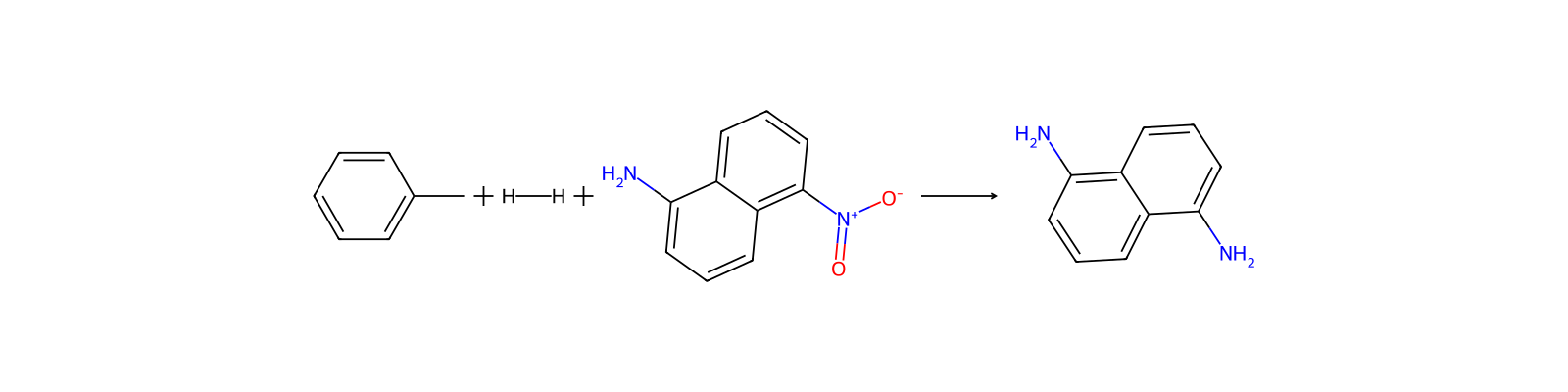
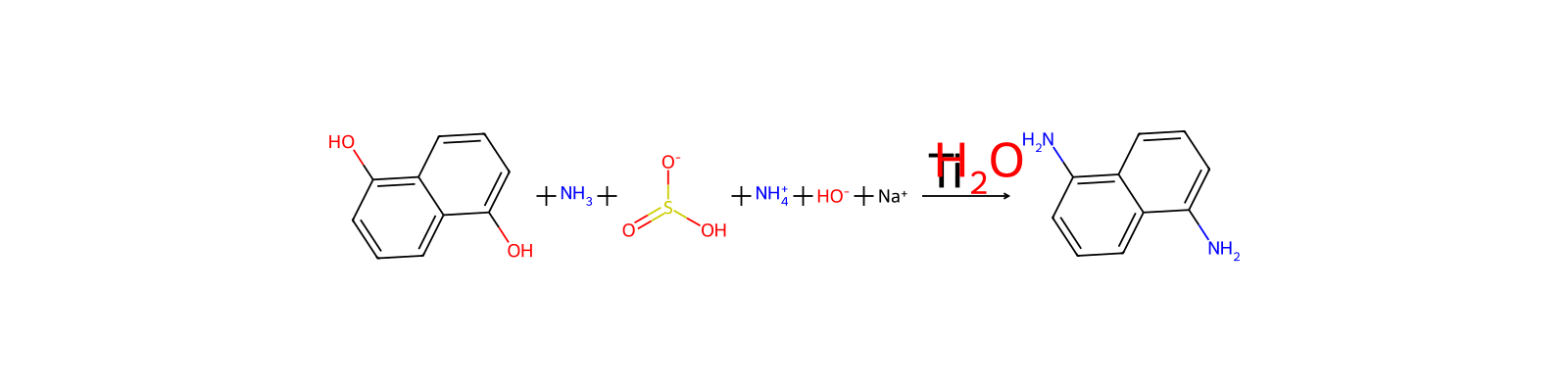
REDUCTION OF 1,5-DINITRONAPHTHALENE; AMMONOLYSIS OF 1,5-DIHYDROXYNAPHTHALENE

1-Nitronaphthalene can be nitrated further to give a 40:60 mixture of 1,5- and 1,8-dinitronaphthalenes. Similar results are obtained by direct nitration of naphthalene with H2SO4-HNO3 under careful control of temperature over the range 40-80 °C. Although separation of the isomers by fractional crystallization or solvent extraction is usually carried out at this stage, the mixed isomers can also be reduced and the resulting diamines separated. Reduction of the dinitronaphthalenes is achieved by treatment of a nonaqueous solution with iron or hydrogen in the presence of a catalyst.

... Amination of 1,5-dihydroxynaphthalene with ammonia and ammonium bisulfite. Although less efficient on a stage basis it offers an economical alternative to nitration and reduction if the 1,8-naphthalenediamine is not also required.

General Manufacturing InformationNOT PRODUCED COMMERCIALLY IN THE US
Applications · 4 items

Related reactions

17 records
New reaction record
HRID 758 reaction equation
HRID 758As reactantuspto-grants-1998_03
HRID 22622 reaction equation
HRID 22622As reactantuspto-grants-2005_02
HRID 49657 reaction equation
HRID 49657As productuspto-grants-2004_03
HRID 479923 reaction equation
HRID 479923As reactantuspto-grants-2003_11
HRID 525980 reaction equation
HRID 525980As reactantuspto-grants-2016_05
HRID 702982 reaction equation
HRID 702982As productTraining data from https://doi.org/10.1039/C8SC04228D (3/10)
HRID 992196 reaction equation
HRID 992196As reactantuspto-grants-2002_10
HRID 1074310 reaction equation
HRID 1074310As productuspto-grants-1990_11
Page 1 of 3

Compound notes

Loading…

On this pageBasic informationOverviewNames & identifiersPropertiesSafety & regulationChemistry & industryRelated reactionsCompound notes
More actions
New noteNew reactionRequest quotes
Decomposition
When heated to decomposition it emits toxic fumes of /nitrogen oxide/.
Melting Point · 3 items

374 °F (NTP, 1992)

190 °C

187 °C

Vapor Pressure · 2 items

0.0000293 [mmHg]

Vapor pressure, Pa at 20 °C: 0.0000023

Physical Description · 3 items

1,5-naphthalenediamine appears as colorless to pale purple crystals or lavender powder. (NTP, 1992)

Colorless to light purple solid; [ICSC] Sensitive to prolonged exposure to air; [CAMEO] Powder; [MSDSonline]

COLOURLESS-TO-LIGHT-PURPLE CRYSTALS.

Physicochemical properties

Melting point
185 · 185-187 °C(lit.)
Boiling point
200 · 200-210°C 5mm
Density
1.4 · 1.4
vapor pressure
0 Pa · 0Pa at 20℃
refractive index
1.6441 · 1.6441 (estimate)
Flash point
200 · 200-210°C/5mm
storage temp.
Keep in dark place,Inert atmosphere,Room temperature
solubility
0.04 g/l · 0.04g/l
pka
4.59 · 4.59±0.10(Predicted)
form
Powder
color
Gray to dark brown
Water Solubility
0.1 g/100 · <0.1 g/100 mL at 20.5 ºC
BRN
907947 · 907947
Henry's Law Constant
1.5 · 1.5×105 mol/(m3Pa) at 25℃, HSDB (2015)
InChI
1S/C10H10N2/c11-9-5-1-3-7-8(9)4-2-6-10(7)12/h1-6H,11-12H2
InChIKey
KQSABULTKYLFEV-UHFFFAOYSA-N
SMILES
Nc1cccc2c(N)cccc12
LogP
0.91 · 0.91
Dissociation constant
4.21 at · 4.21 at 25℃
Toxicology and Carcinogenesis
1 · Bioassay of 1,5-Naphthalenediamine for Possible Carcinogenicity (CASRN 2243-62-1)
CAS DataBase Reference
2243 · 2243-62-1(CAS DataBase Reference)
EWG's Food Scores
2 · 2
FDA UNII
13 PD3J52LK · 13PD3J52LK
NIST Chemistry Reference
1 · 1,5-Naphthalenediamine(2243-62-1)
IARC
3 · 3 (Vol. 27, Sup 7) 1987
EPA Substance Registry System
1 · 1,5-Naphthalenediamine (2243-62-1)
UNSPSC Code
12352100 · 12352100
NACRES
22 · NA.22
Symbol(GHS)
8 · GHS08,GHS09
Signal word
Warning
Hazard statements
351 · H351-H410
Precautionary statements
202 · P202-P273-P280-P308+P313-P391-P405
Hazard Codes
Xn,N
Risk Statements
40 · 40-50/53
Safety Statements
36 · 36/37-60-61
RIDADR
3077 · UN 3077 9/PG 3
WGK Germany
2 · 2
RTECS
3400000 · QJ3400000
HazardClass
9 · 9
PackingGroup
III
HS Code
29215990 · 29215990
Storage Class
11 · 11 - Combustible Solids
Hazard Classifications
4 OralAquatic · Acute Tox. 4 OralAquatic Acute 1Aquatic Chronic 1Carc. 2Skin Sens. 1
Hazardous Substances Data
2243 · 2243-62-1(Hazardous Substances Data)
REACH Registrations
Active
Reactivity Profile · 1 item

1,5-NAPHTHALENEDIAMINE neutralizes acids in exothermic reactions to form salts plus water. May be incompatible with isocyanates, halogenated organics, peroxides, phenols (acidic), epoxides, anhydrides, and acid halides. Flammable gaseous hydrogen may be generated in combination with strong reducing agents, such as hydrides.

Chemical DangersDecomposes on burning. This produces toxic fumes.
Air and Water ReactionsThis chemical is sensitive to prolonged exposure to air. Insoluble in water.
Hazard Classes and Categories · 5 items

Acute Tox. 4 (68.6%)

Carcinogenicity - category 2

Acute toxicity (Oral) - Category 4

Hazardous to the aquatic environment (Acute) - Category 2

Carc. 2

Safety & protection

Fire Fighting · 2 items

Fires involving this material can be controlled with a dry chemical, carbon dioxide or Halon extinguisher. (NTP, 1992)

Use water spray, foam, powder, carbon dioxide.

First Aid Measures · 4 items

Fresh air, rest. Refer for medical attention.

Rinse and then wash skin with water and soap. Refer for medical attention .

First rinse with plenty of water for several minutes (remove contact lenses if easily possible), then refer for medical attention.

Rest. Refer for medical attention .

First Aid · 1 item

EYES: First check the victim for contact lenses and remove if present. Flush victim's eyes with water or normal saline solution for 20 to 30 minutes while simultaneously calling a hospital or poison control center. Do not put any ointments, oils, or medication in the victim's eyes without specific instructions from a physician. IMMEDIATELY transport the victim after flushing eyes to a hospital even if no symptoms (such as redness or irritation) develop.

Safe StorageWell closed.
Nonfire Spill Response · 1 item

SMALL SPILLS AND LEAKAGE: If a spill of this chemical occurs, FIRST REMOVE ALL SOURCES OF IGNITION, then you should dampen the solid spill material with acetone and transfer the dampened material to a suitable container. Use absorbent paper dampened with acetone to pick up any remaining material. Seal your contaminated clothing and the absorbent paper in a vapor-tight plastic bag for eventual disposal. Solvent wash all contaminated surfaces with acetone followed by washing with a soap and water solution. Do not reenter the contaminated area until the Safety Officer (or other responsible person) has verified that the area has been properly cleaned.

Disposal Methods · 1 item

SRP: The most favorable course of action is to use an alternative chemical product with less inherent propensity for occupational exposure or environmental contamination. Recycle any unused portion of the material for its approved use or return it to the manufacturer or supplier. Ultimate disposal of the chemical must consider: the material's impact on air quality; potential migration in soil or water; effects on animal, aquatic, and plant life; and conformance with environmental and public health regulations.

Spillage Disposal · 1 item

Personal protection: particulate filter respirator adapted to the airborne concentration of the substance. Do NOT let this chemical enter the environment. Sweep spilled substance into covered sealable containers. Carefully collect remainder. Then store and dispose of according to local regulations.

Isolation and EvacuationExcerpt from ERG Guide 171 [Substances (Low to Moderate Hazard)]:
Eye PreventionWear safety spectacles.
Fire PreventionNO open flames.
Inhalation RiskNo indication can be given about the rate at which a harmful concentration of this substance in the air is reached on evaporation at 20 °C.
Skin PreventionProtective gloves. Protective clothing.

Toxicology

Ecotoxicity Values · 5 items

EC50 Tetrahymena pyriformis /(unicellular, ciliated freshwater protozoa)/ 45 mg/L/60 hr

EC50 Scenedesmus subspicatus /(freshwater algae)/ 0.3 mg/L/72 hr (cell multiplication inhibition test)

EC50 Daphnia magna (Straus) 15 mg/L/24 hr

LC50 Brachydanio rerio /(Zebra fish)/ 17 mg/L/96 hr /Conditions of bioassay not specified/

LC50 Oryzias latipes /(Japanese medaka)/ 31 mg/L/48 hr /Conditions of bioassay not specified/

Environmental Fate · 3 items

TERRESTRIAL FATE: Based on a classification scheme(1), an estimated Koc value of 5,000(SRC), determined from a structure estimation method(2), indicates that 1,5-naphthalenediamine is expected to have slight mobility in soil(SRC). 1,5-Naphthalenediamine is a weak base with a pKa of 4.44(3) indicating it will partially exist in the protonated form under acidic conditions. Volatilization from moist surfaces is not expected to be an important fate process because cations do not volatilize and the estimated Henry's Law constant of the free base is 6.6X10⁻¹¹ atm-cu m/mole(SRC), calculated using a fragment constant estimation method(4). 1,5-Naphthalenediamine is not expected to volatilize from dry soil surfaces(SRC) based upon an estimated vapor pressure of 2.9X10⁻⁵ mm Hg(SRC), determined from a fragment constant method(5). 1,5-Naphthalenediamine was not degraded in a single screening study using an activated sludge inoculum; however, no data were located regarding the biodegradation of 1,5-naphthalenediamine in soil(6).

AQUATIC FATE: Based on a classification scheme(1), an estimated Koc value of 5,000(SRC), determined from a structure estimation method(2), indicates that 1,5-naphthalenediamine is expected to adsorb to suspended solids and sediment(SRC). 1,5-Naphthalenediamine is a weak base with a pKa of 4.44(3) indicating it will partially exist in the protonated form under acidic conditions. Volatilization from water surfaces is not expected to be an important fate process because cations do not volatilize and the estimated Henry's Law constant of the free base is 6.6X10⁻¹¹ atm-cu m/mole(SRC), calculated using a fragment constant estimation method(4). According to a classification scheme(5), a BCF of 1.5 measured in carp(6), suggests bioconcentration in aquatic organisms is low(SRC). 1,5-Naphthalenediamine was not degraded in a single screening study using an activated sludge inoculum(5); however, no data were located regarding the biodegradation of 1,5-naphthalenediamine in water(SRC).

ATMOSPHERIC FATE: According to a model of gas/particle partitioning of semivolatile organic compounds in the atmosphere(1), 1,5-naphthalenediamine, which has an estimated vapor pressure of 2.9X10⁻⁵ mm Hg at 25 °C (SRC), determined from a fragment constant method(2), is expected to exist in both the vapor and particulate phases in the ambient atmosphere. Vapor-phase 1,5-naphthalenediamine is degraded in the atmosphere by reaction with photochemically-produced hydroxyl radicals(SRC); the half-life for this reaction in air is estimated to be 2 hours(SRC), calculated from its rate constant of 2X10⁻¹⁰ cu cm/molecule-sec at 25 °C(SRC) that was derived using a structure estimation method(3). Particulate-phase 1,5-naphthalenediamine may be removed from the air by wet and dry deposition(SRC). Naphthalene and structurally related chemicals absorb light greater than 290 nm and may be susceptible to photolysis(4); however the rate of this potential reaction is not known for 1,5-naphthalenediamine(SRC).

Adverse EffectsSkin Sensitizer - An agent that can induce an allergic reaction in the skin.
Exposure RoutesThe substance can be absorbed into the body by inhalation of its aerosol and by ingestion.
Ongoing Test Status · 1 item

The following link will take the user to the National Toxicology Program (NTP) Test Agent Search Results page, which tabulates all of the "Standard Toxicology & Carcinogenesis Studies", "Developmental Studies", and "Genetic Toxicity Studies" performed with this chemical. Clicking on the "Testing Status" link will take the user to the status (i.e., in review, in progress, in preparation, on test, completed, etc.) and results of all the studies that the NTP has done on this chemical. [http://ntp-apps.niehs.nih.gov/ntp_tox/index.cfm?fuseaction=ntpsearch.searchresults&searchterm=2243-62-1]

ICSC Environmental DataThe substance is harmful to aquatic organisms.
Soil Adsorption/Mobility · 1 item

Using a structure estimation method based on molecular connectivity indices(1), the Koc for 1,5-naphthalenediamine can be estimated to be 5,000(SRC). According to a classification scheme(2), this estimated Koc value suggests that 1,5-naphthalenediamine is expected to have slight mobility in soil. The pKa of 1,5-naphthalenediamine is 4.44(3), indicating that this compound will partially exist in the protonated form in the environment under acidic conditions and cations generally adsorb to organic carbon and clay more strongly than their neutral counterparts(4). Primary and secondary aromatic amines are also susceptible to strong irreversible binding to humic material due to the high reactivity of the aromatic amino group(5).

Artificial Pollution Sources1,5-Naphthalenediamine's production and use as an organic synthesis reagent(1) may result in its release to the environment through various waste streams(SRC).
Environmental Biodegradation · 1 item

1,5-Naphthalenediamine, present at 100 mg/l, reached 0% of its theoretical BOD in 4 weeks using an activated sludge inoculum at 30 mg/l and the Japanese MITI test(1). No biodegradation data was located for 1,5-naphthalenediamine in soil or water(SRC).

Carcinogen Classification · 6 items

1,5-Naphthalenediamine

Group 3: Not classifiable as to its carcinogenicity to humans

Volume 27: (1982) Some Aromatic Amines, Anthraquinones and Nitroso Compounds, and Inorganic Fluorides Used in Drinking-water and Dental Preparations

1987

1987

1,5-Naphthalene-diamine

Environmental BioconcentrationA BCF of 1.5 was measured for carp exposed to 0.02 mg/l of 1,5-naphthalenediamine for 6 weeks(1). According to a classification scheme(2), this BCF value suggests that bioconcentration in aquatic organisms is low(SRC).
Volatilization from Water/Soil · 1 item

1,5-Naphthalenediamine is a weak base with a pKa of 4.44(1) indicating it will partially exist in the protonated form under acidic conditions. Volatilization from water and moist soil surfaces is not expected to be an important fate process because cations do not volatilize and the estimated Henry's Law constant of the free base is 6.6X10⁻¹¹ atm-cu m/mole(SRC), calculated using a fragment constant estimation method(2). 1,5-Naphthalenediamine is not expected to volatilize from dry soil surfaces(SRC) based upon an estimated vapor pressure of 2.9X10⁻⁵ mm Hg at 25 °C(SRC), determined from a fragment constant method(3).

Safety data

wgk
2
rtecs
QJ3400000
ridadr
UN 3077 9/PG 3
hs_code
29215990
risk_code
40-50/53
Signal word
Warning
Symbol(GHS)
GHS08,GHS09
hazard_code
Xn,N
safety_code
36/37-60-61
hazard_class
9
Storage Class
11 - Combustible Solids
packing_group
III
Hazard statements
H351-H410
REACH Registrations
Active
Hazard Classifications
Acute Tox. 4 OralAquatic Acute 1Aquatic Chronic 1Carc. 2Skin Sens. 1
Precautionary statements
P202-P273-P280-P308+P313-P391-P405
Hazardous Substances Data
2243-62-1(Hazardous Substances Data)

Uses1,5-Naphthalenediamineis an important raw material and intermediate used in organic synthesis, pharmaceuticals, agrochemicals and dyestuffs. The reducing properties of 1,5-diaminonaphthalene (1,5-DAN) as a MALDI matrix ( matrix-assisted laser desorption ionization) to amino acid sequencing and disulfide bond mapping of human urotensin II possessing one disulfide bond, and human guanylin possessing two disulfide bonds.

UsesAromatic amines likely to have high carcinogenic potency. QSARs of aromatic amines.

Uses1,5-naphthalenediamine be used as intermediates for the synthesis of materials.

General DescriptionColorless to pale purple crystals or lavender powder.

Upstream & downstream products

Upstream raw materials

1,4,5-TrinitronaphthaleneNaphthalene, 1,4,5,8-tetranitro-5-nitronaphthalen-1-amine1-Nitronaphthalene

Downstream products

1,5-Naphthalene diisocyanate5-Amino-1-naphthol

Additional notes

DefinitionChEBI: A naphthalenediamine compound having amino substituents in the 1- and 5-positions.