
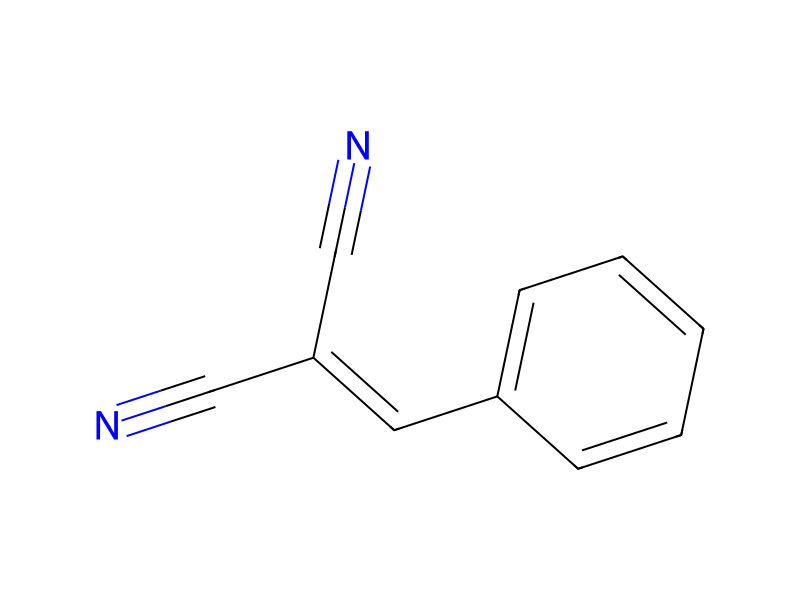
Basic information
- CAS
2700-22-3- Standard SMILES
N#CC(C#N)=Cc1ccccc1- InChIKey
WAVNYPVYNSIHNC-UHFFFAOYSA-N- Molecular formula
- C10H6N2
- Average molar mass
- 154.17 g/mol
- Monoisotopic mass
- 154.05309819
Names & identifiers
- Preferred name
- Malononitrile, benzylidene-
- IUPAC
- 2-benzylidenepropanedinitrile
- English name
- BENZYLIDENEMALONONITRILE
- Molecular formula
- C10H6N2
- Molecular weight
- 154.17
Names & synonyms
Benzylidenemalononitrile2700-22-3Benzalmalononitrilealpha-CyanocinnamonitrileBenzylidenemalonodinitrilebeta,beta-DicyanostyreneBenzylidene malononitrileMALONONITRILE, BENZYLIDENE-2-Phenyl-1,1-dicyanoethyleneBenzal-malonitrilbeta,beta-Styrenedicarbonitrile2,2-Dicyano-1-phenylethylene
Show more names
2-Benzylidenepropanedinitriletl237f2370AKOS USSH-4110217RARECHEM AL BX 0531DicyanovinylbenzeneMalononitrile benzalBenzalmalononitrile >
Propanedinitrile, (phenylmethylene)-NSC 490Benzal-malonitril [German]TL 237AI3-19689EINECS 220-283-6F 2370DTXSID10181490
Database identifiers
- CAS
2700-22-3- PubChem CID
- 17608
- DTXSID
DTXSID10181490- UNII
- 2HQB24UJ25
- EC Number
- 220-283-6
- Nikkaji
- J41.614B
Properties
Computed structural properties
- XLogP
- 2.2
- Topological polar surface area
- 47.6 Ų
- Hydrogen bond donors
- 0
- Hydrogen bond acceptors
- 2
- Rotatable bonds
- 1
- Heavy atoms
- 12
- Formal charge
- 0
- Complexity
- 247
Experimental & physicochemical properties
SpringerMaterials PropertiesCrystal structure
LogP2.15
Physicochemical properties
- Melting point
- 83 · 83-85 °C (lit.)
- Boiling point
- 120 · 120-125°C 0,6mm
- Density
- 1.1975 · 1.1975 (rough estimate)
- refractive index
- 1.482 · 1.4820 (estimate)
- Flash point
- 120 · 120-125°C/0.6mm
- storage temp.
- Sealed in dry,Room Temperature
- solubility
- soluble in Methanol
- form
- powder to crystal
- color
- White to Orange to Green
- BRN
- 1907519 · 1907519
- CAS DataBase Reference
- 2700 · 2700-22-3(CAS DataBase Reference)
- FDA UNII
- 2 HQB24UJ25 · 2HQB24UJ25
- UNSPSC Code
- 12352100 · 12352100
- NACRES
- 22 · NA.22
- Symbol(GHS)
- 7 · GHS07
- Signal word
- Warning
- Hazard statements
- 302 · H302+H312+H332-H315-H319-H335
- Precautionary statements
- 261 · P261-P280-P301+P312-P302+P352+P312-P304+P340+P312-P305+P351+P338
- Hazard Codes
- Xn
- Risk Statements
- 20 · 20/21/22-36/37/38
- Safety Statements
- 26 · 26-36/37/39
- RIDADR
- 3276 · 3276
- WGK Germany
- 3 · 3
- RTECS
- 3500000 · OO3500000
- HazardClass
- 6.1 · 6.1
- PackingGroup
- III
- HS Code
- 29269095 · 29269095
- Limited Quantities
- 5 kg · 5.0 kg (11 lbs) (solid)
- Excepted Quantities
- Max Inner Pack (30g or 30ml) and Max Outer Pack (1Kg or 1L)
Safety & regulation
GHS classification
GHS Classification
Warning
H302 (97.7%): Harmful if swallowed [Warning Acute toxicity, oral]
P261, P264, P264+P265, P270, P271, P280, P301+P317, P302+P352, P304+P340, P305+P351+P338, P317, P319, P321, P330, P332+P317, P337+P317, P362+P364, P403+P233, P405, and P501 (click each P-code to see the statement)
Aggregated GHS information provided per 44 reports by companies from 4 notifications to the ECHA C&L Inventory. Each notification may be associated with multiple companies.
Hazard information
Hazard Classes and CategoriesAcute Tox. 4 (97.7%)
Safety data
- wgk
- 3
- rtecs
- OO3500000
- ridadr
- 3276
- hs_code
- 29269095
- risk_code
- 20/21/22-36/37/38
- Signal word
- Warning
- Symbol(GHS)
- GHS07
- hazard_code
- Xn
- safety_code
- 26-36/37/39
- hazard_class
- 6.1
- packing_group
- III
- Hazard statements
- H302+H312+H332-H315-H319-H335
- Limited Quantities
- 5.0 kg (11 lbs) (solid)
- Excepted Quantities
- Max Inner Pack (30g or 30ml) and Max Outer Pack (1Kg or 1L)
- Precautionary statements
- P261-P280-P301+P312-P302+P352+P312-P304+P340+P312-P305+P351+P338
Chemistry & industry
Applications
UsesBenzylidenemalononitrile was used in fluorescence-based assay for determination of soluble methane monooxygenase activity in solution.
General DescriptionBenzylidenemalononitrile undergoes rapid and catalyst-free solid/vapor reaction with primary alkyl amines to yield N-benzylidene-amine. It undergoes addition reaction with octyl- and decylzirconocene chloride. It is a potential substrate for soluble methane monooxygenase.
Upstream & downstream products
Upstream raw materials
Suppliers78 total
梯希爱(上海)化成工业发展有限公司021-67121386 · [email protected]
上海阿拉丁生化科技股份有限公司400-6206333 13167063860 · [email protected]
韶远科技(上海)有限公司021-50795510 4000665055 · [email protected]
Hangzhou Collab Medicine Co.,Ltd.+86-15936229464 · [email protected]
Hebei Chuanghai Biotechnology Co., Ltd+86-17732866630 · [email protected]
湖北威德利化学试剂有限公司181-6332-1995 18062128043 · [email protected]
上海麦克林生化科技股份有限公司021-50706066 15221275939 · [email protected]
安徽合诺生物科技有限公司0555-2761852
爱斯特(成都)生物制药股份有限公司+86-28-85122536 85324413 · [email protected]
上海仲因实业有限公司2537653158 16621191650 · [email protected]
Dayang Chem (Hangzhou) Co.,Ltd.+86-0571-88938639 17705817739 · [email protected]
北京索莱宝科技有限公司010-50973130 17801761073 · [email protected]
阿法埃莎(中国)化学有限公司400-6106006 · [email protected]
安耐吉化学&3A(安徽泽升科技股份有限公司)400-0056266 · [email protected]
上海瀚鸿科技股份有限公司021-54306202 13764082696 · [email protected]
安徽合诺生物科技有限公司18455579438
湖北魏氏化学试剂股份有限公司17771898297 13125137661 · [email protected]
玛雅试剂+86 (573) 82222445 (0)18006601000 452520369 · [email protected]
赛默飞世尔科技(中国)有限公司800-810-5118 · [email protected]
北京伊诺凯科技有限公司400-810-7969 010-59572699 · [email protected]
江苏艾康生物医药研发有限公司025-66113011 13913916777 · [email protected]
TCI AMERICA800-4238616 · [email protected]
TOKYO CHEMICAL INDUSTRY CO., LTD.03-36680489 · [email protected]
TCI Europe320-37350700 · [email protected]
上海丽康新材料有限公司+86-16631818819 +86-17736933208 · [email protected]
PT CHEM GROUP LIMITED+86-85511178; +86-85511178 · [email protected]
上海创赛科技有限公司400-6087598 15021221957 · [email protected]
上海鑫圭生物科技有限公司15121041756 · [email protected]
上海嵩爰化工科技有限公司010-1234567 18521000990 · [email protected]
普善实业(陕西)有限公司029-81310890 18165209495 · [email protected]
Sigma-Aldrich西格玛奥德里奇(上海)贸易有限公司021-61415566 800-8193336 · [email protected]
北京禾兴源科技有限公司18511709189 · [email protected]
郑州九亿时光新材料有限公司+86-15225627621 +86-13213167925 · [email protected]
山东领海生物科技有限公司15092083467 · [email protected]
上海玻尔化学试剂有限公司19102157732 · [email protected]
安阳鸿蒙新材料有限公司19588588067 · [email protected]
sgtlifesciences pvt ltd+91-8790379245 · [email protected]
陕西缔都医药化工有限公司029-029-81120477 17792793610 · [email protected]
南京科晟祥科技有限公司18252089365 · [email protected]
郑州阿尔法化工有限公司0371-53765687 18937137882 · [email protected]
安阳鸿蒙新材料有限公司0372-19588588067 19588588067 · [email protected]
上海源叶生物科技有限公司13636370518 · [email protected]
上海颖心实验室设备有限公司021-021-59178156 15300768757 · [email protected]
山东西亚化学有限公司4009903999 13395398332 · [email protected]
广东翁江化学试剂有限公司0751-2886750 13927877953 · [email protected]
广州市金华大化学试剂有限公司020-84383047 · [email protected]
金锦乐(湖南)化学有限公司18001959627(微信同号) 18001959627 · [email protected]
上海贤鼎生物科技有限公司021-021-52271985 17721149837 · [email protected]
合肥钼凯医药科技有限公司18130062233 · [email protected]
Shanghai Acmec Biochemical Technology Co., Ltd.+86-18621343501 · [email protected]
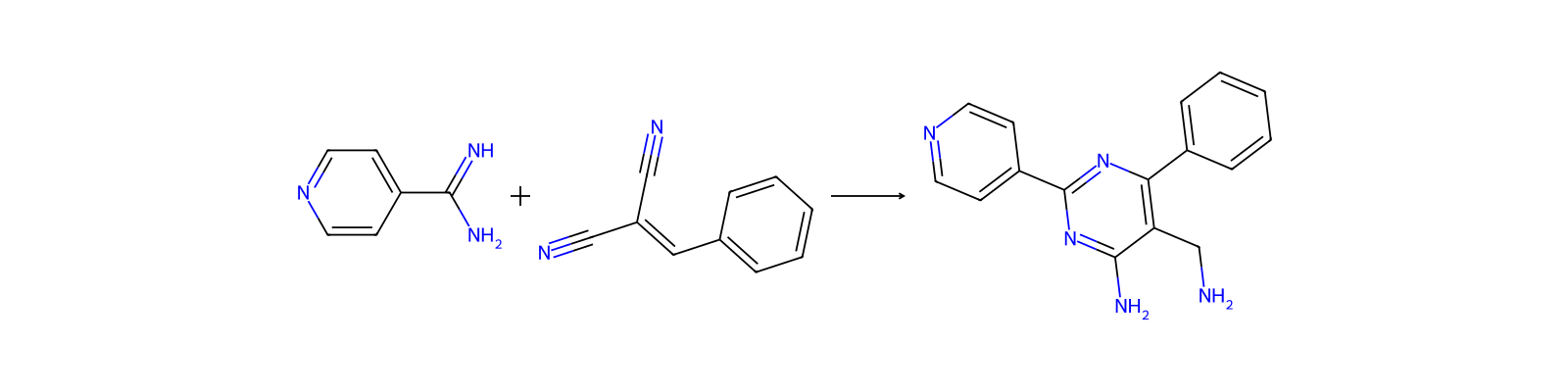
Related reactions
14 records




Compound notes
Loading…