
(4-Methoxyphenyl)boronic acid
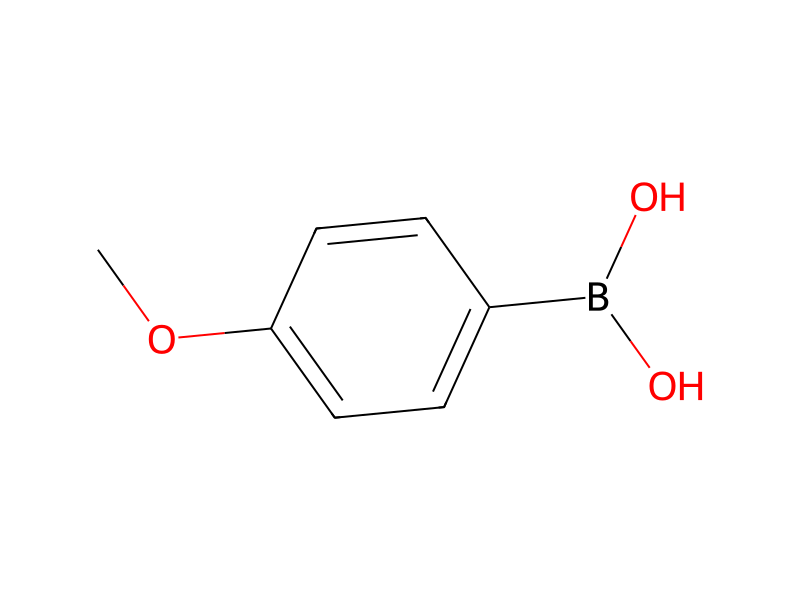
Basic information
- CAS
5720-07-0- Standard SMILES
COc1ccc(B(O)O)cc1- InChIKey
VOAAEKKFGLPLLU-UHFFFAOYSA-N- Molecular formula
- C7H9BO3
- Average molar mass
- 151.96 g/mol
- Monoisotopic mass
- 152.06447455
Overview
structure in first source
Names & identifiers
- Preferred name
- (4-Methoxyphenyl)boronic acid
- IUPAC
- (4-methoxyphenyl)boronic acid
- English name
- 4-Methoxyphenylboronic acid
- Molecular formula
- C7H9BO3
- Molecular weight
- 151.96
Names & synonyms
4-Methoxyphenylboronic acid5720-07-0(4-Methoxyphenyl)boronic acidBenzeneboronic acid, p-methoxy-DTXSID60205837RefChem:562987DTXCID90128328611-482-24-Methoxybenzeneboronic acidp-Methoxyphenylboronic acidp-Anisylboronic acidp-Methoxybenzeneboronic acid
Show more names
AKOS 91312AKOS BRN-00164-boronoanisoleBIO-FARMA BF000847TIMTEC-BB SBB004055RARECHEM AH PB 0191
MFCD000391394-methoxyphenylboronicacid4-Methoxyphenyl boronic acidBoronic acid, p-methoxyphenyl-BORONIC ACID, (4-METHOXYPHENYL)-4-methoxylphenylboronic acid4methoxyphenylboronic acid4-methoxy-phenylboronic acid
Database identifiers
- CAS
5720-07-0- PubChem CID
- 201262
- DTXSID
DTXSID60205837- ChEMBL
CHEMBL21427- EC Number
- 611-482-2
- Nikkaji
- J54.864B
Properties
Computed structural properties
- Topological polar surface area
- 49.7 Ų
- Hydrogen bond donors
- 2
- Hydrogen bond acceptors
- 3
- Rotatable bonds
- 2
- Heavy atoms
- 11
- Formal charge
- 0
- Complexity
- 110
Physicochemical properties
- Melting point
- 204 · 204-206 °C(lit.)
- Boiling point
- 306.8 · 306.8±44.0 °C(Predicted)
- Density
- 1.17 · 1.17±0.1 g/cm3(Predicted)
- storage temp.
- Keep in dark place,Sealed in dry,Room Temperature
- solubility
- Soluble in dimethyl sulfoxide and methanol.
- form
- Crystalline Powder
- pka
- 8.96 · 8.96±0.10(Predicted)
- color
- White to light beige
- BRN
- 2936912 · 2936912
- InChI
- InChI=1S/C7H9BO3/c1-11-7-4-2-6(3-5-7)8(9)10/h2-5,9-10H,1H3
- InChIKey
- VOAAEKKFGLPLLU-UHFFFAOYSA-N
- SMILES
- B(C1=CC=C(OC)C=C1)(O)O
- CAS DataBase Reference
- 5720 · 5720-07-0(CAS DataBase Reference)
- UNSPSC Code
- 12352103 · 12352103
- NACRES
- 22 · NA.22
- Symbol(GHS)
- 7 · GHS07
Safety & regulation
Safety information is for reference only and does not replace the supplier’s Safety Data Sheet (SDS), applicable regulations, or professional assessment.
GHS classification
GHS Classification
Warning
H315 (98.1%): Causes skin irritation [Warning Skin corrosion/irritation]
P261, P264, P264+P265, P271, P280, P302+P352, P304+P340, P305+P351+P338, P319, P321, P332+P317, P337+P317, P362+P364, P403+P233, P405, and P501 (click each P-code to see the statement)
Aggregated GHS information provided per 53 reports by companies from 13 notifications to the ECHA C&L Inventory. Each notification may be associated with multiple companies.
Hazard information
Hazard Classes and CategoriesSkin Irrit. 2 (98.1%)
Safety data
- PPE
- dust mask type N95 (US), Eyeshields, Gloves
- wgk
- 3
- tsca
- No
- rtecs
- CY8975000
- hs_code
- 29310095
- risk_code
- 36/37/38
- Signal word
- Warning
- Symbol(GHS)
- GHS07
- hazard_code
- Xi
- safety_code
- 26-36-37/39
- hazard_class
- IRRITANT
- Storage Class
- 11 - Combustible Solids
- target organs
- Respiratory system
- Hazard statements
- H315-H319-H335
- Hazard Classifications
- Eye Irrit. 2Skin Irrit. 2STOT SE 3
Chemistry & industry
Applications
Uses4-Methoxyphenylboronic acid can be used as a common organic reagent in Suzuki coupling reactions to study the N-arylation of imidazoles and amines catalyzed by copper exchange of calcium fluorophosphates.Reagent used in the preparation of various biological inhibitors.
Uses4-Methoxyphenylboronic acid is a reagent used forSuzuki-Miyaura cross-coupling reactionsPd-catalyzed direct arylationHighly effective synthesis using palladium-catalyzed arylation Suzuki-Miyaura cross-coupling in waterPalladium-catalyzed stereoselective Heck-type reactionTandem-type Pd(II)-catalyzed oxidative Heck reaction and intramolecular C-H amidation sequenceCopper-mediated ligandless aerobic fluoroalkylation of arylboronic acids with fluoroalkyl iodides Ruthenium catalyzed direct arylationRh-catalyzed asymmetric conjugate addition
Uses4-Methoxylphenylboronic Acid is a phenylboronic acid used to investigate boron function in plants.
Usessuzuki reaction
Upstream & downstream products
Downstream products
Related reactions
7,951 records


Compound notes
Loading…