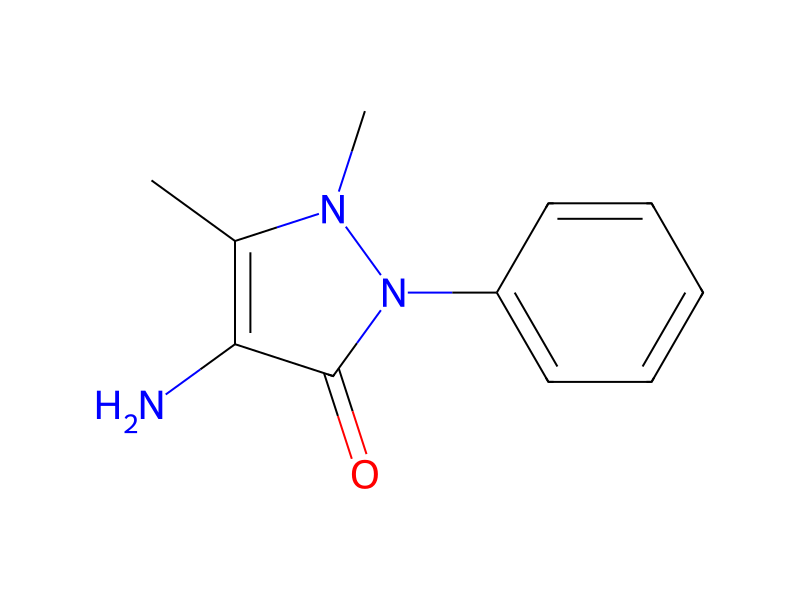
4-Aminoantipyrine
Completing data — refresh the page later to see the latest
Basic information
- CAS
83-07-8- Standard SMILES
Cc1c(N)c(=O)n(-c2ccccc2)n1C- InChIKey
RLFWWDJHLFCNIJ-UHFFFAOYSA-N- Molecular formula
- C11H13N3O
- Average molar mass
- 203.24 g/mol
- Monoisotopic mass
- 203.10586205
Overview
4-aminoantipyrine is a pyrazolone, a member of the class of pyrazoles that is antipyrine substituted at C-4 by an amino group. It is a metabolite of aminopyrine and of metamizole. It has a role as a non-steroidal anti-inflammatory drug, a non-narcotic analgesic, an antipyretic, an EC 1.14.99.1 (prostaglandin-endoperoxide synthase) inhibitor, an antirheumatic drug, a drug metabolite, a peripheral nervous system drug and a marine xenobiotic metabolite. It is a primary amino compound and a pyrazolone. It is functionally related to an antipyrine.
Names & identifiers
- Preferred name
- 4-Aminoantipyrine
- IUPAC
- 4-amino-1,5-dimethyl-2-phenylpyrazol-3-one
- English name
- 4-Aminoantipyrine
- Molecular formula
- C11H13N3O
- Molecular weight
- 203.24
Names & synonyms
4-AminoantipyrineAMPYRONE83-07-84-AminophenazoneAminoantipyrineMetapirazone4-AminoantipyreneAminoantipyrinSolvapyrin-AAminoazopheneAminoazophenazoneSolnapyrin-A
Show more names
4-AMINOANTIPYRIN4-AMINO-1,5-DIMETHYL-2-PHENYL-1,2-DIHYDRO-PYRAZOL-3-ONENSC 60242
4-AAP3H-Pyrazol-3-one, 4-amino-1,2-dihydro-1,5-dimethyl-2-phenyl-4-Amino-2,3-dimethyl-1-phenyl-3-pyrazolin-5-one4-Amino-1,5-dimethyl-2-phenyl-1,2-dihydro-3H-pyrazol-3-oneDTXSID8048860CHEBI:590260M0B7474RANSC-60242
Database identifiers
- CAS
83-07-8- PubChem CID
- 2151
- DTXSID
DTXSID8048860- ChEMBL
CHEMBL1165011- ChEBI
CHEBI:59026- UNII
- 0M0B7474RA
- EC Number
- 201-452-3
- Nikkaji
- J796J
Properties
Computed structural propertiesFilling in
- XLogP
- 0.1
- Topological polar surface area
- 49.6 Ų
- Hydrogen bond donors
- 1
- Hydrogen bond acceptors
- 3
- Rotatable bonds
- 1
- Heavy atoms
- 15
- Formal charge
- 0
- Complexity
- 305
Experimental & physicochemical properties
DrugsPharmaceuticals -> Metabolite of Metamizole
Animal DrugsPharmaceuticals -> Animal Drugs -> Approved in Taiwan
Endocrine DisruptorsPotential endocrine disrupting compound
Collision Cross Section
151.49 Ų [M+K]+ [CCS Type: TW; Method: calibrated with polyalanine and drug standards]
142.6 Ų [M+H]+ [CCS Type: TW; Method: calibrated with polyalanine and drug standards]
142.48 Ų [M+H]+
Physicochemical properties
- Melting point
- 105 · 105-110 °C(lit.)
- Boiling point
- 340 C · 340 C
- Density
- 0.8 · 0.8
- bulk density
- 430 kg/m3 · 430kg/m3
- refractive index
- 1.493 · 1.4930 (estimate)
- storage temp.
- Keep in dark place,Inert atmosphere,Room temperature
Safety & regulation
Safety information is for reference only and does not replace the supplier’s Safety Data Sheet (SDS), applicable regulations, or professional assessment.
GHS classification
GHS Classification
This chemical does not meet GHS hazard criteria for 1% (1 of 105) of reports.
Warning
H302 (99%): Harmful if swallowed [Warning Acute toxicity, oral]
P261, P264, P264+P265, P270, P271, P280, P301+P317, P302+P352, P304+P340, P305+P351+P338, P319, P321, P330, P332+P317, P337+P317, P362+P364, P403+P233, P405, and P501 (click each P-code to see the statement)
Aggregated GHS information provided per 105 reports by companies from 13 notifications to the ECHA C&L Inventory. Each notification may be associated with multiple companies.
Hazard information
Regulatory Information4-Amino-2,3-dimethyl-1-phenyl-3-pyrazolin-5-one: Does not have an individual approval but may be used under an appropriate group standard
Other Safety InformationIMAP assessments - 3H-Pyrazol-3-one, 4-amino-1,2-dihydro-1,5-dimethyl-2-phenyl-: Environment tier I assessment
Hazard Classes and CategoriesAcute Tox. 4 (99%)
Safety data
- F
- 8-9-23
- PPE
- dust mask type N95 (US), Eyeshields, Gloves
- wgk
- 3
- tsca
- TSCA listed
- rtecs
- CD2480000
- hs_code
- 29331190
- Toxicity
- LD50 orally in Rabbit: 1700 mg/kg
- risk_code
- 22-36/37/38-20/21/22
- Signal word
- Warning
Chemistry & industry
Pharmacology
ATC CodeN02BB03
MeSH Pharmacological Classification
Anti-inflammatory agents that are non-steroidal in nature. In addition to anti-inflammatory actions, they have analgesic, antipyretic, and platelet-inhibitory actions. They act by blocking the synthesis of prostaglandins by inhibiting cyclooxygenase, which converts arachidonic acid to cyclic endoperoxides, precursors of prostaglandins. Inhibition of prostaglandin synthesis accounts for their analgesic, antipyretic, and platelet-inhibitory actions; other mechanisms may contribute to their anti-inflammatory effects.
Substances used for the detection, identification, analysis, etc. of chemical, biological, or pathologic processes or conditions. Indicators are substances that change in physical appearance, e.g., color, at or approaching the endpoint of a chemical titration, e.g., on the passage between acidity and alkalinity. Reagents are substances used for the detection or determination of another substance by chemical or microscopical means, especially analysis. Types of reagents are precipitants, solvents, oxidizers, reducers, fluxes, and colorimetric reagents. (From Grant & Hackh's Chemical Dictionary, 5th ed, p301, p499)
Uses & manufacturing
Use Classification
Pharmaceuticals -> Animal Drugs -> Approved in Taiwan
Pharmaceuticals -> Nervous System -> Analgesics -> Pyrazolones -> Transformation products
General Manufacturing Information3H-Pyrazol-3-one, 4-amino-1,2-dihydro-1,5-dimethyl-2-phenyl-: ACTIVE
Applications
Uses4-Aminoantipyrine is a metabolite of aminopyrine, having both analgesic and anti-inflammatory properties. It readily forms metal complexes due to its amino nitrogen, a strong coordination site.4-aminoantipyrine forms Schiff bases when treated with aldehydes/ketones, which are used in chemosensing applications.Coupling Reagent for Trinder's reagent in colorimetric hydrogen peroxide detectionassays.Forms highly stable dyes by coupling with Trinder's reagent in presence of Peroxidase and H2O2. Therefore suitable for use in test strip and solution diagnostics.
Related reactions
19 records







Compound notes
Loading…