Completing data — refresh the page later to see the latest
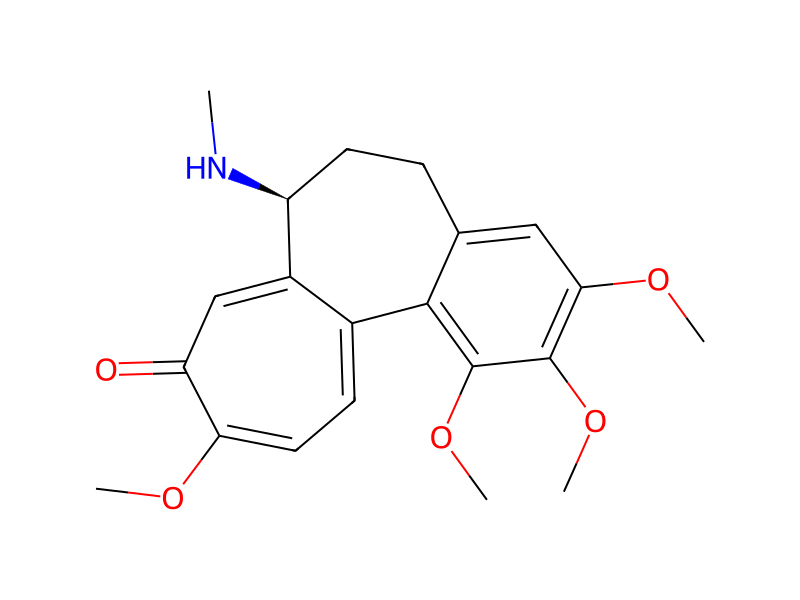
Basic information
- CAS
477-30-5- Standard SMILES
CN[C@H]1CCc2cc(OC)c(OC)c(OC)c2-c2ccc(OC)c(=O)cc21- InChIKey
NNJPGOLRFBJNIW-HNNXBMFYSA-N- Molecular formula
- C21H25NO5
- Average molar mass
- 371.433 g/mol
- Monoisotopic mass
- 371.1732729
Names & identifiers
- Preferred name
- Colcemid
- IUPAC
- (7S)-1,2,3,10-Tetramethoxy-7-(methylamino)-6,7-dihydrobenzo[a]heptalen-9(5H)-one
- English name
- DEMECOLCINE
- Molecular formula
- C21H25NO5
- Molecular weight
- 371.43
Names & synonyms
COLCEMIDCOLCHAMINEomaineColcemideTropisteron(S)-1,2,3,10-Tetramethoxy-7-(methylamino)-6,7-dihydrobenzo[a]heptalen-9(5H)-oneomainOsaminC-12669nsc3096
Database identifiers
- CAS
477-30-5- PubChem CID
- 220401
- DTXSID
DTXSID7020342- ChEMBL
CHEMBL312862- ChEBI
CHEBI:4393- UNII
- Z01IVE25KI
- EC Number
- 207-514-6
- Nikkaji
- J9.231B
Properties
Physicochemical properties
- Melting point
- 73 · 73-75°C
- alpha
- 20 · D20 -129.0° (c = 1 in chloroform)
- Boiling point
- 501.11 °C · 501.11°C (rough estimate)
- Density
- 1.235 · 1.2350 (rough estimate)
- refractive index
- 1.5614 · 1.5614 (estimate)
- storage temp.
- 2 · 2-8°C
- solubility
- 10 mg/mL · DMSO: 10 mg/mL
- form
- powder
- pka
- 8.48 · 8.48±0.40(Predicted)
- color
- White to off-white
- Sensitive
- Air & Light Sensitive
- BRN
- 2822892 · 2822892
- Stability
- Hygroscopic
- InChI
- 1S/C21H25NO5/c1-22-15-8-6-12-10-18(25-3)20(26-4)21(27-5)19(12)13-7-9-17(24-2)16(23)11-14(13)15/h7,9-11,15,22H,6,8H2,1-5H3
- InChIKey
- NNJPGOLRFBJNIW-UHFFFAOYSA-N
- SMILES
- N(C1CCc2c(c(c(c(c2)OC)OC)OC)C3=CC=C(C(=O)C=C31)OC)C
- FDA UNII
- 1 IVE25KI · Z01IVE25KI
- ATC code
- 1 CC01 · L01CC01
- UNSPSC Code
- 12352207 · 12352207
- NACRES
- 75 · NA.75
- Symbol(GHS)
- 6 · GHS06
- Signal word
- Danger
- Hazard statements
- 300 · H300
- Precautionary statements
- 264 · P264-P301+P310
- Hazard Codes
- T,T+
- Risk Statements
- 25 · 25-26/27/28
- Safety Statements
- 22 · 22-24/25-45-36/37/39
- RIDADR
- 2811 · UN 2811 6.1/PG 2
- WGK Germany
- 3 · 3
- RTECS
- 800000 · GH0800000
- F
- 8 · 8-10-23
- HazardClass
- 6.1 · 6.1(a)
- PackingGroup
- II
- Toxicity
- 50 oral · LD50 oral in mouse: 25530ug/kg
Safety & regulation
Safety information is for reference only and does not replace the supplier’s Safety Data Sheet (SDS), applicable regulations, or professional assessment.
Safety data
- F
- 8-10-23
- wgk
- 3
- rtecs
- GH0800000
- ridadr
- UN 2811 6.1/PG 2
- Toxicity
- LD50 oral in mouse: 25530ug/kg
- risk_code
- 25-26/27/28
- Signal word
- Danger
- Symbol(GHS)
- GHS06
- hazard_code
- T,T+
- safety_code
- 22-24/25-45-36/37/39
- hazard_class
- 6.1(a)
- packing_group
- II
- Hazard statements
- H300
- Precautionary statements
- P264-P301+P310
Chemistry & industry
Applications
DescriptionColcemid is a colchicine derivative that inhibits tubulin polymerization as potently as colchicine (IC50 = 2.1 and 2.4 μM, respectively) but is less toxic. At very low (nanomolar) concentrations, colcemid suppresses microtubule dynamicity and inhibits cell migration, while at micromolar levels it blocks microtubule assembly, arresting cells in metaphase. Mitotic block by colcemid is used to synchronize cells and for karyotyping in cytogenetic studies. Prolonged exposure to colcemid can activate p53, leading to apoptosis.
UsesAn antimitotic agent that disrupts microtubles by binding to tubulin and preventing its polymerization. Stimulates the intrinsic GTPase activity of tubulin. Induces apoptosis in several normal and tumor cell lines and activates the JNK/SAPK signaling pathway.
UsesInhibitor of spindle fiber formation
UsesCell synchronization agent; for chromosome visualization; to induce oocyte enucleation for somatic cell cloning.
General DescriptionColcemid is also known as demecolcine. Its generic name is N-methyl-N-deacetyl-colchicine. Colcemid depolymerizes microtubules and blocks mitosis at metaphase.
Upstream & downstream products
Downstream products
Suppliers49 total
北京华美互利生物化工010-56205725 · [email protected]
南通飞宇生物科技有限公司0513-68819626 15152877458 · [email protected]
成都乐美天医药科技有限公司17308096051 17308096051 · [email protected]
云南苏理生物医药科技有限公司0871-68355600 18787766125 · [email protected]
上海优宁维生物科技股份有限公司15921930842 15921930842 · [email protected]
北京阿克曼科技有限公司18001219251
Dayang Chem (Hangzhou) Co.,Ltd.+86-0571-88938639 17705817739 · [email protected]
LGM Pharma1-(800)-881-8210 · [email protected]
大连美仑生物技术有限公司0411-62910999 13889544652 · [email protected]
Hangzhou Sage Chemical Co., Ltd.+86057186818502 13588463833 · [email protected]
安耐吉化学&3A(安徽泽升科技有限公司)021-58432009 400-005-6266 · [email protected]
成都普思生物科技股份有限公司028-85370565-229 18080489829 · [email protected]
InvivoChem中国13549236410 · [email protected]
四川库利南科技有限公司400-1166-196 18981987031 · [email protected]
广州爱纯医药科技有限公司020-39119399 18927568969 · [email protected]
上海麦克林生化科技股份有限公司15221275939 15221275939 · [email protected]
凯试(上海)科技有限公司021-50135380 · [email protected]
Sigma-Aldrich西格玛奥德里奇(上海)贸易有限公司021-61415566 800-8193336 · [email protected]
上海一研生物科技有限公司021-69985186 13611928337 · [email protected]
Alfa Chemistry1-516-6625404 · [email protected]
上海陶术生物科技股份有限公司+1-781-999-5354; +1-00000000000 · [email protected]
上海玻尔化学试剂有限公司19102157732 · [email protected]
艾吉析科技(上海)有限公司17717235263 17717235263 · [email protected]
浙江珲达生物科技有限公司0571-89903022 18679456698 · [email protected]
风咏生物(AbMole)021-10000000 13000000000 · [email protected]
上海一飞生物科技有限公司021-65675885 18964387627 · [email protected]
上海源叶生物科技有限公司18916372613 · [email protected]
成都标样生物科技有限公司028-81700200 13308200041 · [email protected]
Shanghai Acmec Biochemical Technology Co., Ltd.+86-18621343501 · [email protected]
杭州洁汉化工有限公司+86-571-86217390; +8618058761490 · [email protected]
江苏艾康生物医药研发有限公司025-58859352 15955137747 · [email protected]
上海易恩化学技术有限公司400-400-1332688 18019345275 · [email protected]
career henan chemical co+86-0371-86658258 · [email protected]
上海吉至生化科技有限公司021-4009004166/18616739031 18616739031 · [email protected]
上海宏叶生物科技有限公司400-9205774 400-920-5774 · [email protected]
深圳聚合生化科技有限公司+86-400-002-6226 13028896684 · [email protected]
上海氟德化工有限公司021-544580828 021-54450828 · [email protected]
陕西缔都医药化工有限公司029-029-029-81148696 18161915376 · [email protected]
ANHUI WITOP BIOTECH CO., LTD+8618071025641 · [email protected]
TargetMol中国(陶术生物)4008200310 15002144251 · [email protected]
上海迈瑞尔生化科技有限公司18621169109 · [email protected]
SHANGHAI KEAN TECHNOLOGY CO., LTD.+8613817748580 · [email protected]
陕西缔都医药化工有限公司+86-29-81139210 17389186172 · [email protected]
北京百灵威科技有限公司18210857532 18210857532 · [email protected]
杭州艾可思医药科技有限公司+86-0571-89301730 +86-18337276608 · [email protected]
南京世洲生物科技有限公司025-85560043 15850508050 · [email protected]
上海阿摩尔生物科技有限公司13370042665 18916960931 · [email protected]
南京奥泽化工有限公司15189842686 · [email protected]
Henan Fengda Chemical Co., Ltd+86-371-86557731 +86-13613820652 · [email protected]
Additional notes
DefinitionChEBI: A secondary amino compound that is (S)-colchicine in which the N-acetyl group is replaced by an N-methyl group. Isolable from the autumn crocus, Colchicum autumnale, it is less toxic than olchicine and is used as an antineoplastic.
Related reactions
0 records
No reaction records under the current filter.
Compound notes
Loading…