Colcemid
COLCEMID · COLCHAMINE · omaine · Colcemide · Tropisteron · (S)-1,2,3,10-Tetramethoxy-7-(methylamino)-6,7-dihydrobenzo[a]heptalen-9(5H)-one · omain · Osamin
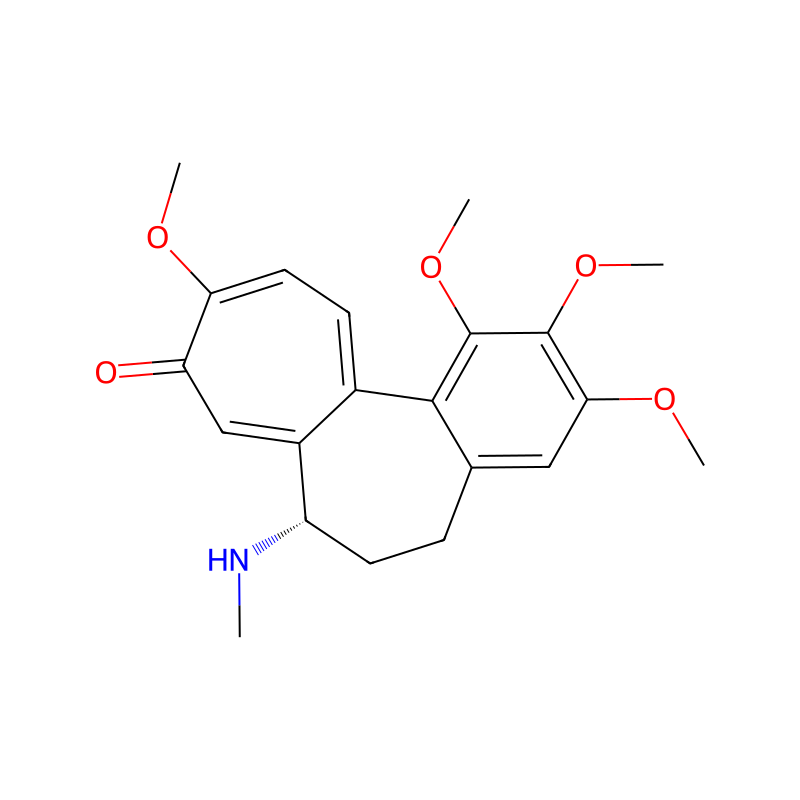
Identifiers & Physical Properties
| CAS No. | 477-30-5 |
|---|---|
| Molecular formula | C21H25NO5 |
| Average molar mass | 371.433 g/mol |
| Monoisotopic mass | 371.1732729 g/mol |
| SMILES | CN[C@H]1CCc2cc(OC)c(OC)c(OC)c2-c2ccc(OC)c(=O)cc21 |
| InChIKey | NNJPGOLRFBJNIW-HNNXBMFYSA-N |
| PubChem CID | 220401 |
| ChEMBL | CHEMBL312862 |
| ChEBI | CHEBI:4393 |
| EC No. | 207-514-6 |
| DTXSID | DTXSID7020342 |
Chemical & Physical Properties
| Melting point | 73-75°C |
|---|---|
| alpha | D20 -129.0° (c = 1 in chloroform) |
| Boiling point | 501.11°C (rough estimate) |
| Density | 1.2350 (rough estimate) |
| Refractive index | 1.5614 (estimate) |
| Storage conditions | 2-8°C |
| Solubility | DMSO: 10 mg/mL |
| Physical state | powder |
| pKa (acidity coefficient) | 8.48±0.40(Predicted) |
| Color | White to off-white |
| Sensitivity | Air & Light Sensitive |
| BRN | 2822892 |
| Stability | Hygroscopic |
| InChI | 1S/C21H25NO5/c1-22-15-8-6-12-10-18(25-3)20(26-4)21(27-5)19(12)13-7-9-17(24-2)16(23)11-14(13)15/h7,9-11,15,22H,6,8H2,1-5H3 |
| InChIKey | NNJPGOLRFBJNIW-UHFFFAOYSA-N |
| SMILES | N(C1CCc2c(c(c(c(c2)OC)OC)OC)C3=CC=C(C(=O)C=C31)OC)C |
| FDA UNII | Z01IVE25KI |
| ATC code | L01CC01 |
| UNSPSC Code | 12352207 |
| NACRES | NA.75 |
| GHS pictogram | GHS06 |
| Signal word | Danger |
| GHS hazard statements | H300 |
| GHS precautionary statements | P264-P301+P310 |
| Hazard symbols | T,T+ |
| Risk statements (R) | 25-26/27/28 |
| Safety statements (S) | 22-24/25-45-36/37/39 |
| UN transport number | UN 2811 6.1/PG 2 |
| Water hazard class (WGK) | 3 |
| RTECS number | GH0800000 |
| F | 8-10-23 |
| Hazard class | 6.1(a) |
| Packing group | II |
| Toxicity | LD50 oral in mouse: 25530ug/kg |
Safety & Regulations
| F | 8-10-23 |
|---|---|
| Water hazard class (WGK) | 3 |
| RTECS number | GH0800000 |
| UN transport number | UN 2811 6.1/PG 2 |
| Toxicity | LD50 oral in mouse: 25530ug/kg |
| Risk statements (R) | 25-26/27/28 |
| Signal word | Danger |
| GHS pictogram | GHS06 |
| Hazard symbols | T,T+ |
| Safety statements (S) | 22-24/25-45-36/37/39 |
| Hazard class | 6.1(a) |
| Packing group | II |
| GHS hazard statements | H300 |
| GHS precautionary statements | P264-P301+P310 |
Applications & Uses
Description
Colcemid is a colchicine derivative that inhibits tubulin polymerization as potently as colchicine (IC50 = 2.1 and 2.4 μM, respectively) but is less toxic. At very low (nanomolar) concentrations, colcemid suppresses microtubule dynamicity and inhibits cell migration, while at micromolar levels it blocks microtubule assembly, arresting cells in metaphase. Mitotic block by colcemid is used to synchronize cells and for karyotyping in cytogenetic studies. Prolonged exposure to colcemid can activate p53, leading to apoptosis.
Uses
An antimitotic agent that disrupts microtubles by binding to tubulin and preventing its polymerization. Stimulates the intrinsic GTPase activity of tubulin. Induces apoptosis in several normal and tumor cell lines and activates the JNK/SAPK signaling pathway.
Uses
Inhibitor of spindle fiber formation
Uses
Cell synchronization agent; for chromosome visualization; to induce oocyte enucleation for somatic cell cloning.
General Description
Colcemid is also known as demecolcine. Its generic name is N-methyl-N-deacetyl-colchicine. Colcemid depolymerizes microtubules and blocks mitosis at metaphase.