
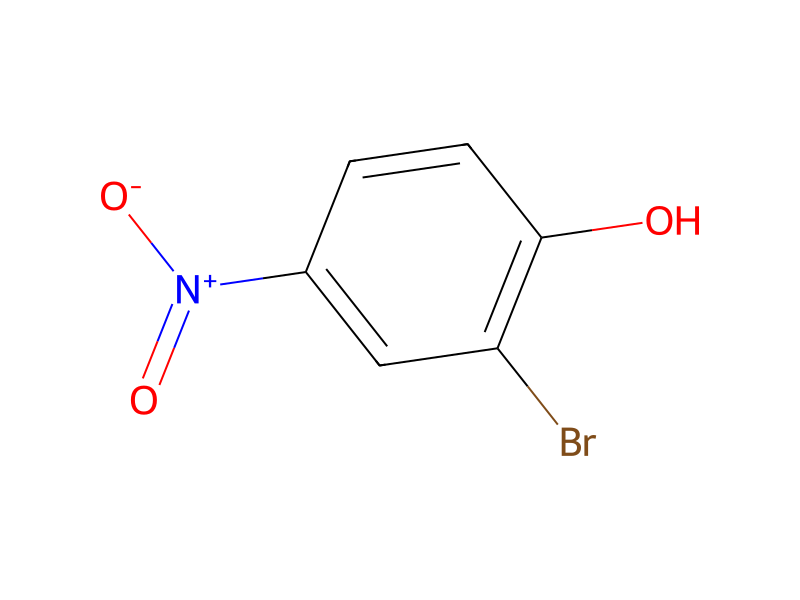
Basic information
- CAS
5847-59-6- Standard SMILES
O=[N+]([O-])c1ccc(O)c(Br)c1- InChIKey
DCIPFSYBGTWYCR-UHFFFAOYSA-N- Molecular formula
- C6H4BrNO3
- Average molar mass
- 218 g/mol
- Monoisotopic mass
- 216.93746
Names & identifiers
- Preferred name
- 2-Bromo-4-nitrophenol
- IUPAC
- 2-bromo-4-nitrophenol
- English name
- 2-Bromo-4-nitrophenol
- Molecular formula
- C6H4BrNO3
- Molecular weight
- 218
Names & synonyms
2-BROMO-4-NITROPHENOL5847-59-6Phenol, 2-bromo-4-nitro-NSC-212120WTK249GKL9DTXSID10207164RefChem:1062463DTXCID10129655611-662-0MFCD06656567NSC 2121203-bromo-4-hydroxynitrobenzene
Show more names
2-Bromo-4-nitrophenoPhenol,2-broMo-4-nitro-2-Bromo-4-nitrophenol >3-Bromo-4-hydroxynitrobenzene2-Bromo-4-nitrophenol >=98.0%
4-HYDROXY-3-BROMONITROBENZENENSC2121202-brom-4-nitro-phenolPhenol, 2-bromo-4-nitro- (8CI)(9CI)SCHEMBL144190SCHEMBL4902091DCIPFSYBGTWYCR-UHFFFAOYSA-NCK1185
Database identifiers
- CAS
5847-59-6- PubChem CID
- 22109
- DTXSID
DTXSID10207164- UNII
- WTK249GKL9
- EC Number
- 611-662-0
- Nikkaji
- J441.023H
Properties
Computed structural properties
- XLogP
- 2.4
- Topological polar surface area
- 66.1 Ų
- Hydrogen bond donors
- 1
- Hydrogen bond acceptors
- 3
- Rotatable bonds
- 0
- Heavy atoms
- 11
- Formal charge
- 0
- Complexity
- 158
Physicochemical properties
- Melting point
- 111 · 111-115 °C
- Boiling point
- 298.1 · 298.1±25.0 °C(Predicted)
- Density
- 1.8994 · 1.8994 (rough estimate)
- refractive index
- 1.62 · 1.6200 (estimate)
- storage temp.
- Inert atmosphere,Room Temperature
- solubility
- soluble in Methanol
- form
- powder to crystal
- pka
- 5.36 · 5.36±0.22(Predicted)
- color
- White to Yellow
- Water Solubility
- 22 g/L · 22g/L(100 ºC)
- λmax
- 404 nm · 404nm(NaOH)(lit.)
- BRN
- 2441518 · 2441518
- InChI
- 1S/C6H4BrNO3/c7-5-3-4(8(10)11)1-2-6(5)9/h1-3,9H
- InChIKey
- DCIPFSYBGTWYCR-UHFFFAOYSA-N
- SMILES
- Oc1ccc(cc1Br)[N+]([O-])=O
- CAS DataBase Reference
- 5847 · 5847-59-6(CAS DataBase Reference)
- FDA UNII
- 249 GKL9 · WTK249GKL9
- UNSPSC Code
- 12352100 · 12352100
- NACRES
- 22 · NA.22
- Symbol(GHS)
- 7 · GHS07,GHS09
- Signal word
- Warning
- Hazard statements
- 302 · H302-H400
- Precautionary statements
- 273 · P273-P301+P312+P330
- PPE
- 95 · dust mask type N95 (US), Eyeshields, Gloves
- Hazard Codes
- Xi,N,Xn
- Risk Statements
- 22 · 22-50
- Safety Statements
- 61 · 61
- RIDADR
- 3077 · UN3077 9/PG 3
- WGK Germany
- 3 · 3
- HazardClass
- IRRITANT
- PackingGroup
- III
- HS Code
- 2922290090 · 2922290090
- Storage Class
- 11 · 11 - Combustible Solids
- Hazard Classifications
- 4 OralAquatic · Acute Tox. 4 OralAquatic Acute 1
Safety & regulation
GHS classification
GHS Classification
Warning
H302 (100%): Harmful if swallowed [Warning Acute toxicity, oral];H400 (95.2%): Very toxic to aquatic life [Warning Hazardous to the aquatic environment, acute hazard]
P264, P270, P273, P301+P317, P330, P391, and P501 (click each P-code to see the statement)
Aggregated GHS information provided per 42 reports by companies from 3 notifications to the ECHA C&L Inventory. Each notification may be associated with multiple companies.;Information may vary between notifications depending on impurities, additives, and other factors. The percentage value in parenthesis indicates the notified classification ratio from companies that provide hazard codes. Only hazard codes with percentage values above 10% are shown. For more detailed information, please visit ECHA C&L website.
Hazard information
Hazard Classes and CategoriesAcute Tox. 4 (100%);Aquatic Acute 1 (95.2%)
Safety data
- PPE
- dust mask type N95 (US), Eyeshields, Gloves
- wgk
- 3
- ridadr
- UN3077 9/PG 3
- hs_code
- 2922290090
- risk_code
- 22-50
- Signal word
- Warning
- Symbol(GHS)
- GHS07,GHS09
- hazard_code
- Xi,N,Xn
- safety_code
- 61
- hazard_class
- IRRITANT
- Storage Class
- 11 - Combustible Solids
- packing_group
- III
- Hazard statements
- H302-H400
- Hazard Classifications
- Acute Tox. 4 OralAquatic Acute 1
- Precautionary statements
- P273-P301+P312+P330
Chemistry & industry
Applications
Uses2-Bromo-4-nitrophenol is used as an important intermediate in the synthesis of some pharmaceuticals and fine chemicals.
Upstream & downstream products
Downstream products
Suppliers100 total
梯希爱(上海)化成工业发展有限公司021-67121386 · [email protected]
上海阿拉丁生化科技股份有限公司400-6206333 13167063860 · [email protected]
上海凌富药物研究有限公司+86(21)5895 0110 19945755304 · [email protected]
南通润丰石油化工有限公司66017690 19952660367 · [email protected]
上海策嵘生物科技有限公司[email protected]
温州共赢化学有限公司+86-0086-577-64498589 +86-15355981851 · [email protected]
常州市阿尔捷化工商贸有限公司13813686894 · [email protected]
宁波季诺化学品有限公司0574-87314919 057487319282 · [email protected]
T&W GROUP021-61551611 13296011611 · [email protected]
爱斯特(成都)生物制药股份有限公司+86-28-85122536 85324413 · [email protected]
上海赫文斯化工有限公司15721252604 17321035817 · [email protected]
Dayang Chem (Hangzhou) Co.,Ltd.+86-0571-88938639 17705817739 · [email protected]
韶远科技(上海)有限公司021-50795510 4000665055 · [email protected]
毕佳索(上海毕得医药科技股份有限公司)400-6005915 · [email protected]
Syntechem Co.,Ltd[email protected]
北京华威锐科化工有限公司0757-86329057 18934348241 · [email protected]
上海辅欣医药科技有限公司+86-021-021-50872116 · [email protected]
安耐吉化学&3A(安徽泽升科技股份有限公司)400-0056266 · [email protected]
常州安轩化工有限公司13912302692 · [email protected]
上海瀚鸿科技股份有限公司021-54306202 13764082696 · [email protected]
Changzhou Helios Biomedical Science and Technology Co.,LTD.+8618961213068;+8618961100976 · [email protected]
上海钰康生物科技有限公司18939844854 · [email protected]
上海常丰生物医药科技有限公司+86-021-61727342 13611721451 · [email protected]
上海竺钥化工有限公司021-33559231 18964673308 · [email protected]
山东西亚化学有限公司13355009207 13355009207 · [email protected]
百科源(成都)科技有限公司15021461747 · [email protected]
上海钰康生物科技有限公司15618758386 15618758386 · [email protected]
南京维奥化工有限公司Please Send Email 18652950785 · [email protected]
上海思域化工科技有限公司86-21-34053660 · [email protected]
南京精瑞久安生物技术有限公司025-58196018 800028039 · [email protected]
上海特伯化学科技有限公司+86-21-60341587 · [email protected]
江苏艾康生物医药研发有限公司025-66113011 13913916777 · [email protected]
TCI AMERICA800-4238616 · [email protected]
TOKYO CHEMICAL INDUSTRY CO., LTD.03-36680489 · [email protected]
TCI Europe320-37350700 · [email protected]
上海睿升化工科技有限公司+86-021-50935922
山东友帮生化科技有限公司15098208899 · [email protected]
上海毕得医药科技股份有限公司400-164-7117 18317119277 · [email protected]
北京奥秘佳得医药科技有限公司+86-13522808617 · [email protected]
Labnetwork lnc.+86-27-50766799 +86-18062016861 · [email protected]
上海卓因生物科技有限公司021-61317773 · [email protected]
上海御略医药科技有限公司021-60345187 13671753212 · [email protected]
杭州杰恒化工有限公司0571-87396432 · [email protected]
上海纳谦化学科技有限公司13598610367 13598610367 · [email protected]
常州天瑞医药科技有限公司0519-85386832 13382812559 · [email protected]
上海拓目化工有限公司13391076197 · [email protected]
陕西缔都医药化工有限公司029-81024372 17792795018 · [email protected]
上海市凯瑜琳医药科技有限公司021-18721936-595 18721936595 · [email protected]
Sigma-Aldrich西格玛奥德里奇(上海)贸易有限公司021-61415566 800-8193336 · [email protected]
Accela ChemBio Inc.+1(858) 699-3322 · [email protected]
Related reactions
50 records


Compound notes
Loading…