HomeMCPWorkbenchSkills
HomeWorkbenchNotificationsMe
llms.txt · MCP GuidePrivacy Policy · Terms of Service · Supportv1.8.3
  1. Home
  2. /Compound

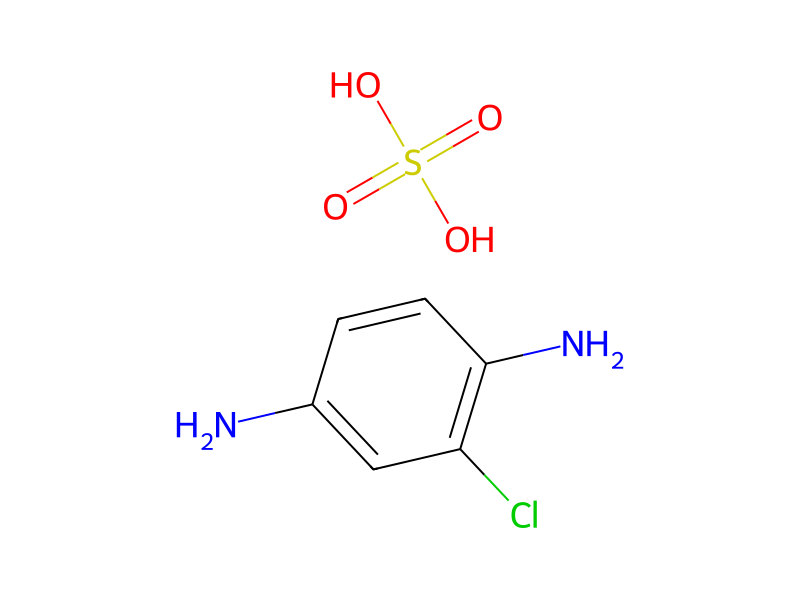
2-Chloro-p-phenylenediamine sulfate

HCID 22584
New reaction
Print
Basic informationOverviewNames & identifiersPropertiesSafety & regulationChemistry & industryRelated reactionsCompound notes
Substructure searchFind similar structures

Basic information

CAS
61702-44-1
Standard SMILES
Nc1ccc(N)c(Cl)c1.O=S(=O)(O)O
InChIKey
GQFGHCRXPLROOF-UHFFFAOYSA-N
Molecular formula
C6H7ClN2.H2O4S
Average molar mass
240.67 g/mol
Monoisotopic mass
239.9971556

Overview

2-chloro-p-phenylenediamine sulfate appears as light gray or lavender powder. (NTP, 1992)

Names & identifiers

Preferred name
2-Chloro-p-phenylenediamine sulfate
IUPAC
2-chlorobenzene-1,4-diamine;sulfuric acid
English name
2-Chloro-1,4-phenylenediamine sulfate
Molecular formula
C6H9ClN2O4S
Molecular weight
240.66

Names & synonyms

2-chlorobenzene-1,4-diamine sulfate2-Chloro-p-phenylenediamine sulfate2-Chloro-1,4-phenylenediamine sulfate6219-71-2Fourrine SO1,4-Benzenediamine, 2-chloro-, sulfateFourrine 812-Cl-p-PDRenal SO2-CHLORO-1,4-BENZENEDIAMINE SULFATE2-Chlorobenzene-1,4-diammonium sulphateC.I. Oxidation Base 13A
Show more names
JAROCOL CPPDSDithranol Impurity 72,5-DIAMINOCHLOROBENZENE SULFATE1,4-Diamino-2-chlorobenzenesulfate2-CHLORO-1,4-DIAMINOBENZENE SULFATE1-CHLORO-2,5-DIAMINOBENZENE SULFATE2-Chloro-p-phenlenediamine sulfate2-Chloro-4-phenylenediamine sulfate
renal brown soCCRIS 1452-Chloro p-phenylenediamine sulphatep-Phenylenediamine, 2-chloro-, sulfateC.I. 760663-Chloro-4-aminoaniline sulfateHSDB 6247NCI-C03316

Database identifiers

Properties

Computed structural properties

Topological polar surface area
135 Ų
Hydrogen bond donors
4
Hydrogen bond acceptors
6
Rotatable bonds
0
Heavy atoms
14
Formal charge
0
Complexity
178

Experimental & physicochemical properties

Chemical ClassesNitrogen Compounds -> Amines, Aromatic
Cosmetics · 2 items

Cosmetic ingredients (2-Chloro-p-Phenylenediamine Sulfate) -> CIR (Cosmetic Ingredient Review)

Hair dyeing

Solubilityless than 1 mg/mL at 70 °F (NTP, 1992)
Melting Point484 to 487 °F (NTP, 1992)
Physical Description2-chloro-p-phenylenediamine sulfate appears as light gray or lavender powder. (NTP, 1992)

Physicochemical properties

Melting point
251 · 251-253 °C
storage temp.
Keep in dark place,Inert atmosphere,Room temperature
solubility
DMSO (Sparingly), Water (Slightly)
form
Solid
color
Off-White to Pale Grey
Water Solubility
0.1 g/100 · <0.1 g/100 mL at 21 ºC

Safety & regulation

Safety information is for reference only and does not replace the supplier’s Safety Data Sheet (SDS), applicable regulations, or professional assessment.

GHS classification

GHS Classification · 6 items

Danger

H301 (12.2%): Toxic if swallowed [Danger Acute toxicity, oral]

P261, P262, P264, P264+P265, P270, P271, P272, P280, P301+P316, P302+P352, P304+P340, P305+P351+P338, P316, P317, P319, P321, P330, P332+P317, P333+P317, P337+P317, P361+P364, P362+P364, P403+P233, P405, and P501 (click each P-code to see the statement)

Aggregated GHS information provided per 49 reports by companies from 7 notifications to the ECHA C&L Inventory. Each notification may be associated with multiple companies.

Danger

H301 (21.4%): Toxic if swallowed [Danger Acute toxicity, oral]

Hazard information

Regulatory Information · 3 items

Chemical: 1,4-Benzenediamine, 2-chloro-, sulfate

REACH registered substance: 2-chlorobenzene-1,4-diammonium sulphate (EC: 228-291-1)

1,4-Benzenediamine, 2-chloro-, sulfate: Does not have an individual approval but may be used as a component in a product covered by a group standard. It is not approved for use as a chemical in its own right.

Other Safety InformationIMAP assessments - 2-Chloro-1,4-benzenediamine: Human health tier II assessment
DOT LabelPoison
Fire HazardsFlash point data for this chemical are not available; however, it is probably combustible. (NTP, 1992)
Health HazardsSYMPTOMS: This compound may cause irritation.
Hazards SummaryInsufficient evidence of carcinogenicity in rats or mice; Emergency treatment: Methemoglobinemia; [HSDB] See 2-Chloro-p-phenylenediamine.

Chemistry & industry

Uses & manufacturing

UsesCIR ingredient: 2-Chloro-p-Phenylenediamine Sulfate
Use ClassificationCosmetics -> Hair dyeing
General Manufacturing Information1,4-Benzenediamine, 2-chloro-, sulfate (1:?): ACTIVE

Applications

Uses2-Chloro-p-phenylenediamine monosulfate (2-Chloro-1,4-diaminobenzene monosulfate) may be used in chemical synthesis studies.

General DescriptionLight gray or lavender powder.

Upstream & downstream products

Upstream raw materials

2-Chloro-4-nitroaniline

Additional notes

DefinitionChEBI: An arylammonium sulfate salt obtained by combining 2-chloro-1,4-phenylenediamine with one molar equivalent of sulfuric acid.

Related reactions

2 records
New reaction record
HRID 903839 reaction equation
HRID 903839As reactant
HRID 2082651 reaction equation
HRID 2082651As reactant

Compound notes

On this pageBasic informationOverviewNames & identifiersPropertiesSafety & regulationChemistry & industryRelated reactionsCompound notes
CAS
61702-44-1、6219-71-2
PubChem CID
22584
DTXSID
DTXSID0020284
ChEMBL
CHEMBL1391326
ChEBI
CHEBI:76597
UNII
851056T3RC
EC Number
228-291-1、262-915-3
BRN
8441373 · 8441373
Stability
Stable. Incompatible with oxidizing agents, acids.
Cosmetics Ingredients Functions
HAIR DYEING
Cosmetic Ingredient Review (CIR)
2 · 2-Chloro-1,4-phenylenediamine sulfate (61702-44-1)
InChI
1S/C6H7ClN2.H2O4S/c7-5-3-4(8)1-2-6(5)9;1-5(2,3)4/h1-3H,8-9H2;(H2,1,2,3,4)
InChIKey
GQFGHCRXPLROOF-UHFFFAOYSA-N
SMILES
OS(O)(=O)=O.Nc1ccc(N)c(Cl)c1
Toxicology and Carcinogenesis
2 · Bioassay of 2-Chloro-p-phenylenediamine Sulfate for Possible Carcinogenicity (CASRN 61702-44-1)
CAS DataBase Reference
61702 · 61702-44-1(CAS DataBase Reference)
EWG's Food Scores
3 · 3-5
FDA UNII
851056 T3RC · 851056T3RC
EPA Substance Registry System
2 · 2-Chloro-1,4-phenylenediamine sulfate (1:1) (61702-44-1)
UNSPSC Code
12352116 · 12352116
NACRES
22 · NA.22
Symbol(GHS)
7 · GHS07
Signal word
Warning
Hazard statements
312 · H312+H332-H315-H319-H335
Precautionary statements
261 · P261-P264-P280-P302+P352+P312-P304+P340+P312-P305+P351+P338
target organs
Respiratory system
Hazard Codes
Xn
Risk Statements
20 · 20/21-36/37/38-33
Safety Statements
26 · 26-36/37/39-39-36-22
RIDADR
2811 · 2811
WGK Germany
3 · 3
RTECS
1581000 · CZ1581000
HazardClass
6.1 · 6.1
PackingGroup
II
HS Code
2921519090 · 2921519090
Storage Class
11 · 11 - Combustible Solids
Hazard Classifications
4 DermalAcute · Acute Tox. 4 DermalAcute Tox. 4 InhalationEye Irrit. 2Skin Irrit. 2STOT SE 3
Reactive GroupSalts, Acidic
Special Reports · 2 items

Final Report on the safety assessment of 2-chloro-p-phenylenediamine and 2-chloro-p-phenylenediamine sulfate. J Am Coll Toxicol 11(4) 521-30 (1992).

EVIDENCE IS GIVEN SUPPORTING TESTING OF THE CLASS OF COMPOUNDS PHENYLENEDIAMINES FOR THEIR TOXIC EFFECTS ON HUMAN HEALTH AND THE ENVIRONMENT. THE RESULTS OF TOXICITY TESTING OF 22 COMPOUNDS ARE TABULATED AS ARE THE EFFECTS FOR WHICH TESTING IS BEING CONSIDERED FOR 13 COMPOUNDS, AND THE USES OR POTENTIAL USES OF 47 PHENYLENEDIAMINES.[UNITED STATES EPA; PHENYLENEDIAMINES; RESPONSE TO INTERAGENCY TESTING COMMITTEE; FED REGIST 47(5) 973 (1982)]

Reactivity Profile · 1 item

An acidic salt of an amine. Materials in this group are generally soluble in water. The resulting solutions contain moderate concentrations of hydrogen ions and have pH's of less than 7.0. They react as acids to neutralize bases. These neutralizations generate heat, but less or far less than is generated by neutralization of inorganic acids, inorganic oxoacids, and carboxylic acid. They usually do not react as either oxidizing agents or reducing agents but such behavior is not impossible. Many of these compounds catalyze organic reactions.

Air and Water ReactionsOxidizes on exposure to air, becoming purple and eventually black [Hawley]. Insoluble in water.
Hazard Classes and Categories · 3 items

Acute Tox. 3 (12.2%)

Acute Tox. 3 (21.4%)

Acute toxicity (ingestion) - category 4

Safety & protection

Fire FightingFires involving this material can be controlled with a dry chemical, carbon dioxide or Halon extinguisher. (NTP, 1992)
First Aid · 1 item

EYES: First check the victim for contact lenses and remove if present. Flush victim's eyes with water or normal saline solution for 20 to 30 minutes while simultaneously calling a hospital or poison control center. Do not put any ointments, oils, or medication in the victim's eyes without specific instructions from a physician. IMMEDIATELY transport the victim after flushing eyes to a hospital even if no symptoms (such as redness or irritation) develop.

Nonfire Spill Response · 1 item

SMALL SPILLS AND LEAKAGE: If you spill this chemical, you should dampen the solid spill material with water, then transfer the dampened material to a suitable container. Use absorbent paper dampened with water to pick up any remaining material. Seal your contaminated clothing and the absorbent paper in a vapor-tight plastic bag for eventual disposal. Wash all contaminated surfaces with a soap and water solution. Do not reenter the contaminated area until the Safety Officer (or other responsible person) has verified that the area has been properly cleaned.

Isolation and EvacuationExcerpt from ERG Guide 154 [Substances - Toxic and/or Corrosive (Non-Combustible)]:
Personal Protective Equipment (PPE) · 1 item

RECOMMENDED RESPIRATOR: Where the neat test chemical is weighed and diluted, wear a NIOSH-approved half face respirator equipped with an organic vapor/acid gas cartridge (specific for organic vapors, HCl, acid gas and SO2) with a dust/mist filter. (NTP, 1992)

Toxicology

Adverse EffectsOccupational hepatotoxin - Secondary hepatotoxins: the potential for toxic effect in the occupational setting is based on cases of poisoning by human ingestion or animal experimentation.
Toxicity SummarySafe in the present practices of use and concentration. Ingredient, concentration, and use information are available in documents discoverable at https://cir-reports.cir-safety.org
Ongoing Test Status · 1 item

The following link will take the user to the National Toxicology Program (NTP) Test Agent Search Results page, which tabulates all of the "Standard Toxicology & Carcinogenesis Studies", "Developmental Studies", and "Genetic Toxicity Studies" performed with this chemical. Clicking on the "Testing Status" link will take the user to the status (i.e., in review, in progress, in preparation, on test, completed, etc.) and results of all the studies that the NTP has done on this chemical. /2-Chloro-p-phenylenediamine sulfate (1:1)/ [http://ntp-apps.niehs.nih.gov/ntp_tox/index.cfm?fuseaction=ntpsearch.searchresults&searchterm=61702-44-1]

Human Toxicity ExcerptsPOTENTIAL METHEMOGLOBIN FORMER
Carcinogen Classification · 6 items

2-Chloro-p-phenylenediamine sulfate

TR-113: Bioassay of 2-Chloro-p-phenylenediamine Sulfate for Possible Carcinogenicity (CASRN 61702-44-1) (1978 )

04/26/78

No Evidence

No Evidence

No Evidence

Non-Human Toxicity Excerpts · 1 item

A BIOASSAY FOR POSSIBLE CARCINOGENICITY OF 2-CHLORO-P-PHENYLENEDIAMINE SULFATE WAS CONDUCTED USING RATS AND MICE. THE COMPOUND WAS ADMINISTERED IN THE FEED, AT EITHER OF 2 CONCENTRATIONS, TO GROUPS OF MALE AND FEMALE ANIMALS OF EACH SPECIES. THE DIETARY CONCENTRATIONS USED WERE 0.3 AND 0.15% FOR THE HIGH AND LOW DOSE RATS, RESPECTIVELY, AND 0.6 AND 0.3% FOR THE HIGH AND LOW DOSE MICE, RESPECTIVELY. COMPOUND ADMINISTRATION WAS FOR 105-107 WEEKS IN RATS, 87 WEEKS IN HIGH DOSE MICE, AND 104-105 WEEKS IN LOW DOSE MICE. THERE WAS INSUFFICIENT EVIDENCE THAT DIETARY ADMINISTRATION WAS CARCINOGENIC TO RATS OR MICE.

Safety data

wgk
3
rtecs
CZ1581000
ridadr
2811
hs_code
2921519090
risk_code
20/21-36/37/38-33
Signal word
Warning
Symbol(GHS)
GHS07
hazard_code
Xn
safety_code
26-36/37/39-39-36-22
hazard_class
6.1
Storage Class
11 - Combustible Solids
packing_group
II
target organs
Respiratory system
Hazard statements
H312+H332-H315-H319-H335
Hazard Classifications
Acute Tox. 4 DermalAcute Tox. 4 InhalationEye Irrit. 2Skin Irrit. 2STOT SE 3
Precautionary statements
P261-P264-P280-P302+P352+P312-P304+P340+P312-P305+P351+P338