HomeMCPWorkbenchSkills
HomeWorkbenchNotificationsMe
llms.txt · MCP GuidePrivacy Policy · Terms of Service · Supportv1.8.3
  1. Home
  2. /Compound

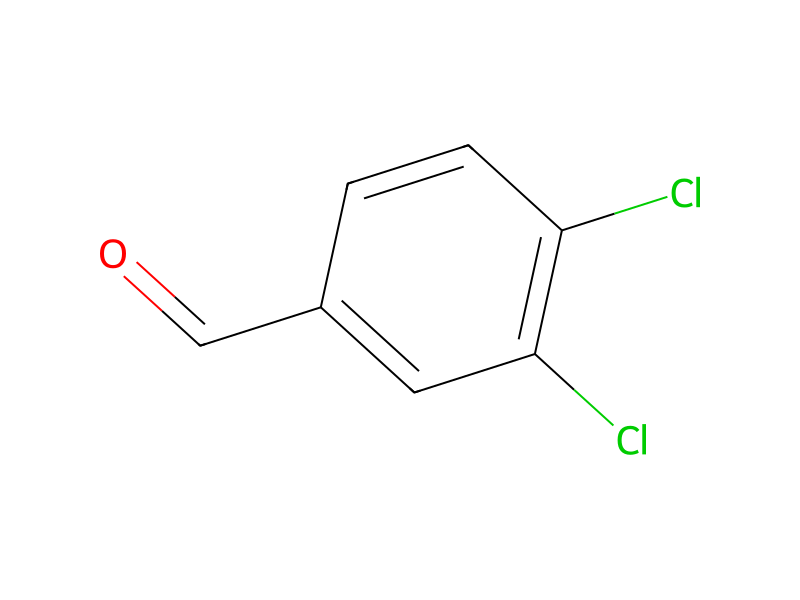
3,4-Dichlorobenzaldehyde

HCID 22710
New reaction
Print
Basic informationOverviewNames & identifiersPropertiesSafety & regulationChemistry & industryRelated reactionsCompound notes
Substructure searchFind similar structures

Basic information

CAS
6287-38-3
Standard SMILES
O=Cc1ccc(Cl)c(Cl)c1
InChIKey
ZWUSBSHBFFPRNE-UHFFFAOYSA-N
Molecular formula
C7H4Cl2O
Average molar mass
175.01 g/mol
Monoisotopic mass
173.9639201

Overview

3,4-dichlorobenzaldehyde appears as white crystalline solid or chunky powder. (NTP, 1992)

Names & identifiers

Preferred name
3,4-Dichlorobenzaldehyde
IUPAC
3,4-dichlorobenzaldehyde
English name
3,4-Dichlorobenzaldehyde
Molecular formula
C7H4Cl2O
Molecular weight
175.01

Names & synonyms

3,4-DICHLOROBENZALDEHYDE6287-38-3Benzaldehyde, 3,4-dichloro-CCRIS 6015DTXSID0024971NSC 8763EINECS 228-520-5UNII-I6Z632WSJ5I6Z632WSJ5M,P-DICHLOROBENZALDEHYDEDICHLOROBENZALDEHYDE, 3,4-NSC-8763
Show more names
3,4-dichloro-benzaldehyd3,4-DCADAKOS BBS-00000836Ixazomib Impurity 14OTAVA-BB BB7018801961LABOTEST-BB LT009323843,4-Dichlorobenzaldehyde,95%
DTXCID7049713,4-DICHLOROBENZENECARBOXALDEHYDERefChem:91020228-520-5InChI=1/C7H4Cl2O/c8-6-2-1-5(4-10)3-7(6)9/h1-4ZWUSBSHBFFPRNE-UHFFFAOYSA-NMFCD00003351CHEMBL1528012

Database identifiers

CAS
6287-38-3
PubChem CID
22710
DTXSID
DTXSID0024971
ChEMBL
CHEMBL1528012
UNII
I6Z632WSJ5
EC Number
228-520-5
Nikkaji
J30.721A

Properties

Computed structural properties

XLogP
2.9
Topological polar surface area
17.1 Ų
Hydrogen bond donors
0
Hydrogen bond acceptors
1
Rotatable bonds
1
Heavy atoms
10
Formal charge
0
Complexity
127

Experimental & physicochemical properties

SpringerMaterials PropertiesNuclear quadrupole resonance spectroscopy
LogP2.53
Solubilityless than 1 mg/mL at 72.5 °F (NTP, 1992)
Flash Pointgreater than 235 °F (NTP, 1992)
Boiling Point477 to 478 °F at 760 mmHg (NTP, 1992)
Melting Point106 to 111 °F (NTP, 1992)
Physical Description3,4-dichlorobenzaldehyde appears as white crystalline solid or chunky powder. (NTP, 1992)

Physicochemical properties

Melting point
39 · 39-42 °C (lit.)
Boiling point
247 · 247-248 °C (lit.)
Density
1.3456 · 1.3456 (rough estimate)

Safety & regulation

Safety information is for reference only and does not replace the supplier’s Safety Data Sheet (SDS), applicable regulations, or professional assessment.

GHS classification

GHS Classification · 4 items

Danger

H314 (94.3%): Causes severe skin burns and eye damage [Danger Skin corrosion/irritation]

P260, P264, P264+P265, P280, P301+P330+P331, P302+P361+P354, P304+P340, P305+P354+P338, P316, P317, P321, P363, P405, and P501 (click each P-code to see the statement)

Aggregated GHS information provided per 53 reports by companies from 5 notifications to the ECHA C&L Inventory. Each notification may be associated with multiple companies.

Hazard information

Regulatory Information · 2 items

Chemical: Benzaldehyde, 3,4-dichloro-

Benzaldehyde, 3,4-dichloro-: Does not have an individual approval but may be used under an appropriate group standard

DOT LabelCorrosive
Fire HazardsThis chemical is probably combustible. (NTP, 1992)
Health Hazards · 1 item

SYMPTOMS: Symptoms of exposure to this compound may include a burning sensation, coughing, wheezing, laryngitis, shortness of breath, headache, nausea, vomiting, and corrosion of the mucous membranes, upper respiratory tract, eyes and skin. Inhalation may be fatal as a result of spasm, inflammation and edema of the larynx and bronchi, chemical pneumonitis and pulmonary edema.

Reactive GroupAldehydes
Reactivity Profile3,4-DICHLOROBENZALDEHYDE is incompatible with strong oxidizers and strong bases. It may also be incompatible with iron. (NTP, 1992)
Air and Water Reactions

Chemistry & industry

Uses & manufacturing

General Manufacturing InformationBenzaldehyde, 3,4-dichloro-: ACTIVE

Applications

Uses3,4-Dichlorobenzaldehyde was used to design and prepare chalcone derivatives as potential antitumor agents, anti-inflammatory and cancer chemopreventive agents.

General DescriptionWhite crystalline solid or chunky powder.

Upstream & downstream products

Upstream raw materials

Hexamethylenetetramine1,2-Dichlorobenzene5-Chloro-2-hydroxy-2,4,6-cycloheptatrien-1-one2,4,6-Cycloheptatrien-1-one, 2,5-dichloro-Methyl 3,4-dichlorobenzoate3,4-Dichlorobenzotrichloride3,4-Dichlorobenzaldehyde oxime3,4-Dichlorobenzyl alcohol3,4-Dichloroiodobenzene3,4-Dichlorobenzyl mercaptanIronpentacarbonyl1,2-Dichloro-4-(chloromethyl)benzene

Related reactions

236 records
New reaction record
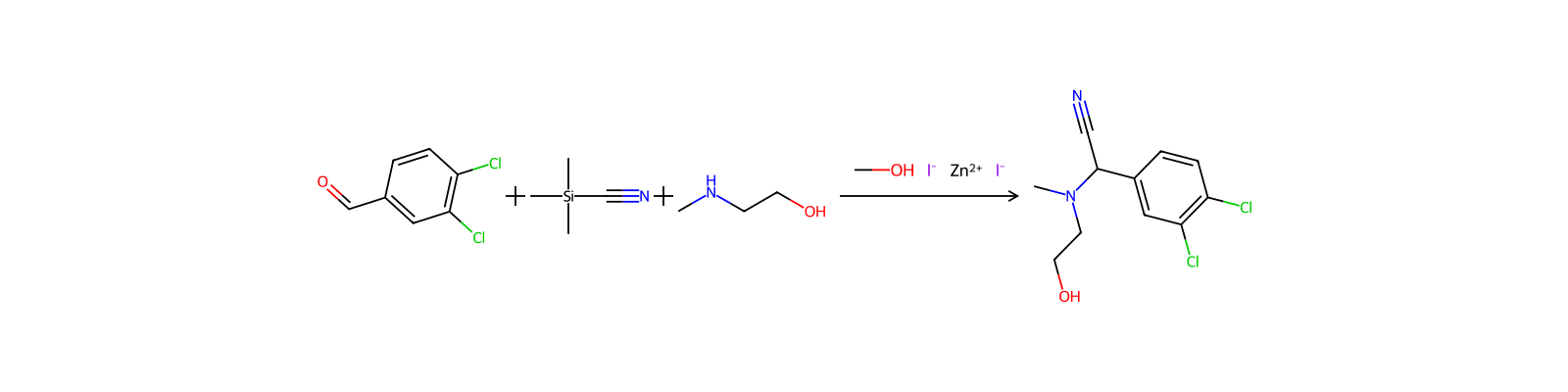
HRID 1837 reaction equation
HRID 1837As reactant
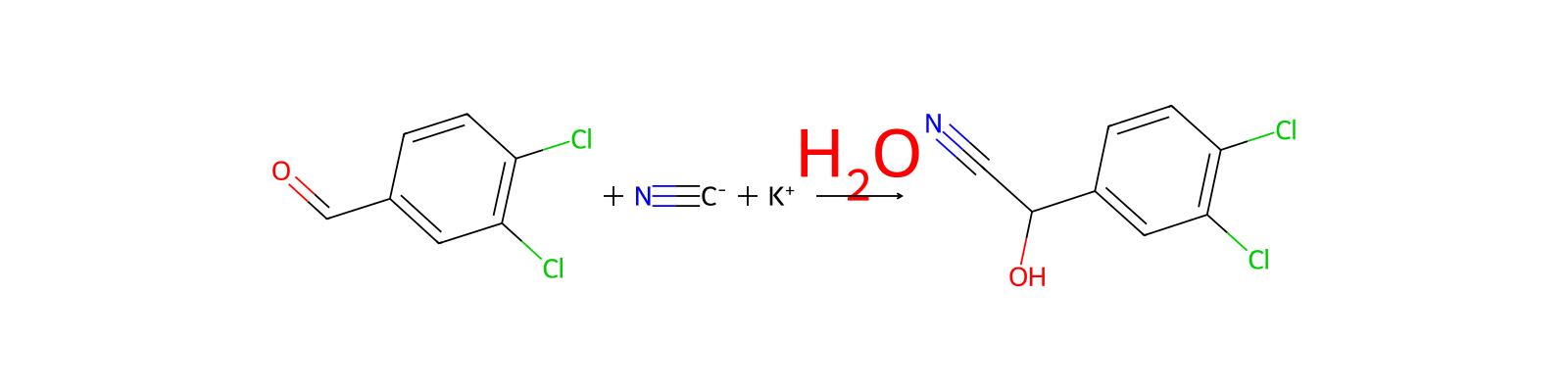
HRID 1838 reaction equation
HRID 1838As reactant
HRID 23289 reaction equation
HRID 23289As reactant
HRID 40607 reaction equation
HRID 40607As reactant
HRID 48325 reaction equation
HRID 48325As reactant
HRID 48334 reaction equation
HRID 48334As reactant
HRID 48338 reaction equation
HRID 48338As reactant
HRID 48340 reaction equation
HRID 48340As reactant
PreviousPage 1 of 30

Compound notes

On this pageBasic informationOverviewNames & identifiersPropertiesSafety & regulationChemistry & industryRelated reactionsCompound notes
refractive index
1.5756 · 1.5756 (estimate)
Flash point
230 °F · >230 °F
storage temp.
2 · 2-8°C
solubility
soluble in Methanol
form
Low Melting Solid
color
White to slightly yellow
Water Solubility
INSOLUBLE
Sensitive
Air Sensitive
BRN
636379 · 636379
InChI
1S/C7H4Cl2O/c8-6-2-1-5(4-10)3-7(6)9/h1-4H
InChIKey
ZWUSBSHBFFPRNE-UHFFFAOYSA-N
SMILES
[H]C(=O)c1ccc(Cl)c(Cl)c1
CAS DataBase Reference
6287 · 6287-38-3(CAS DataBase Reference)
FDA UNII
6 Z632WSJ5 · I6Z632WSJ5
NIST Chemistry Reference
3 · Benzaldehyde, 3,4-dichloro-(6287-38-3)
EPA Substance Registry System
3 · Benzaldehyde, 3,4-dichloro- (6287-38-3)
UNSPSC Code
12352100 · 12352100
NACRES
22 · NA.22
Symbol(GHS)
5 · GHS05
Signal word
Danger
Hazard statements
314 · H314
Precautionary statements
260 · P260-P280-P303+P361+P353-P304+P340+P310-P305+P351+P338-P363
PPE
3 · Eyeshields, Faceshields, Gloves, type P3 (EN 143) respirator cartridges
Hazard Codes
C,Xi
Risk Statements
34 · 34-36/37/38
Safety Statements
26 · 26-27-28-36/37/39-45
RIDADR
1759 · UN 1759 8/PG 2
WGK Germany
3 · 3
F
9 · 9-23
Hazard Note
Irritant/Air Sensitive
TSCA
TSCA listed
HazardClass
8 · 8
PackingGroup
III
HS Code
2913000090 · 2913000090
Storage Class
8 A · 8A - Combustible corrosive hazardous materials
Hazard Classifications
1 Skin · Eye Dam. 1Skin Corr. 1B
Limited Quantities
1 Kg · 1 Kg (2.2 lbs) (solid)
Excepted Quantities
Max Inner Pack (30g or 30ml) and Max Outer Pack (500g or 500ml)
This material may be sensitive to prolonged exposure to air, light and moisture. Insoluble in water.
Hazard Classes and CategoriesSkin Corr. 1C (94.3%)

Safety & protection

Fire FightingFires involving this material can be controlled with a dry chemical, carbon dioxide or Halon extinguisher. (NTP, 1992)
First Aid · 1 item

EYES: First check the victim for contact lenses and remove if present. Flush victim's eyes with water or normal saline solution for 20 to 30 minutes while simultaneously calling a hospital or poison control center. Do not put any ointments, oils, or medication in the victim's eyes without specific instructions from a physician. IMMEDIATELY transport the victim after flushing eyes to a hospital even if no symptoms (such as redness or irritation) develop.

Nonfire Spill Response · 1 item

SMALL SPILLS AND LEAKAGE: Should a spill occur while you are handling this chemical, FIRST REMOVE ALL SOURCES OF IGNITION, then you should dampen the solid spill material with 60-70% ethanol and transfer the dampened material to a suitable container. Use absorbent paper dampened with 60-70% ethanol to pick up any remaining material. Seal the absorbent paper, and any of your clothes, which may be contaminated, in a vapor-tight plastic bag for eventual disposal. Solvent wash all contaminated surfaces with 60-70% ethanol followed by washing with a soap and water solution. Do not reenter the contaminated area until the Safety Officer (or other responsible person) has verified that the area has been properly cleaned.

Isolation and EvacuationExcerpt from ERG Guide 154 [Substances - Toxic and/or Corrosive (Non-Combustible)]:
Personal Protective Equipment (PPE)MINIMUM PROTECTIVE CLOTHING: If Tyvek-type disposable protective clothing is not worn during handling of this chemical, wear disposable Tyvek-type sleeves taped to your gloves.

Safety data

F
9-23
PPE
Eyeshields, Faceshields, Gloves, type P3 (EN 143) respirator cartridges
wgk
3
tsca
TSCA listed
ridadr
UN 1759 8/PG 2
hs_code
2913000090
risk_code
34-36/37/38
Signal word
Danger
Symbol(GHS)
GHS05
hazard_code
C,Xi
hazard_note
Irritant/Air Sensitive
safety_code
26-27-28-36/37/39-45
hazard_class
8
Storage Class
8A - Combustible corrosive hazardous materials
packing_group
III
Hazard statements
H314
Limited Quantities
1 Kg (2.2 lbs) (solid)
Excepted Quantities
Max Inner Pack (30g or 30ml) and Max Outer Pack (500g or 500ml)
Hazard Classifications
Eye Dam. 1Skin Corr. 1B
Precautionary statements
P260-P280-P303+P361+P353-P304+P340+P310-P305+P351+P338-P363
3,4-Dichlorotoluene

Downstream products

2,3',4'-Trichloroacetophenone3',4'-Dichloroacetophenone3-Chloro-4-fluorobenzaldehyde3,4-Dichlorophenylacetylene(4R)-(3',4'-Dichlorophenyl)-3,4-dihydro-2H-naphthalen-1-one