
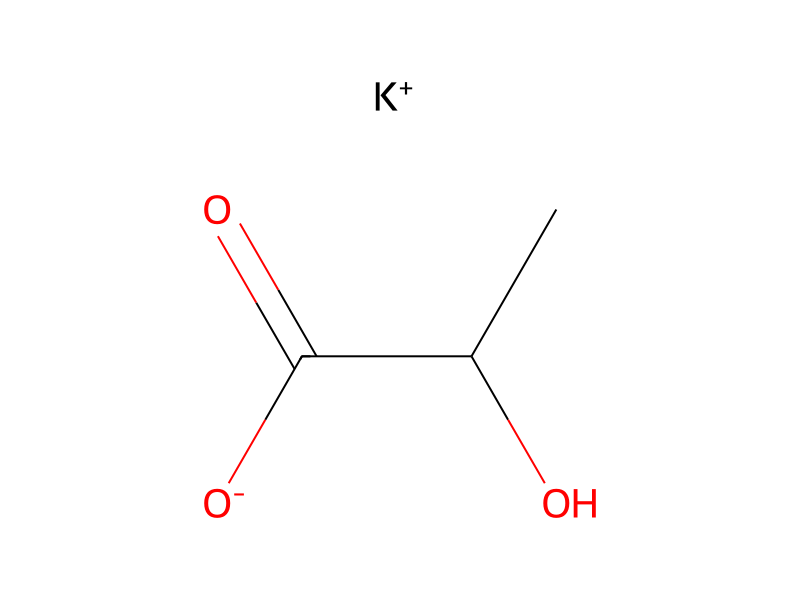
Basic information
- Standard SMILES
CC(O)C(=O)[O-].[K+]- InChIKey
PHZLMBHDXVLRIX-UHFFFAOYSA-M- Molecular formula
- C3H5KO3
- Average molar mass
- 128.17 g/mol
- Monoisotopic mass
- 127.9875757
Overview
Based on the available information included in this report, the CIR Expert Panel concludes that Glycolic and Lactic Acid, their common salts and their simple esters, are safe for use in cosmetic products at concentrations less than or equal to 10%, at final formulation pH greater than or equal to 3.5, when formulated to avoid increasing sun sensitivity or when directions for use include the daily use of sun protection. These ingredients are safe for use in salon products at concentrations less than or equal to 30%, at final formulation pH greater than or equal to 3.0, in products designed for brief, discontinuous use followed by thorough rinsing from the skin, when applied by trained professionals, and when application is accompanied by directions for the daily use of sun protection...Potassium Lactate...
Names & identifiers
- Preferred name
- Potassium Lactate
- IUPAC
- potassium 2-hydroxypropanoate
- English name
- Potassium lactate
- Molecular formula
- C3H7KO3
- Molecular weight
- 130.18
Names & synonyms
POTASSIUM LACTATE996-31-6potassium 2-hydroxypropanoateMonopotassium lactateLactic acid, potassium saltConclyte KMonopotassium 2-hydroxypropanoateLactic acid, monopotassium saltPropanoic acid, 2-hydroxy-, monopotassium saltPotassium alpha-hydroxypropionateEINECS 213-631-3Monopotassium 2-hydroxypropanoate acid
Show more names
PURASAL(R)P/HQ 60Lactate (potassium)POTASSIUM DL-LACTATEMONOPOTASSIUMLACTATEPotassium lactate 50%Lactic acid (potassium)potassium lactate solutionlacticacid,monopotassiumsalt
INS NO.326INS-326E-326Propanoic acid, 2-hydroxy-, potassium salt (1:1)RefChem:86787387V1KMK4QVPotassium alphahydroxypropionateMonopotassium 2hydroxypropanoate
Database identifiers
- CAS
996-31-6- PubChem CID
- 23671663
- DTXSID
DTXSID80883631- ChEMBL
CHEMBL1200664- UNII
- 276897E67U
- EC Number
- 213-631-3
- Nikkaji
- J35.496A
Properties
Computed structural properties
- Topological polar surface area
- 60.4 Ų
- Hydrogen bond donors
- 1
- Hydrogen bond acceptors
- 3
- Rotatable bonds
- 1
- Heavy atoms
- 7
- Formal charge
- 0
- Complexity
- 63.2
Experimental & physicochemical properties
Chemical ClassesMetals -> Organic Acids, Metal Salts
Cosmetics
Cosmetic ingredients (Potassium Lactate) -> CIR (Cosmetic Ingredient Review)
Antimicrobial
Food AdditivesFLAVOR ENHANCER -> FDA Substance added to food
Human Drugs
FDA approved drugs -> Active ingredient
FDA approved drugs -> Active ingredient
Physical DescriptionLiquid
Physicochemical properties
- Boiling point
- 115 °C · 115 °C
- Density
- 1.32 g/cm3 · 1.32 g/cm3
- storage temp.
- 2 · 2-8°C, sealed storage, away from moisture
- form
- syrupy liquid
- color
- Clear, colorless, or slightly yellowish
- PH
- 7.45 · 7.45(1 mM solution);7.89(10 mM solution);8.3(100 mM solution);8.62(1000 mM solution)
- Odor
- 100 % · at 100.00%. odorless
- Cosmetics Ingredients Functions
- SKIN CONDITIONINGBUFFERINGHUMECTANT
- InChI
- InChI=1S/C3H6O3.K.H/c1-2(4)3(5)6;;/h2,4H,1H3,(H,5,6);;
- InChIKey
- LVFFNGBHDOMRED-UHFFFAOYSA-N
- SMILES
- C(O)(C)C(=O)O.[KH]
- CAS DataBase Reference
- 996 · 996-31-6(CAS DataBase Reference)
- Substances Added to Food (formerly EAFUS)
- POTASSIUM LACTATE
- FDA 21 CFR
- 184.1639 · 184.1639
- EWG's Food Scores
- 1 · 1-4
- FDA UNII
- 87 V1KMK4QV · 87V1KMK4QV
- ATC code
- 5 XA15 · B05XA15
- EPA Substance Registry System
- Potassium lactate (996-31-6)
- Symbol(GHS)
- 6 · GHS06
- Signal word
- Danger
- Hazard statements
- 331 · H331-H319
- Precautionary statements
- 261 · P261-P271-P304+P340-P311-P321-P403+P233-P405-P501-P264-P280-P305+P351+P338-P337+P313P
- WGK Germany
- -
- TSCA
- TSCA listed
Safety & regulation
GHS classification
GHS Classification
This chemical does not meet GHS hazard criteria for 19.9% (29 of 146) of reports.
Warning
H319 (79.5%): Causes serious eye irritation [Warning Serious eye damage/eye irritation]
P264+P265, P280, P305+P351+P338, and P337+P317 (click each P-code to see the statement)
Aggregated GHS information provided per 146 reports by companies from 4 notifications to the ECHA C&L Inventory.
Hazard information
Regulatory Information
Chemical: Propanoic acid, 2-hydroxy-, monopotassium salt
Propanoic acid, 2-hydroxy-, potassium salt (1:1) is listed on the EPA's Chemical Data Reporting (CDR) system. Manufacturers and importers of Propanoic acid, 2-hydroxy-, potassium salt (1:1) are required to report information about their production and use of this chemical to the EPA under the Toxic Substances Control Act (TSCA). (40 eCFR Part 711)
Propanoic acid, 2-hydroxy-, monopotassium salt: Does not have an individual approval but may be used under an appropriate group standard
Other Safety InformationIMAP assessments - Propanoic acid, 2-hydroxy-, monopotassium salt: Human health tier I assessment
Hazards SummaryA mild eye irritant; [RTECS] See Sodium lactate. See Lactic acid.
EPA Safer ChemicalChemical: Potassium lactate
Hazard Classes and CategoriesEye Irrit. 2 (79.5%)
Toxicology
Toxicity Summary
Based on the available information included in this report, the CIR Expert Panel concludes that Glycolic and Lactic Acid, their common salts and their simple esters, are safe for use in cosmetic products at concentrations less than or equal to 10%, at final formulation pH greater than or equal to 3.5, when formulated to avoid increasing sun sensitivity or when directions for use include the daily use of sun protection. These ingredients are safe for use in salon products at concentrations less than or equal to 30%, at final formulation pH greater than or equal to 3.0, in products designed for brief, discontinuous use followed by thorough rinsing from the skin, when applied by trained professionals, and when application is accompanied by directions for the daily use of sun protection...Potassium Lactate...
Safe for use in cosmetics, with qualifications
Safety data
- wgk
- -
- tsca
- TSCA listed
- Signal word
- Danger
- Symbol(GHS)
- GHS06
- Hazard statements
- H331-H319
- Precautionary statements
- P261-P271-P304+P340-P311-P321-P403+P233-P405-P501-P264-P280-P305+P351+P338-P337+P313P
Chemistry & industry
Pharmacology
ATC Code
B - Blood and blood forming organs
QB - Blood and blood forming organs
Uses & manufacturing
Uses
CIR ingredient: Potassium Lactate
Used as a flavor enhancer; [FDA] Used in solution as an antioxidant and synergist; [JECFA]
U.S. Production2023: 10,000,000 - <25,000,000 lb
Consumer UsesFlame retardant
Industry UsesFire extinguishing agent
Household ProductsInformation on 16 consumer products that contain Potassium lactate in the following categories is provided:
Use Classification
EPA Safer Chemical Functional Use Classes -> Processing Aids and Additives
Safer Chemical Classes -> Green circle - The chemical has been verified to be of low concern
Food Additives -> ANTIOXIDANT_SYNERGIST; SYNERGIST -> JECFA Functional Classes
Cosmetics -> Antimicrobial
General Manufacturing Information
Food, beverage, and tobacco product manufacturing
Propanoic acid, 2-hydroxy-, potassium salt (1:1): ACTIVE
Applications
DescriptionPotassium lactate is a compound with formula KC3H5O3, or H3C-CHOH-COOK. It is the potassium salt of lactic acid. It is produced by neutralizing lactic acid which is fermented from a sugar source. It has E number "E326". Potassium lactate is a liquid product that is usually 60% solids but is available at up to 78 % solids. Potassium lactate is commonly used in meat and poultry products to extend shelf life and increase food safety as it has a broad antimicrobial action and is effective at inhibiting most spoilage and pathogenic bacteria. Potassium lactate is also used as an extinguishing media in the First Alert Tundra fire extinguishers.
UsesPotassium DL- Lactate is used in preparation of high solids and high protein lactose-free aseptic milk concentration and milk powders with forward osmosis.
UsesPotassium Lactate is a flavor enhancer that is the potassium salt of lactic acid. it is a hygroscopic, white, odorless solid and is prepared commercially by the neutralization of lactic acid with potassium hydroxide. it is used as a flavoring agent and enhancer in some meat and poultry products, a humectant, and a ph control agent.
Upstream & downstream products
Upstream raw materials
Downstream products
Suppliers50 total
北京华美互利生物化工010-56205725 · [email protected]
上海康朗生物科技有限公司021-61998208 18217752821 · [email protected]
天津市光复科技发展有限公司022-85689490 13132141716 · [email protected]
上海麦克林生化科技股份有限公司021-50706066 15221275939 · [email protected]
武汉欣扬瑞和化学科技有限公司13720274133 · [email protected]
武汉欣扬瑞和化学科技有限公司153-07155313 15307155313 · [email protected]
上海腾准生物科技有限公司19821570922 · [email protected]
上海毕得医药科技股份有限公司400-1647117 13681763483 · [email protected]
湖北金梭生物科技有限公司00123456789 · [email protected]
Baoji Guokang Healthchem co.,ltd+8615604608665 15604608665 · [email protected]
金华市佰康生物工程有限公司0573-15557365800 15557365800
上海仲因实业有限公司2537653158 16621191650 · [email protected]
Dayang Chem (Hangzhou) Co.,Ltd.+86-0571-88938639 17705817739 · [email protected]
上海弘顺生物科技有限公司15901914505 · [email protected]
山东穗泰生物科技有限公司15689727968 · [email protected]
武汉卡诺斯科技有限公司027-83238443 15327105076 · [email protected]
福建盛世嘉泰药业有限公司13385921167
上海钰康生物科技有限公司+86-18930848214 +86-021-56762820 · [email protected]
上海泰坦科技股份有限公司400-6009262 15618770481 · [email protected]
合肥天健化工有限公司551-65418679 15856988503;15837135945 · [email protected]
广东谦进化学试剂有限公司0751-2818792 13435114148 · [email protected]
武汉贝乐叶生物医药科技有限公司15871353653 18086118076 · [email protected]
西安拉维亚生物科技有限公司13022827400 18629620162 · [email protected]
广东大小化工有限公司1866-171603 18666171603 · [email protected]
Xiamen AmoyChem Co., Ltd+86-86-5926051114 · [email protected]
北京环宇世纪化学科技有限公司hysj_bj.com
成都润泽本土化工有限公司13096311329 028-88469284 616445927 · [email protected]
湖北巨胜科技有限公司027-59599241 18871490274 · [email protected]
天津荣燊化工有限公司18317763565; 18317763565 · [email protected]
桦特昇生物科技(武汉)有限公司027-59207879 1972026995 18140587686 · [email protected]
TargetMol中国(陶术生物)021-021-33632979 15002134094 · [email protected]
Alfa Chemistry1-516-6625404 · [email protected]
湖北军瑞生物科技有限公司13971166412 · [email protected]
湖北恒绿源科技有限公司027-88188016 18717196322 · [email protected]
厦门志信化学有限公司+86-5922680277 +86-13806087780 · [email protected]
上海玻尔化学试剂有限公司19102157732 · [email protected]
武汉匠信生物科技有限公司19272768272 18007157445 · [email protected]
上海阿拉丁生化科技股份有限公司6206333 13167063860 · [email protected]
陕西缔都医药化工有限公司029-029-81120477 17792793610 · [email protected]
河南沃咖斯生物科技有限公司18537671377 · [email protected]
上海源叶生物科技有限公司13636370518 · [email protected]
山东亚图生物科技有限公司0531-55555418 15301096991
武汉市承天精细化工有限公司18164098996 · [email protected]
湖北海嘉生物科技有限公司15071111164
武汉克米克生物医药技术有限公司027-13163388153 13163388153 · [email protected]
山东西亚化学有限公司4009903999 13395398332 · [email protected]
河北贞佳新材料有限公司0319-5925599 13315915972
湖北世腾化工科技有限公司19086915685 18971850150 · [email protected]
深圳市森迪生物科技有限公司18126413629 0755-23311925 2355327053 · [email protected]
深圳市森迪生物科技有限公司18124570582 TEL:0755-23574479 2355327139 · [email protected]
Related reactions
2 records

Linked notes
Loading…