
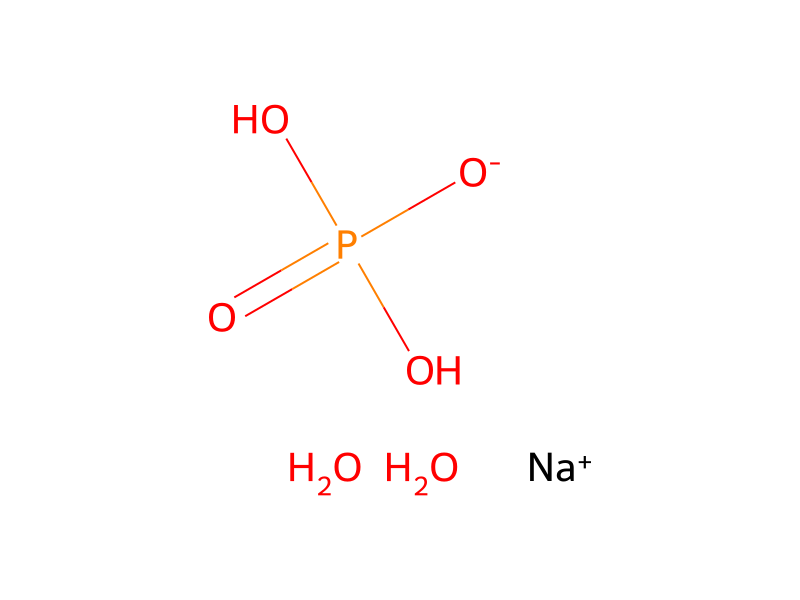
Basic information
- Standard SMILES
O.O.O=P([O-])(O)O.[Na+]- InChIKey
VBJGJHBYWREJQD-UHFFFAOYSA-M- Molecular formula
- H6NaO6P
- Average molar mass
- 156.01 g/mol
- Monoisotopic mass
- 155.97996882
Overview
See other relationships...
Names & identifiers
- Preferred name
- Sodium Phosphate, Monobasic, Dihydrate
- IUPAC
- sodium;dihydrogen phosphate;dihydrate
- English name
- Sodium dihydrogen phosphate dihydrate
- Molecular formula
- NaH2PO4·2H2O
- Molecular weight
- 156.01
Names & synonyms
13472-35-0Sodium dihydrogen phosphate dihydrateSodium phosphate monobasic dihydrateMonosodium phosphate dihydrateSodium phosphate, monobasic, dihydratePhosphoric acid, monosodium salt, dihydrateSodium phosphate dihydrateMonosodium dihydrogen phosphate dihydrateSodium phosphate (NaH2PO4) dihydrateUNII-5QWK6659565QWK665956DTXSID90158903
Show more names
Sodium dihydrogen orthophosphateSODIUM BIPHOSPHATESODIUM DIHYDROGEN PHOSPHATE 2H2OKH2PO7NaH?PO?·2H?OSAMARIUM 1,000PPM99.0 ~ 101.0%,ACS
Sodium Dihydrogen Orthophosphate dihydrateMONOBASIC SODIUM PHOSPHATE DIHYDRATEMONOBASIC SODIUM PHOSPHATE, DIHYDRATESODIUM PHOSPHATE MONOBASIC (DIHYDRATE)MONOSODIUM DIHYDROGEN PHOSPHATE, DIHYDRATESODIUM PHOSPHATE, MONOBASIC, DIHYDRATE [II]SODIUM PHOSPHATE, MONOBASIC, DIHYDRATE [MI]SODIUM PHOSPHATE MONOBASIC (DIHYDRATE) [WHO-DD]
Database identifiers
- CAS
13472-35-0- PubChem CID
- 23673460
- DTXSID
DTXSID90158903- UNII
- 5QWK665956
- EC Number
- 603-853-2
Properties
Computed structural properties
- Topological polar surface area
- 82.6 Ų
- Hydrogen bond donors
- 4
- Hydrogen bond acceptors
- 6
- Rotatable bonds
- 0
- Heavy atoms
- 8
- Formal charge
- 0
- Complexity
- 61.9
Experimental & physicochemical properties
Chemical ClassesMetals -> Phosphates, Metallic Salts
Animal DrugsPharmaceuticals -> UK Veterinary Medicines Directorate List
Physical DescriptionColorless solid; [Merck Index] White hygroscopic solid; [Acros Organics MSDS]
Physicochemical properties
- Melting point
- 60 °C · 60 °C
- Density
- 1 · 1,915 g/cm3
- bulk density
- 1000 kg/m3 · 1000kg/m3
- storage temp.
- 5 °C · Store at +5°C to +30°C.
- solubility
- 2 O: · H2O: 1 M at 20 °C, clear, colorless
- form
- Solid
- color
- White
- Odor
- Odorless
- PH Range
- 4.2 · 4.2 - 4.5
- PH
- 4 · 4.0-4.5 (25℃, 50mg/mL in H2O)
- Water Solubility
- SOLUBLE
- Sensitive
- Hygroscopic
- λmax
- 260 nm · λ: 260 nm Amax: 0.085λ: 280 nm Amax: 0.070
- Merck
- 14 · 14,8660
- Stability
- Stable.
- Cosmetics Ingredients Functions
- BUFFERINGDEODORANTANTI-SEBORRHEIC
- InChI
- 1S/Na.H3O4P.2H2O/c;1-5(2,3)4;;/h;(H3,1,2,3,4);2*1H2/q+1;;;/p-1
- InChIKey
- VBJGJHBYWREJQD-UHFFFAOYSA-M
- SMILES
- O.O.[Na+].OP(O)([O-])=O || O.O.[Na+].OP(O)([O-])=O
- FDA 21 CFR
- 172.892 · 172.892
- CAS DataBase Reference
- 13472 · 13472-35-0(CAS DataBase Reference)
- EWG's Food Scores
- 1 · 1
- FDA UNII
- 5 QWK665956 · 5QWK665956
- EPA Substance Registry System
- Phosphoric acid, monosodium salt (13472-35-0)
- UNSPSC Code
- 12352302 · 12352302
- NACRES
- 25 · NA.25
- Symbol(GHS)
- 7 · GHS07
- Signal word
- Warning
- Hazard statements
- 302 · H302-H315-H319-H335
- Precautionary statements
- 261 · P261-P301+P312-P302+P352-P304+P340-P305+P351+P338
- Hazard Codes
- Xi
- Risk Statements
- 36 · 36-36/37/38
- Safety Statements
- 39 · 39-26-24/25-36
- WGK Germany
- 1 · 1
- RTECS
- 1900500 · WA1900500
- TSCA
- Yes
- HS Code
- 2835 · 2835 22 00
- Storage Class
- 11 · 11 - Combustible Solids
- Toxicity
- 50 orally · LD50 orally in Rabbit: 8290 mg/kg LD50 dermal Rabbit > 7940 mg/kg
Safety & regulation
GHS classification
GHS Classification
This chemical does not meet GHS hazard criteria for 100% (52 of 52) of all reports.
Not Classified
Aggregated GHS information provided per 52 reports by companies from 2 notifications to the ECHA C&L Inventory.
Hazard information
Regulatory Information
Chemical: Phosphoric acid, monosodium salt, dihydrate
Sodium phosphate, monobasic, dihydrate: Does not have an individual approval but may be used under an appropriate group standard
Other Safety InformationIMAP assessments - Phosphoric acid, monosodium salt, dihydrate: Human health tier I assessment
Hazards SummaryIntraperitoneal LD50 (mouse) > 5,008 mg/kg; [RTECS] An eye irritant; [Acros Organics MSDS] See Sodium phosphate, monobasic.
Hazard Classes and CategoriesNot Classified
Safety data
- wgk
- 1
- tsca
- Yes
- rtecs
- WA1900500
- hs_code
- 2835 22 00
- Toxicity
- LD50 orally in Rabbit: 8290 mg/kg LD50 dermal Rabbit > 7940 mg/kg
- risk_code
- 36-36/37/38
- Signal word
- Warning
- Symbol(GHS)
- GHS07
- hazard_code
- Xi
- safety_code
- 39-26-24/25-36
- Storage Class
- 11 - Combustible Solids
- Hazard statements
- H302-H315-H319-H335
- Precautionary statements
- P261-P301+P312-P302+P352-P304+P340-P305+P351+P338
Chemistry & industry
Uses & manufacturing
UsesUsed in boiler water treatment, food production (dry acidulant and sequestrant), and human and veterinary medicine (urinary acidifier); [Merck Index]
Applications
DescriptionSodium Dihydrogen Phosphate occurs as two forms: the crystal form (dihydrate) called Sodium Dihydrogen Phosphate (crystal) and anhydrous form called Sodium Dihydrogen Phosphate (anhydrous) It is used as an acidity regulator and sequestrant in foods. It is used as a pH buffer (baking powders, fleet enema solution, electroplating baths, and acid cleaners), emulsifier, laboratory reagent, metal phosphating reagent, and textile dyeing/printing auxiliary. It is also used to treat boiled water and waste waster and to remove halogen from waste gases. Furthermore, it is used as a cattle feed supplement, as nutritional supplement in food, in dentrifice formulations, in vitreous enamel frits, for the synthesis of pharmaceuticals, and as a phosphate source for micro-organisms in effluent treatment.
UsesSodium dihydrogen phosphate dihydrate acts as buffering capacity reagent in molecular biology, biochemistry and chromatography. It is used in the preparation of biological buffers. It is also used in the purification of antibodies, as a laxative and, in combination with other sodium phosphates.Sodium phosphate monobasic dihydrate is a reagent with very high buffering capacity widely used in molecular biology, biochemistry and chromatography. Sodium phosphate dibasic is highly hygroscopic and water soluble.Recommended chemicals for the preparation of phosphate buffers are sodium dihydrogen phosphate dihydrate,NaH2PO4.2H2O(mol. wt.156.0),disodium hydrogen phosphate dihydrate,Na2HPO4.2H2O (mol. wt.178.0), and sodium hydroxide pellets.
UsesSodium dihydrogen phosphate dihydrate is typically used as a phosphate buffer system component for downstream biomolecule chromatography steps or final liquid formulation.Due to its low microbial and endotoxin limits, Sodium dihydrogen phosphate dihydrate Emprove Expert is especially suitable for high-risk applications.
Upstream & downstream products
Upstream raw materials
Suppliers50 total
国药集团化学试剂有限公司86-21-63210123 · [email protected]
上海阿拉丁生化科技股份有限公司400-6206333 13167063860 · [email protected]
INTATRADE GmbH+49 3493/605464 · [email protected]
河北创海生物科技有限公司+86-86-13131129325 · [email protected]
河北展药生物科技有限公司15369953316 +8615369953316 · [email protected]
Baoji Guokang Healthchem co.,ltd+8615604608665 15604608665 · [email protected]
Dayang Chem (Hangzhou) Co.,Ltd.+86-0571-88938639 17705817739 · [email protected]
Syntechem Co.,Ltd[email protected]
上海迈瑞尔生化科技有限公司4006356688 18621169109 · [email protected]
上海晶抗生物工程有限公司021-54721350 13524668266 · [email protected]
大连美仑生物技术有限公司0411-62910999 13889544652 · [email protected]
阿法埃莎(中国)化学有限公司400-6106006 · [email protected]
安耐吉化学&3A(安徽泽升科技股份有限公司)400-0056266 · [email protected]
武汉卡诺斯科技有限公司027-83238443 15327105076 · [email protected]
北京绿百草科技发展有限公司010-61136123 · [email protected]
上海瀚鸿科技股份有限公司021-54306202 13764082696 · [email protected]
徐州徐试化学科技有限公司0516-82282337 19709920092 · [email protected]
上海泰坦科技股份有限公司400-6009262 15618770481 · [email protected]
天津金汇太亚化学试剂有限公司022-59582624 18622766592 · [email protected]
山东西亚化学有限公司13355009207 13355009207 · [email protected]
玛雅试剂+86 (573) 82222445 (0)18006601000 452520369 · [email protected]
天津希恩思生化科技有限公司400 638 7771 · [email protected]
Xiamen AmoyChem Co., Ltd+86-86-5926051114 · [email protected]
南京化学试剂股份有限公司025-58369808 17895012682 · [email protected]
武汉吉业升化工有限公司027-13545242311 13545242311 · [email protected]
斯百全化学(上海)有限公司021-021-021-67601398-809-809-809 15221380277 · [email protected]
上海源叶生物科技有限公司13636370518 · [email protected]
艾科试剂4008-755-333 18080918076 · [email protected]
赛默飞世尔科技(中国)有限公司800-810-5118 · [email protected]
北京伊诺凯科技有限公司400-810-7969 010-59572699 · [email protected]
深圳振强药物研发有限公司0755-66853366 13670046396 · [email protected]
南京杜莱生物技术有限公司025-84699383-8003;025-846993838003-8003 18013301590 · [email protected]
上海乐晨国际贸易有限公司021-67256163 · [email protected]
北京环宇世纪化学科技有限公司hysj_bj.com
上海将来实业股份有限公司400-0066400 13621662912 · [email protected]
安徽科迪达化工有限公司0554-2106669 · [email protected]
HBCChem, Inc.+1-510-219-6317 · [email protected]
上海麦克林生化科技股份有限公司15221275939 15221275939 · [email protected]
杭州杰恒化工有限公司0571-87396432 · [email protected]
四川海诺威科技有限公司13708085536 13708085536 · [email protected]
天津锦耀翔承科技有限公司18822227517 18822227517 · [email protected]
北京华扬致成科技有限公司13716033033 · [email protected]
Sigma-Aldrich西格玛奥德里奇(上海)贸易有限公司021-61415566 800-8193336 · [email protected]
Alfa Chemistry1-516-6625404 · [email protected]
九鼎化学(上海)科技有限公司4009209199 · [email protected]
杭州鼎燕化工有限公司0571-87157530-8003 18267553885 · [email protected]
厦门志信化学有限公司+86-5922680277 +86-13806087780 · [email protected]
Shijiazhuang Erche Biotechnology Co., Ltd8613343119830 13343119830 · [email protected]
Alfa Chemistry+1-5166625404 · [email protected]
廊坊乾耀科技有限公司0316-2132008 19932680339 · [email protected]
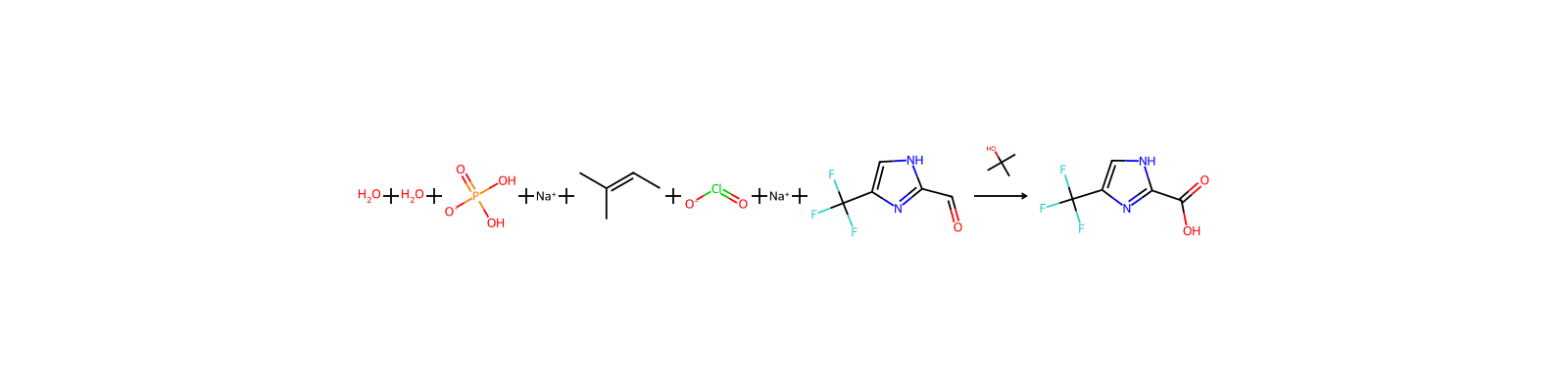
Related reactions
76 records






Linked notes
Loading…