HRID 1182As reactant
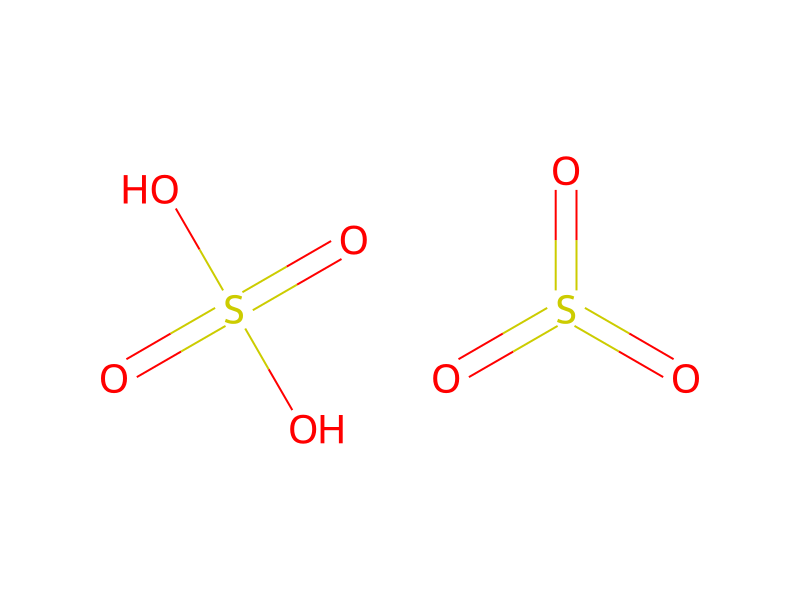
8014-95-7O=S(=O)(O)O.O=S(=O)=OHIFJUMGIHIZEPX-UHFFFAOYSA-NThick fuming yellow liquid. Density 16.5 lb / gal. Very toxic by inhalation. Corrosive to metals and tissue, quickly causing severe burns. Used to make chemicals, dyes, explosives and in petroleum refining.
8014-95-7Toxic Gases & Vapors -> Acids, Inorganic
Carcinogens
1.91 to 1.97 at 59 °F (USCG, 1999)
114.70 lb/cu ft, 15.33 lb/USA gal
Relative density (water = 1): 1.9
Colorless or slightly colored, viscous liquid
Heavy, oily liquid; colorless to dark brown depending on purity
Heavy, fuming, yellow liquid
Safety information is for reference only and does not replace the supplier’s Safety Data Sheet (SDS), applicable regulations, or professional assessment.
Danger
H314 (100%): Causes severe skin burns and eye damage [Danger Skin corrosion/irritation]
P260, P261, P264, P264+P265, P271, P280, P284, P301+P330+P331, P302+P361+P354, P304+P340, P305+P354+P338, P316, P317, P319, P320, P321, P363, P403+P233, P405, and P501 (click each P-code to see the statement)
Aggregated GHS information provided per 183 reports by companies from 10 notifications to the ECHA C&L Inventory. Each notification may be associated with multiple companies.
Danger
H314: Causes severe skin burns and eye damage [Danger Skin corrosion/irritation]
Chemical: Sulfuric acid, mixture with sulfur trioxide
Sulfuric acid, mixt. with sulfur trioxide is listed on the EPA's Chemical Data Reporting (CDR) system. Manufacturers and importers of Sulfuric acid, mixt. with sulfur trioxide are required to report information about their production and use of this chemical to the EPA under the Toxic Substances Control Act (TSCA). (40 eCFR Part 711)
Sulfuric acid, mixture with sulfur trioxide: Does not have an individual approval but may be used under an appropriate group standard
The New Jersey Worker and Community Right to Know Act requires public and private employers to provide information about hazardous substances at their workplaces. (N.J.S.A. 34:5A-1 et. seq.)
Used to make surfactants, dyes, nitrocellulose, explosives, and caprolactam; Also used in petroleum refining and as a drying agent for chlorine & nitric acid; [HSDB] Oleum is a solution of sulfur trioxide in 100% sulfuric acid used in the synthesis of organic chemicals; [Britannica]
Petroleum Production and Refining [Category: Industry]
Chem int for linear alkylbenzene sulfonate surfactants, for dyes; chem agent in petroleum refining, in nitration of explosives, in nitrocellulose mfr, in caprolactam mfr; drying agent for chlorine and nitric acid
Sulfating and sulfonating agent, dehydrating agent in nitrations, dyes, explosives, lab reagent.
(1975) 1.29X10+11 g (Sulfuric acid)
(1984) 1.19X10+11 g /Sulfuric acid/
(1975) 2.75X10+11 g (Sulfuric acid)
(1984) 4.26X10+11 g (Sulfuric acid)
2023: 8,500,000 - <25,000,000 lb
(1972) 2.36X10+12 grams
(1975) 1.89X10+12 grams
(1984) 3.80X10+13 g /Sulfuric acid/
Sulfur trioxide produced by the contact process is absorbed in concentrated sulfuric acid.
Oleum is produced industrially in contact plants, where sulfur trioxide- containing gases are passed through a special oleum tower. In a double-absorption plant this is located upstream from the intermediate absorber; otherwise it is upstream from the final absorber. ... Sulfur trioxide-containing gas enters the oleum-irrigated packed tower at ca. 200 °C. Depending on the desired product concentration, the tower is irrigated with 22% or 35% oleum at a temperature of ca. 40 - 50 °C. Oleum of higher concentration leaves the tower at ca. 60 - 80 °C. It is adjusted to the desired final oleum concentration by addition of concentrated sulfuric acid from the intermediate or final absorber of the contact plant, and is then cooled in special coolers. Product is withdrawn from the oleum circuit downstream from the cooler. Oleum of higher concentrations (e.g., 60 - 65%) is obtained by mixing 20 - 36% oleum with pure sulfur trioxide.
Thick fuming yellow liquid. Density 16.5 lb / gal. Very toxic by inhalation. Corrosive to metals and tissue, quickly causing severe burns. Used to make chemicals, dyes, explosives and in petroleum refining.
Liquid
Colorless to brown, fuming, viscous, and hygroscopic liquid; [ICSC]
COLOURLESS-TO-BROWN FUMING VISCOUS OILY HYGROSCOPIC LIQUID WITH CHARACTERISTIC ODOUR.
38 mPa-sec at 25 °C /30% SO3, wt % (% Oleum)/
Fumes strongly in moist air. Extremely hygroscopic. Reacts violently with water.
Consists of sulfuric acid and up to 80% sulfur trioxide
Heat capacity: 1.55 kJ/kg-K at 20 °C /50% SO3, wt % (% Oleum)/
COMBINATION WATER - 18.37% FREE SULFUR TRIOXIDE - 0%, TOTAL SULFUR TRIOXIDE - 81.63%; AMOUNT OF SULFUR TRIOXIDE WITH 100% SULFURIC ACID
Special Hazards of Combustion Products: Toxic and irritating vapors are generated. (USCG, 1999)
· EXCEPT FOR ACETIC ANHYDRIDE (UN1715), THAT IS FLAMMABLE, some of these materials may burn, but none ignite readily.
Not combustible. Many reactions may cause fire or explosion. Gives off irritating or toxic fumes (or gases) in a fire. Risk of fire and explosion on contact with bases, combustible substances, reducing agents, water or organic materials.
A very dangerous fire hazard by chemical reaction with reducing agents and carbohydrates.
Sulfuric acid and oleum are nonflammable liquids, but they can cause or support a fire by reacting with other chemicals.
Acid mist is irritating to eyes, nose and throat. Liquid causes severe burns of skin and eyes. (USCG, 1999)
· CORROSIVE and/or TOXIC; inhalation, ingestion or contact (skin, eyes) with vapors, dusts or substance may cause severe injury, burns or death.
Excerpt from ERG Guide 137 [Substances - Water-Reactive - Corrosive]:
NO water. In case of fire in the surroundings, use appropriate extinguishing media. In case of fire: keep drums, etc., cool by spraying with water. NO direct contact of the substance with water.
Fresh air, rest. Half-upright position. Artificial respiration may be needed. Refer immediately for medical attention.
Wear protective gloves when administering first aid. First rinse with plenty of water for at least 15 minutes, then remove contaminated clothes and rinse again. Refer immediately for medical attention.
Rinse with plenty of water for several minutes (remove contact lenses if easily possible). Refer immediately for medical attention.
Rinse mouth. Give nothing to drink. Do NOT induce vomiting. Refer immediately for medical attention.
· CALL 911. Then call emergency response telephone number on shipping paper. If shipping paper not available or no answer, refer to appropriate telephone number listed on the inside back cover.
· Do not touch damaged containers or spilled material unless wearing appropriate protective clothing.
INGESTION: have victim drink water or milk; do NOT induce vomiting.
General First Aid:
· Wear positive pressure self-contained breathing apparatus (SCBA).
0.1 [mg/m3], inhalable fraction[German Research Foundation (DFG)]
Keep tightly closed in glass-stoppered bottles.
Separated from food and feedstuffs, incompatible materials ... Dry. Cool. Ventilation along the floor.
Evacuate danger area! Consult an expert! Ventilation. NEVER direct water jet on liquid. Do NOT absorb in saw-dust or other combustible absorbents. Collect leaking liquid in covered plastic containers. Absorb remaining liquid in dry sand or inert absorbent and remove to safe place. Do NOT let this chemical enter the environment.
SRP: Wastewater from contaminant suppression, cleaning of protective clothing/equipment, or contaminated sites should be contained and evaluated for subject chemical or decomposition product concentrations. Concentrations shall be lower than applicable environmental discharge or disposal criteria. Alternatively, pretreatment and/or discharge to a permitted wastewater treatment facility is acceptable only after review by the governing authority and assurance that "pass through" violations will not occur. Due consideration shall be given to remediation worker exposure (inhalation, dermal and ingestion) as well as fate during treatment, transfer and disposal. If it is not practicable to manage the chemical in this fashion, it must be evaluated in accordance with EPA 40 CFR Part 261, specifically Subpart B, in order to determine the appropriate local, state and federal requirements for disposal.
Solid remedies react with spilled liq to form skin that supresses fumes to permit close approach or completely solidifies spill.
SRP: The most favorable course of action is to use an alternative chemical product with less inherent propensity for occupational harm/injury/toxicity or environmental contamination. Recycle any unused portion of the material for its approved use or return it to the manufacturer or supplier. Ultimate disposal of the chemical must consider: the material's impact on air quality; potential migration in soil or water; effects on animal and plant life; and conformance with environmental and public health regulations.
Evacuate danger area! Consult an expert! Personal protection: chemical protection suit including self-contained breathing apparatus. Do NOT let this chemical enter the environment. Do NOT absorb in saw-dust or other combustible absorbents. Collect leaking liquid in sealable containers. Absorb remaining liquid in dry sand or inert absorbent. Then store and dispose of according to local regulations. Cautiously neutralize remainder with lime or soda ash.
Cough. Sore throat. Burning sensation. Shortness of breath. Laboured breathing.
Redness. Pain. Blisters. Serious skin burns.
Redness. Pain. Blurred vision. Severe burns.
Burns in mouth and throat. Burning sensation behind the breastbone. Abdominal pain. Vomiting. Shock or collapse.
/SIGNS AND SYMPTOMS/ Lungs may be affected by repeated or prolonged exposure to an aerosol of this substance. Risk of tooth erosion upon repeated or prolonged exposure to an aerosol of this substance. Strong inorganic acid mists containing this substance are carcinogenic to humans.
/SIGNS AND SYMPTOMS/ Inhalation of the substance may cause lung edema ... The symptoms of lung edema often do not become manifest until a few hours have passed and they are aggravated by physical effort. Rest and medical observation is therefore essential. Immediate administration of an appropriate inhalation therapy by a doctor or a person authorized by him/her, should be considered.
/SIGNS AND SYMPTOMS/ Potential symptoms of overexposure are eye, skin, nose and throat irritation; pulmonary edema, bronchitis; emphysema; conjunctivitis; stomatis; dental erosion; tracheobronchitis; skin and eye burns; dermatitis.
/SIGNS AND SYMPTOMS/ Symptomatology (...ingestion or skin contact): 1. Corrosion of mucous membranes of mouth, throat and esophagus, with immediate pain and dysphagia. Necrotic areas ... grayish white but soon acquire a blackish discoloration (yellow in case of nitric acid) and sometimes shrunken or wrinkled texture ... 2. Epigastric pain ... may be assoc with nausea and vomiting ... At times, gastric hemorrhage may be intense, and vomitus then contains fresh blood. Profound thirst. 3. Ulceration of all membranes and tissues with which the acid comes in contact. After the ingestion of concn mineral acid, this corrosion may lead within a few hr or a few days to gastric perforation and peritonitis. 4. Circulatory collapse with clammy skin, weak and rapid pulse, shallow resp, and scanty urine. Circulatory shock is often immediate cause of death. /Acids/
For more Human Toxicity Excerpts (Complete) data for Oleum (9 total), please visit the HSDB record page.
There is suffcient evidence that occupational exposure to strong-inorganic-acid mists containing sulfuric acid is carcinogenic. Overall evaluation Occupational exposure to strong-inorganic-acid mists containing sulfuric acid is carcinogenic to humans (Group 1). /Strong inorganic acid mists/
A2; Suspected human carcinogen. /Sulfuric acid contained in strong inorganic acid mists/
Immediate first aid: Ensure that adequate decontamination has been carried out. If patient is not breathing, start artificial respiration, preferably with a demand-valve resuscitator, bag-valve-mask device, or pocket mask, as trained. Perform CPR as necessary. Immediately flush contaminated eyes with gently flowing water. Do not induce vomiting. If vomiting occurs, lean patient forward or place on left side (head-down position, if possible) to maintain an open airway and prevent aspiration. Keep patient quiet and maintain normal body temperature. Obtain medical attention. /Inorganic acids and related compounds/
Basic treatment: Establish a patent airway (oropharyngeal or nasopharyngeal airway, if needed). Suction if necessary. Watch for signs of respiratory insufficiency and assist respirations if needed. Administer oxygen by nonrebreather mask at 10 to 15 L/min. Monitor for pulmonary edema and treat if necessary ... . Monitor for shock and treat if necessary ... . For eye contamination, flush eyes immediately with water. Irrigate each eye continuously with 0.9% saline (NS) during transport ... . Do not use emetics. Activated charcoal is not effective. For ingestion, rinse mouth and administer 5 ml/kg up to 200 ml of water for dilution if the patient can swallow, has a strong gag reflex, and does not drool ... . Do not attempt to neutralize because of exothermic reaction. Cover skin burns with dry, sterile dressings after decontamination ... . /Inorganic acids and related compounds/
Advanced treatment: Consider orotracheal or nasotracheal intubation for airway control in the patient who is unconscious, has severe pulmonary edema, or is in severe respiratory distress. Early intubation, at the first sign of upper airway obstruction, may be necessary. Positive-pressure ventilation techniques with a bag valve mask device may be beneficial. Consider drug therapy for pulmonary edema ... . Consider administering a beta agonist such as albuterol for severe bronchospasm ... . Monitor cardiac rhythm and treat arrhythmias as necessary ... . Start IV administration of D5W /SRP: "To keep open", minimal flow rate/. Use 0.9% saline (NS) or lactated Ringer's(LR) if signs of hypovolemia are present. For hypotension with signs of hypovolemia, administer fluid cautiously. Consider vasopressors if patient is hypotensive with a normal fluid volume. Watch for signs of fluid overload ... . Use proparacaine hydrochloride to assist eye irrigation ... . /Inorganic acids and related compounds/
0.12
CALEPA
LC50 Rat/male inhalation 1.4 mg/L 1 hr
LC50 Rat/female inhalation 1.2 mg/L 1 hr
LC50 Rat/male inhalation 420 ppm 1 hr
LC50 Rat/female inhalation 347 ppm 1 hr
Persons in charge of vessels or facilities are required to notify the National Response Center (NRC) immediately, when there is a release of this designated hazardous substance, in an amount equal to or greater than its reportable quantity of 1000 lb or 454 kg. The toll free number of the NRC is (800) 424-8802. The rule for determining when notification is required is stated in 40 CFR 302.4 (section IV. D.3.b).
Oleum (Fuming Sulfuric acid)
1.00
10,000
Toxic chemical that can be released at a facility.
Grades: Commercial (10% to 70% free sulfur trioxide, depending on supplier); CP /chemically pure: a grade designation signifying a minimum of impurities, but not 100% purity/.
Sulfuric acid (100% H2SO4) containing varying amt of sulfur trioxide in soln. Less concentrated sulfuric acid is sometimes erroneously called "oleum".
Avail grades contain up to about 80% free sulfur trioxide.
Synthetic Dye and Pigment Manufacturing
Packaging/Delivery: Oleum grades are supplied by railroad tank car or ship. Marketed in Europe only
Oleum strengths are usually reported as weight percent free SO3 or percent equivalent sulfuric acid ... Oleum is generally thought of as a mixture of sulfuric acid and free sulfur trioxide
UsesSulfuric acid probably is the most important industrial chemical of modern time. Most sulfuric acid manufactured is used by the fertilizer industry for making phosphoric acid and phosphate fertilizers. Sulfuric acid has numerous applications. Some major uses include extracting ores; pickling metal; making explosives; manufacturing dyes, glues, and parchment papers; producing nitric and other acids; purifying petroleum; preparing metal sulfates; and synthesizing many organics. Sulfuric acid also is used in lead storage batteries for automobiles. The lead storage battery was invented by Gaston Plante in 1859. Sulfuric acid is used heavily in sulfonation, estertification, oxidation, dehydration, and acid-base neutralization reactions. Sulfuric acid is a common laboratory reagent used for laboratory preparation of a large number of salts; as a dehydrating agent; as a component of chromic mixture for cleaning glassware; and in acid-base titration. The acid has been in wide usage in various industrial applications for more than two hundred years. Commercial concentrated acid has an assay of 95 to 98% H2SO4. Its normality is 36 N and density 1.834 to 1.836 g/mL.
DescriptionFuming sulfuric acid is also called oleum, which is a trade name. It is a heavy, oily liquid, colorless to dark brown depending on purity, and fumes strongly in moist air and is extremely hygroscopic. Fuming sulfuric acid is a solution of sulfur trioxide in sulfuric acid. Sulfur trioxide is forced into solution with sulfuric acid to the point that the solution cannot hold any more. As soon as the solution is exposed to air, the fuming begins, forming dense vapor clouds. It is violently water reactive, as are most acids. Oleum is also a strong irritant to tissue. The four-digit UN identification number is 1831.
Uses65% Sulfur Trioxide (Fuming) in Sulfuric Acid is a useful reagent that is widely used in the preparation of various compounds. It has been used for processing sulfonated polyoxadizole into ion-conducting films.
UsesIn manufacture of fertilizers, explosives, dyestuffs, other acids, parchment paper, glue, purification of petroleum, pickling of metal.
General DescriptionThick fuming yellow liquid. Density 16.5 lb / gal. Very toxic by inhalation. Corrosive to metals and tissue, quickly causing severe burns. Used to make chemicals, dyes, explosives and in petroleum refining.