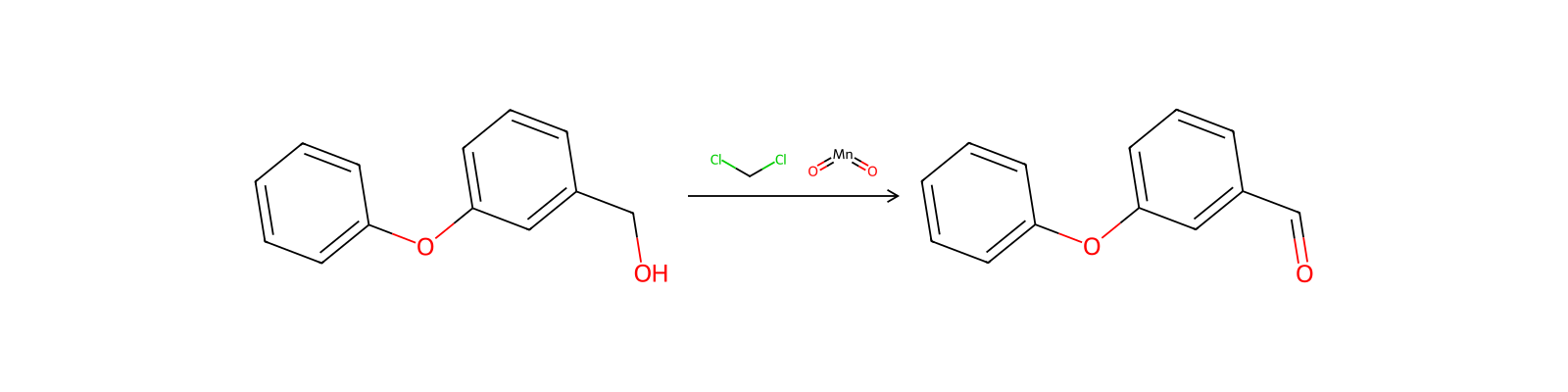
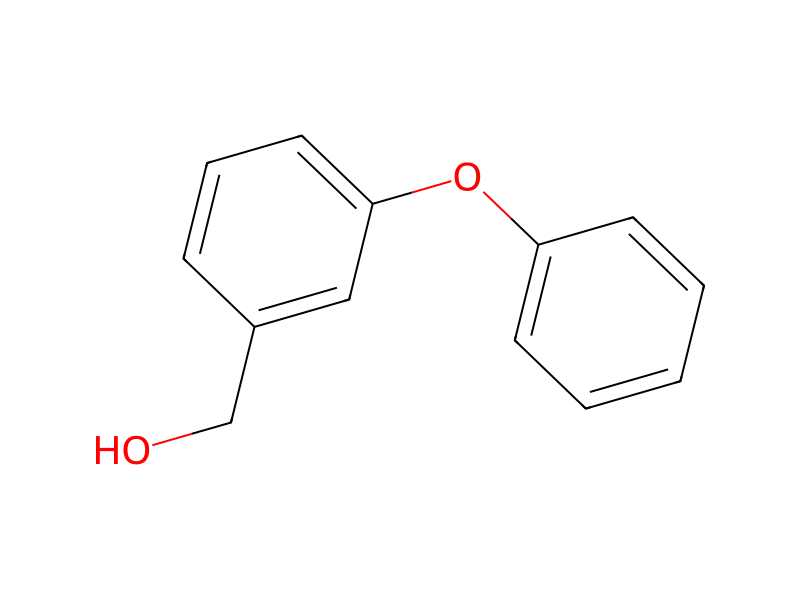
Basic information
- Standard SMILES
OCc1cccc(Oc2ccccc2)c1- InChIKey
KGANAERDZBAECK-UHFFFAOYSA-N- Molecular formula
- C13H12O2
- Average molar mass
- 200.23 g/mol
- Monoisotopic mass
- 200.08372962
Overview
(3-phenoxyphenyl)methanol is a member of the class of benzyl alcohols that is benzyl alcohol bearing a phenoxy substituent at C-3. It is a metbaolite of the insecticide permethrin. It has a role as a marine xenobiotic metabolite. It is a member of benzyl alcohols and an aromatic ether.
Names & identifiers
- Preferred name
- 3-Phenoxybenzyl alcohol
- IUPAC
- (3-phenoxyphenyl)methanol
- English name
- 3-Phenoxybenzyl alcohol
- Molecular formula
- C13H12O2
- Molecular weight
- 200.23
Names & synonyms
(3-Phenoxyphenyl)methanol3-Phenoxybenzyl alcohol13826-35-2m-Phenoxybenzyl alcohol3-Phenoxybenzenemethanol3-PhenoxybenzylalcoholBenzenemethanol, 3-phenoxy-3-(Hydroxymethyl)diphenyl etherBENZYL ALCOHOL, m-PHENOXY-DTXSID70277561-hydroxymethyl-3-phenoxybenzene04964J25DQ
Show more names
3-PBAmpbdMeta Phenoxy Benzal Alcohol3-Phenoxybenzy3-phenoxybenzylRARECHEM AL BD 00583-PhenoxyBenzalcoholPermethrinEPImpurityHYDROXYMETHYLDIPHENYL
DTXCID007756CHEBI:62527RefChem:504782237-525-1MFCD00004636(3-phenoxy-phenyl)-methanolm-phenoxy-benzyl alcohol3-Phenoxylbenzyl alcohol
Database identifiers
- CAS
13826-35-2- PubChem CID
- 26295
- DTXSID
DTXSID7027756- ChEMBL
CHEMBL1869836- ChEBI
CHEBI:62527- UNII
- 04964J25DQ
- EC Number
- 237-525-1
- Nikkaji
- J60.251E
Properties
Computed structural properties
- XLogP
- 2.5
- Topological polar surface area
- 29.5 Ų
- Hydrogen bond donors
- 1
- Hydrogen bond acceptors
- 2
- Rotatable bonds
- 3
- Heavy atoms
- 15
- Formal charge
- 0
- Complexity
- 175
Experimental & physicochemical properties
Chemical ClassesOther Classes -> Other Aromatic Compounds
Pesticides
Environmental transformation -> Pesticide transformation products (metabolite, successor)
Pesticides -> Insecticides -> Pyrethroid insecticides -> Pyrethroid ester insecticides -> Transformation products
Pesticide degradation product
Physical DescriptionColorless or light yellow liquid; [Alfa Aesar MSDS]
Physicochemical properties
- Melting point
- 4 · 4-7°C
- Boiling point
- 135 · 135-140 °C/0.1 mmHg (lit.)
- Density
- 1.149 g/mL · 1.149 g/mL at 25 °C (lit.)
- vapor pressure
- 0.1 mm · 0.1 mm Hg ( 37.7 °C)
- refractive index
- 20 · n20/D 1.591(lit.)
- Flash point
- 230 °F · >230 °F
- storage temp.
- Sealed in dry,Room Temperature
- solubility
- Chloroform (Slightly), Methanol (Slightly)
- form
- Solid or Liquid
- pka
- 14.19 · 14.19±0.10(Predicted)
- color
- White or clear colorless
- Water Solubility
- Insoluble
- BRN
- 475312 · 475312
- Stability
- Stable. Combustible. Incompatible with strong oxidizing agents.
- InChI
- 1S/C13H12O2/c14-10-11-5-4-8-13(9-11)15-12-6-2-1-3-7-12/h1-9,14H,10H2
- InChIKey
- KGANAERDZBAECK-UHFFFAOYSA-N
- SMILES
- OCc1cccc(Oc2ccccc2)c1
- LogP
- 2.797 at · 2.797 at 25℃
- CAS DataBase Reference
- 13826 · 13826-35-2(CAS DataBase Reference)
- EWG's Food Scores
- 1 · 1
- FDA UNII
- 4964 J25DQ · 04964J25DQ
- NIST Chemistry Reference
- 3 · Benzenemethanol, 3-phenoxy-(13826-35-2)
- EPA Substance Registry System
- 3 · 3-Phenoxybenzenemethanol (13826-35-2)
- UNSPSC Code
- 12352100 · 12352100
- NACRES
- 22 · NA.22
- Symbol(GHS)
- 7 · GHS07
- Signal word
- Warning
- Hazard statements
- 302 · H302
- Precautionary statements
- 301 · P301+P312+P330
- PPE
- Eyeshields, Faceshields, Gloves, type ABEK (EN14387) respirator filter
- Hazard Codes
- Xn,Xi
- Risk Statements
- 22 · 22
- Safety Statements
- 26 · 26-36/37-29
- RIDADR
- 3082 · UN 3082 9 / PGIII
- WGK Germany
- 3 · 3
- RTECS
- 775400 · DP0775400
- Hazard Note
- Irritant
- TSCA
- TSCA listed
- HS Code
- 29062990 · 29062990
- Storage Class
- 10 · 10 - Combustible liquids
- Hazard Classifications
- 4 Oral · Acute Tox. 4 Oral
- Toxicity
- 50 · mouse,LD50,intraperitoneal,575mg/kg (575mg/kg),Journal of Agricultural and Food Chemistry. Vol. 25, Pg. 9, 1977.
- REACH Registrations
- Active
Safety & regulation
GHS classification
GHS Classification
Warning
H302 (100%): Harmful if swallowed [Warning Acute toxicity, oral]
P264, P270, P273, P301+P317, P330, P391, and P501 (click each P-code to see the statement)
Aggregated GHS information provided per 131 reports by companies from 6 notifications to the ECHA C&L Inventory. Each notification may be associated with multiple companies.
Hazard information
Regulatory Information
Chemical: Benzenemethanol, 3-phenoxy-
Status: Cease Manufacture Update: 31-05-2016 https://echa.europa.eu/registration-dossier/-/registered-dossier/17461
Benzenemethanol, 3-phenoxy-: Does not have an individual approval but may be used as a component in a product covered by a group standard. It is not approved for use as a chemical in its own right.
Hazards Summary
A mild eye irritant; Causes muscle weakness and dermatitis in dermal lethal-dose studies of rabbits; Causes effects to transaminases in inhalation lethal-concentration studies of rats; Causes other degenerative changes to brain in oral lethal-dose studies of mice; Causes somnolence, ataxia, and dyspnea in oral lethal-dose studies of rats; [RTECS] A skin and strong eye irritant; Harmful by ingestion; [Alfa Aesar MSDS] See Phenyl ether.
Hazard Classes and CategoriesAcute Tox. 4 (100%)
Toxicology
Adverse EffectsNeurotoxin - Other CNS neurotoxin
Toxicity DataLC (rat) = 2,000 mg/m3/1hr
USGS Health-Based Screening Levels for Evaluating Water-Quality
3-Phenoxybenzyl alcohol
Pesticide degradation product
Smith, C.D. and Nowell, L.H., 2024. Health-Based Screening Levels for evaluating water-quality data (3rd ed.). DOI:10.5066/F71C1TWP
Safety data
- PPE
- Eyeshields, Faceshields, Gloves, type ABEK (EN14387) respirator filter
- wgk
- 3
- tsca
- TSCA listed
- rtecs
- DP0775400
- ridadr
- UN 3082 9 / PGIII
- hs_code
- 29062990
- Toxicity
- mouse,LD50,intraperitoneal,575mg/kg (575mg/kg),Journal of Agricultural and Food Chemistry. Vol. 25, Pg. 9, 1977.
- risk_code
- 22
- Signal word
- Warning
- Symbol(GHS)
- GHS07
- hazard_code
- Xn,Xi
- hazard_note
- Irritant
- safety_code
- 26-36/37-29
- Storage Class
- 10 - Combustible liquids
- Hazard statements
- H302
- REACH Registrations
- Active
- Hazard Classifications
- Acute Tox. 4 Oral
- Precautionary statements
- P301+P312+P330
Chemistry & industry
Pharmacology
Metabolism/Metabolites(3-Phenoxyphenyl)methanol is a known human metabolite of trans-Permethrin.
Uses & manufacturing
Use Classification
Environmental transformation -> Pesticide transformation products (metabolite, successor)
Pesticides -> Insecticides -> Pyrethroid insecticides -> Pyrethroid ester insecticides -> Transformation products
General Manufacturing InformationBenzenemethanol, 3-phenoxy-: ACTIVE
Applications
Uses3-Phenoxybenzyl alcohol has been used in the synthesis of 3-phenoxylbenzyl β-D-glucuronide.
Upstream & downstream products
Upstream raw materials
Downstream products
Suppliers50 total
国药集团化学试剂有限公司86-21-63210123 · [email protected]
梯希爱(上海)化成工业发展有限公司021-67121386 · [email protected]
上海阿拉丁生化科技股份有限公司400-6206333 13167063860 · [email protected]
济南百隆化学有限公司[email protected] · [email protected]
广州隽沐生物科技股份有限公司020-36607679; 13502246435 · [email protected]
上海泰矶林实业有限公司02150630626 17717886015 · [email protected]
河北创海生物科技有限公司+86-86-13131129325 · [email protected]
Dayang Chem (Hangzhou) Co.,Ltd.+86-0571-88938639 17705817739 · [email protected]
上海泰锐尔生物科技有限公司021-54822871 13817743194
Syntechem Co.,Ltd[email protected]
南通萧畅医药贸易有限公司0513-82104991 18862997351 · [email protected]
上海迈瑞尔生化科技有限公司4006356688 18621169109 · [email protected]
阿法埃莎(中国)化学有限公司400-6106006 · [email protected]
安耐吉化学&3A(安徽泽升科技股份有限公司)400-0056266 · [email protected]
常州科化生物科技有限公司0519-68985668 13685222090 · [email protected]
上海瀚鸿科技股份有限公司021-54306202 13764082696 · [email protected]
上海钰康生物科技有限公司+86-18930848214 +86-021-56762820 · [email protected]
上海相辉医药科技有限公司13761987713 · [email protected]
BOC Sciences1-631-485-4226; 16314854226 · [email protected]
孝感深远化工有限公司15527621225; 15527621225 · [email protected]
山东西亚化学有限公司13355009207 13355009207 · [email protected]
四川库利南科技有限公司400-1166-196 18981987031 · [email protected]
天津希恩思生化科技有限公司400 638 7771 · [email protected]
艾科试剂4008-755-333 18080918076 · [email protected]
上海思域化工科技有限公司86-21-34053660 · [email protected]
赛默飞世尔科技(中国)有限公司800-810-5118 · [email protected]
北京伊诺凯科技有限公司400-810-7969 010-59572699 · [email protected]
TCI AMERICA800-4238616 · [email protected]
TOKYO CHEMICAL INDUSTRY CO., LTD.03-36680489 · [email protected]
TCI Europe320-37350700 · [email protected]
深圳振强药物研发有限公司0755-66853366 13670046396 · [email protected]
上海灏云化工科技有限公司021-68367562 · [email protected]
上海倍卓生物科技有限公司021-61119791,13386096464 · [email protected]
上海将来实业股份有限公司400-0066400 13621662912 · [email protected]
安徽科迪达化工有限公司0554-2106669 · [email protected]
上海毕得医药科技股份有限公司400-164-7117 18317119277 · [email protected]
北京奥秘佳得医药科技有限公司+86-13522808617 · [email protected]
上海御略医药科技有限公司021-60345187 13671753212 · [email protected]
江苏艾康生物医药研发有限公司025-66028182 17714375163 · [email protected]
湖北巨胜科技有限公司027-59599241 18871490274 · [email protected]
池州凯隆进出口贸易有限公司[email protected]
Sigma-Aldrich西格玛奥德里奇(上海)贸易有限公司021-61415566 800-8193336 · [email protected]
桦特昇生物科技(武汉)有限公司027-59207879 1972026995 18140587686 · [email protected]
九鼎化学(上海)科技有限公司4009209199 · [email protected]
上海博熠生物医药科技有限公司021-021-54331997 18321536537 · [email protected]
厦门志信化学有限公司+86-5922680277 +86-13806087780 · [email protected]
sgtlifesciences pvt ltd+91-8790379245 · [email protected]
BOC Sciences16314854226 · [email protected]
上海思言生物科技有限公司021-50908862,442785678,326799392 18721037013 · [email protected]
上海西陇生化科技有限公司021-52907766-8042
Additional notes
DefinitionChEBI: A member of the class of benzyl alcohols that is benzyl alcohol bearing a phenoxy substituent at C-3. It is a metbaolite of the insecticide permethrin.
Related reactions
113 records


Linked notes
Loading…