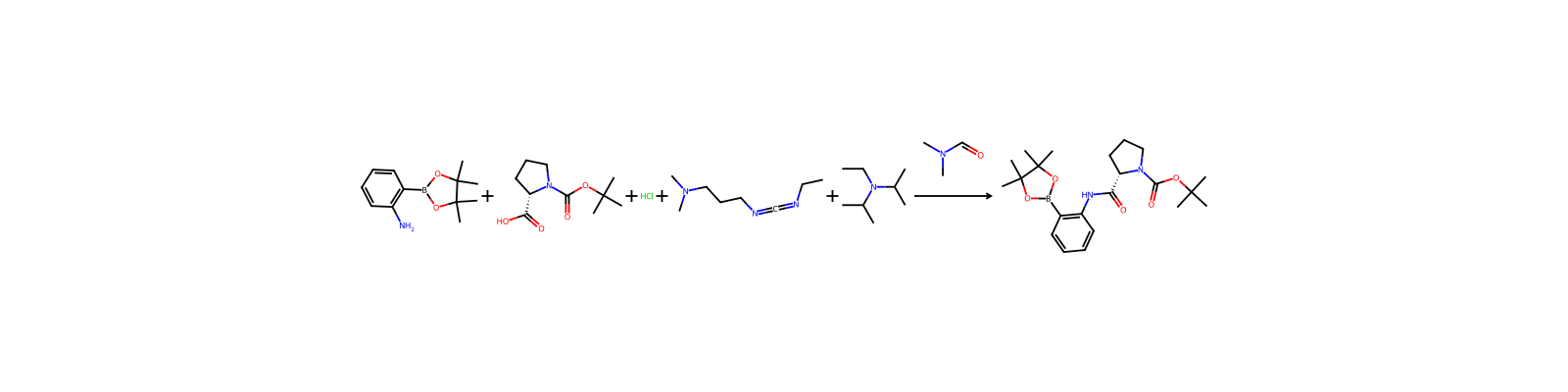
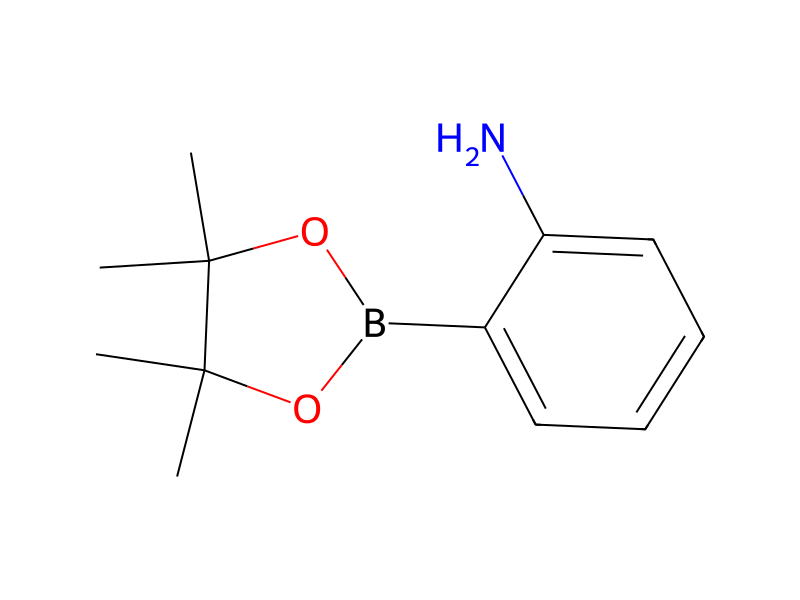
Basic information
- Standard SMILES
CC1(C)OB(c2ccccc2N)OC1(C)C- InChIKey
ZCJRWQDZPIIYLM-UHFFFAOYSA-N- Molecular formula
- C12H18BNO2
- Average molar mass
- 219.09 g/mol
- Monoisotopic mass
- 219.14305922
Names & identifiers
- Preferred name
- 2-(4,4,5,5-Tetramethyl-1,3,2-dioxaborolan-2-yl)aniline
- IUPAC
- 2-(4,4,5,5-tetramethyl-1,3,2-dioxaborolan-2-yl)aniline
- English name
- 2-Aminophenylboronic acid pinacol ester
- Molecular formula
- C12H18BNO2
- Molecular weight
- 219.09
Names & synonyms
191171-55-82-(4,4,5,5-Tetramethyl-1,3,2-dioxaborolan-2-yl)anilineDTXSID50370422RefChem:84285DTXCID30321457626-344-72-Aminophenylboronic acid pinacol esterMFCD021794482-aminophenylboronic acid, pinacol ester2-(tetramethyl-1,3,2-dioxaborolan-2-yl)anilineBenzenamine, 2-(4,4,5,5-tetramethyl-1,3,2-dioxaborolan-2-yl)-2-aminobenzeneboronic acid pinacol ester
Show more names
an-2-yLCAS:191171-55-8-1,3,2-dioxaboroL2-(4,4,5,5-TetramethyL2-Aminophenylboronic A2-DIOXABOROLAN-2-YL)ANILINE2-Aminobenzeneboronic acid pin2-Aminophenylboronic acid picol ester
(2-aminophenyl)boronic acid pinacol esterAKOS005256282AS-3013SY0080612-(2-AMINOPHENYL)-4,4,5,5-TETRAMETHYL-1,3,2-DIOXABOROLANEEN300-1951882-(4,4,5,5-tetramethyl-[1,3,2]dioxaborolan-2-yl)phenylamine2-(4,4,5,5-TETRAMETHYL-1,3,2-DIOXABOROLAN-2-YL)ANILINE;2-AMINOPHENYLBORONIC ACID, PINACOL CYCLIC ESTER;2-AMINOPHENYLBORONIC ACID, PINACOL ESTER;2-AMINOBENZENEBORONIC ACID PINACOL ESTER;2-Aminobenzeneboronic acid pinacol cyclic ester;2-Aminophenylboronic a
Database identifiers
- CAS
191171-55-8- PubChem CID
- 2734652
- DTXSID
DTXSID50370422- EC Number
- 626-344-7
- Nikkaji
- J1.486.110F
Properties
Computed structural properties
- Topological polar surface area
- 44.5 Ų
- Hydrogen bond donors
- 1
- Hydrogen bond acceptors
- 3
- Rotatable bonds
- 1
- Heavy atoms
- 16
- Formal charge
- 0
- Complexity
- 252
Physicochemical properties
- Melting point
- 63 · 63-68 °C (lit.)
- Boiling point
- 125 °C/1.5mmHg · 125°C/1.5mmHg(lit.)
- Density
- 1.05 · 1.05±0.1 g/cm3(Predicted)
- storage temp.
- Keep in dark place,Sealed in dry,Room Temperature
- solubility
- Chloroform (Slightly), Methanol (Slightly)
- pka
- 3.51 · 3.51±0.10(Predicted)
- form
- Crystalline Powder
- color
- Cream
- Water Solubility
- Insoluble
- Sensitive
- Air Sensitive
- BRN
- 8548809 · 8548809
- InChI
- InChI=1S/C12H18BNO2/c1-11(2)12(3,4)16-13(15-11)9-7-5-6-8-10(9)14/h5-8H,14H2,1-4H3
- InChIKey
- ZCJRWQDZPIIYLM-UHFFFAOYSA-N
- SMILES
- C1(N)=CC=CC=C1B1OC(C)(C)C(C)(C)O1
- CAS DataBase Reference
- 191171 · 191171-55-8(CAS DataBase Reference)
- UNSPSC Code
- 12352103 · 12352103
- NACRES
- 22 · NA.22
- Symbol(GHS)
- 7 · GHS07
- Signal word
- Warning
- Hazard statements
- 315 · H315-H319-H335
- Precautionary statements
- 261 · P261-P264-P271-P280-P302+P352-P305+P351+P338
- target organs
- Respiratory system
- PPE
- 95 · dust mask type N95 (US), Eyeshields, Gloves
- Hazard Codes
- Xi,Xn
- Risk Statements
- 36 · 36/37/38-20/21/22
- Safety Statements
- 26 · 26-36
- WGK Germany
- 3 · 3
- HS Code
- 29310099 · 29310099
- Storage Class
- 11 · 11 - Combustible Solids
- Hazard Classifications
- 2 Skin · Eye Irrit. 2Skin Irrit. 2STOT SE 3
Safety & regulation
GHS classification
GHS Classification
Warning
H315 (100%): Causes skin irritation [Warning Skin corrosion/irritation]
P261, P264, P264+P265, P271, P280, P302+P352, P304+P340, P305+P351+P338, P319, P321, P332+P317, P337+P317, P362+P364, P403+P233, P405, and P501 (click each P-code to see the statement)
Aggregated GHS information provided per 48 reports by companies from 7 notifications to the ECHA C&L Inventory. Each notification may be associated with multiple companies.
Hazard information
Hazard Classes and CategoriesSkin Irrit. 2 (100%)
Safety data
- PPE
- dust mask type N95 (US), Eyeshields, Gloves
- wgk
- 3
- hs_code
- 29310099
- risk_code
- 36/37/38-20/21/22
- Signal word
- Warning
- Symbol(GHS)
- GHS07
- hazard_code
- Xi,Xn
- safety_code
- 26-36
- Storage Class
- 11 - Combustible Solids
- target organs
- Respiratory system
- Hazard statements
- H315-H319-H335
- Hazard Classifications
- Eye Irrit. 2Skin Irrit. 2STOT SE 3
- Precautionary statements
- P261-P264-P271-P280-P302+P352-P305+P351+P338
Chemistry & industry
Applications
UsesReactant involved in synthesis of:Indolo[3,4-cd][1]benzazepines via Pictet-Spengler-type cyclizationsAntimicrobial amphiphilic aryl peptideomimeticsPyridoquinazolines and benzo[h][1,6]naphthyridines via intramolecular electrophilic substitution reactionsThienopyridine derivativesDihydroquinolonesMethacrylamidophenylboronic acids
UsesReactant involved in synthesis of: Indolo[3,4-cd]benzazepines via Pictet-Spengler-type cyclizations Antimicrobial amphiphilic aryl peptideomimetics Pyridoquinazolines and benzo[h] naphthyridines via intramolecular electrophilic substitution reaction
Upstream & downstream products
Downstream products
Suppliers50 total
梯希爱(上海)化成工业发展有限公司021-67121386 · [email protected]
上海阿拉丁生化科技股份有限公司400-6206333 13167063860 · [email protected]
Dayang Chem (Hangzhou) Co.,Ltd.+86-0571-88938639 17705817739 · [email protected]
韶远科技(上海)有限公司021-50795510 4000665055 · [email protected]
上海迈瑞尔生化科技有限公司4006356688 18621169109 · [email protected]
北京华威锐科化工有限公司0757-86329057 18934348241 · [email protected]
河北松辰医药科技有限公司0319-5801333-8008 15630992918 · [email protected]
南京药石科技股份有限公司025-86918202 4000255188 · [email protected]
阿法埃莎(中国)化学有限公司400-6106006 · [email protected]
安耐吉化学&3A(安徽泽升科技股份有限公司)400-0056266 · [email protected]
武汉凯威斯科技有限公司86-027-67849912 · [email protected]
上海瀚鸿科技股份有限公司021-54306202 13764082696 · [email protected]
上海相辉医药科技有限公司13761987713 · [email protected]
嘉兴市艾森化工有限公司0573-85285100 18627885956 · [email protected]
Pure Chemistry Scientific Inc.001-857-928-2050 or 1-888-588-9418 · [email protected]
郑州药领医药科技有限公司13526569071 · [email protected]
上海隆盛化工有限公司58099637 13585536065 · [email protected]
武汉丰泰威远科技有限公司+86-27-8746-5837 +86-18627785180 · [email protected]
武汉丰泰威远科技有限公司027-87465837 19945049750 · [email protected]
西安凯翔医药科技有限公司029-86538357
天津希恩思生化科技有限公司400 638 7771 · [email protected]
赛默飞世尔科技(中国)有限公司800-810-5118 · [email protected]
江苏艾康生物医药研发有限公司025-66113011 13913916777 · [email protected]
上海健超生物科技有限公司150-2103-5486 18017383231 · [email protected]
TOKYO CHEMICAL INDUSTRY CO., LTD.03-36680489 · [email protected]
深圳康特腾科技有限公司86-0755-86635001 · [email protected]
越林试剂021-62960152 · [email protected]
上海宸香医药科技有限公司021-20960837 · [email protected]
上海洪创医药科技有限公司18151128828 · [email protected]
苏州爱玛特生物科技有限公司0512-56316828 4008675858 · [email protected]
上海将来实业股份有限公司021-61552785 · [email protected]
HBCChem, Inc.+1-510-219-6317 · [email protected]
上海毕得医药科技股份有限公司400-164-7117 18317119277 · [email protected]
郑州阿尔法化工有限公司0371-53732842 15981811963 · [email protected]
Labnetwork lnc.+86-27-50766799 +86-18062016861 · [email protected]
成都零六生物科技有限公司400-1166-196 13458535857 · [email protected]
上海卓因生物科技有限公司021-61317773 · [email protected]
杭州宇昊化工科技有限公司0571-82693216 · [email protected]
上海御略医药科技有限公司021-60345187 13671753212 · [email protected]
杭州杰恒化工有限公司0571-87396432 · [email protected]
上海嵩爰化工科技有限公司010-1234567 18521000990 · [email protected]
上海蓉霖医药科技有限公司18602194589 · [email protected]
Sigma-Aldrich西格玛奥德里奇(上海)贸易有限公司021-61415566 800-8193336 · [email protected]
铜陵恒优生物科技有限公司021-50426030 13856289449;13124863828 · [email protected]
诺尔凯立科技有限公司86-(0)21-31261262 373522135 · [email protected]
九鼎化学(上海)科技有限公司4009209199 · [email protected]
Henan Alfa Chemical Co., Ltd+8618339805032 · [email protected]
厦门志信化学有限公司+86-5922680277 +86-13806087780 · [email protected]
硼诺科技(北京)有限公司010-15313962280 15313962280 · [email protected]
南京艾比克斯生化科技有限公司025-87193546 18652950785 · [email protected]
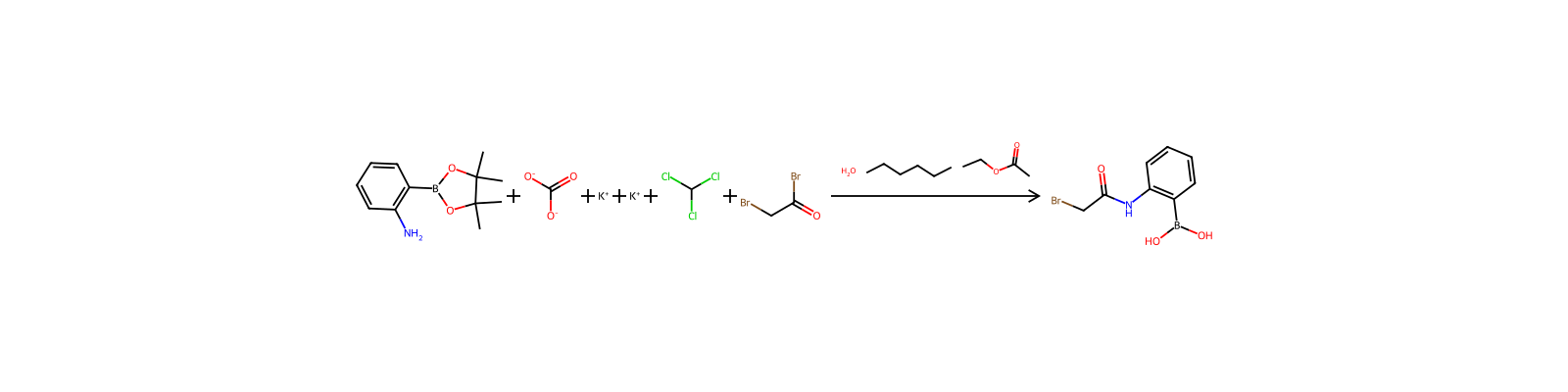
Related reactions
39 records






Linked notes
Loading…