
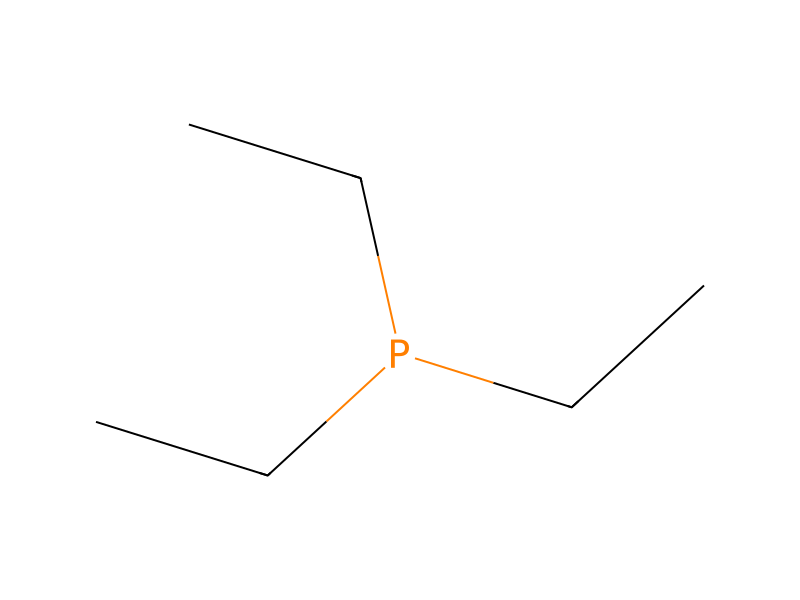
Basic information
- CAS
554-70-1- Standard SMILES
CCP(CC)CC- InChIKey
RXJKFRMDXUJTEX-UHFFFAOYSA-N- Molecular formula
- C6H15P
- Average molar mass
- 118.16 g/mol
- Monoisotopic mass
- 118.09113748
Names & identifiers
- Preferred name
- Triethylphosphine
- IUPAC
- triethylphosphane
- English name
- Triethylphosphine
- Molecular formula
- C6H15P
- Molecular weight
- 118.16
Names & synonyms
TriethylphosphineTRIETHYLPHOSPHANEPhosphine, triethyl-Triethyl phosphineEINECS 209-068-8UNII-5W435D16PMBRN 09691705W435D16PMPhosphorus triethyl4-16-00-01699 (Beilstein Handbook Reference)TRIETHYLPHOSPHINE [MI]DTXSID3060293
Show more names
PEt3Triethylphosphine,99%Et3Ptl409Cytop? 320CYTOP(R) 320AURORA KA-1111HISHICOLIN P-2
CHEBI:39971(C2H5)3Pphosphine, triethylRefChem:191547DTXCID7041885UN2845209-068-8InChI=1/C6H15P/c1-4-7(5-2)6-3/h4-6H2,1-3H
Database identifiers
- CAS
554-70-1- PubChem CID
- 27365
- DTXSID
DTXSID3060293- ChEBI
CHEBI:39971- UNII
- 5W435D16PM
- EC Number
- 209-068-8
- Nikkaji
- J44.119H
Properties
Computed structural properties
- XLogP
- 1
- Topological polar surface area
- 0 Ų
- Hydrogen bond donors
- 0
- Hydrogen bond acceptors
- 0
- Rotatable bonds
- 3
- Heavy atoms
- 7
- Formal charge
- 0
- Complexity
- 25
Experimental & physicochemical properties
Physical DescriptionColorless liquid with an odor of hyacinths; [Merck Index] Pungent odor; [Alfa Aesar MSDS]
Physicochemical properties
- Melting point
- -88 °C · -88°C
- Boiling point
- 127 · 127-128 °C(lit.)
- Density
- 0.88 g/mL · 0.88 g/mL at 20 °C
- refractive index
- 20 · n20/D 1.456(lit.)
- Flash point
- 1 °F · 1 °F
- form
- liquid
- color
- colorless
- Odor
- vile, nauseating odor.stench
- Water Solubility
- Insoluble in water.
- Sensitive
- Air & Moisture Sensitive
- Merck
- 14 · 14,9675
- BRN
- 969170 · 969170
- InChI
- 1S/C6H15P/c1-4-7(5-2)6-3/h4-6H2,1-3H3
Safety & regulation
GHS classification
GHS Classification
Danger
H224 (17.5%): Extremely flammable liquid and vapor [Danger Flammable liquids];H225 (81.2%): Highly Flammable liquid and vapor [Danger Flammable liquids];H250 (100%): Catches fire spontaneously if exposed to air [Danger Pyrophoric liquids];H302 (17.5%): Harmful if swallowed [Warning Acute toxicity, oral];H314 (95%): Causes severe skin burns and eye damage [Danger Skin corrosion/irritation];H318 (17.5%): Causes serious eye damage [Danger Serious eye damage/eye irritation]
P210, P222, P231, P233, P240, P241, P242, P243, P260, P264, P264+P265, P270, P280, P301+P317, P301+P330+P331, P302+P335+P334, P302+P361+P354, P303+P361+P353, P304+P340, P305+P354+P338, P316, P317, P321, P330, P363, P370+P378, P403+P235, P405, and P501 (click each P-code to see the statement)
Aggregated GHS information provided per 80 reports by companies from 4 notifications to the ECHA C&L Inventory. Each notification may be associated with multiple companies.;Information may vary between notifications depending on impurities, additives, and other factors. The percentage value in parenthesis indicates the notified classification ratio from companies that provide hazard codes. Only hazard codes with percentage values above 10% are shown. For more detailed information, please visit ECHA C&L website.
Hazard information
Hazards SummaryPyrophoric; Self-heating in large quantities and may catch fire; An irritant; Harmful by inhalation; [Alfa Aesar MSDS] See Tributylphosphine and tert-Butylphosphine.
Hazard Classes and CategoriesFlam. Liq. 1 (17.5%);Flam. Liq. 2 (81.2%);Pyr. Liq. 1 (100%);Acute Tox. 4 (17.5%);Skin Corr. 1B (95%);Eye Dam. 1 (17.5%)
Toxicology
Toxicity DataLC (mouse) > 1,000 mg/m3/10min
Safety data
Chemistry & industry
Uses & manufacturing
UsesUsed in organic syntheses; [Merck Index]
General Manufacturing InformationPhosphine, triethyl-: ACTIVE
Applications
Usessuzuki reaction
UsesTriethylphosphine is used as a ligand for arylation. It is used in organic synthesis.
UsesIn organic syntheses.
Upstream & downstream products
Downstream products
Suppliers100 total
上海阿拉丁生化科技股份有限公司400-6206333 13167063860 · [email protected]
武汉欣扬瑞和化学科技有限公司13720274133 · [email protected]
武汉欣扬瑞和化学科技有限公司153-07155313 15307155313 · [email protected]
上海遐瑞医药科技有限公司+86-021-61551413 · [email protected]
Related reactions
68 records


Compound notes
Loading…