Reaction equation

[Br:1][CH2:2][CH2:3][CH2:4][CH2:5][CH3:6].C1(C)C=CC=CC=1.[CH2:14]([P:16]([CH2:19][CH3:20])[CH2:17][CH3:18])[CH3:15]>CCCCCC>[Br-:1].[CH2:14]([P+:16]([CH2:19][CH3:20])([CH2:17][CH3:18])[CH2:2][CH2:3][CH2:4][CH2:5][CH3:6])[CH3:15]Participants
Reactant 3


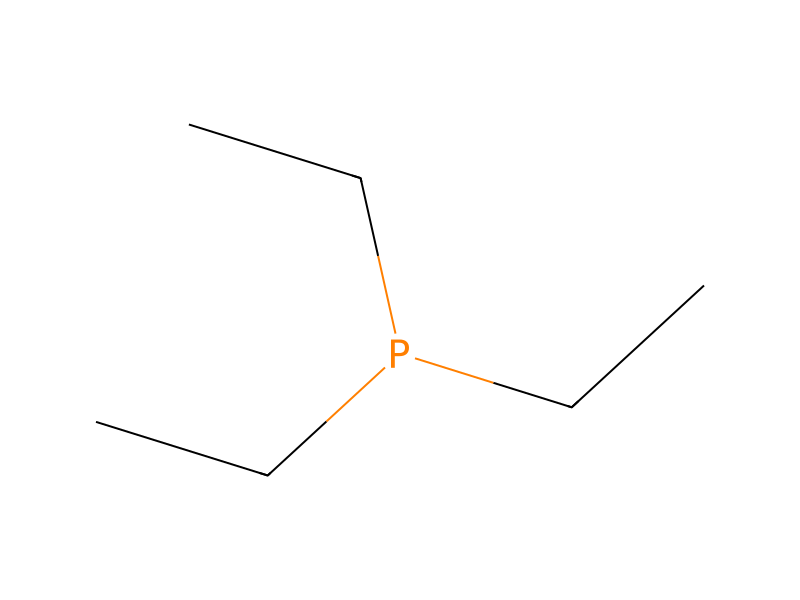
Product 1

Reagents, catalysts & solvents 1

Procedure
77 g (0.5 moles) of 1-bromopentane (a reagent available from Tokyo Chemical Industry Co., Ltd.) was added dropwise in 236 g (0.5 moles) of a 25% toluene solution of triethylphosphine (HISHICOLIN (registered trademark) P-2, a trade name of Nippon Chemical Industrial Co., Ltd.), and the mixture was allowed to react at 70 to 80° C. for 6 hours. After completion of the reaction, hexane was added for crystallization, thereby obtaining 113 g (percent yield: 84%) of a crystal of triethylpentylphosphonium bromide. 27 g (0.3 moles) of sodium dicyanamide (a reagent available from Wako Pure Chemical Industries, Ltd.) was added to 81 g (0.3 moles) of this triethylpentylphosphonium bromide, and the mixture was allowed to react in an aqueous system. Subsequently, the reaction mixture was stirred for aging at room temperature for 3 hours. After completion of stirring, a product was extracted with dichloromethane and passed through a silica gel column for purification. The solvent was distilled off, and the residue was dried in vacuo at 100° C. and at a degree of vacuum of 0.5 kPa for 5 hours. Confirmation of the thus obtained product was carried out by means of 1H-NMR, 13C-NMR and 31P-NMR. A yield of the product (pale yellow transparent liquid) was 77 g (percent yield: 69%), and it was confirmed by 31P-NMR that its purity was 98% or more.
Workup
- customto react at 70 to 80° C. for 6 hours
- additionwas added for crystallization
Sources & evidence
- ORD record
- ord-dded9d6b527343789fff9e8d4f188e8d
- Source dataset
- uspto-grants-2012_01
- Patent number
- US08088995B2
Linked notes
Loading…