

Basic information
- CAS
628692-15-9- Standard SMILES
COc1ncc(B(O)O)cn1- InChIKey
YPWAJLGHACDYQS-UHFFFAOYSA-N- Molecular formula
- C5H7BN2O3
- Average molar mass
- 153.93 g/mol
- Monoisotopic mass
- 154.05497248
Names & identifiers
- Preferred name
- 2-Methoxypyrimidine-5-boronic acid
- IUPAC
- (2-methoxypyrimidin-5-yl)boronic acid
- English name
- 2-Methoxypyrimidine-5-boronic acid
- Molecular formula
- C5H7BN2O3
- Molecular weight
- 153.93
Names & synonyms
2-Methoxypyrimidine-5-boronic acid628692-15-9DTXSID70371597RefChem:262814DTXCID80322631670-240-4(2-methoxypyrimidin-5-yl)boronic Acid2-Methoxy-5-pyrimidineboronic acid2-methoxypyrimidin-5-ylboronic acidMFCD03094664Boronic acid, (2-methoxy-5-pyrimidinyl)-2-Methoxy-5-pyrimidylboronic Acid
Show more names
2-METHOXYL-5-PYRIMIDYLBORIC ACID2-Methoxypyrimidine-5-boronicaci2-Methoxy PyriMidine boronic acid2-METHOXYL-5-PYRIMIDINEBORIC ACID2-MethoxypyriMidine-4-boronic acid
2-Methoxy-5-pyrimidinylboronic Acid(2-methoxypyrimidin-5-yl)boronicAcidHY-W0046982-METHOXYPYRIMIDIN-5-YL-5-BORONIC ACID2-Methoxy-pyrimidine-5-boronic acidMethoxypyrimidine-5-boronic acidA8682SCHEMBL9497
Database identifiers
- CAS
628692-15-9- PubChem CID
- 2736778
- DTXSID
DTXSID70371597- EC Number
- 670-240-4
- Nikkaji
- J2.035.654E
Properties
Computed structural properties
- Topological polar surface area
- 75.5 Ų
- Hydrogen bond donors
- 2
- Hydrogen bond acceptors
- 5
- Rotatable bonds
- 2
- Heavy atoms
- 11
- Formal charge
- 0
- Complexity
- 116
Physicochemical properties
- Melting point
- 161 °C · 161°C(lit.)
- Boiling point
- 378.3 · 378.3±52.0 °C(Predicted)
- Density
- 1.33 · 1.33±0.1 g/cm3(Predicted)
- storage temp.
- Keep in dark place,Sealed in dry,Room Temperature
- solubility
- soluble in Methanol
- form
- powder to crystal
- pka
- 5.59 · 5.59±0.11(Predicted)
- color
- White to Light yellow
- InChI
- InChI=1S/C5H7BN2O3/c1-11-5-7-2-4(3-8-5)6(9)10/h2-3,9-10H,1H3
- InChIKey
- YPWAJLGHACDYQS-UHFFFAOYSA-N
- SMILES
- B(C1=CN=C(OC)N=C1)(O)O
- CAS DataBase Reference
- 628692 · 628692-15-9(CAS DataBase Reference)
- UNSPSC Code
- 12352106 · 12352106
- NACRES
- 21 · NA.21
- Symbol(GHS)
- 7 · GHS07
- Signal word
- Warning
- Hazard statements
- 302 · H302-H319
- Precautionary statements
- 264 · P264-P270-P280-P301+P312-P305+P351+P338-P337+P313
- Hazard Codes
- Xi
- Risk Statements
- 36 · 36-41-36/37/38
- Safety Statements
- 26 · 26-39-36/37/39
- WGK Germany
- 3 · WGK 3
- HazardClass
- IRRITANT
- HS Code
- 29349990 · 29349990
- Storage Class
- 11 · 11 - Combustible Solids
- Hazard Classifications
- 4 OralEye · Acute Tox. 4 OralEye Irrit. 2
Safety & regulation
GHS classification
GHS Classification
Warning
H302 (89.1%): Harmful if swallowed [Warning Acute toxicity, oral]
P261, P264, P264+P265, P270, P271, P280, P301+P317, P302+P352, P304+P340, P305+P351+P338, P319, P321, P330, P332+P317, P337+P317, P362+P364, P403+P233, P405, and P501 (click each P-code to see the statement)
Aggregated GHS information provided per 46 reports by companies from 7 notifications to the ECHA C&L Inventory. Each notification may be associated with multiple companies.
Hazard information
Hazard Classes and CategoriesAcute Tox. 4 (89.1%)
Safety data
- wgk
- WGK 3
- hs_code
- 29349990
- risk_code
- 36-41-36/37/38
- Signal word
- Warning
- Symbol(GHS)
- GHS07
- hazard_code
- Xi
- safety_code
- 26-39-36/37/39
- hazard_class
- IRRITANT
- Storage Class
- 11 - Combustible Solids
- Hazard statements
- H302-H319
- Hazard Classifications
- Acute Tox. 4 OralEye Irrit. 2
- Precautionary statements
- P264-P270-P280-P301+P312-P305+P351+P338-P337+P313
Chemistry & industry
Applications
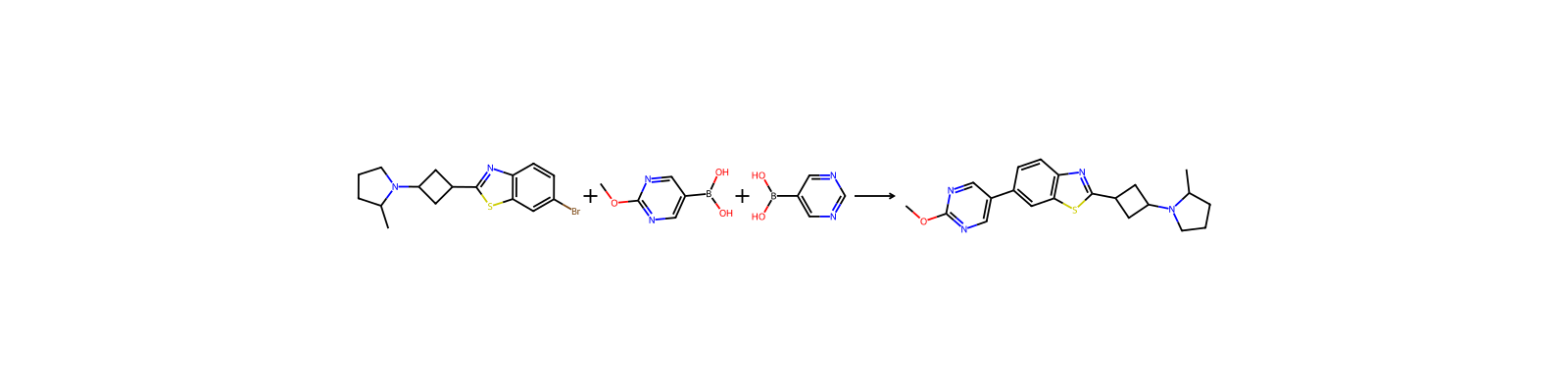
Uses2-Methoxypyrimidine-5-boronic acid serves as a coupling partner in Suzuki–Miyaura reactions to synthesize diverse heterocyclic scaffolds. It reacts with intermediates such as compound 26 or 6-bromo-3-(4-hydroxyphenyl)-coumarin using potassium carbonate and palladium catalysts (e.g., Pd(OAc)₂ or 1,1′-bis(di-tert-butylphosphino)ferrocene palladium dichloride) in solvents including DMF or deep eutectic systems at 85 °C. The reagent also couples with 2-(4-((4-chloro-6-morpholino-1,3,5-triazin-2-yl)amino)phenyl)ethan-1-ol in DME/aqueous sodium carbonate under microwave heating[1][2][3]. The compound participates in Liebeskind–Srögl couplings with thioester or amide intermediates (such as series 18a–18c or 20a–20f) using tetrakis(triphenylphosphine)palladium(0) and copper(I) thiophene-2-carboxylate in THF at 100 °C, yielding target products in ranges of 22–55% or 29–50%[1].
Upstream & downstream products
Upstream raw materials
Downstream products
Suppliers100 total
梯希爱(上海)化成工业发展有限公司021-67121386 · [email protected]
INTATRADE GmbH+49 3493/605464 · [email protected]
T&W GROUP021-61551611 13296011611 · [email protected]
Dayang Chem (Hangzhou) Co.,Ltd.+86-0571-88938639 17705817739 · [email protected]
科瑞迪化学400-821-5857 021-64326257 · [email protected]
北京华威锐科化工有限公司0757-86329057 18934348241 · [email protected]
河北松辰医药科技有限公司0319-5801333-8008 15630992918 · [email protected]
安耐吉化学&3A(安徽泽升科技股份有限公司)400-0056266 · [email protected]
上海恩诺生物科技有限公司+86 (21) 6435-5022
上海瀚鸿科技股份有限公司021-54306202 13764082696 · [email protected]
石家庄德科达化工有限公司0311-67790228 15531158659 · [email protected]
上海萃森医药科技有限公司13472757003
上海钰康生物科技有限公司+86-18930848214 +86-021-56762820 · [email protected]
上海相辉医药科技有限公司13761987713 · [email protected]
Pure Chemistry Scientific Inc.001-857-928-2050 or 1-888-588-9418 · [email protected]
上海隆盛化工有限公司58099637 13585536065 · [email protected]
上海攀鸿化工科技有限公司021-56491756 13512199871 · [email protected]
杰达维(上海)医药科技发展有限公司/J & W PharmLab021-64340559 · [email protected]
杭州东帆化学有限公司86-0571-85151182
skychemical Co.Ltd021-20958197 20965099 · [email protected]
南京博源医药科技有限公司025-58649566 15005191108 · [email protected]
成都法玛斯医药有限公司15528092102 · [email protected]
苏州岚云医药科技有限公司2332782371 · [email protected]
赛默飞世尔科技(中国)有限公司800-810-5118 · [email protected]
上海遐瑞医药科技有限公司+86 21 61551611
江苏艾康生物医药研发有限公司025-66113011 13913916777 · [email protected]
上海健超生物科技有限公司150-2103-5486 18017383231 · [email protected]
TCI AMERICA800-4238616 · [email protected]
TOKYO CHEMICAL INDUSTRY CO., LTD.03-36680489 · [email protected]
TCI Europe320-37350700 · [email protected]
Labex Corporation+91-11-26135922 or +91-11-46160359 · [email protected]
上海卡洛化学有限公司21-33526724 18930996265 · [email protected]
上海仁曲医药科技有限公司18171398856 2968382473 · [email protected]
上海偕腾生物科技有限公司+86-021-58975553 · [email protected]
深圳康特腾科技有限公司86-0755-86635001 · [email protected]
越林试剂021-62960152 · [email protected]
Clearsynth Labs Limited+91-22-26355700 · [email protected]
上海彰锐化工科技有限公司021-54880687
上海宸香医药科技有限公司021-20960837 · [email protected]
上海湄水化工科技有限公司021-60549325 18616193163
泰州同新生物医药科技有限公司0523-86818997 18652728585 · [email protected]
上海毕得医药科技股份有限公司400-164-7117 18317119277 · [email protected]
Labnetwork lnc.+86-27-50766799 +86-18062016861 · [email protected]
上海石洋化工有限公司021-56795766 · [email protected]
湖南华腾制药有限公司400-8592883 · [email protected]
成都安斯利生物医药有限公司028-85305008 02885305008 · [email protected]
凯试(上海)科技有限公司021-50135380 · [email protected]
上海皓骏医药科技有限公司021-34621078 13120882795 · [email protected]
北京六合宁远医药科技股份有限公司010-60400365-8001 15910885229 · [email protected]
上海皓之翔生物科技有限公司(原上海拓青化工有限公司)526763801 13301653310 · [email protected]
Related reactions
135 records




Compound notes
Loading…