
HRID 150825As reactant
Completing data — refresh the page later to see the latest
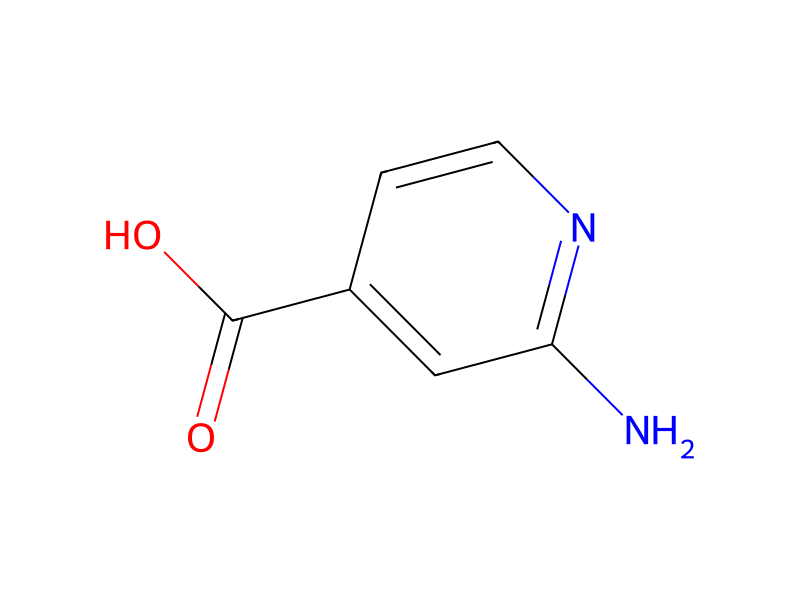
13362-28-2Nc1cc(C(=O)O)ccn1QMKZZQPPJRWDED-UHFFFAOYSA-N13362-28-2DTXSID40299072CHEMBL3322866Safety information is for reference only and does not replace the supplier’s Safety Data Sheet (SDS), applicable regulations, or professional assessment.
Warning
H302 (84.8%): Harmful if swallowed [Warning Acute toxicity, oral]
P261, P264, P264+P265, P270, P271, P280, P301+P317, P302+P352, P304+P340, P305+P351+P338, P319, P321, P330, P332+P317, P337+P317, P362+P364, P403+P233, P405, and P501 (click each P-code to see the statement)
Aggregated GHS information provided per 46 reports by companies from 5 notifications to the ECHA C&L Inventory. Each notification may be associated with multiple companies.
Uses2-Aminoisonicotinic acid, a common organic synthetic intermediate, is primarily used as a molecular backbone in the structural modification and synthesis of pyridine-containing drug molecules. Furthermore, because this compound contains both amino and carboxyl groups, it also has excellent applications in supramolecular chemistry and the construction of metal-organic frameworks. The carboxyl group on its pyridine ring can be converted to an ester group under normal acidic esterification conditions, or to an amide via the addition of amines to sulfoxide.
DescriptionAs an organic acid, 2-Aminoisonicotinic acid (AN) can be grafted onto chitosan chains through amidation, thereby introducing 2-aminopyridine residues with good hydration capacity. Due to its specific chemical structure possessing push-pull effects and suitable length, 2-aminoisonicotinic acid is a promising ligand for the design of functional metal-organic frameworks. In addition, some studies demonstrated that the compounds bearing 2-aminopyridine residues showed good antibacterial activities. Given its functional characteristics, the grafting of 2-amino isonicotinic acid onto chitosan is expected to exhibit good water solubility and antibacterial activity and serve as an effective ligand to form stable chitosaniodine complexes with iodine for antibacterial applications[1].


