
HRID 35275As reactant
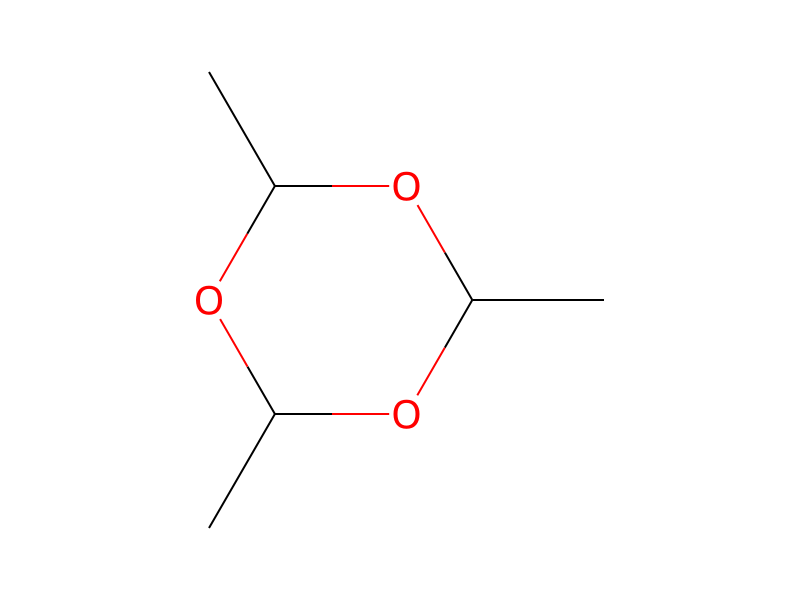
123-63-7CC1OC(C)OC(C)O1SQYNKIJPMDEDEG-UHFFFAOYSA-NParaldehyde appears as a clear colorless liquid with a pleasant odor. Flash point 96 °F. Melting point 54 °F. Less dense than water. Vapors are heavier than air.
123-63-7、1499-02-1DTXSID9023419CHEMBL1410743CHEBI:27909Other Classes -> Aldehydes
Flammable agents - 3rd degree
DEA NFLIS-Drug Category -> Depressants and Tranquilizers
DEA Schedule IV Controlled Substance -> Depressants
Pharmaceuticals -> Listed in ZINC15
Pharmaceuticals -> Antiepileptics
Log Kow = 0.67
0.67
0.67
0.67
CHARACTERISTIC AROMATIC ODOR
Agreeable odor
DISAGREEABLE TASTE
Burning taste
0.9943 at 68 °F (USCG, 1999) - Less dense than water; will float
0.9923 @ 20 °C/4 °C
SPECIFIC HEAT 0.434; BULK DENSITY 8.27 LB/GAL (20 °C)
0.99 g/cm³
0.9943 @ 20°C
Safety information is for reference only and does not replace the supplier’s Safety Data Sheet (SDS), applicable regulations, or professional assessment.
Warning
H226: Flammable liquid and vapor [Warning Flammable liquids]
P210, P233, P240, P241, P242, P243, P280, P303+P361+P353, P370+P378, P403+P235, and P501 (click each P-code to see the statement)
This chemical does not meet GHS hazard criteria for < 0.1% (1 of 1566) of reports.
Warning
H226 (> 99.9%): Flammable liquid and vapor [Warning Flammable liquids]
Chemical: 1,3,5-Trioxane, 2,4,6-trimethyl-
DEA schedule IV controlled substance
SP - indicates a substance that is identified in a proposed Significant New Use Rule.
REACH registered substance: 2,4,6-trimethyl-1,3,5-trioxane (EC: 204-639-8)
1,3,5-Trioxane, 2,4,6-trimethyl-: HSNO Approval: HSR001209 Approved with controls
The New Jersey Worker and Community Right to Know Act requires public and private employers to provide information about hazardous substances at their workplaces. (N.J.S.A. 34:5A-1 et. seq.)
Special Hazards of Combustion Products: Emits toxic fumes on heating.
· HIGHLY FLAMMABLE: Will be easily ignited by heat, sparks or flames.
Highly flammable. Above 24 °C explosive vapour/air mixtures may be formed.
DANGEROUS, WHEN EXPOSED TO HEAT, FLAME OR OXIDIZERS.
FLAMMABLE LIQUID.
INHALATION AND INGESTION: Irritation, headache, bronchitis, pulmonary edema. Irritating to digestive tract. Hypnotic and analgesic properties. Incoordination and drowsiness, followed by sleep. Larger doses-coma-weak pulse and shallow respiration, cyanosis-death from respiratory paralysis. EYES: irritation-can cause serious injury. SKIN: Dermatitis (skin inflammation). (USCG, 1999)
· May cause toxic effects if inhaled or absorbed through skin.
Paraldehyde is subject to control under the Federal Control Substance Act of 1970 as a schedule IV (C-IV) drug.
Paraldehyde is an indirect food additive for use as a component of adhesives.
Derivatives designated as a habit forming drug.
USEPA/ECAO; Health and Environmental Effects Profile for Paraldehyde (1989) EPA/600/X-86/169. /This document contains/ both published literature and information obtained from Agency program office files were evaluated as they pertained to potential human health, aquatic life,and environmental effects of hazardous waste constituents. Existing data are insufficient to determine a reference dose or a carcinogenic potency factor for paraldehyde.
... Paraldehyde, diazepam, secobarbital and valproic acid are used when rapid effect for termination of prolonged or serial seizures is desired.[Graves NM, Kriel RL; Pediatr Neurol 3 (6): 321-6 (1987)]
Excerpt from ERG Guide 129 [Flammable Liquids (Water-Miscible / Noxious)]:
Use water spray, alcohol-resistant foam, dry powder, carbon dioxide. In case of fire: keep drums, etc., cool by spraying with water.
Fresh air, rest. Refer for medical attention.
Remove contaminated clothes. Rinse and then wash skin with water and soap.
First rinse with plenty of water for several minutes (remove contact lenses if easily possible), then refer for medical attention.
Do NOT induce vomiting. Give one or two glasses of water to drink. Refer for medical attention .
· CALL 911. Then call emergency response telephone number on shipping paper. If shipping paper not available or no answer, refer to appropriate telephone number listed on the inside back cover.
· ELIMINATE all ignition sources (no smoking, flares, sparks or flames) from immediate area.
EYES: First check the victim for contact lenses and remove if present. Flush victim's eyes with water or normal saline solution for 20 to 30 minutes while simultaneously calling a hospital or poison control center. Do not put any ointments, oils, or medication in the victim's eyes without specific instructions from a physician. IMMEDIATELY transport the victim after flushing eyes to a hospital even if no symptoms (such as redness or irritation) develop.
General First Aid:
Use water spray, dry chemical, "alcohol resistant" foam, or carbon dioxide. Water may be ineffective. Use water spray to keep fire exposed containers cool. Approach fire from upwind to avoid hazardous vapors and toxic decomposition products.
If material is on fire or involved in a fire: Do not extinguish fire unless flow can be stopped. Use water in flooding quantities as fog. Solid streams of water may spread fire. Cool all affected containers with flooding quantities of water. Apply water from as far a distance as possible. Use "alcohol" foam, dry chemical or carbon dioxide.
PARALDEHYDE SHOULD BE STORED IN WELL-FILLED, TIGHT, LIGHT-RESISTANT GLASS CONTAINERS WITH A CAPACITY OF NO MORE THAN 30 ML, AT A TEMP NOT EXCEEDING 25 °C.
Store in a cool, dry, well ventilated location. Separate from alkalies, acids, iodides, oxidizing material, rubber, and plastic. Inside storage should be in a standard flammable liquids storage warehouse, room, or cabinet.
IT IS BEST STORED IN 2- OR 5-ML AMPULES, WHICH CAN BE OPENED FRESHLY & UNUSED CONTENTS DISCARDED.
SRP: At the time of review, criteria for land treatment or burial (sanitary landfill) disposal practices are subject to significant revision. Prior to implementing land disposal of waste residue (including waste sludge), consult with environmental regulatory agencies for guidance on acceptable disposal practices.
A good candidate for liquid injection incineration at a temperature range of 650 to 1,600 °C and a residence time of 0.1 to 2 seconds. A good candidate for rotary kiln incineration at a temperature range of 820 to 1,600 °C and residence times of seconds for liquids and gases, and hours for solids. A good candidate for fluidized bed incineration at a temperature range of 450 to 980 °C and residence times of seconds for liquids and gases, and longer for solids.
Remove all ignition sources. Personal protection: filter respirator for organic gases and vapours adapted to the airborne concentration of the substance. Collect leaking and spilled liquid in sealable non-plastic containers as far as possible. Absorb remaining liquid in sand or inert absorbent. Then store and dispose of according to local regulations.
Animal studies indicate that disulfiram slows the metabolism of paraldehyde by way of inhibition of acetaldehyde dehydrogenase resulting in an increase in blood concn of paraldehyde & acetaldehyde. Until this potential interaction is investigated in humans, paraldehyde & disulfiram should be admin together with caution.
INTERACTIONS BETWEEN PARALDEHYDE & ETHYL ALCOHOL ARE NOT WELL UNDERSTOOD ... DOSES OF 1-2 OZ IN ALCOHOLICS SOMETIMES KILL WITHIN 0.5-4 HR. IN ANIMALS ETHANOL & PARALDEHYDE ARE SYNERGISTIC BUT LESS THAN ADDITIVE IN TERMS OF LETHALITY; UNDER SOME DOSAGE SCHEDULES, HOWEVER, EXPTL DATA SUGGEST THAT THESE DRUGS ARE ANTAGONISTIC.
ADDITIVE CNS DEPRESSION MAY OCCUR WHEN PARALDEHYDE IS ADMIN CONCOMITANTLY WITH OTHER CNS DEPRESSANTS SUCH AS BARBITURATES OR ALCOHOL. SOME FATALITIES HAVE BEEN ASSOCIATED WITH CONCOMITANT USE OF ALCOHOL & PARALDEHYDE.
The increased acetate levels which may follow paraldehyde administration reportedly may increase the danger of sulfonamide crystalluria.
For more Interactions (Complete) data for PARALDEHYDE (7 total), please visit the HSDB record page.
TERRESTRIAL FATE: If released to soil, paraldehyde may volatilize rapidly from soil surfaces or it may leach into deeper soil. Potential degradation products include acetaldehyde and acetic acid. (SRC)
AQUATIC FATE: If released to water, volatilization is expected to be an important, if not the dominant, fate process (half-life in a model river: 31 hr). Paraldehyde is not expected to bioaccumulate in aquatic organisms, or adsorb to suspended solids and sediments in water. (SRC)
ATMOSPHERIC FATE: Based on a vapor pressure of 25.5 mm Hg at 20 °C(1), paraldehyde is expected to exist almost entirely in the vapor phase in the atmosphere(2,SRC). Reaction with photochemically generated hydroxyl radicals is expected to be the dominant removal mechanism (half-life 45 hours). The relatively high water solubility of paraldehyde (125,000 mg/l at 25 °C(3)) suggests that this compound may also be removed from the atmosphere in precipitation(SRC).
Burning sensation. Cough. Shortness of breath. Further see Ingestion.
Redness. Pain.
Redness. Pain.
Burning sensation in the throat and chest. Nausea. Vomiting. Diarrhoea. Drowsiness. Unconsciousness.
Soil adsorption coefficients (Koc) of 7-55 were estimated for paraldehyde using linear regression equations based on a water solubility of 125,000 mg/l at 25 °C and a log Kow of 0.67(1,2,3,SRC). These Koc values suggest that paraldehyde would be very highly mobile in soil and that adsorption to suspended solids and sediments in water would be insignificant(4,SRC).
... IT MAY PRODUCE EXCITEMENT OR DELIRIUM IN PRESENCE OF PAIN. ... IN LARGE DOSES, IT PRODUCES RESPIRATORY DEPRESSION & HYPOTENSION.
SOME DELAY IN ONSET OF RESP MOVEMENTS HAS BEEN OBSERVED IN NEONATES FOLLOWING ITS ADMIN TO MOTHER DURING LABOR.
Patients poisoned by paraldehyde commonly exhibit very rapid, labored respiratory movements. Acidosis, bleeding gastritis, muscular irritability, azotemia, oliguria, albuminuria, leukocytosis, fatty changes in the liver and kidney with toxic hepatitis and nephrosis, pulmonary hemorrhages and edema, and dilatation of the right ventricle have all been observed in cases of severe acute or chronic paraldehyde poisoning.
Chronic paraldehyde intoxication results in tolerance and dependence. The paraldehyde addict may become acquainted with the drug when it is used in the treatment of alcoholism and then, surprisingly in view of its disagreeable taste and odor, prefer it to alcohol. Paraldehyde addiction resembles alcoholism, and sudden withdrawal may result in delirium tremens and vivid hallucinations.
For more Human Toxicity Excerpts (Complete) data for PARALDEHYDE (18 total), please visit the HSDB record page.
Paraldehyde may be released to the environment in emissions or effluents from sites of its manufacture or industrial use (paraldehyde is used as a drug, chemical intermediate, dyestuff intermediate, and solvent(1)) and from disposal of wastes containing this compound (ie hospital wastes)(2,3,SRC).
Based on a water solubility of 125,000 mg/l at 25 °C and a log Kow of 0.67, bioconcentration factors (BCF) of 0.8-2 were estimated for paraldehyde(1,2,3,SRC). These BCF values suggest that paraldehyde would not bioaccumulate significantly in aquatic organisms(SRC).
Paraldehyde is subject to control under the Federal Control Substance Act of 1970 as a schedule IV (C-IV) drug.
Paraldehyde is an indirect food additive for use as a component of adhesives.
Derivatives designated as a habit forming drug.
U182; As stipulated in 40 CFR 261.33, when paraldehyde, as a commercial chemical product or manufacturing chemical intermediate or an off-specification commercial chemical product or a manufacturing chemical intermediate, becomes a waste, it must be managed according to Federal and/or State hazardous waste regulations. Also defined as a hazardous waste is any residue, contaminated soil, water, or other debris resulting from the cleanup of a spill, into water or on dry land, of this waste. Generators of small quantities of this waste may qualify for partial exclusion from hazardous waste regulations (40 CFR 261.5).
This action promulgates standards of performance for equipment leaks of Volatile Organic Compounds (VOC) in the Synthetic Organic Chemical Manufacturing Industry (SOCMI). These standards implement Section 111 of the Clean Air Act and are based on the Administrator's determination that emissions from the SOCMI cause, or contribute significantly to, air pollution which may reasonably be anticipated to endanger public health or welfare. The intended effect of these standards is to require all newly constructed, modified, and reconstructed SOCMI process units to use the best demonstrated system of continuous emission reduction for equipment leaks of VOC, considering costs, non air quality health and environmental impact and energy requirements. Paraldehyde is produced, as an intermediate or final product, by process units covered under this subpart. These standards of performance become effective upon promulgation but apply to affected facilities for which construction or modification commenced after January 5, 1981.
Persons in charge of vessels or facilities are required to notify the National Response Center (NRC) immediately, when there is a release of this designated hazardous substance, in an amount equal to or greater than its reportable quantity of 1000 lb or 454 kg. The toll free number of the NRC is (800) 424-8802; In the Washington D.C. metropolitan area (202) 426-2675. The rule for determining when notification is required is stated in 40 CFR 302.4 (section IV. D.3.b).
N - Nervous system
QN - Nervous system
Paraldehyde is believed to reduce the release of acetylcholine in response to neuronal depolarization. The exact mechanism of this effect is unknown.
BELIEVED TO DEPRESS MANY LEVELS OF CNS INCLUDING ASCENDING RETICULAR ACTIVATING SYSTEM TO CAUSE IMBALANCE BETWEEN INHIBITORY & FACILITATORY MECHANISMS.
The mean half life is 7.5 hours in a range if 3.5-9.5 hours.
The biological half-life of paraldehyde /in humans/ has been reported to be 3.5 to 9.5 hours with an average of about 7.5 hours.
Paraldehyde is believed to undergo depolymerization to acetaldehyde followed by oxidation by aldehyde dehydrogenase. It is thought to ultimately be metabolized to carbon dioxide and water.
It is believed that paraldehyde is depolymerized to acetaldehyde in the liver & then oxidized by aldehyde dehydrogenase to acetic acid, which is ultimately metabolized to carbon dioxide & water.
Drugs used to prevent SEIZURES or reduce their severity.
Drugs used to induce drowsiness or sleep or to reduce psychological excitement or anxiety.
93% of orally administered paraldehyde is absorbed from the gastrointestinal tract.
70-80% is metabolized to carbon dioxide and subsequently exhaled. 11-28% is exhaled as the parent compound. 0.1-2.5% is excreted in the urine as the parent compound.
Paraldehyde is rapidly absorbed from ... IM injection sites. Maximum serum concn, which may range from 34 to 150 ug/ml, are reached within 20-60 minutes following oral admin of 10 ml ... or IM admin of 0.25 ml/kg. ... Although tissue distribution ... has not been extensively studied, it is known that the concn ... in CSF is about 25 to 30% lower than that in the blood. Maximum paraldehyde concn are reached in the CSF 30-60 minutes after oral or IM admin ...
Oral paraldehyde is rapidly absorbed and widely distributed; the drug readily crosses the placental barrier. With hypnotic doses, 70 to 80% is metabolized in the liver, most of the remainder is exhaled, and a small amount is excreted in urine.
... PARALDEHYDE EQUILIBRATES RAPIDLY BETWEEN MATERNAL & FETAL BLOODS.
FETAL/MATERNAL CONCN RATIO IS 0.94. /FROM TABLE/
Used as a substitute for acetaldehyde, an intermediate for dyes and other organic compounds, a solvent (fats, oils, waxes, gums, and resins), a rubber accelerator, and a medication (anticonvulsant and sedative); [HSDB] No longer prescribed as a medication; Was used as a motor fuel from 1939-1945; [Ullmann]
SUBSTITUTE FOR ACETALDEHYDE; MFR DYESTUFF INTERMEDIATES; SOLVENT FOR FATS, OILS, WAXES, GUMS, RESINS; LEATHER, MIXTURES FOR CELLULOSE DERIVATIVES
MFR ORGANIC COMPOUNDS
INDUSTRIALLY IT HAS BEEN USED AS SOLVENT & ALSO AS RUBBER ACTIVATOR & ANTIOXIDANT
Used in chemical synthesis as a source of acetaldehyde whereby resin formation and other secondary reactions are largely eliminated. ... for instance, ... production of pyridines and chlorination of chloral.
MEDICATION
PREPD BY POLYMERIZATION OF ACETALDEHYDE CATALYZED BY HCL & H2SO4 AT MEDIUM TO HIGH TEMP. CATALYZED BY MIXTURE OF H2SO4 & H3PO4.
BY TREATING ACETALDEHYDE WITH SMALL QUANTITIES OF SULFUR DIOXIDE, HYDROCHLORIC ACID, CARBONYL CHLORIDE, OR ZINC CHLORIDE; ALMOST COMPLETE CONVERSION OCCURS, & BY FREEZING LIQ & THEN DISTILLING CRYSTALLIZED MATERIAL, IF NECESSARY, PURE PARALDEHYDE IS PRODUCED.
Grade: Technical, USP.
Paraldehyde: Oral & Rectal (liquid) Paral (C-IV) from Forest.
Paraldehyde: Parenteral (Sterile) Paraldehyde injection (C-IV) from CMC.
The British Pharmacopeia specifies that it contains a suitable amount of an antioxidant; the USA Pharmacopeia permits a suitable stabilizer.
For more Formulations/Preparations (Complete) data for PARALDEHYDE (8 total), please visit the HSDB record page.
Fragrance Ingredients
Flavouring Agent -> FLAVOURING_AGENT -> JECFA Functional Classes
Environmental transformation -> Pesticide transformation products (metabolite, successor)
1,3,5-Trioxane, 2,4,6-trimethyl-: ACTIVE
/Paraldehyde is/ a cyclic polymer (trimer) of acetaldehyde.
DescriptionParaldehyde was first synthesized in 1829 by Wildenbusch and introduced into clinical practice in the United Kingdom by the Italian physician Vincenzo Cervello in 1882. Paraldehyde, a polymer of acetaldehyde, is a clear colorless or slightly yellow transparent liquid with a strong aromatic as well as a disagreeable taste that at low temperatures, it solidifies into a crystalline mass. This agent decomposes with strong into toxic products that may be released into water, soil, or atmosphere.
UsesParaldehyde is used in ethanol hangover prevention. It is also used in the treatment of rectal diseases in patients with delirium tremens.
UsesParaldehyde is used as solvent for fats, oils, waxes, rubber and resins; as substitute for acetaldehyde; as intermediate for organic chemicals, dyestuffs, accelerators for vulcanizations, rubber oxidants, etc. Product Data Sheet
UsesReactant involved in:• ;Modified Sanford reaction1• ;Synthesis of N-arylbenzoquinaldinium derivatives with antimicrobial activity2• ;Hydroformylation of alkenylamines3• ;Studies of molecules with inhibitory activity against HIV-1 integrase4• ;Irregular Wittig reactions for the formation of α-hydroxyketones5
Usesmanufacture of organic compounds.
General DescriptionParaldehyde is recognizable as the cyclictrimer of acetaldehyde. It is a liquid with a strong characteristicodor detectable in the expired air and an unpleasanttaste. These properties limit its use almost exclusively toan institutional setting (e.g., in the treatment of deliriumtremens). In the past, when containers were opened and airadmitted and then reclosed and allowed to stand, fatalitiesoccurred because of oxidation of paraldehyde to glacialacetic acid.
PreparationPrepared by the polymerization of acetaldehyde catalyzed by hydrochloric acid and sulfuric acid at medium to high temperatures.
DefinitionChEBI: Paraldehyde is a trioxane that is 1,3,5-trioxane substituted by methyl groups at positions 2, 4 and 6. It has a role as a sedative.


