HomeMCPWorkbenchSkills
HomeWorkbenchNotificationsMe
llms.txt · MCP GuidePrivacy Policy · Terms of Service · Supportv1.8.3
  1. Home
  2. /Compound

Disperse Violet 1

HCID 31420
New reaction
Print
Basic informationNames & identifiersPropertiesSafety & regulationChemistry & industryRelated reactionsCompound notes
Substructure searchFind similar structures

Basic information

CAS
128-95-0
Standard SMILES
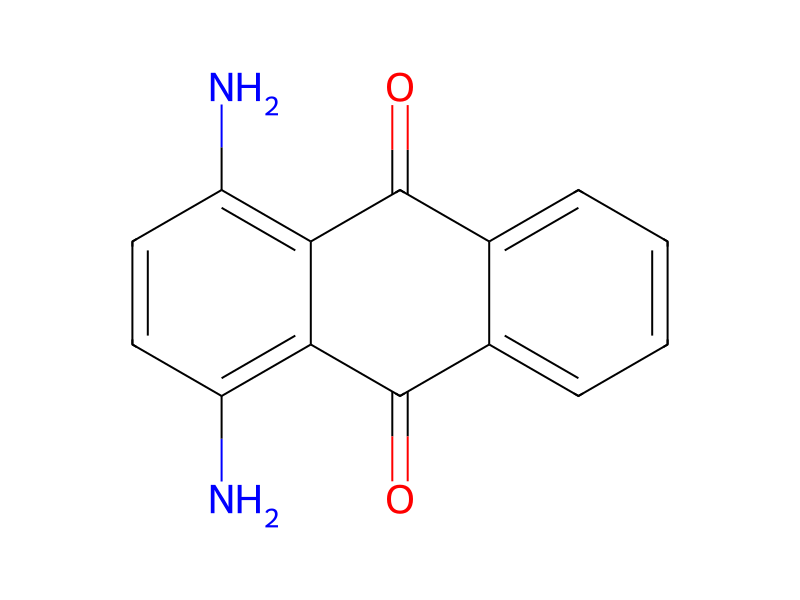
Nc1ccc(N)c2c1C(=O)c1ccccc1C2=O
InChIKey
FBMQNRKSAWNXBT-UHFFFAOYSA-N
Molecular formula
C14H10N2O2
Average molar mass
238.24 g/mol
Monoisotopic mass
238.07422757

Names & identifiers

Preferred name
Disperse Violet 1
IUPAC
1,4-diaminoanthracene-9,10-dione
English name
1,4-Diamino anthraquinone
Molecular formula
C14H10N2O2
Molecular weight
238.24

Names & synonyms

1,4-Diaminoanthraquinone128-95-0Disperse violet 1KrisolamineAcetate Red Violet ROracet Violet 2RCibacet Violet 2R9,10-Anthracenedione, 1,4-diamino-Grasol Violet RSeacyl Violet RSetacyl Violet RDisperse Violet K
Show more names
1,4-diaminoanthracene-9,10-dioneCI 611001,4-diamino-9,10-anthracenedioneNSC 7833NSC 63807oilvioletrViolet ER
C.I. Disperse Violet 1Gracet Violet 2RResiren Violet TRSetile Violet 3RAmacel heliotrope RDuranol Violet 2RNacelan Violet 4RDispersive Violet K

Database identifiers

CAS
128-95-0、71775-54-7
PubChem CID
31420
DTXSID
DTXSID2041252
ChEMBL
CHEMBL86771
UNII
N21HDQ0TKN
EC Number
204-922-6、615-398-7
Nikkaji
J3.264F、J710.752H

Properties

Computed structural properties

XLogP
2.6
Topological polar surface area
86.2 Ų
Hydrogen bond donors
2
Hydrogen bond acceptors
4
Rotatable bonds
0
Heavy atoms
18
Formal charge
0
Complexity
346

Experimental & physicochemical properties

Chemical Classes · 2 items

Dyes -> Anthraquinone Dyes

Dye

Cosmetics · 2 items

Cosmetic ingredients (Disperse Violet 1) -> CIR (Cosmetic Ingredient Review)

Hair dyeing

SpringerMaterials PropertiesBoiling point
LogP3.0
Physical DescriptionDark violet solid; [EC: SCCS (Scientific Committee on Consumer Safety), Opinion on Disperse Violet 1, 22 June 2010] Black powder; [Alfa Aesar MSDS]
Collision Cross Section147.5 Ų [M]+ [CCS Type: DT; Buffer gas: N2; Ionization: APCI+; Dataset: TOXCAST; Source Identifier: DTXSID2041252]

Physicochemical properties

Melting point
265 · 265-269 °C(lit.)
Boiling point
380.84 °C · 380.84°C (rough estimate)
Density

Safety & regulation

Safety information is for reference only and does not replace the supplier’s Safety Data Sheet (SDS), applicable regulations, or professional assessment.

GHS classification

GHS Classification · 6 items

This chemical does not meet GHS hazard criteria for 21.4% (31 of 145) of reports.

Danger

H301 (62.8%): Toxic if swallowed [Danger Acute toxicity, oral]

P260, P261, P264, P270, P272, P280, P301+P316, P302+P352, P319, P321, P330, P333+P317, P362+P364, P405, and P501 (click each P-code to see the statement)

Aggregated GHS information provided per 145 reports by companies from 15 notifications to the ECHA C&L Inventory. Each notification may be associated with multiple companies.

Not Classified

Hazard information

Regulatory Information · 2 items

Chemical: 9,10-Anthracenedione, 1,4-diamino-

9,10-Anthracenedione, 1,4-diamino-: Does not have an individual approval but may be used as a component in a product covered by a group standard. It is not approved for use as a chemical in its own right.

Hazards Summary · 1 item

In a patch test study of 104 human female volunteers, 1 to 3 subjects exhibited skin sensitization; Another study of 98 human female volunteers produced 1 subject with a possible sensitization reaction; Causes mild eye irritation in experimental animals at a concentration of 1% in water; A skin sensitizer in a local lymph node assay of mice; No evidence of photo-allergy in a study of guinea pigs; No adverse effects observed in 13-week feeding study of rats at 500 ppm in the diet; Diffuse midzonal/centrilobular liver hypertrophy and increased cholesterol levels observed in males at 20 mg/kg/day in 90-day oral study of rats; [EC: Scientific Committee on Consumer Safety, Opinion on Disperse Violet 1, 22 June 2010] An eye irritant; Risk of irreversible adverse health effects; [Alfa Aesar MSDS]

Hazard Classes and CategoriesAcute Tox. 3 (62.8%)

Toxicology

Chemistry & industry

Uses & manufacturing

Uses · 3 items

CIR ingredient: Disperse Violet 1

Used as a hair dye; [EC: Scientific Committee on Consumer Safety, Opinion on Disperse Violet 1, 22 June 2010]

Dressing Hair [Category: Other]

Household ProductsInformation on 8 consumer products that contain C.I. Disperse violet 1 in the following categories is provided:
Use ClassificationCosmetics -> Hair dyeing
General Manufacturing Information9,10-Anthracenedione, 1,4-diamino-: ACTIVE
Applications · 2 items

UsesAs an anthraquinone derivative, 1,4-Diamino anthraquinone is a potent and selective protein kinase CK1 delta inhibitor. Studies suggest that it has potential solar cell applications. 1,4-Diamino anthraquinone can be used in studies as a potential competitive non-peptidic inhibitor of HIV-1 proteinase.

UsesUse as the intermediate of synthetic dyes. Use anthraquinone reductive dyes and dispersal dyes and acid dyes and intermediates. Itself to disperse dyestuffs purple. 1,4-Diaminoanthraquinone oxidized with different metal atoms gives rise to conducting coordination polymers consisting of difunctional ligand molecules linked by metal atoms. 1, 4-diaminoanthraquinone has solar cell applications. A hybrid Si/poly (1, 4-diaminoanthraquinone) photoconductive diode for optical sensor applications. Acts as the sequential incorporation of the mediator in electrochemical sensing of glucose on a gold electrode.

Upstream & downstream products

Upstream raw materials

Fuming sulfuric acidSulfur

Related reactions

18 records
New reaction record
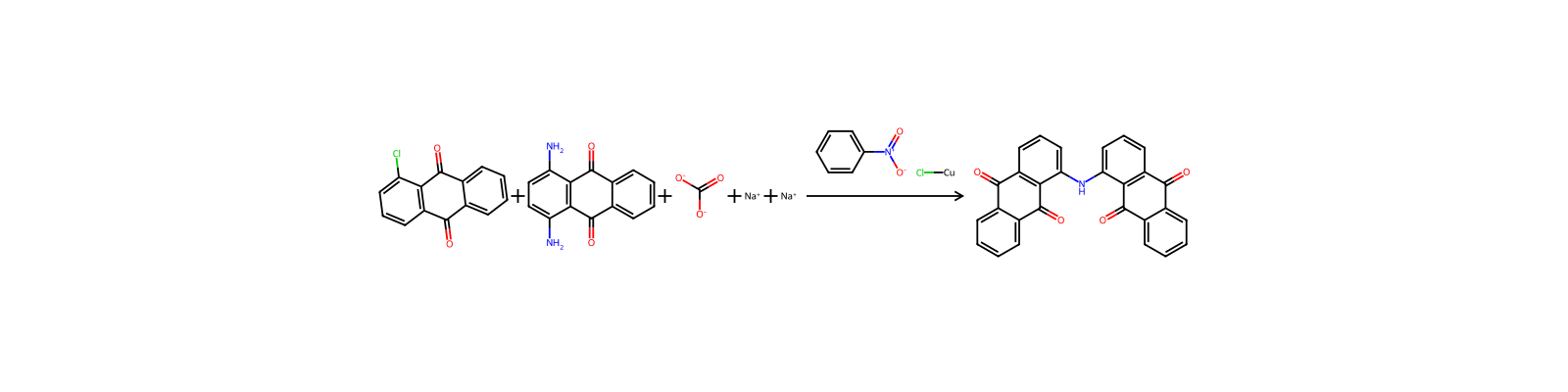
HRID 64622 reaction equation
HRID 64622As reactant
HRID 255846 reaction equation
HRID 255846As reactant
HRID 256135 reaction equation
HRID 256135As reactant
HRID 256272 reaction equation
HRID 256272As reactant
HRID 262413 reaction equation
HRID 262413As reactant
HRID 441767 reaction equation
HRID 441767As reactant
HRID 441769 reaction equation
HRID 441769As reactant
HRID 1110434 reaction equation
HRID 1110434As reactant
PreviousPage 1 of 3

Compound notes

On this pageBasic informationNames & identifiersPropertiesSafety & regulationChemistry & industryRelated reactionsCompound notes
1.44 g/cm3 · 1.44 g/cm3 (20℃)
vapor pressure
1 hPa · <1 hPa (25 °C)
refractive index
1.65 · 1.6500 (estimate)
Flash point
340 °C · 340 °C
storage temp.
Keep in dark place,Inert atmosphere,Room temperature
solubility
Soluble in benzene, pyridine, the difficulties, slightly soluble in hot aniline acetate, ethanol.
pka
1.17 · 1.17±0.20(Predicted)
form
Solid
color
Dark Violet to Black
PH
7 · 7 (H2O, 20℃)
Water Solubility
228.7 ug/L · 228.7ug/L(25 ºC)
BRN
2216556 · 2216556
Henry's Law Constant
2.1 · 2.1×104 mol/(m3Pa) at 25℃, Duchowicz et al. (2020)
Stability
Light Sensitive
Cosmetics Ingredients Functions
COLORANTHAIR DYEING
Cosmetic Ingredient Review (CIR)
1 · 1,4-Diamino anthraquinone (128-95-0)
InChI
1S/C14H10N2O2/c15-9-5-6-10(16)12-11(9)13(17)7-3-1-2-4-8(7)14(12)18/h1-6H,15-16H2
InChIKey
FBMQNRKSAWNXBT-UHFFFAOYSA-N
SMILES
Nc1ccc(N)c2C(=O)c3ccccc3C(=O)c12
LogP
3 · 3.000
CAS DataBase Reference
128 · 128-95-0(CAS DataBase Reference)
EWG's Food Scores
3 · 3-6
FDA UNII
21 HDQ0TKN · N21HDQ0TKN
NIST Chemistry Reference
1 · 1,4-Diaminoanthraquinone(128-95-0)
EPA Substance Registry System
1 · 1,4-Diaminoanthraquinone (128-95-0)
UNSPSC Code
12352116 · 12352116
NACRES
23 · NA.23
Symbol(GHS)
7 · GHS07
Signal word
Warning
Hazard statements
317 · H317
Precautionary statements
261 · P261-P272-P280-P302+P352-P333+P313-P362+P364
PPE
95 · Eyeshields, Gloves, type N95 (US)
Risk Statements
22 · 22
Safety Statements
22 · 22-36/37
WGK Germany
2 · 2
RTECS
6300000 · CB6300000
Autoignition Temperature
400 °C · >400 °C
TSCA
TSCA listed
HS Code
2922399090 · 2922399090
Storage Class
11 · 11 - Combustible Solids
Hazard Classifications
1 · Skin Sens. 1
Toxicity
50 orally · LD50 orally in Rabbit: 5790 mg/kg
Adverse EffectsOccupational hepatotoxin - Secondary hepatotoxins: the potential for toxic effect in the occupational setting is based on cases of poisoning by human ingestion or animal experimentation.
Toxicity SummarySafe in the present practices of use and concentration. Ingredient, concentration, and use information are available in documents discoverable at https://cir-reports.cir-safety.org

Safety data

PPE
Eyeshields, Gloves, type N95 (US)
wgk
2
tsca
TSCA listed
rtecs
CB6300000
hs_code
2922399090
Toxicity
LD50 orally in Rabbit: 5790 mg/kg
risk_code
22
Signal word
Warning
Symbol(GHS)
GHS07
safety_code
22-36/37
Storage Class
11 - Combustible Solids
Hazard statements
H317
Hazard Classifications
Skin Sens. 1
Autoignition Temperature
>400 °C
Precautionary statements
P261-P272-P280-P302+P352-P333+P313-P362+P364
2,4-Diaminotoluene
Hydroquinone
Sodium bicarbonate
1,4-Dihydroxyanthraquinone
Sodium hydroxide
4-Nitroaniline
1,4-Dihydroxyanthraquinone
Nitrobenzene

Downstream products

Disperse Violet 28VAT BLACK 271,4-bis[(3-chloro-2-hydroxypropyl)amino]anthraquinoneVat Brown BRDisperse Violet 26PLUMBAGINDisperse Blue 601-amino-4-[[4-[(dimethylamino)methyl]phenyl]amino]anthraquinoneDisperse purple H-FRLVat Brown 11-BromoanthraceneDisperse Blue 14Solvent Green 31,4-Diamino-2,3-dihydroanthraquinone