
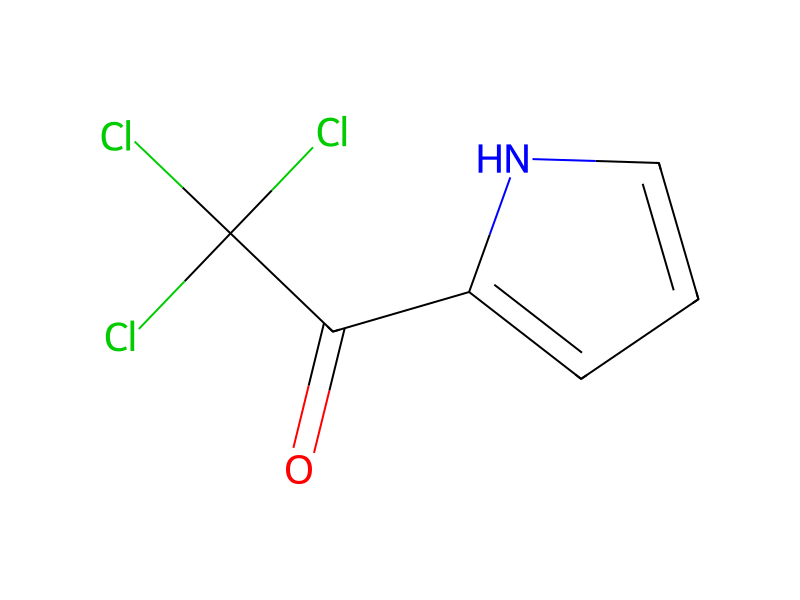
Basic information
- CAS
35302-72-8- Standard SMILES
O=C(c1ccc[nH]1)C(Cl)(Cl)Cl- InChIKey
BBFDGMDENAEMKF-UHFFFAOYSA-N- Molecular formula
- C6H4Cl3NO
- Average molar mass
- 212.5 g/mol
- Monoisotopic mass
- 210.935847
Names & identifiers
- Preferred name
- 2-(Trichloroacetyl)pyrrole
- IUPAC
- 2,2,2-trichloro-1-(1H-pyrrol-2-yl)ethanone
- English name
- 2-(TRICHLOROACETYL)PYRROLE
- Molecular formula
- C6H4Cl3NO
- Molecular weight
- 212.46
Names & synonyms
2-(Trichloroacetyl)pyrroleDTXSID70313578RefChem:462443DTXCID60264702671-031-035302-72-82,2,2-Trichloro-1-(1H-pyrrol-2-yl)ethanone2,2,2-Trichloro-1-(1H-pyrrol-2-yl)ethan-1-oneMFCD00128757Ethanone, 2,2,2-trichloro-1-(1H-pyrrol-2-yl)-2-(trichloroacetyl)-1h-pyrrole2-trichloroacetyl-1H-pyrrole
Show more names
NSC 272669LABOTEST-BB LT00452244trichloroacetyl)pyrrole2-(Trichloroacetyl)-pyrrol2-(Trichloroacetyl)-1H-pyrr2-PYRROLYL TRICHLOROMETHYL KETONE
2,2,2-trichloro-1-(1h-pyrrol-2-yl)-ethanone2,2,2-trichloro-1-pyrrol-2-ylethan-1-one2,2,2-Trichloro-1-(1H-pyrrol-2-yl)ethanone; 2,2,2-Trichloro-1-(1H-pyrrol-2-yl)ethanone; 2-(Trichloroacetyl)-1H-pyrrole; NSC 272669; Pyrrol-2-yl Trichloromethyl Ketone;NSC272669trichloroacetyl pyrrole2-trichloracetyl pyrrole2-trichloroacetyl pyrrole2-Trichloroacetylpyrrolidine
Database identifiers
- CAS
35302-72-8- PubChem CID
- 321487
- DTXSID
DTXSID70313578- ChEMBL
CHEMBL4994876- EC Number
- 671-031-0
- Nikkaji
- J705.927B
Properties
Computed structural properties
- XLogP
- 2.8
- Topological polar surface area
- 32.9 Ų
- Hydrogen bond donors
- 1
- Hydrogen bond acceptors
- 1
- Rotatable bonds
- 1
- Heavy atoms
- 11
- Formal charge
- 0
- Complexity
- 166
Physicochemical properties
- Melting point
- 72 · 72-74 °C (lit.)
- Boiling point
- 285 ℃ · 285℃
- Density
- 1.591 · 1.591
- Flash point
- 126 ℃ · 126℃
- storage temp.
- 2 · 2-8°C
- solubility
- Chloroform, Methanol
- form
- Powder
- pka
- 14.18 · 14.18±0.50(Predicted)
- color
- Pale gray
- InChI
- 1S/C6H4Cl3NO/c7-6(8,9)5(11)4-2-1-3-10-4/h1-3,10H
- InChIKey
- BBFDGMDENAEMKF-UHFFFAOYSA-N
- SMILES
- ClC(Cl)(Cl)C(=O)c1ccc[nH]1
- CAS DataBase Reference
- 35302 · 35302-72-8(CAS DataBase Reference)
- UNSPSC Code
- 12352100 · 12352100
- NACRES
- 22 · NA.22
- Symbol(GHS)
- 7 · GHS07
- Signal word
- Warning
- Hazard statements
- 315 · H315-H319-H335
- Precautionary statements
- 261 · P261-P264-P271-P280-P302+P352-P305+P351+P338
- target organs
- Respiratory system
- PPE
- 95 · dust mask type N95 (US), Eyeshields, Gloves
- Hazard Codes
- Xi
- Risk Statements
- 36 · 36/37/38-36/37//38
- Safety Statements
- 26 · 26-36
- RIDADR
- 1759 · UN 1759 8/PG III
- WGK Germany
- 3 · 3
- HazardClass
- IRRITANT
- PackingGroup
- III
- HS Code
- 29339900 · 29339900
- Storage Class
- 11 · 11 - Combustible Solids
- Hazard Classifications
- 2 Skin · Eye Irrit. 2Skin Irrit. 2STOT SE 3
Safety & regulation
GHS classification
GHS Classification
Danger
H314 (14.3%): Causes severe skin burns and eye damage [Danger Skin corrosion/irritation];H315 (85.7%): Causes skin irritation [Warning Skin corrosion/irritation];H319 (85.7%): Causes serious eye irritation [Warning Serious eye damage/eye irritation];H335 (85.7%): May cause respiratory irritation [Warning Specific target organ toxicity, single exposure; Respiratory tract irritation]
P260, P261, P264, P264+P265, P271, P280, P301+P330+P331, P302+P352, P302+P361+P354, P304+P340, P305+P351+P338, P305+P354+P338, P316, P319, P321, P332+P317, P337+P317, P362+P364, P363, P403+P233, P405, and P501 (click each P-code to see the statement)
Aggregated GHS information provided per 49 reports by companies from 7 notifications to the ECHA C&L Inventory. Each notification may be associated with multiple companies.;Information may vary between notifications depending on impurities, additives, and other factors. The percentage value in parenthesis indicates the notified classification ratio from companies that provide hazard codes. Only hazard codes with percentage values above 10% are shown. For more detailed information, please visit ECHA C&L website.
Hazard information
Hazard Classes and CategoriesSkin Corr. 1C (14.3%);Skin Irrit. 2 (85.7%);Eye Irrit. 2 (85.7%);STOT SE 3 (85.7%)
Safety data
- PPE
- dust mask type N95 (US), Eyeshields, Gloves
- wgk
- 3
- ridadr
- UN 1759 8/PG III
- hs_code
- 29339900
- risk_code
- 36/37/38-36/37//38
- Signal word
- Warning
- Symbol(GHS)
- GHS07
- hazard_code
- Xi
- safety_code
- 26-36
- hazard_class
- IRRITANT
- Storage Class
- 11 - Combustible Solids
- packing_group
- III
- target organs
- Respiratory system
- Hazard statements
- H315-H319-H335
- Hazard Classifications
- Eye Irrit. 2Skin Irrit. 2STOT SE 3
- Precautionary statements
- P261-P264-P271-P280-P302+P352-P305+P351+P338
Chemistry & industry
Applications
Uses2-(Trichloroacetyl)pyrrole, is a building block used for the synthesis of more complex pharmaceutical compounds, such as Oroidin, Hymenidin and Clathrodin.
General Description2-(Trichloroacetyl)pyrrole is a 2-substituted pyrrole. It undergoes acylation to afford 4-acyl derivatives (4-formyl to 4-hexanoyl).
Upstream & downstream products
Upstream raw materials
Downstream products
Suppliers100 total
梯希爱(上海)化成工业发展有限公司021-67121386 · [email protected]
上海阿拉丁生化科技股份有限公司400-6206333 13167063860 · [email protected]
Career Henan Chemica Co+86-0371-86658258 +86-13203830695 · [email protected]
毕佳索(上海毕得医药科技股份有限公司)400-6005915 · [email protected]
上海麦克林生化科技股份有限公司021-50706066 15221275939 · [email protected]
T&W GROUP021-61551611 13296011611 · [email protected]
爱斯特(成都)生物制药股份有限公司+86-28-85122536 85324413 · [email protected]
Baoji Guokang Healthchem co.,ltd+8615604608665 15604608665 · [email protected]
焦作沃恩生物科技有限责任公司0391-3702345 18739121806
Dayang Chem (Hangzhou) Co.,Ltd.+86-0571-88938639 17705817739 · [email protected]
韶远科技(上海)有限公司021-50795510 4000665055 · [email protected]
上海迈瑞尔生化科技有限公司4006356688 18621169109 · [email protected]
阿法埃莎(中国)化学有限公司400-6106006 · [email protected]
上海德默医药科技有限公司400-021-7337 2355568890 · [email protected]
安耐吉化学&3A(安徽泽升科技股份有限公司)400-0056266 · [email protected]
武汉凯威斯科技有限公司86-027-67849912 · [email protected]
上海瀚鸿科技股份有限公司021-54306202 13764082696 · [email protected]
上海钰康生物科技有限公司+86-18930848214 +86-021-56762820 · [email protected]
上海相辉医药科技有限公司13761987713 · [email protected]
苏州新瑞生物科技有限公司13401437572 · [email protected]
嘉兴市艾森化工有限公司0573-85285100 18627885956 · [email protected]
郑州药领医药科技有限公司13526569071 · [email protected]
学研惠(武汉)科技有限公司15727060112 · [email protected]
上海泰坦科技股份有限公司400-6009262 15618770481 · [email protected]
上海隆盛化工有限公司58099637 13585536065 · [email protected]
郑州研德生物科技有限公司0371-63682289 15538176268 · [email protected]
杭州东帆化学有限公司86-0571-85151182
山东西亚化学有限公司13355009207 13355009207 · [email protected]
玛雅试剂+86 (573) 82222445 (0)18006601000 452520369 · [email protected]
天津希恩思生化科技有限公司400 638 7771 · [email protected]
常州琬瑶生物科技有限公司0519-89185693 15312551983 · [email protected]
赛默飞世尔科技(中国)有限公司800-810-5118 · [email protected]
上海遐瑞医药科技有限公司+86 21 61551611
TOKYO CHEMICAL INDUSTRY CO., LTD.03-36680489 · [email protected]
越林试剂021-62960152 · [email protected]
金瓯生物医药(南京)有限公司13000000000 · [email protected]
上海宸香医药科技有限公司021-20960837 · [email protected]
北京环宇世纪化学科技有限公司hysj_bj.com
上海将来实业股份有限公司400-0066400 13621662912 · [email protected]
上海毕得医药科技股份有限公司400-164-7117 18317119277 · [email protected]
Labnetwork lnc.+86-27-50766799 +86-18062016861 · [email protected]
北京福源坊科技有限公司010-57903446 15869909019 · [email protected]
陕西缔都医药化工有限公司+86-029-81138252 +86-173 9270 1263 · [email protected]
上海鑫圭生物科技有限公司15121041756 · [email protected]
江苏艾康生物医药研发有限公司025-66028182 17714375163 · [email protected]
凯试(上海)科技有限公司021-50135380 · [email protected]
Sigma-Aldrich西格玛奥德里奇(上海)贸易有限公司021-61415566 800-8193336 · [email protected]
诺尔凯立科技有限公司86-(0)21-31261262 373522135 · [email protected]
成都瑞欧克科技有限公司028-64353063 · [email protected]
九鼎化学(上海)科技有限公司4009209199 · [email protected]
Related reactions
116 records


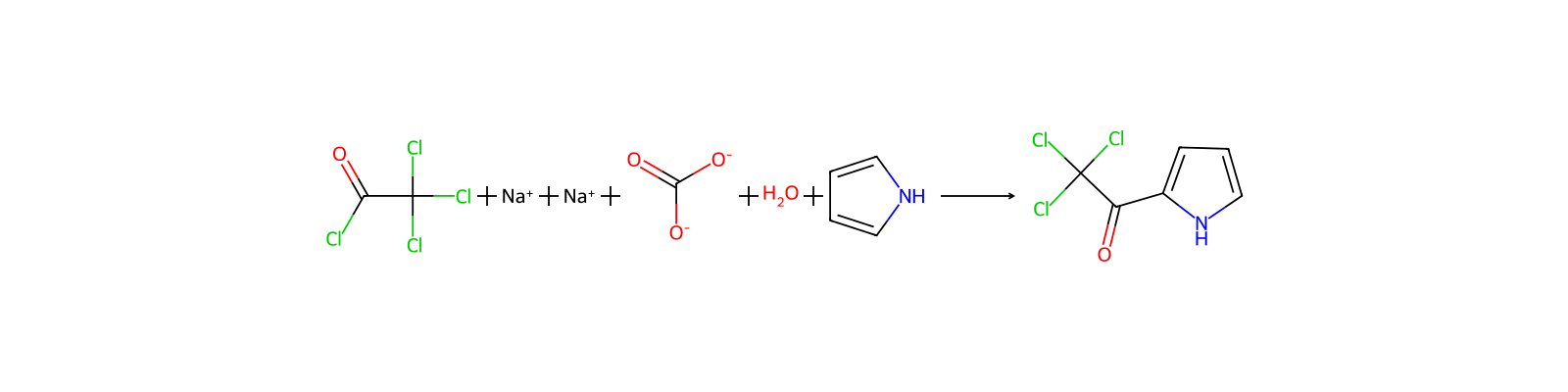

Compound notes
Loading…