Reaction equation

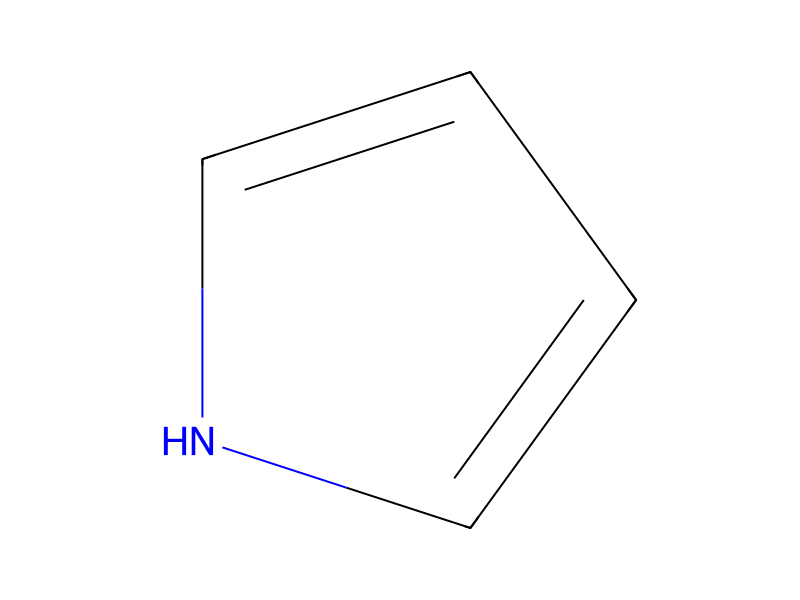
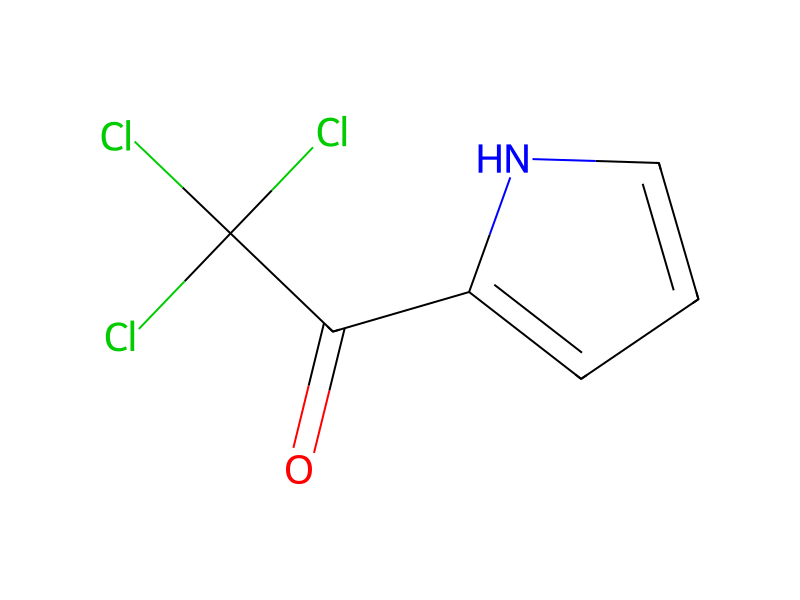
[Cl:1][C:2]([Cl:7])([Cl:6])[C:3](Cl)=[O:4].[NH:8]1[CH:12]=[CH:11][CH:10]=[CH:9]1.C(=O)([O-])[O-].[K+].[K+]>C(OCC)C.O>[Cl:1][C:2]([Cl:7])([Cl:6])[C:3]([C:9]1[NH:8][CH:12]=[CH:11][CH:10]=1)=[O:4]Participants
6
Reactant 3


Product 1
Reagents, catalysts & solvents 2


Procedure
45 g (247 mmol) of trichloroacetyl chloride and 100 ml of ethyl ether were introduced into a three-necked flask. A solution of 15.4 g (230 mmol) of pyrrole in 100 ml of ethyl ether was added dropwise and the mixture was stirred at room temperature for one hour, then a solution of 20 g of potassium carbonate in 60 ml of water was added slowly. The organic phase was decanted off, dried over magnesium sulfate, evaporated, the residue triturated in hexane and filtered. 42.7 g (87%) of the expected compound of melting point 78°-79° C. were recovered.
Workup
- customThe organic phase was decanted off
- dry with materialdried over magnesium sulfate
- customevaporated
- customthe residue triturated in hexane
- filtrationfiltered
- custom42.7 g (87%) of the expected compound of melting point 78°-79° C. were recovered
Sources & evidence
- ORD record
- ord-1c0764d0c4c24228988989f273084ebb
- Source dataset
- uspto-grants-1998_03
- Patent number
- US05723499
Linked notes
Loading…