HomeMCPWorkbenchSkills
HomeWorkbenchNotificationsMe
llms.txt · MCP GuidePrivacy Policy · Terms of Service · Supportv1.8.0
  1. Home
  2. /Compound

Isodecanol

HCID 32898
New noteNew reactionRequest quotes
Print preview
Basic informationOverviewNames & identifiersPropertiesSafety & regulationChemistry & industryRelated reactionsCompound notes
Substructure searchFind similar structures

Basic information

CAS
25339-17-7
Standard SMILES
CC(C)CCCCCCCO
InChIKey
PLLBRTOLHQQAQQ-UHFFFAOYSA-N
Molecular formula
C10H22O
Average molar mass
158.28 g/mol
Monoisotopic mass
158.16706532

Overview

Isodecyl alcohol is a colorless liquid with a mild alcohol odor. Floats on water. (USCG, 1999)

Names & identifiers

Preferred name
Isodecanol
IUPAC
8-methylnonan-1-ol
English name
Isodecanol
Molecular formula
C10H22O
Molecular weight
158.28

Names & synonyms

Isodecanol25339-17-7ISODECYL ALCOHOLExxal 103160X491M7RefChem:923673DTXSID4027864246-869-18-methylnonan-1-ol8-methyl-1-nonanol55505-26-58-Methylnonanol
Show more names
8-Methylnonane-1-olDECANOL MIXTURE OF ISOMERSisodecylIsodecanoIsodesyl alcoholDECANOL-ISOMERENGEMISCH
1-Nonanol, 8-methyl-8-Methyl-1-nonyl AlcoholMFCD00044085iso-DecylalcoholHSDB 616EINECS 246-869-1UNII-3160X491M78-Methyl-nonan-1-ol

Database identifiers

CAS
25339-17-7、55505-26-5、68551-08-6
PubChem CID
32898
DTXSID
DTXSID3058660
UNII
3160X491M7
EC Number
246-869-1
Nikkaji
J71.269H

Properties

Computed structural properties

XLogP
3.8
Topological polar surface area
20.2 Ų
Hydrogen bond donors
1
Hydrogen bond acceptors
1
Rotatable bonds
7
Heavy atoms
11
Formal charge
0
Complexity
69.3

Experimental & physicochemical properties

SolventsSolvents -> Alcohols (<C12)
SpringerMaterials PropertiesChemical shift
FragrancesFragrance Ingredient (Isodecyl alcohol) -> IFRA transparency List
OdorWEAK ALCOHOLIC
Density · 3 items

0.841 at 68 °F (USCG, 1999) - Less dense than water; will float

0.8395

Relative density (water = 1): 0.84

Color/FormColorless liquid
Solubility · 2 items

Insoluble in water

Solubility in water, g/100ml: 2.5

Flash Point · 3 items

220 °F (USCG, 1999)

220 °F

104 °C o.c.

Boiling Point · 3 items

428 °F at 760 mmHg (USCG, 1999)

220 °C

220 °C

Safety & regulation

Safety information is for reference only and does not replace the supplier’s Safety Data Sheet (SDS), applicable regulations, or professional assessment.

GHS classification

GHS Classification · 6 items

This chemical does not meet GHS hazard criteria for 20.3% (95 of 469) of reports.

Warning

H315 (60.6%): Causes skin irritation [Warning Skin corrosion/irritation]

P264, P264+P265, P273, P280, P302+P352, P305+P351+P338, P321, P332+P317, P337+P317, P362+P364, P391, and P501 (click each P-code to see the statement)

Aggregated GHS information provided per 469 reports by companies from 6 notifications to the ECHA C&L Inventory. Each notification may be associated with multiple companies.

Warning

Hazard information

Regulatory Information · 3 items

Chemical: Isodecanol

Isodecanol is listed on the EPA's Chemical Data Reporting (CDR) system. Manufacturers and importers of Isodecanol are required to report information about their production and use of this chemical to the EPA under the Toxic Substances Control Act (TSCA). (40 eCFR Part 711)

Isodecanol: Does not have an individual approval but may be used under an appropriate group standard

DOT LabelClass 9
Fire Hazards · 2 items

Excerpt from ERG Guide 171 [Substances (Low to Moderate Hazard)]:

Combustible.

Fire PotentialCombustible when exposed to heat or flame.
Health HazardsDirect contact with skin can produce irritation. (USCG, 1999)
Hazards Summary · 1 item

A skin, eye, and respiratory tract irritant; May cause CNS depression; Defats the skin; [ICSC] Higher alcohols are not highly toxic in the industrial setting; Can cause liver injury, somnolence, and respiratory depression in experimental animals; Can cause smarting of the skin; Extended exposure may cause second degree burns; [HSDB] A skin irritant; [CAMEO] Causes hepatitis in feeding studies of rats; [RTECS] Causes malformations at doses that are maternally toxic; [REPROTOX] An eye irritant; [MSDSonline]

Chemistry & industry

Uses & manufacturing

Uses · 5 items

Used as an antifoaming agent in textile processing, in synthetic lubricants, in uranium refining, as a specialty solvent, and to make plasticizers; [HSDB]

Textiles (Fiber & Fabric Manufacturing) [Category: Industry]

Production of plasticizers

Antifoaming agent in textile processing

Chemical intermediate for the plasticizer, diisodecyl phthalate; ingredient in synthetic lubricants; agent in uranium refining; specialty solvent; antifoaming agent in textile processing.

ImpuritiesBy-products of propylene-butylene polymerization/to produce isodecyl alcohol/are isooctyl and isononyl alcohols
U.S. Exports · 3 items

(1972) No Data

(1975) No Data

(1986) No Data

U.S. Imports · 3 items

(1972) No Data

(1975) No Data

(1984) 7.48X10+9 g/DECYL ALCOHOLS/

U.S. Production · 6 items

2023: <25,000 lb

This chemical is listed as a High Production Volume (HPV) (65FR81686). Chemicals listed as HPV were produced in or imported into the U.S. in >1 million pounds in 1990 and/or 1994. The HPV list is based on the 1990 Inventory Update Rule. (IUR) (40 CFR part 710 subpart B; 51FR21438).

(1972) 6.8X10+10 GRAMS

(1973) 7.91X10+10 GRAMS

(1980) 59,000 tonnes

For more U.S. Production (Complete) data for ISODECYL ALCOHOL (9 total), please visit the HSDB record page.

Consumption PatternsApprox 70% as a chem int for the plasticizer, diisodecyl phthalate; approx 30% for all other uses (1972)
Industry UsesStabilizing agent
Methods of Manufacturing · 2 items

Reaction of nonenes, carbon monoxide, and hydrogen using a cobalt catalyst (oxo process), followed by hydrogenation

Related reactions

32 records

New reaction record
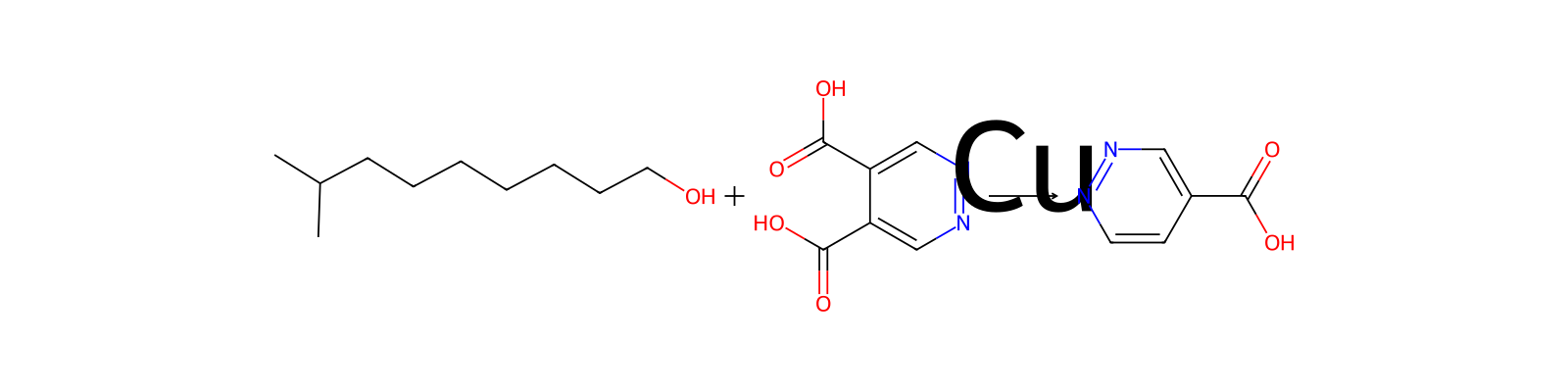
HRID 27730 reaction equation
HRID 27730As reactantuspto-grants-1980_09
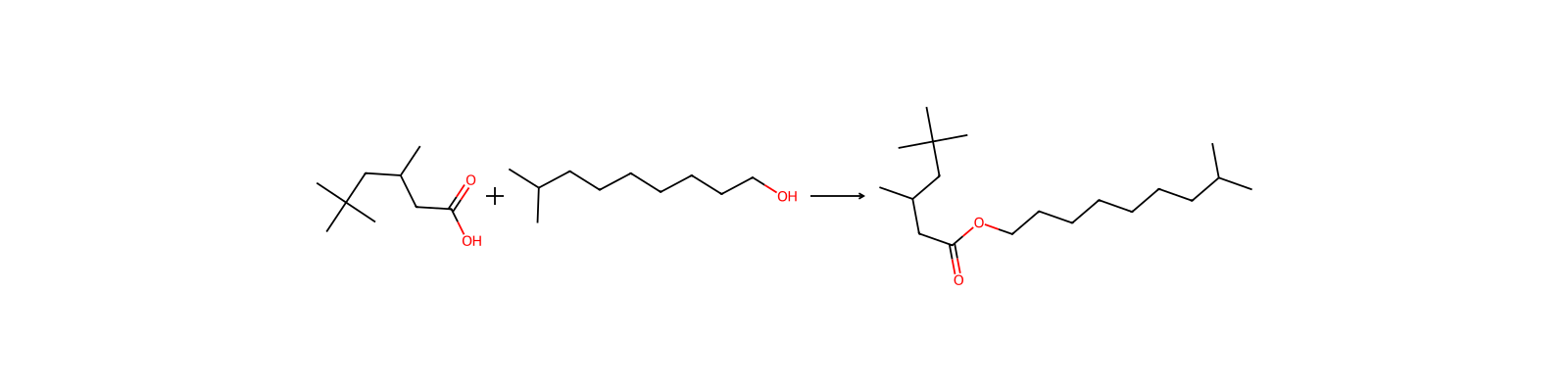
HRID 104475 reaction equation
HRID 104475As reactantTraining data from https://doi.org/10.1039/C8SC04228D (2/10)
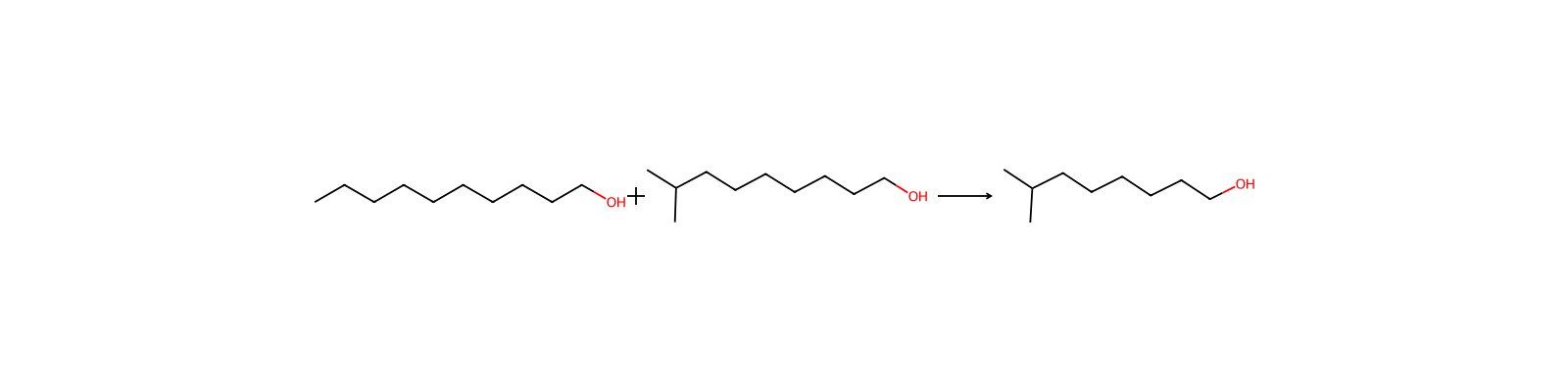
HRID 258957 reaction equation
HRID 258957As reactantuspto-grants-1977_07
HRID 370382 reaction equation
HRID 370382As reactantuspto-grants-1985_07
HRID 370383 reaction equation
HRID 370383As reactantuspto-grants-1985_07
HRID 482851 reaction equation
HRID 482851As reactantuspto-grants-1986_03
HRID 726930 reaction equation
HRID 726930As reactantuspto-grants-1998_01
HRID 811803 reaction equation
HRID 811803As reactantTest data from https://doi.org/10.1039/C8SC04228D
Page 1 of 4

Compound notes

Loading…

On this pageBasic informationOverviewNames & identifiersPropertiesSafety & regulationChemistry & industryRelated reactionsCompound notes
More actions
New noteNew reactionRequest quotes
Decomposition
When heated to decomposition it emits acrid smoke and irritating fumes.
Melting Point · 3 items

less than 140 °F (USCG, 1999)

FP: LESS THAN 140 °F= LESS THAN 60 °C= LESS THAN 333 DEG K

7 °C

Vapor Density · 2 items

5.5 (AIR= 1)

Relative vapor density (air = 1): 5.5

Physicochemical properties

Melting point
-60 °C · -60°C
Boiling point
215 · 215-225 °C
Density
0.838 g/mL · 0.838 g/mL at 20 °C
refractive index
20 · n20/D 1.440
Flash point
95 °C · 95 °C
storage temp.
Refrigerator
solubility
Benzene (Sparingly), Chloroform (Slightly)
form
Oil
color
Colourless
Odor
Weak alcoholic.
Henry's Law Constant
1.8 · 1.8×10-1 mol/(m3Pa) at 25℃, HSDB (2015)
Cosmetics Ingredients Functions
PERFUMING
InChI
InChI=1S/C10H22O/c1-10(2)8-6-4-3-5-7-9-11/h10-11H,3-9H2,1-2H3
InChIKey
PLLBRTOLHQQAQQ-UHFFFAOYSA-N
SMILES
C(CCC(C)C)CCCCO
LogP
3.74 · 3.740 (est)
EWG's Food Scores
1 · 1
FDA UNII
3160 X491M7 · 3160X491M7
EPA Substance Registry System
Isodecanol (25339-17-7)
Symbol(GHS)
7 · GHS07
Signal word
Warning
Hazard statements
411 · H411-H315-H319
Precautionary statements
264 · P264-P280-P305+P351+P338-P337+P313P-P264-P280-P302+P352-P321-P332+P313-P362
Hazard Codes
Xi
Risk Statements
36 · 36
Safety Statements
26 · 26-36
RIDADR
3082 · 3082
RTECS
960000 · NR0960000
TSCA
TSCA listed
HazardClass
9 · 9
PackingGroup
III
Hazardous Substances Data
25339 · 25339-17-7(Hazardous Substances Data)
Reactive GroupAlcohols and Polyols
Reactivity Profile · 1 item

ISODECYL ALCOHOL attacks plastics. REF [Handling Chemicals Safely, 1980. p. 236]. Acetyl bromide reacts violently with alcohols or water, [Merck 11th ed., 1989]. Mixtures of alcohols with concentrated sulfuric acid and strong hydrogen peroxide can cause explosions. Example: An explosion will occur if dimethylbenzylcarbinol is added to 90% hydrogen peroxide then acidified with concentrated sulfuric acid. Mixtures of ethyl alcohol with concentrated hydrogen peroxide form powerful explosives. Mixtures of hydrogen peroxide and 1-phenyl-2-methyl propyl alcohol tend to explode if acidified with 70% sulfuric acid, [Chem. Eng. News 45(43):73(1967); J, Org. Chem. 28:1893(1963)]. Alkyl hypochlorites are violently explosive. They are readily obtained by reacting hypochlorous acid and alcohols either in aqueous solution or mixed aqueous-carbon tetrachloride solutions. Chlorine plus alcohols would similarly yield alkyl hypochlorites. They decompose in the cold and explode on exposure to sunlight or heat. Tertiary hypochlorites are less unstable than secondary or primary hypochlorites, [NFPA 491 M, 1991]. Base-catalysed reactions of isocyanates with alcohols should be carried out in inert solvents. Such reactions in the absence of solvents often occur with explosive violence, [Wischmeyer(1969)].

Atmospheric Standards · 1 item

This action promulgates standards of performance for equipment leaks of Volatile Organic Compounds (VOC) in the Synthetic Organic Chemical Manufacturing Industry (SOCMI). The intended effect of these standards is to require all newly constructed, modified, and reconstructed SOCMI process units to use the best demonstrated system of continuous emission reduction for equipment leaks of VOC, considering costs, non air quality health and environmental impact and energy requirements. Isodecyl alcohol is produced, as an intermediate or a final product, by process units covered under this subpart.

Chemical DangersReacts with strong oxidants.
Air and Water ReactionsNo rapid reaction with air. No rapid reaction with water.
NFPA Hazard Classification · 3 items

0 - Materials that, under emergency conditions, would offer no hazard beyond that of ordinary combustible materials.

1 - Materials that must be preheated before ignition can occur. Materials require considerable preheating, under all ambient temperature conditions, before ignition and combustion can occur.

0 - Materials that in themselves are normally stable, even under fire conditions.

Safety & protection

Fire Fighting · 2 items

Fire Extinguishing Agents Not to Be Used: Water or foam may cause frothing

Use powder, carbon dioxide, foam. Water may be ineffective.

First Aid Measures · 4 items

Fresh air, rest. Refer for medical attention.

Remove contaminated clothes. Rinse and then wash skin with water and soap. Refer for medical attention .

First rinse with plenty of water for several minutes (remove contact lenses if easily possible), then refer for medical attention.

Rinse mouth. Rest. Refer for medical attention .

First AidWash affected area with water for 15 min. (USCG, 1999)
Safe StorageSeparated from strong oxidants.
Fire Fighting ProceduresExtinguish with dry chemical, alcohol foam, or carbon dioxide. Water may be ineffective on fire.
Storage Conditions · 1 item

Materials which are toxic as stored or which can decompose into toxic components ... should be stored in a cool well ventilated place, out of the direct rays of the sun, away from areas of high fire hazard, and should be periodically inspected. Incompatible materials should be isolated ...

Cleanup MethodsCollect leaking and spilled liquid in sealable containers as far as possible. Absorb remaining liquid in sand or inert absorbent and remove to safe place.
Nonfire Spill ResponseExcerpt from ERG Guide 171 [Substances (Low to Moderate Hazard)]:
Disposal Methods · 1 item

SRP: The most favorable course of action is to use an alternative chemical product with less inherent propensity for occupational exposure or environmental contamination. Recycle any unused portion of the material for its approved use or return it to the manufacturer or supplier. Ultimate disposal of the chemical must consider: the material's impact on air quality; potential migration in soil or water; effects on animal, aquatic, and plant life; and conformance with environmental and public health regulations.

Spillage DisposalCollect leaking and spilled liquid in sealable containers as far as possible. Absorb remaining liquid in sand or inert absorbent. Then store and dispose of according to local regulations.
Isolation and EvacuationExcerpt from ERG Guide 171 [Substances (Low to Moderate Hazard)]:
Eye PreventionWear safety goggles.

Toxicology

Ecotoxicity Values · 2 items

LC50 Artemia salina (Brine shrimp) 3.4 mg/L/24 hr; static /formulated product/

LC50 Nitocra spinipes (Harpacticoid copepod) 1.3 mg/L/96 hr (95% confidence limit: 1.0-1.7 mg/L); static /formulated product/

Environmental Fate · 3 items

TERRESTRIAL FATE: Based on a classification scheme(1), an estimated Koc value of 80(SRC), determined from a structure estimation method(2), indicates that isodecyl alcohol is expected to have high mobility in soil(SRC). Volatilization of isodecyl alcohol from moist soil surfaces may be an important fate process(SRC) given an estimated Henry's Law constant of 5.5X10⁻⁵ atm-cu m/mole(SRC), using a fragment constant estimation method(3). Isodecyl alcohol is not expected to volatilize from dry soil surfaces(SRC) based upon an estimated vapor pressure of 2.1X10⁻² mm Hg(SRC), determined from a fragment constant method(4). Theoretical BOD values of 14-24% in 5 days(5) indicate that biodegradation may be an important environmental fate process in soil(SRC).

AQUATIC FATE: Based on a classification scheme(1), an estimated Koc value of 80(SRC), determined from a structure estimation method(2), indicates that isodecyl alcohol is not expected to adsorb to suspended solids and sediment(SRC). Volatilization from water surfaces may be expected(3) based upon an estimated Henry's Law constant of 5.5X10⁻⁵ atm-cu m/mole(SRC), developed using a fragment constant estimation method(4). Using this Henry's Law constant and an estimation method(3), volatilization half-lives for a model river and model lake are 24 hours and 11 days, respectively(SRC). According to a classification scheme(5), an estimated BCF of 145(SRC), from an estimated log Kow of 3.71(6), and a regression-derived equation(7), suggests the potential for bioconcentration in aquatic organisms is high(SRC). Theoretical BOD values of 14-24% in 5 days(8) indicate that biodegradation may be an important environmental fate process in water.

ATMOSPHERIC FATE: According to a model of gas/particle partitioning of semivolatile organic compounds in the atmosphere(1), isodecyl alcohol, which has an estimated vapor pressure of 2.1X10⁻² mm Hg at 25 °C(SRC), determined from a fragment constant method(2), is expected to exist solely as a vapor in the ambient atmosphere. Vapor-phase isodecyl alcohol is degraded in the atmosphere by reaction with photochemically-produced hydroxyl radicals(SRC); the half-life for this reaction in air is estimated to be 25 hours(SRC), calculated from its rate constant of 1.5X10⁻¹¹ cu cm/molecule-sec at 25 °C(SRC) that was derived using a structure estimation method(3).

Adverse EffectsNeurotoxin - Acute solvent syndrome
Exposure RoutesThe substance can be absorbed into the body by inhalation, through the skin and by ingestion.
Signs and Symptoms · 4 items

Cough. Dizziness. Lethargy. Headache. Nausea. Sore throat.

Dry skin. Redness.

Redness. Pain.

Diarrhoea. Vomiting. Further see Inhalation.

ICSC Environmental DataThis substance may be hazardous to the environment. Special attention should be given to fish.
Soil Adsorption/Mobility · 1 item

Using a structure estimation method based on molecular connectivity indices(1), the Koc of isodecyl alcohol can be estimated to be 81(SRC). According to a classification scheme(2), this estimated Koc value suggests that isodecyl alcohol is expected to have high mobility in soil.

Human Toxicity Excerpts · 2 items

/SIGNS AND SYMPTOMS/ The substance irritates the eyes, the skin and the respiratory tract. Exposure could cause central nervous system depression.

/SIGNS AND SYMPTOMS/ Direct contact with skin can produce irritation. ... Vapors are non-irritating to the eyes and throat. Causes smarting of skin and first-degree burns on short exposure; may cause secondary burns on long exposure.

Artificial Pollution SourcesIsodecyl alcohol's use as an intermediate for the production of plasticizers(1) and as an antifoaming agent in textile processing(2) may result in its release to the environment through various waste streams(SRC).
Environmental Biodegradation · 1 item

AEROBIC: In sewage, isodecyl alcohol gave a theoretical oxygen demand of 24, 44, 42 and 39 percent in 5, 10, 15 and 20 days, respectively(1). In acclimated sewage isodecyl alcohol gave theoretical oxygen demand of 14, 26, 45 and 32 percent in 5, 10, 15 and 20 days, respectively(1). Isodecyl alcohol gave theoretical oxygen demand of 6, 17, 34 and 40 percent in 5, 10, 15 and 20 days, respectively, in seawater(1). In a manometric study of poorly soluble compounds, isodecyl alcohol degraded 17.4 and 22.4 percent of ultimate BOD/theoretical oxygen demand with 10 minutes of sonification(2).

Environmental Bioconcentration · 1 item

An estimated BCF of 145 was calculated for isodecyl alcohol(SRC), using an estimated log Kow of 3.71(1) and a regression-derived equation(2). According to a classification scheme(3), this BCF suggests the potential for bioconcentration in aquatic organisms is high(SRC), provided the compound is not metabolized by the organism(SRC).

Volatilization from Water/Soil · 1 item

The Henry's Law constant for isodecyl alcohol is estimated as 5.5X10⁻⁵ atm-cu m/mole(SRC) using a fragment constant estimation method(1). This Henry's Law constant indicates that isodecyl alcohol is expected to volatilize from water surfaces(2). Based on this Henry's Law constant, the volatilization half-life from a model river (1 m deep, flowing 1 m/sec, wind velocity of 3 m/sec)(2) is estimated as 24 hours(SRC). The volatilization half-life from a model lake (1 m deep, flowing 0.05 m/sec, wind velocity of 0.5 m/sec)(2) is estimated as 11 days(SRC). Isodecyl alcohol's Henry's Law constant indicates that volatilization from moist soil surfaces may occur(SRC). Isodecyl alcohol is not expected to volatilize from dry soil surfaces(SRC) based upon an estimated vapor pressure of 2.07X10⁻² mm Hg(SRC), determined from a fragment constant method(3).

Regulatory information

Atmospheric Standards · 1 item

This action promulgates standards of performance for equipment leaks of Volatile Organic Compounds (VOC) in the Synthetic Organic Chemical Manufacturing Industry (SOCMI). The intended effect of these standards is to require all newly constructed, modified, and reconstructed SOCMI process units to use the best demonstrated system of continuous emission reduction for equipment leaks of VOC, considering costs, non air quality health and environmental impact and energy requirements. Isodecyl alcohol is produced, as an intermediate or a final product, by process units covered under this subpart.

Safety data

tsca
TSCA listed
rtecs
NR0960000
ridadr
3082
risk_code
36
Signal word
Warning
Symbol(GHS)
GHS07
hazard_code
Xi
safety_code
26-36
hazard_class
9
packing_group
III
Hazard statements
H411-H315-H319
Precautionary statements
P264-P280-P305+P351+P338-P337+P313P-P264-P280-P302+P352-P321-P332+P313-P362
Hazardous Substances Data
25339-17-7(Hazardous Substances Data)

Polymerization of propylenes and butenes with phosphoric acid at 200 °C and 3040-6080 kPa to give a mixture of branched olefins /which upon alkaline hydrolysis/ gives isodecyl alcohol.

Formulations/Preparations · 2 items

Grades or purity: Technical: mixed isomers.

The commercial product typically consists of trimethyl-1-heptanols and dimethyl-1-octanols; the composition and CAS registry number depend on the olefin feedstock.

Use ClassificationFragrance Ingredients
General Manufacturing Information · 3 items

Plastics Material and Resin Manufacturing

Isodecanol: ACTIVE

Commercial products from the family of 6 to 11 carbon alcohols that make up the plasticizer range are available both as ... pure single carbon chain materials and as complex isomeric mixtures. Commercial descriptions of plasticizer range alcohols are ... in general a ... pure material is called "-anol" /eg, 1-decanol/, and the mixtures are called "-yl alcohol /eg, decyl alcohol/ or "iso...yl alcohol" /eg, isodecyl alcohol/.

Applications · 3 items

UsesAntifoaming agent in textile processing.

UsesIsodecanol is a useful component for anti-wear lubricating oil.

General DescriptionColorless liquid with a mild alcohol odor. Floats on water.

Upstream & downstream products

Downstream products

DI-ISO-DECYL PHTHALATE

Additional notes

DefinitionMixed isomers.