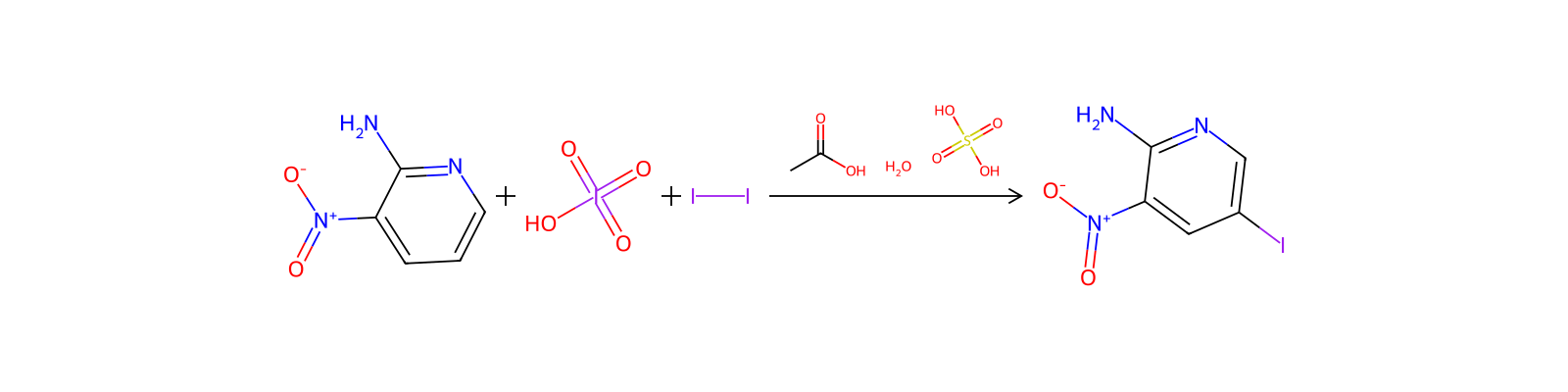
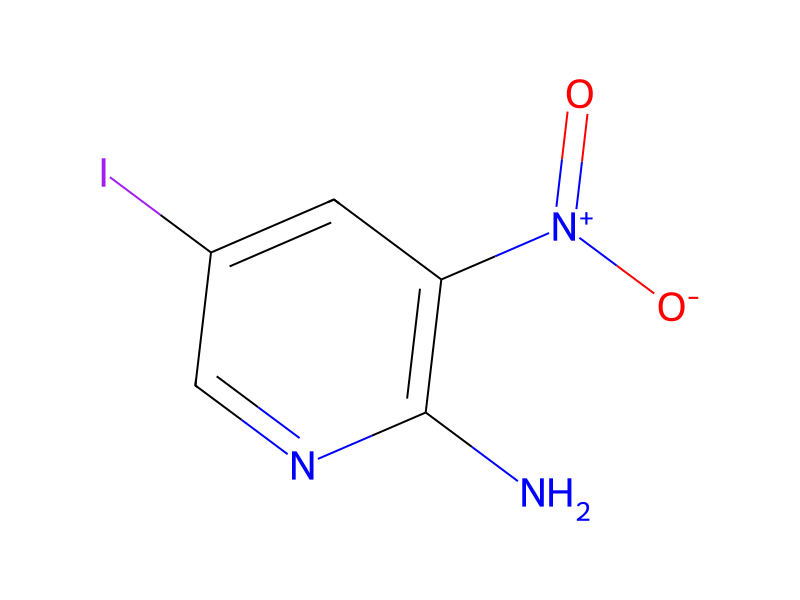
Basic information
- Standard SMILES
Nc1ncc(I)cc1[N+](=O)[O-]- InChIKey
MDJUWRHSXKZSOJ-UHFFFAOYSA-N- Molecular formula
- C5H4IN3O2
- Average molar mass
- 265.01 g/mol
- Monoisotopic mass
- 264.93482
Names & identifiers
- Preferred name
- 2-Amino-5-iodo-3-nitropyridine
- IUPAC
- 5-iodo-3-nitropyridin-2-amine
- English name
- 2-AMINO-5-IODO-3-NITROPYRIDINE
- Molecular formula
- C5H4IN3O2
- Molecular weight
- 265.01
Names & synonyms
25391-57-52-Amino-5-iodo-3-nitropyridineDTXSID10391991RefChem:464616DTXCID60342852626-879-65-iodo-3-nitropyridin-2-amineMFCD040384645-iodo-3-nitro-pyridin-2-amine2-Pyridinamine, 5-iodo-3-nitro-5-Iodo-3-nitro-2-aminopyridineSCHEMBL1601280
Show more names
Zinc042029185-iodo-3-nitro-2-pyridinamine2-PYRIDINAMINE,5-IODO-3-NITRO2-Amino-3-nitro-5-iodopyridine5-IODO-3-NITRO-PYRIDIN-2-YLAMINE2-Amino-5-iodo-3-nitropyridine 95+%2-AMINO-5-IODO-3-NITROPYRIDINE ISO 9001:2015 REACH
5-iodo-3-nitro-2-pyridylamineSBB065277AKOS005257300PB233792-Amino-5-iodo-3-nitropyridine, 97%DS-12470SY041319DB-046691
Database identifiers
- CAS
25391-57-5- PubChem CID
- 3384468
- DTXSID
DTXSID10391991- EC Number
- 626-879-6
Properties
Computed structural properties
- XLogP
- 1.5
- Topological polar surface area
- 84.7 Ų
- Hydrogen bond donors
- 1
- Hydrogen bond acceptors
- 4
- Rotatable bonds
- 0
- Heavy atoms
- 11
- Formal charge
- 0
- Complexity
- 160
Physicochemical properties
- Melting point
- 215 · 215-219 °C (lit.)
- Boiling point
- 365.4 · 365.4±42.0 °C(Predicted)
- Density
- 2.229 · 2.229±0.06 g/cm3(Predicted)
- storage temp.
- 2 · under inert gas (nitrogen or Argon) at 2–8 °C
- form
- solid
- pka
- 0.41 · 0.41±0.49(Predicted)
- Appearance
- Light yellow to yellow Solid
- InChI
- 1S/C5H4IN3O2/c6-3-1-4(9(10)11)5(7)8-2-3/h1-2H,(H2,7,8)
- InChIKey
- MDJUWRHSXKZSOJ-UHFFFAOYSA-N
- SMILES
- Nc1ncc(I)cc1[N+]([O-])=O
- CAS DataBase Reference
- 25391 · 25391-57-5(CAS DataBase Reference)
- UNSPSC Code
- 12352100 · 12352100
- NACRES
- 22 · NA.22
- Symbol(GHS)
- 7 · GHS07
- Signal word
- Warning
- Hazard statements
- 302 · H302-H315-H317-H319-H335
- Precautionary statements
- 261 · P261-P280-P305+P351+P338
- target organs
- Respiratory system
- PPE
- 95 · dust mask type N95 (US), Eyeshields, Faceshields, Gloves
- Hazard Codes
- Xn,Xi
- Risk Statements
- 22 · 22-36/37/38-43
- Safety Statements
- 26 · 26-36/37
- WGK Germany
- 3 · 3
- Hazard Note
- Irritant
- HS Code
- 2933399990 · 2933399990
- Storage Class
- 11 · 11 - Combustible Solids
- Hazard Classifications
- 4 OralEye · Acute Tox. 4 OralEye Irrit. 2Skin Irrit. 2Skin Sens. 1STOT SE 3
Safety & regulation
GHS classification
GHS Classification
Warning
H302 (100%): Harmful if swallowed [Warning Acute toxicity, oral];H315 (100%): Causes skin irritation [Warning Skin corrosion/irritation];H317 (100%): May cause an allergic skin reaction [Warning Sensitization, Skin];H319 (100%): Causes serious eye irritation [Warning Serious eye damage/eye irritation];H335 (100%): May cause respiratory irritation [Warning Specific target organ toxicity, single exposure; Respiratory tract irritation]
P261, P264, P264+P265, P270, P271, P272, P280, P301+P317, P302+P352, P304+P340, P305+P351+P338, P319, P321, P330, P332+P317, P333+P317, P337+P317, P362+P364, P403+P233, P405, and P501 (click each P-code to see the statement)
Aggregated GHS information provided per 39 reports by companies from 2 notifications to the ECHA C&L Inventory. Each notification may be associated with multiple companies.;Information may vary between notifications depending on impurities, additives, and other factors. The percentage value in parenthesis indicates the notified classification ratio from companies that provide hazard codes. Only hazard codes with percentage values above 10% are shown. For more detailed information, please visit ECHA C&L website.
Hazard information
Hazard Classes and CategoriesAcute Tox. 4 (100%);Skin Irrit. 2 (100%);Skin Sens. 1 (100%);Eye Irrit. 2 (100%);STOT SE 3 (100%)
Safety data
- PPE
- dust mask type N95 (US), Eyeshields, Faceshields, Gloves
- wgk
- 3
- hs_code
- 2933399990
- risk_code
- 22-36/37/38-43
- Signal word
- Warning
- Symbol(GHS)
- GHS07
- hazard_code
- Xn,Xi
- hazard_note
- Irritant
- safety_code
- 26-36/37
- Storage Class
- 11 - Combustible Solids
- target organs
- Respiratory system
- Hazard statements
- H302-H315-H317-H319-H335
- Hazard Classifications
- Acute Tox. 4 OralEye Irrit. 2Skin Irrit. 2Skin Sens. 1STOT SE 3
- Precautionary statements
- P261-P280-P305+P351+P338
Chemistry & industry
Applications
Uses2-Amino-5-iodo-3-nitropyridine is used in the synthetic preparation of disubstituted pyridinyl azabicyclo heptanes as epibatidine analogs. These analogs are evaluated for its affinity for nicotinic acetylcholine receptors via in vitro and antinociceptive properties via in vivo in rats.
Upstream & downstream products
Upstream raw materials
Downstream products
Suppliers50 total
上海衡新化工科技有限公司13917104483; 13917104483 · [email protected]
苏州启航生物科技有限公司18151111370 · [email protected]
上海毕得医药科技股份有限公司400-1647117 13681763483 · [email protected]
Suzhou ARTK Medchem Co., Ltd.+86-18168183658 · [email protected]
环生美森医药技术(山东)有限公司0531-88762217 18301471076 · [email protected]
Dayang Chem (Hangzhou) Co.,Ltd.+86-0571-88938639 17705817739 · [email protected]
毕佳索(上海毕得医药科技股份有限公司)400-6005915 · [email protected]
北京索莱宝科技有限公司010-50973130 17801761073 · [email protected]
安耐吉化学&3A(安徽泽升科技股份有限公司)400-0056266 · [email protected]
常州科化生物科技有限公司0519-68985668 13685222090 · [email protected]
上海瀚鸿科技股份有限公司021-54306202 13764082696 · [email protected]
Advanced chemblocks inc650-6922368 650-6922368;650-6922368 · [email protected]
上海钰康生物科技有限公司+86-18930848214 +86-021-56762820 · [email protected]
菏泽博纳医药科技有限公司15865805009 · [email protected]
宝鸡缔都医药化工有限公司029-81145305 17791533577 · [email protected]
北京伊诺凯科技有限公司15652467323 · [email protected]
济南千叶医药技术有限公司0531-81313138 13066006660 · [email protected]
金瓯生物医药(南京)有限公司13000000000 · [email protected]
上海毕得医药科技股份有限公司400-164-7117 18317119277 · [email protected]
南京多隆生物科技有限公司18905173768 · [email protected]
Sigma-Aldrich西格玛奥德里奇(上海)贸易有限公司021-61415566 800-8193336 · [email protected]
北京六合宁远医药科技股份有限公司010-60400365-8001 15910885229 · [email protected]
苏州新凯生物医药技术有限公司0512-67213637 13952409868 · [email protected]
斯派螺(武汉)药物研发有限公司[email protected]
HANGZHOU LEAP CHEM CO., LTD.+86-571-87711850 +86-15355479329 · [email protected]
百益化学(连云港)有限公司18552648286 · [email protected]
上海阿拉丁生化科技股份有限公司6206333 13167063860 · [email protected]
南京药石科技股份有限公司4000255188 · [email protected]
Guangzhou Yuheng Pharmaceutical Technology Co., Ltd+8613580539051 · [email protected]
上海源叶生物科技有限公司13636370518 · [email protected]
湖北威德利化学试剂有限公司15871722230 · [email protected]
上海瀚思化工有限公司17717618050 · [email protected]
成都同创源医药科技有限公司028-83379370 13880556291 · [email protected]
南京凯姆铂医药科技有限公司025-66162170
郑州汇聚化工有限公司0371-55900031 18137872243 · [email protected]
南京麦瑞米生物技术有限公司025-87782433 18021532344 · [email protected]
上海万千化工有限公司18796480002 18796480002 · [email protected]
杭州洁汉化工有限公司+86-571-86217390; +8618058761490 · [email protected]
石家庄靖康科技有限公司13933818572 · [email protected]
常州帝通化工有限公司0519-88298848 18118010980 · [email protected]
江苏艾康生物医药研发有限公司025-66061636 19370895928 · [email protected]
上海易恩化学技术有限公司400-400-1332688 18019345275 · [email protected]
上海皓鸿生物医药科技有限公司400-8210725 400821072 · [email protected]
厦门盈融达化工有限公司+86-0592-6210733 · [email protected]
career henan chemical co+86-0371-86658258 · [email protected]
ATK CHEMICAL COMPANY LIMITED+undefined-21-51877795 · [email protected]
武汉赢元贝商贸有限公司86-13349903920 13349903920 · [email protected]
上海文嘉生物医药科技有限公司15001899038 · [email protected]
南京阿斯法姆医药科技有限公司02558867862; 18751812725 · [email protected]
苏州诺行贸易有限公司0512-65816829 18662214788 · [email protected]
Related reactions
13 records


Linked notes
Loading…