
Iodoacetamide
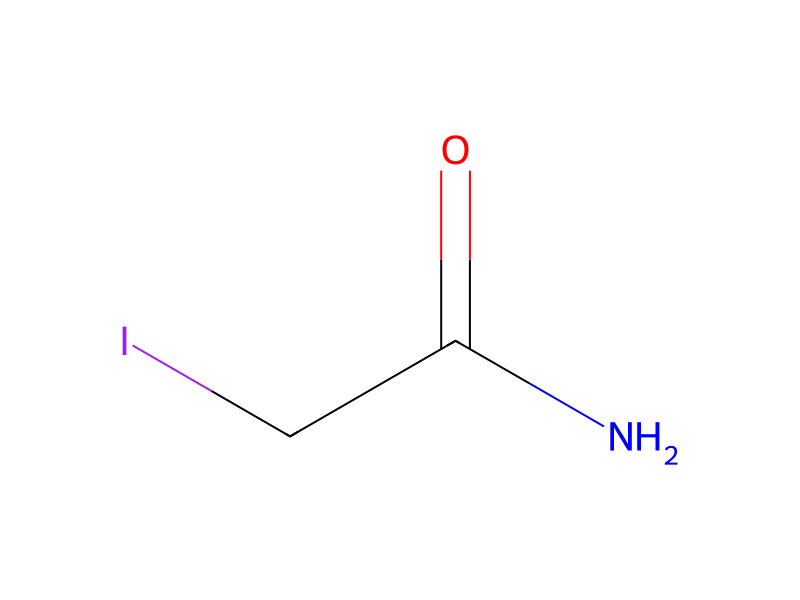
Basic information
- CAS
144-48-9- Standard SMILES
NC(=O)CI- InChIKey
PGLTVOMIXTUURA-UHFFFAOYSA-N- Molecular formula
- C2H4INO
- Average molar mass
- 184.96 g/mol
- Monoisotopic mass
- 184.93376
Overview
Iodoacetamide is a sulfhydryl alkylating reagent that forms covalent bonds with the thiol group of cysteines so the protein or peptide no longer forms disulfide bonds.
Names & identifiers
- Preferred name
- Iodoacetamide
- IUPAC
- 2-iodoacetamide
- English name
- 2-Iodoacetamide
- Molecular formula
- C2H4INO
- Molecular weight
- 184.96
Names & synonyms
2-Iodoacetamideiodoacetamide144-48-9SurautoMonoiodoacetamideACETAMIDE, 2-IODO-DTXSID9020742N-(3-Methoxy-4-butoxybenzyl)thiobarbituric acidZRH8M27S79NSC-9581DTXCID10742RefChem:389075
Show more names
IAMusafd-12-IodacetamidIodoethanamide2-iodo-acetamid
205-630-1USAF D-1alpha-IodoacetamidedeltopiodacetamideiodoacetoamideMFCD00008028CCRIS 7710
Database identifiers
- CAS
144-48-9- PubChem CID
- 3727
- DTXSID
DTXSID9020742- ChEMBL
CHEMBL276727- UNII
- ZRH8M27S79
- EC Number
- 205-630-1
- Nikkaji
- J3.270K
Properties
Computed structural properties
- XLogP
- -0.2
- Topological polar surface area
- 43.1 Ų
- Hydrogen bond donors
- 1
- Hydrogen bond acceptors
- 1
- Rotatable bonds
- 1
- Heavy atoms
- 5
- Formal charge
- 0
- Complexity
- 44.9
Experimental & physicochemical properties
Chemical ClassesNitrogen Compounds -> Other Nitrogen Compounds
SpringerMaterials PropertiesSchoenflies notation
LogP-0.19
Vapor Pressure0.00506 [mmHg]
Physical DescriptionCrystalline solid; [Sigma-Aldrich MSDS]
Physicochemical properties
- Melting point
- 92 · 92-95 °C(lit.)
- Boiling point
- 297.1 · 297.1±23.0 °C(Predicted)
- Density
- 2.1103 · 2.1103 (estimate)
- storage temp.
- 2 · 2-8°C
- solubility
- Soluble in water, dimethyl formamide and ethanol. Slightly soluble in methanol.
- form
- crystalline
- pka
- 15.16 · 15.16±0.40(Predicted)
Safety & regulation
Safety information is for reference only and does not replace the supplier’s Safety Data Sheet (SDS), applicable regulations, or professional assessment.
GHS classification
GHS Classification
Danger
H301 (99%): Toxic if swallowed [Danger Acute toxicity, oral]
P233, P260, P261, P264, P270, P271, P272, P273, P280, P284, P301+P316, P302+P352, P304+P340, P321, P330, P333+P317, P342+P316, P362+P364, P403, P405, and P501 (click each P-code to see the statement)
Aggregated GHS information provided per 192 reports by companies from 14 notifications to the ECHA C&L Inventory. Each notification may be associated with multiple companies.
Hazard information
Regulatory Information
Chemical: Acetamide, 2-iodo-
2-Iodoacetamide: Does not have an individual approval but may be used under an appropriate group standard
Hazards Summary
Causes ulceration or bleeding from the stomach and other GI changes in 74-week intermittent oral studies of rats; [RTECS] May cause irritation; May cause skin and respiratory sensitization; Toxic by ingestion; [Sigma-Aldrich MSDS] See Chloroacetamide.
Hazard Classes and CategoriesAcute Tox. 3 (99%)
Toxicology
Adverse EffectsSkin Sensitizer - An agent that can induce an allergic reaction in the skin.
Safety data
- F
- 8-10-21
- wgk
- 3
- tsca
- TSCA listed
- rtecs
- AC4200000
Chemistry & industry
Pharmacology
MeSH Pharmacological Classification
Highly reactive chemicals that introduce alkyl radicals into biologically active molecules and thereby prevent their proper functioning. Many are used as antineoplastic agents, but most are very toxic, with carcinogenic, mutagenic, teratogenic, and immunosuppressant actions. They have also been used as components in poison gases.
Compounds or agents that combine with an enzyme in such a manner as to prevent the normal substrate-enzyme combination and the catalytic reaction.
Uses & manufacturing
UsesAn alkylating sulfhydryl reagent with action similar to iodoacetate; [ChemIDplus]
General Manufacturing InformationAcetamide, 2-iodo-: ACTIVE
Applications
Uses2-Iodoacetamide is an alkylating reagent for cysteine residues in peptide sequencing. Its actions are similar to those of iodoacetate. By virtue of reaction with cysteine, it is an irreversible inhibitor of enzymes with cysteine at the active site. It reacts much more slowly with histidine residues, but that activity is responsible for inhibition of ribonuclease.
Upstream & downstream products
Upstream raw materials
Related reactions
169 records





Compound notes
Loading…