
Completing data — usually done within a minute
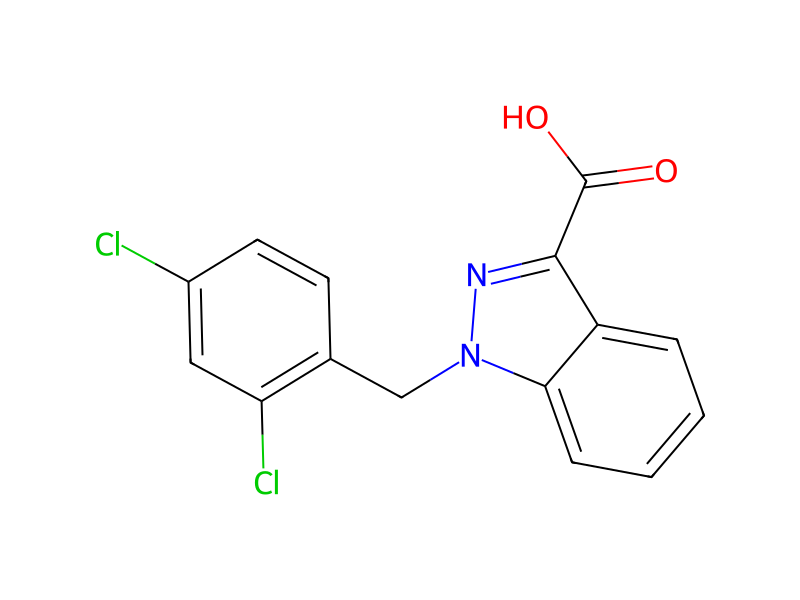
Basic information
- Standard SMILES
O=C(O)c1nn(Cc2ccc(Cl)cc2Cl)c2ccccc12- InChIKey
WDRYRZXSPDWGEB-UHFFFAOYSA-N- Molecular formula
- C15H10Cl2N2O2
- Average molar mass
- 321.163 g/mol
- Monoisotopic mass
- 320.01193292
Names & identifiers
- Preferred name
- 1-(2,4-Dichlorobenzyl)-1H-indazole-3-carboxylic acid
- IUPAC
- 1-[(2,4-Dichlorophenyl)methyl]-1H-indazole-3-carboxylic acid
- English name
- Lonidamine
- Molecular formula
- C15H10Cl2N2O2
- Molecular weight
- 321.16
Names & synonyms
dicalonidaminaf1890LONIDAMINEdoridaminaLonidnmineLONIDAMINGAF-1890:DICALonidamine, >=99%DICLONDAZOLIC ACID
Database identifiers
- CAS
50264-69-2- PubChem CID
- 39562
- DTXSID
DTXSID5020782- ChEMBL
CHEMBL1257030- ChEBI
CHEBI:50138- UNII
- U78804BIDR
- EC Number
- 256-510-0
- Nikkaji
- J10.376D
Properties
Physicochemical properties
- Melting point
- 207 · 207-209°C
- Boiling point
- 537.9 · 537.9±45.0 °C(Predicted)
- Density
- 1.4835 · 1.4835 (rough estimate)
- refractive index
- 1.607 · 1.6070 (estimate)
- storage temp.
- 2 · Sealed in dry,2-8°C
- solubility
- Soluble in DMSO (up to 25 mg/ml).
- pka
- 3 · 3.00±0.10(Predicted)
- form
- solid
- color
- White
- Stability
- 1 year · Stable for 1 year from date of purchase as supplied. Solutions in DMSO may be stored at -20° for up to 1 month.
- InChI
- InChI=1S/C15H10Cl2N2O2/c16-10-6-5-9(12(17)7-10)8-19-13-4-2-1-3-11(13)14(18-19)15(20)21/h1-7H,8H2,(H,20,21)
- InChIKey
- WDRYRZXSPDWGEB-UHFFFAOYSA-N
- SMILES
- N1(CC2=CC=C(Cl)C=C2Cl)C2=C(C=CC=C2)C(C(O)=O)=N1
- CAS DataBase Reference
- 50264 · 50264-69-2(CAS DataBase Reference)
- FDA UNII
- 78804 BIDR · U78804BIDR
- ATC code
- 1 XX07 · L01XX07
- UNSPSC Code
- 12352202 · 12352202
- NACRES
- 77 · NA.77
- Symbol(GHS)
- 7 · GHS07,GHS08
- Signal word
- Danger
- Hazard statements
- 302 · H302-H351-H360
- Precautionary statements
- 201 · P201-P301+P312+P330-P308+P313
- PPE
- 3 · Eyeshields, Gloves, type P3 (EN 143) respirator cartridges
- Hazard Codes
- T
- Risk Statements
- 60 · 60-22-40
- Safety Statements
- 53 · 53-22-36/37/39-45
- WGK Germany
- 3 · 3
- RTECS
- 7886000 · NK7886000
- HS Code
- 29339900 · 29339900
- Storage Class
- 6.1 C · 6.1C - Combustible acute toxic Cat.3toxic compounds or compounds which causing chronic effects
- Hazard Classifications
- 4 OralCarc · Acute Tox. 4 OralCarc. 2Repr. 1B
- Toxicity
- 50 in · LD50 in mice, rats (mg/kg): 900, 1700 orally; 435, 525 i.p. (Heywood)
Safety & regulation
Safety data
- PPE
- Eyeshields, Gloves, type P3 (EN 143) respirator cartridges
- wgk
- 3
- rtecs
- NK7886000
- hs_code
- 29339900
- Toxicity
- LD50 in mice, rats (mg/kg): 900, 1700 orally; 435, 525 i.p. (Heywood)
- risk_code
- 60-22-40
- Signal word
- Danger
- Symbol(GHS)
- GHS07,GHS08
- hazard_code
- T
- safety_code
- 53-22-36/37/39-45
- Storage Class
- 6.1C - Combustible acute toxic Cat.3toxic compounds or compounds which causing chronic effects
- Hazard statements
- H302-H351-H360
- Hazard Classifications
- Acute Tox. 4 OralCarc. 2Repr. 1B
- Precautionary statements
- P201-P301+P312+P330-P308+P313
Chemistry & industry
Applications
DescriptionLonidamine is a derivative of indazole-3-carboxylic acid. It is a kind of orally administrated small molecule, which can inhibit the glycolysis process through inactivating the hexokinase (the first step in glycolysis). It has been shown that cancer cell primarily generates energy through glycolysis process. Therefore, Lonidamine has been used for the treatment of several kinds of cancers. One special property of Lonidamine is that it seems to enhance aerobic glycolysis in normal cells, but inhibit glycolysis only in cancer cells. In addition, there are also evidences that Lonidamine may increase the occurrence of apoptosis. It has also been shown that Lonidamine is effective in the treatment of benigh prostatic hyperplasia (BPH).
DescriptionLonidamine is an antineoplastic agent reportedly effective for the treatment of various cancers, including lung, breast, prostate and brain tumors. Its clinical effect appears to be associated with changes in cellular energy metabolism.
Usescontraceptive, spermicidal
Upstream & downstream products
Upstream raw materials
Suppliers50 total
郑州阿尔法化工有限公司+86-18530059196 · [email protected]
衢州润东化工有限公司0570-8789886 18892685668 · [email protected]
湖北永阔科技有限公司027-59223108 15972152991 · [email protected]
上海阿拉丁生化科技股份有限公司400-6206333 13167063860 · [email protected]
Shanghai Biolang Biotechnology Co., Ltd.+86-15970428662 +86-13397199602 · [email protected]
湖北万得化工有限公司15377098680 15377098680 · [email protected]
成都超九八生物科技有限公司13348960310 13348960310 · [email protected]
LGM Pharma1-(800)-881-8210 · [email protected]
上海将来实业股份有限公司400-0066400 13621662912 · [email protected]
武汉易泰科技有限公司上海分公司18930552037 · [email protected]
上海晶抗生物工程有限公司021-54721350 13524668266 · [email protected]
大连美仑生物技术有限公司0411-62910999 13889544652 · [email protected]
安耐吉化学&3A(安徽泽升科技有限公司)021-58432009 400-005-6266 · [email protected]
南京圣亿来化工有限公司19951936396 · [email protected]
MedBio脉铂医药021-69568360 18916172912 · [email protected]
上海景颜化工科技有限公司13817811078 · [email protected]
VDM Biochemicals0330-2528181 · [email protected]
MedChemexpress LLC021-58955995 · [email protected]
湖北广奥生物科技有限公司027-02702759223056 18162699093 · [email protected]
上海三牧化工技术有限公司021-38681880 13817889927
云南西力生物技术股份有限公司0871-65217109 · [email protected]
Wuhan Demeikai Biotechnology Co., Ltd+8618942921723 · [email protected]
上海源叶生物科技有限公司13636370518 · [email protected]
TOKYO CHEMICAL INDUSTRY CO., LTD.03-36680489 · [email protected]
TCI Europe320-37350700 · [email protected]
深圳康特腾科技有限公司86-0755-86635001 · [email protected]
广州爱纯医药科技有限公司020-39119399 18927568969 · [email protected]
南京生利德生物科技有限公司025-57798810 18652991625 · [email protected]
上海旺瑜生物科技有限公司021-59501308 18321645636 · [email protected]
上海湄水化工科技有限公司021-60549325 18616193163
上海将来实业股份有限公司400-0066400 13621662912 · [email protected]
上海将来实业股份有限公司021-61552785 · [email protected]
HBCChem, Inc.+1-510-219-6317 · [email protected]
湖南华腾制药有限公司400-8592883 · [email protected]
上海麦克林生化科技股份有限公司15221275939 15221275939 · [email protected]
杭州杰恒化工有限公司0571-87396432 · [email protected]
湖北巨胜科技有限公司027-59599241 18871490274 · [email protected]
池州凯隆进出口贸易有限公司[email protected]
Sigma-Aldrich西格玛奥德里奇(上海)贸易有限公司021-61415566 800-8193336 · [email protected]
桦特昇生物科技(武汉)有限公司027-59207879 1972026995 18140587686 · [email protected]
南京熙泽医药科技有限公司025-66023220 15250997978 · [email protected]
TargetMol中国(陶术生物)021-021-33632979 15002134094 · [email protected]
上海昕凯医药科技有限公司21-619849051-1 18521059765 · [email protected]
上海陶术生物科技股份有限公司+1-781-999-5354; +1-00000000000 · [email protected]
BOC Sciences16314854226; +8616314854226 · [email protected]
武汉鑫儒化工有限公司15927387915 15337108568
厦门志信化学有限公司+86-5922680277 +86-13806087780 · [email protected]
上海珞珐生化科技有限公司021-51111890 15317326293 · [email protected]
上海思言生物科技有限公司021-50908862,442785678,326799392 18721037013 · [email protected]
北京华威锐科化工科技有限公司89508211 18501085097 · [email protected]
Additional notes
DefinitionChEBI: A member of the class of indazoles that is 1H-indazole that is substituted at positions 1 and 3 by 2,4-dichlorobenzyl and carboxy groups, respectively.
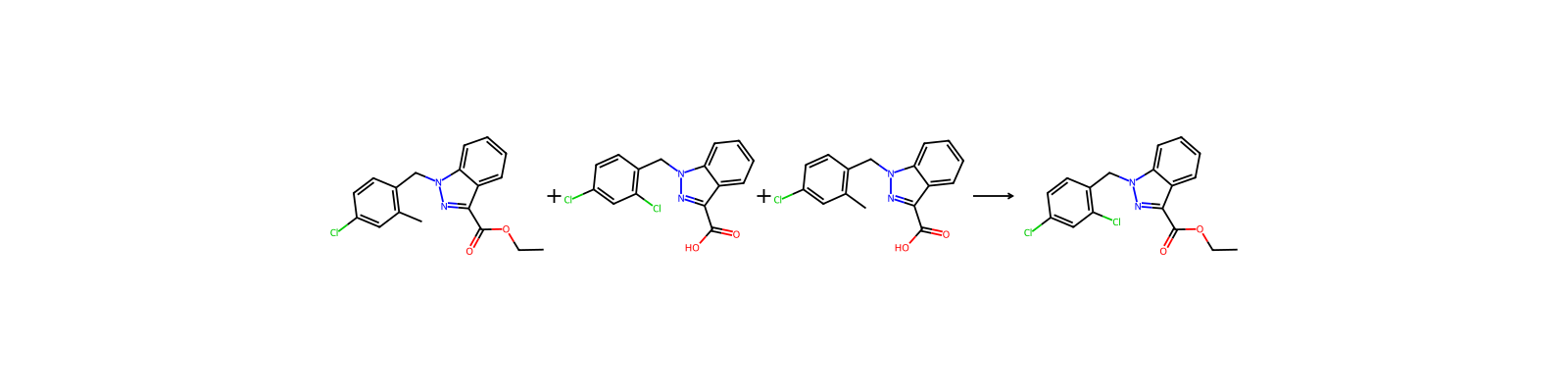
Related reactions
3 records

Linked notes
Loading…