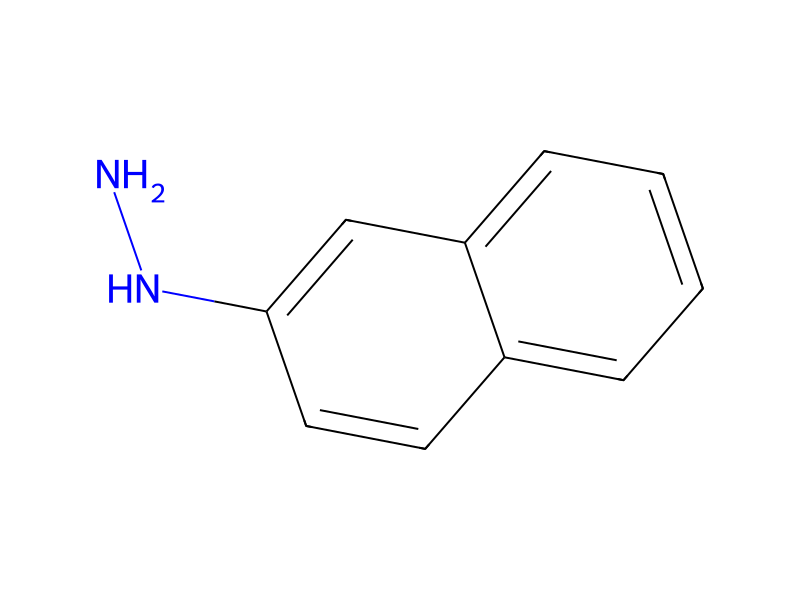
Basic information
- Standard SMILES
NNc1ccc2ccccc2c1- InChIKey
VNICRWVQYFRWDK-UHFFFAOYSA-N- Molecular formula
- C10H10N2
- Average molar mass
- 158.2 g/mol
- Monoisotopic mass
- 158.08439833
Names & identifiers
- Preferred name
- (Naphthalen-2-yl)hydrazine
- IUPAC
- naphthalen-2-ylhydrazine
- English name
- 2-Naphthylhydrazine
- Molecular formula
- C10H10N2
- Molecular weight
- 158.2
Names & synonyms
2-naphthylhydrazine(naphthalen-2-yl)hydrazineRefChem:406689822-033-7naphthalen-2-ylhydrazine2243-57-4NAPHTHALEN-2-YL-HYDRAZINEMFCD00486012(2-Naphthalenyl)hydrazineCHEMBL6172043hydrazine, 2-naphthalenyl-, hydrochloride2-hydrazinonaphthalene
Show more names
AKOS AUF04172-NAPHTHYL HYDRAZINEBETA-NAPHTHYL HYDRAZINEphthalen-2-yl-hydrazinehydrazine, 2-naphthalenyl-Indocyanine Green Impurity 112-NAPHTHYLHYDRAINE HYDROCHLORIDE
2-naphthalenylhydrazine1-(2-Naphthyl)hydraziness-Naphthylhydrazinbeta-naphthylhydrazineNaphthalene, 2-hydrazino-1-(2-Naphthyl)hydrazine #SCHEMBL526498SCHEMBL30982278
Database identifiers
- CAS
2243-57-4- PubChem CID
- 407448
- DTXSID
DTXSID101034443- ChEMBL
CHEMBL6172043- EC Number
- 822-033-7
- Nikkaji
- J30.425E
Properties
Computed structural properties
- XLogP
- 2.7
- Topological polar surface area
- 38.1 Ų
- Hydrogen bond donors
- 2
- Hydrogen bond acceptors
- 2
- Rotatable bonds
- 1
- Heavy atoms
- 12
- Formal charge
- 0
- Complexity
- 147
Physicochemical properties
- Boiling point
- 362.9 · 362.9±11.0 °C(Predicted)
- Density
- 1 · 1+-.0.06 g/cm3(Predicted)
- pka
- 5.66 · 5.66±0.70(Predicted)
- CAS DataBase Reference
- 2243 · 2243-57-4(CAS DataBase Reference)
- Symbol(GHS)
- 7 · GHS07
- Signal word
- Warning
- Hazard statements
- 315 · H315-H319-H335
- Precautionary statements
- 261 · P261-P264b-P271-P280-P302+P352-P304+P340-P305+P351+P338-P312-P362+P364-P403+P233-P501c
- HazardClass
- IRRITANT
Safety & regulation
GHS classification
GHS Classification
Warning
H302 (100%): Harmful if swallowed [Warning Acute toxicity, oral];H312 (100%): Harmful in contact with skin [Warning Acute toxicity, dermal];H315 (100%): Causes skin irritation [Warning Skin corrosion/irritation];H317 (100%): May cause an allergic skin reaction [Warning Sensitization, Skin];H319 (100%): Causes serious eye irritation [Warning Serious eye damage/eye irritation];H332 (100%): Harmful if inhaled [Warning Acute toxicity, inhalation];H335 (100%): May cause respiratory irritation [Warning Specific target organ toxicity, single exposure; Respiratory tract irritation];H341 (100%): Suspected of causing genetic defects [Warning Germ cell mutagenicity];H351 (100%): Suspected of causing cancer [Warning Carcinogenicity]
P203, P261, P264, P264+P265, P270, P271, P272, P280, P301+P317, P302+P352, P304+P340, P305+P351+P338, P317, P318, P319, P321, P330, P332+P317, P333+P317, P337+P317, P362+P364, P403+P233, P405, and P501 (click each P-code to see the statement)
Aggregated GHS information provided per 2 reports by companies from 2 notifications to the ECHA C&L Inventory. Each notification may be associated with multiple companies.;Information may vary between notifications depending on impurities, additives, and other factors. The percentage value in parenthesis indicates the notified classification ratio from companies that provide hazard codes. Only hazard codes with percentage values above 10% are shown. For more detailed information, please visit ECHA C&L website.
Hazard information
Hazard Classes and CategoriesAcute Tox. 4 (100%);Acute Tox. 4 (100%);Skin Irrit. 2 (100%);Skin Sens. 1 (100%);Eye Irrit. 2A (100%);Acute Tox. 4 (100%);STOT SE 3 (100%);Muta. 2 (100%);Carc. 2 (100%)
Safety data
- Signal word
- Warning
- Symbol(GHS)
- GHS07
- hazard_class
- IRRITANT
- Hazard statements
- H315-H319-H335
- Precautionary statements
- P261-P264b-P271-P280-P302+P352-P304+P340-P305+P351+P338-P312-P362+P364-P403+P233-P501c
Chemistry & industry
Applications
Uses2-Naphthylhydrazine-D3 is an intermediate used in the synthesis of Indocyanine Green-d12 (I697002), which is an isotopic analog of Indocyanine Green (I697000), a tricarbocyanine type of dye with infrared absorbing properties that can be used as a diagnostic aid (blood volume determination, cardiac output, hepatic function).
Upstream & downstream products
Downstream products
Suppliers28 total
Hebei Chuanghai Biotechnology Co., Ltd+86-17732866630 · [email protected]
怀化元研达生物技术有限责任公司18711085600 · [email protected]
Dayang Chem (Hangzhou) Co.,Ltd.+86-0571-88938639 17705817739 · [email protected]
山东利腾生物科技有限公司+86-18663721413 +86-15552573001 · [email protected]
怀化元研达生物技术有限责任公司18711085600; 18229999901 · [email protected]
上海柯维化学技术有限公司021-64609169 18901607656 · [email protected]
烟台盛凯伦生物制品有限公司13356901049 · [email protected]
上海景颜化工科技有限公司13817811078 · [email protected]
深圳康特腾科技有限公司86-0755-86635001 · [email protected]
湖北扬信医药科技有限公司15347293736 · [email protected]
PT CHEM GROUP LIMITED+86-85511178; +86-85511178 · [email protected]
成都零六生物科技有限公司400-1166-196 13458535857 · [email protected]
深圳振强药物研发有限公司+86-0755-66853366 +86-13670046396 · [email protected]
聊城莱博特生物医药科技有限公司0635-893290 · [email protected]
山东西亚化学有限公司4009903999 13395398332 · [email protected]
上海煜柯化学品有限公司13391486464 · [email protected]
山东小野化学股份有限公司0539-6362799 20)
上海康满林生物医药有限公司68080707 15021879576 · [email protected]
河南威梯希化工科技有限公司0371-53732842 13383863444 · [email protected]
杭州洁汉化工有限公司+86-571-86217390; +8618058761490 · [email protected]
江苏艾康生物医药研发有限公司025-58859352 15955137747 · [email protected]
厦门盈融达化工有限公司+86-0592-6210733 · [email protected]
career henan chemical co+86-0371-86658258 · [email protected]
济南利恒生物科技有限公司0531-18763987518 18763987518 · [email protected]
河南拉瓦锡化工产品有限公司0371-63682289 18625781376 · [email protected]
重庆卡兰医药有限公司[email protected]
Hefei TNJ Chemical Industry Co.,Ltd.+86-0551-65418671 +86-189 4982 3763 · [email protected]
湖北清北云研医药科技有限责任公司18162595016; 18162595016 · [email protected]
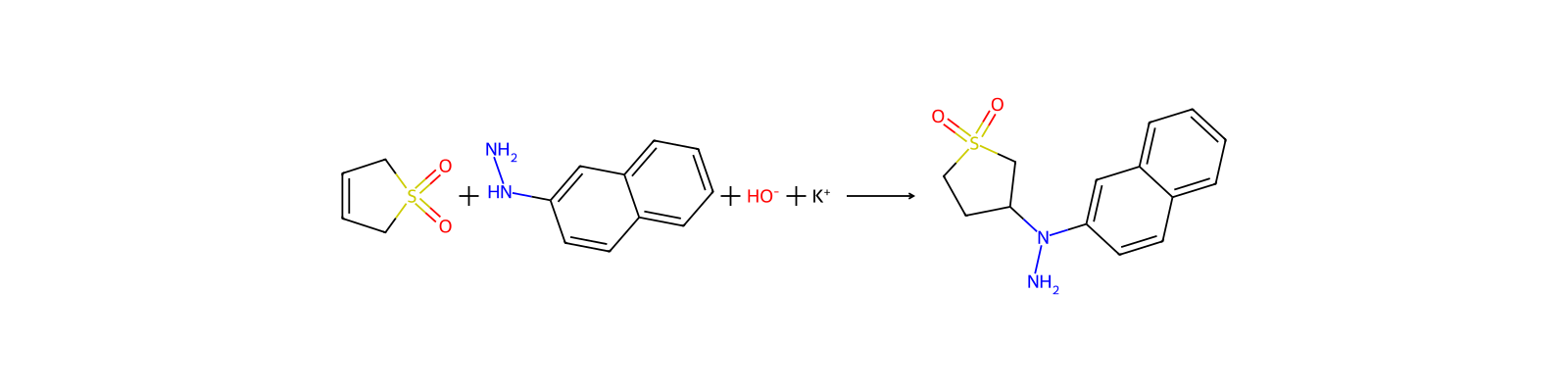
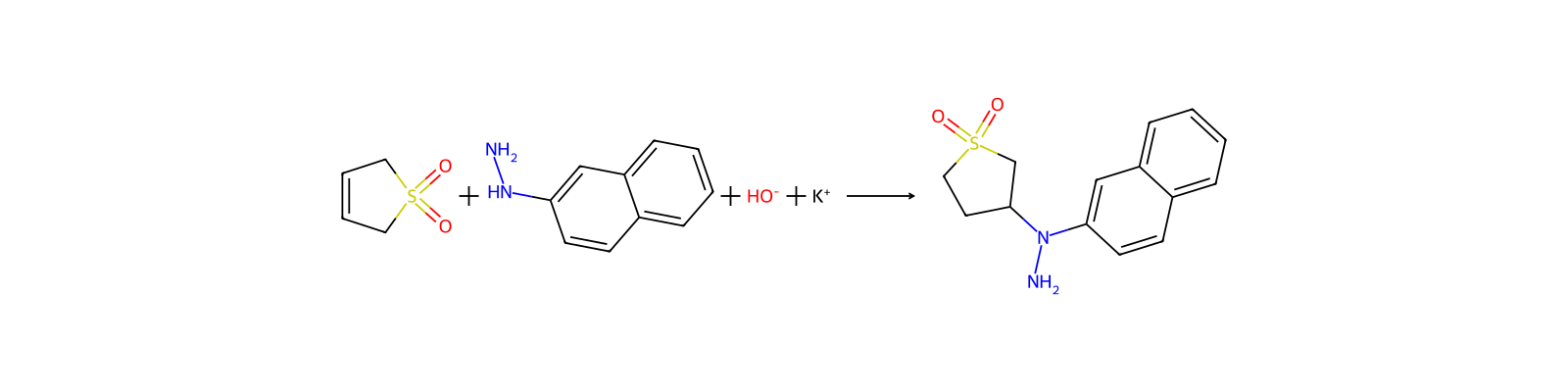
Related reactions
3 records

Linked notes
Loading…