Basic information
- Standard SMILES
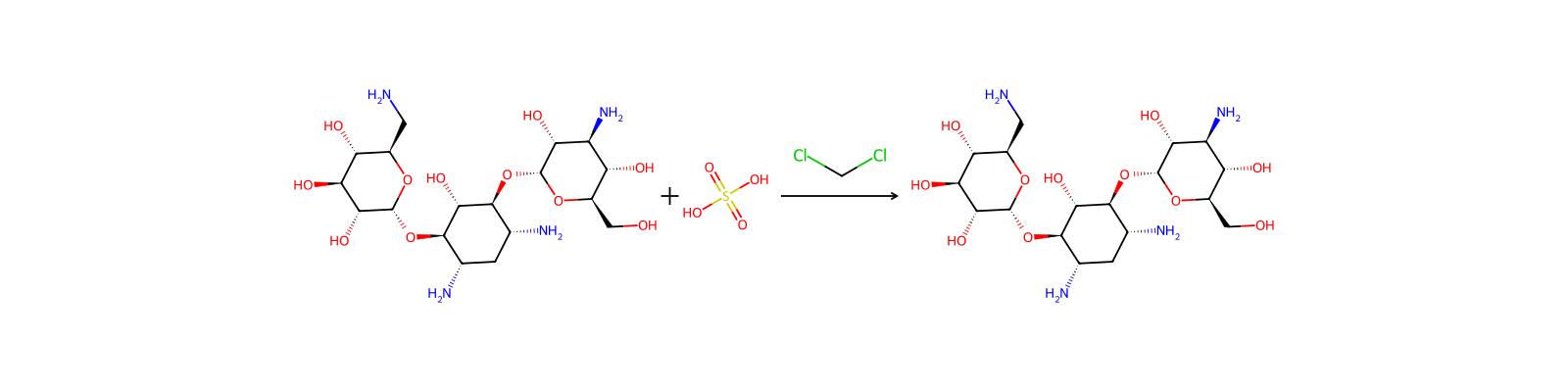
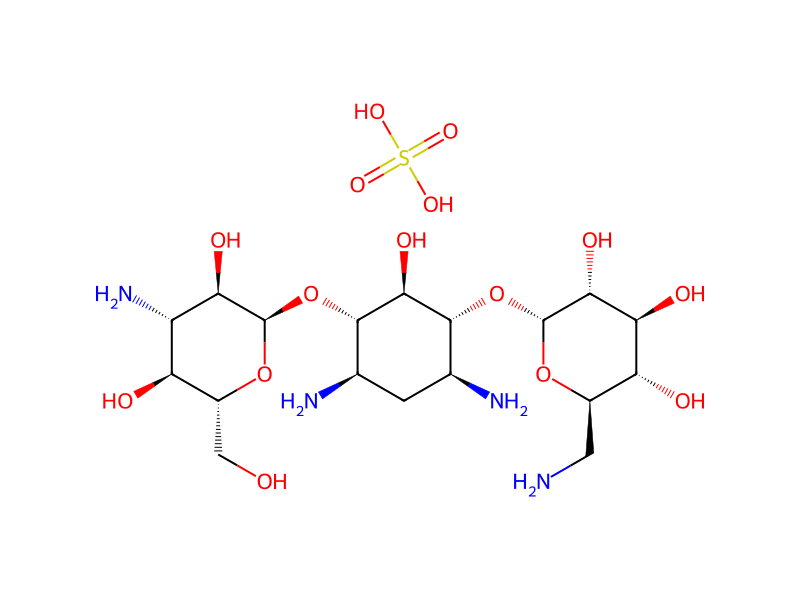
NC[C@H]1O[C@H](O[C@H]2[C@H](O)[C@@H](O[C@H]3O[C@H](CO)[C@@H](O)[C@H](N)[C@H]3O)[C@H](N)C[C@@H]2N)[C@H](O)[C@@H](O)[C@@H]1O.O=S(=O)(O)O- InChIKey
OOYGSFOGFJDDHP-KMCOLRRFSA-N- Molecular formula
- C18H38N4O15S
- Average molar mass
- 582.6 g/mol
- Monoisotopic mass
- 582.20543769
Names & identifiers
- Preferred name
- Kanamycin A Sulfate
- IUPAC
- (2R,3S,4S,5R,6R)-2-(aminomethyl)-6-[(1R,2R,3S,4R,6S)-4,6-diamino-3-[(2S,3R,4S,5S,6R)-4-amino-3,5-dihydroxy-6-(hydroxymethyl)oxan-2-yl]oxy-2-hydroxycyclohexyl]oxyoxane-3,4,5-triol;sulfuric acid
- English name
- Kanamycin sulfate
- Molecular formula
- C18H38N4O15S
- Molecular weight
- 582.58
Names & synonyms
Kanamycin A sulfateKanamycin A sulphateDTXSID1047524J80EX28SMQEINECS 223-347-1(2R,3S,4S,5R,6R)-2-(aminomethyl)-6-[(1R,2R,3S,4R,6S)-4,6-diamino-3-[(2S,3R,4S,5S,6R)-4-amino-3,5-dihydroxy-6-(hydroxymethyl)oxan-2-yl]oxy-2-hydroxycyclohexyl]oxyoxane-3,4,5-triol;sulfuric acidCHEBI:6109DTXCID9027524KANAMYCIN A SULFATE [MI]KANAMYCIN SULFATE [USP-RS]KANAMYCIN SULFATE [USP MONOGRAPH]KANAMYCIN MONOSULFATE [EP MONOGRAPH]
Show more names
KANAMYCIN MONOSULFATEKANAMYCIN ACID SULFATEKANAMYCIN SULPHATEKantrexklebcilKanamycin AcidKanamycin monosulfate CRSkanoKAMYCINKantrim
KANAMYCIN SULFATE (USP-RS)KANAMYCIN SULFATE (USP MONOGRAPH)D-STREPTAMINE, O-3-AMINO-3-DEOXY-.ALPHA.-D-GLUCOPYRANOSYL(1->6)-O-(6-AMINO-6-DEOXY-.ALPHA.-D-GLUCOPYRANOSYL(1->4))-2-DEOXY-, SULFATE (1:1) (SALT)D-STREPTAMINE, O-3-AMINO-3-DEOXY-.ALPHA.-D-GLUCOPYRANOSYL(1->6)-O-(6-AMINO-6-DEOXY-.ALPHA.-D-GLUCOPYRANOSYL(1->4))-2-DEOXY-, SULPHATE (1:1) (SALT)D-Streptamine, O-3-amino-3-deoxy-alpha-D-glucopyranosyl(1->6)-O-(6-amino-6-deoxy-alpha-D-glucopyranosyl(1->4))-2-deoxy-, sulfate (1:1) (salt)KANAMYCIN MONOSULFATE (EP MONOGRAPH)Kanaplex(2R,3S,4S,5R,6R)-2-(aminomethyl)-6-((1R,2R,3S,4R,6S)-4,6-diamino-3-((2S,3R,4S,5S,6R)-4-amino-3,5-dihydroxy-6-(hydroxymethyl)oxan-2-yl)oxy-2-hydroxycyclohexyl)oxyoxane-3,4,5-triol;sulfuric acid
Database identifiers
- CAS
25389-94-0、3847-27-6、64013-70-3- PubChem CID
- 441374
- DTXSID
DTXSID1047524- ChEMBL
CHEMBL1446- ChEBI
CHEBI:6109- UNII
- J80EX28SMQ
- EC Number
- 223-347-1、613-414-7
Properties
Computed structural properties
- Topological polar surface area
- 366 Ų
- Hydrogen bond donors
- 13
- Hydrogen bond acceptors
- 19
- Rotatable bonds
- 6
- Heavy atoms
- 38
- Formal charge
- 0
- Complexity
- 720
Experimental & physicochemical properties
Collision Cross Section221.1 Ų [M+H]+ [CCS Type: TW; Method: calibrated with polyalanine and drug standards]
Physicochemical properties
- Melting point
- 250 °C · 250°C
- alpha
- 112 · +112~+123°(D/20℃)(c=1,H2O)(calculated on the dried basis)
- Density
- 1.3619 · 1.3619 (rough estimate)
- refractive index
- 117.5 ° · 117.5 ° (C=1, H2O)
- storage temp.
- 2 · 2-8°C
- solubility
- 2 O: · H2O: 10-50 mg/mL As a stock solution. Stock solutions should be stored at 2-8°C. Stable at 37°C for 5 days.
- form
- powder
- color
- white to off-white
- PH Range
- 6.5 · 6.5 - 8.5 (1% solution)
- biological source
- Streptomyces kanamyceticus
- Water Solubility
- 10 mg/ml · Soluble in water at 10mg/ml
- Merck
- 14 · 14,5281
- Major Application
- pharmaceutical (small molecule)
- InChIKey
- OOYGSFOGFJDDHP-KMCOLRRFSA-N
- SMILES
- OS(O)(=O)=O.NC[C@H]1O[C@H](O[C@@H]2[C@@H](N)C[C@@H](N)[C@H](O[C@H]3O[C@H](CO)[C@@H](O)[C@H](N)[C@H]3O)[C@H]2O)[C@H](O)[C@@H](O)[C@@H]1O
- FDA UNII
- 80 EX28SMQ · J80EX28SMQ
- UNSPSC Code
- 51281654 · 51281654
- NACRES
- 76 · NA.76
- Symbol(GHS)
- 8 · GHS08
- Signal word
- Danger
- Hazard statements
- 360 D · H360D
- Precautionary statements
- 201 · P201-P202-P280-P308+P313-P405-P501
- PPE
- 95 · Eyeshields, Gloves, type N95 (US)
- Hazard Codes
- T
- Risk Statements
- 61 · 61
- Safety Statements
- 22 · 22-24/25-45-53
- WGK Germany
- 3 · 3
- RTECS
- 3225030 · NZ3225030
- HS Code
- 29419020 · 29419020
- Storage Class
- 6.1 D · 6.1D - Non-combustible acute toxic Cat.3toxic hazardous materials or hazardous materials causing chronic effects
- Hazard Classifications
- 1 B · Repr. 1B
- Toxicity
- 50 in · LD50 in mice: 20.7 g/kg orally; 1450 mg/kg i.p. (Zel'tser)
Safety & regulation
GHS classification
GHS Classification
This chemical does not meet GHS hazard criteria for 1% (1 of 96) of reports.
Danger
H360 (69.8%): May damage fertility or the unborn child [Danger Reproductive toxicity];H372 (29.2%): Causes damage to organs through prolonged or repeated exposure [Danger Specific target organ toxicity, repeated exposure];H400 (29.2%): Very toxic to aquatic life [Warning Hazardous to the aquatic environment, acute hazard];H410 (29.2%): Very toxic to aquatic life with long lasting effects [Warning Hazardous to the aquatic environment, long-term hazard]
P203, P260, P264, P270, P273, P280, P318, P319, P391, P405, and P501 (click each P-code to see the statement)
Aggregated GHS information provided per 96 reports by companies from 10 notifications to the ECHA C&L Inventory. Each notification may be associated with multiple companies.;Reported as not meeting GHS hazard criteria per 1 of 96 reports by companies.;There are 9 notifications provided by 95 of 96 reports by companies with hazard statement code(s).;Information may vary between notifications depending on impurities, additives, and other factors. The percentage value in parenthesis indicates the notified classification ratio from companies that provide hazard codes. Only hazard codes with percentage values above 10% are shown. For more detailed information, please visit ECHA C&L website.
Hazard information
Hazard Classes and Categories
Repr. 1B (69.8%);STOT RE 1 (29.2%);Aquatic Acute 1 (29.2%);Aquatic Chronic 1 (29.2%)
Repr. 1B (100%)
Safety data
- PPE
- Eyeshields, Gloves, type N95 (US)
- wgk
- 3
- rtecs
- NZ3225030
- hs_code
- 29419020
- Toxicity
- LD50 in mice: 20.7 g/kg orally; 1450 mg/kg i.p. (Zel'tser)
- risk_code
- 61
- Signal word
- Danger
- Symbol(GHS)
- GHS08
- hazard_code
- T
- safety_code
- 22-24/25-45-53
- Storage Class
- 6.1D - Non-combustible acute toxic Cat.3toxic hazardous materials or hazardous materials causing chronic effects
- Hazard statements
- H360D
- Hazard Classifications
- Repr. 1B
- Precautionary statements
- P201-P202-P280-P308+P313-P405-P501
Chemistry & industry
Uses & manufacturing
Use ClassificationAnimal Drugs -> FDA Approved Animal Drug Products (Green Book) -> Active Ingredients
Applications
DescriptionKanamycin sulfate has been well known as desirable antibiotics, which shows an obvious curative effect on serious infections caused by gram-negative bacteria such as Escherichia coil, Klebsiella, Proteus, Pneumonia, Enterobacter aerogenes and Shigella. Clinically, this substance is mainly used for infections caused by sensitive bacteria including pulmonary infection, urinary tract infection, biliary tract infection, sepsis, and abdominal cavity infection. For example, the effective antibacterial activity of kanamycin sulfate has been demonstrated by the treatment of acute gonorrheal urethritis in men, showing that a single parenterally administered dose of 2 mg of kanamycin sulfate cured 144 (93%) of 155 men with acute gonorrheal urethritis.1 Moreover, kanamycin sulfate was found to be a valuable drug in the treatment of serious infections in infants and children through an analysis of 140 cases treated during a two-year period.2
DescriptionKanamycin was found by Umezawa et al. in the culture broth of Streptomyces kanamyceticus in 1957. It is produced with other components, kanamycins B (bekanamycin) and C, which are also separated during the purification. The compound shows much lower toxicity than the earlier aminoglycosides, streptomycin and neomycin, and strong activity against a wide range of gram-positive and gram-negative bacteria, including Mycobacterium. Kanamycin has been used clinically for treatment of such serious infections as dysentery, salmonellosis, and tuberculosis.
UsesKanamycin monosulfate, is used as an aminoglycoside antibiotic. Kanamycin can be used as a selection agent in several types of isolation media.Kanamycin sulfate from Streptomyces kanamyceticus has been used in tissue culture media. Kanamycin sulfate can also be used as a selection agent for cells transformed with kanamycin B resistance gene. It is recommended for use in cell culture applications at 100mg/mL.
UsesAntibiotic complex produced by Streptomyces kanamyceticus Okami & Umezawa from Japanese soil. Comprised of three components, kanamycin A, the major component, and kanamycins B and C, two minor congeners. Antibacterial.
UsesKanamycin sulfate is an antibacterial agent similar to neomycin.
General DescriptionKanamycin sulfate is a broad spectrum aminoglycoside-antibiotic derived from Streptomyces kanamyceticus. It is used as an additive in culture media for the isolation of group D streptococci on Kanamycin Esculin Azide Agar and for selection of transformed plant cells containing the neomycin phosphotransferase on a kanamycin-medium. Kanamycin sulfate can also be used as a selection agent for cells transformed with kanamycin B resistance gene. It is recommended for use in cell culture applications at 2 mL/L.
Upstream & downstream products
Upstream raw materials
Suppliers50 total
国药集团化学试剂有限公司86-21-63210123 · [email protected]
北京华美互利生物化工010-56205725 · [email protected]
梯希爱(上海)化成工业发展有限公司021-67121386 · [email protected]
上海阿拉丁生化科技股份有限公司400-6206333 13167063860 · [email protected]
INTATRADE GmbH+49 3493/605464 · [email protected]
湖北恒硕化工有限公司027-82830253 13995541600 · [email protected]
上海迈瑞尔生化科技有限公司4006356688 18621169109 · [email protected]
上海拓克化学科技有限公司+86-021-69895597 13776836200 +86-13776836200 · [email protected]
大连美仑生物技术有限公司0411-62910999 13889544652 · [email protected]
太原市瑞和丰科贸有限公司+86 351 7031519 · [email protected]
安耐吉化学&3A(安徽泽升科技股份有限公司)400-0056266 · [email protected]
北京绿百草科技发展有限公司010-61136123 · [email protected]
上海瀚鸿科技股份有限公司021-54306202 13764082696 · [email protected]
上海柯维化学技术有限公司021-64609169 18901607656 · [email protected]
上海景颜化工科技有限公司13817811078 · [email protected]
Pure Chemistry Scientific Inc.001-857-928-2050 or 1-888-588-9418 · [email protected]
上海泰坦科技股份有限公司400-6009262 15618770481 · [email protected]
武汉丰泰威远科技有限公司027-87465837 19945049750 · [email protected]
BOC Sciences1-631-485-4226; 16314854226 · [email protected]
孝感深远化工有限公司15527621225; 15527621225 · [email protected]
山东西亚化学有限公司13355009207 13355009207 · [email protected]
四川库利南科技有限公司400-1166-196 18981987031 · [email protected]
天津希恩思生化科技有限公司400 638 7771 · [email protected]
湖南汇百侍生物科技有限公司0731-85526065 13308475853 · [email protected]
斯百全化学(上海)有限公司021-021-021-67601398-809-809-809 15221380277 · [email protected]
上海源叶生物科技有限公司13636370518 · [email protected]
艾科试剂4008-755-333 18080918076 · [email protected]
上海思域化工科技有限公司86-21-34053660 · [email protected]
上海遐瑞医药科技有限公司+86 21 61551611
TCI AMERICA800-4238616 · [email protected]
TOKYO CHEMICAL INDUSTRY CO., LTD.03-36680489 · [email protected]
TCI Europe320-37350700 · [email protected]
南京杜莱生物技术有限公司025-84699383-8003;025-846993838003-8003 18013301590 · [email protected]
广州爱纯医药科技有限公司020-39119399 18927568969 · [email protected]
南京生利德生物科技有限公司025-57798810 18652991625 · [email protected]
上海倍卓生物科技有限公司021-61119791,13386096464 · [email protected]
深圳菲斯生物科技有限公司0755-83725350 13380397412 · [email protected]
四川省维克奇生物科技有限公司028-81700200 18116577057 · [email protected]
安倍医疗器械贸易(上海)有限公司400-1500-680 021-62402299 · [email protected]
成都零六生物科技有限公司400-1166-196 13458535857 · [email protected]
湖南华腾制药有限公司400-8592883 · [email protected]
上海鑫圭生物科技有限公司15121041756 · [email protected]
上海麦克林生化科技股份有限公司15221275939 15221275939 · [email protected]
杭州杰恒化工有限公司0571-87396432 · [email protected]
上海永叶生物科技有限公司86-021-61559134 15921386130 · [email protected]
上海嵩爰化工科技有限公司010-1234567 18521000990 · [email protected]
成都润泽本土化工有限公司13096311329 028-88469284 616445927 · [email protected]
凯试(上海)科技有限公司021-50135380 · [email protected]
湖北巨胜科技有限公司027-59599241 18871490274 · [email protected]
Sigma-Aldrich西格玛奥德里奇(上海)贸易有限公司021-61415566 800-8193336 · [email protected]
Additional notes
DefinitionA broadspectrum antibiotic.
Related reactions
11 records


Linked notes
Loading…