
HRID 1508608As product
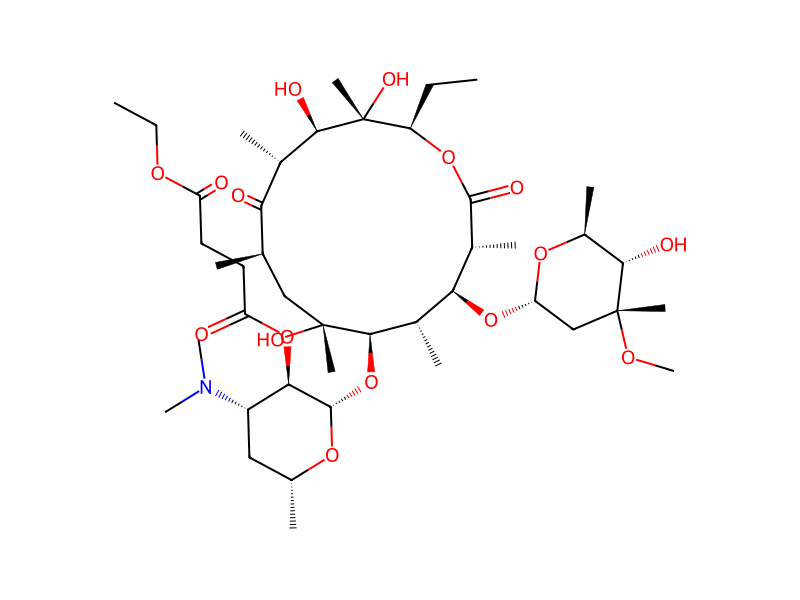
1264-62-6CCOC(=O)CCC(=O)O[C@H]1[C@H](O[C@@H]2[C@@H](C)[C@H](O[C@H]3C[C@@](C)(OC)[C@@H](O)[C@H](C)O3)[C@@H](C)C(=O)O[C@H](CC)[C@@](C)(O)[C@H](O)[C@@H](C)C(=O)[C@H](C)C[C@@]2(C)O)O[C@H](C)C[C@@H]1N(C)CNSYZCCDSJNWWJL-YXOIYICCSA-NErythromycin ethylsuccinate is a erythromycin derivative that is erythromycin A in which the hydroxy group at position 3R is substituted by a (4-ethoxy-4-oxobutanoyl)oxy group. It is used for the treatment of a wide variety of bacterial infections. It is an ethyl ester, a succinate ester, a cyclic ketone and an erythromycin derivative. It is functionally related to an erythromycin A.
1264-62-6、41342-53-4DTXSID4022993CHEMBL1200688CHEBI:31555FREELY SOL IN ACETONE & CHLOROFORM; SOL IN 95% ETHANOL & BENZENE; SPARINGLY SOL IN ETHER; VERY SLIGHTLY SOL IN WATER
FREELY SOLUBLE IN ALC, SOL IN POLYETHYLENE GLYCOL
FDA approved drugs -> Active ingredient
FDA approved drugs -> Active ingredient
AFTER RECONSTITUTION OF COMMERCIALLY AVAILABLE POWDER, SUSPENSIONS ARE STABLE FOR 10 DAYS @ 2-8 °C
Safety information is for reference only and does not replace the supplier’s Safety Data Sheet (SDS), applicable regulations, or professional assessment.
Danger
H317 (29.9%): May cause an allergic skin reaction [Warning Sensitization, Skin]
P233, P260, P261, P264+P265, P271, P272, P280, P284, P302+P352, P304+P340, P305+P351+P338, P321, P333+P317, P337+P317, P342+P316, P362+P364, P403, and P501 (click each P-code to see the statement)
Aggregated GHS information provided per 144 reports by companies from 4 notifications to the ECHA C&L Inventory. Each notification may be associated with multiple companies.
AMONG HYPERSENSITIVITY REACTIONS ARE FEVER, EOSINOPHILIA, & SKIN ERUPTIONS, EACH OF WHICH MAY OCCUR ALONE OR IN COMBINATION; THEY DISAPPEAR SHORTLY AFTER THERAPY IS STOPPED. ...MAY PRODUCE IRRITATIVE EFFECTS. ORAL ADMIN...FREQUENTLY ACCOMPANIED BY EPIGASTRIC DISTRESS, WHICH MAY BE QUITE SEVERE. /ERYTHROMYCIN/
IM INJECTION OF QUANTITIES LARGER THAN 100 MG PRODUCES...SEVERE PAIN... PERSISTS FOR HR: IV PERFUSIONS OF 1-G DOSES...ALMOST REGULARLY IS FOLLOWED BY THROMBOPHLEBITIS. ...6 PT...DEVELOPED DIFFICULTY IN HEARING WHILE BEING TREATED WITH 4 G/DAY...IV. ... CESSATION...LED TO COMPLETE RETURN OF NORMAL HEARING... /ERYTHROMYCIN/
A CASE REPORT OF HEPATOTOXICITY RESULTING FROM ERYTHROMYCIN ETHYLSUCCINATE THERAPY IN 60-YR-OLD FEMALE IS DESCIRBED.
ERYTHROMYCIN ETHYLSUCCINATE
Macrolides [CS]; Decreased Sebaceous Gland Activity [PE]; Macrolide [EPC]; Macrolide Antimicrobial [EPC]
Compounds or agents that combine with an enzyme in such a manner as to prevent the normal substrate-enzyme combination and the catalytic reaction.
Drugs used for their effects on the gastrointestinal system, as to control gastric acidity, regulate gastrointestinal motility and water flow, and improve digestion.
Compounds which inhibit the synthesis of proteins. They are usually ANTI-BACTERIAL AGENTS or toxins. Mechanism of the action of inhibition includes the interruption of peptide-chain elongation, the blocking the A site of ribosomes, the misreading of the genetic code or the prevention of the attachment of oligosaccharide side chains to glycoproteins.
Substances that inhibit the growth or reproduction of BACTERIA.
ERYTHROMYCIN ETHYLSUCCINATE IS PARTIALLY DISSOCIATED IN INTESTINE; BOTH ERYTHROMYCIN & UNDISSOCIATED ESTER ARE ABSORBED &, IN THE BLOOD, THE ESTER IS HYDROLYZED TO RELEASE FREE ERYTHROMYCIN.
ERYTHROMYCIN ETHYLSUCCINATE...IS ADEQUATELY ABSORBED FOLLOWING ORAL ADMINISTRATION, PARTICULARLY WHEN THE STOMACH IS EMPTY. PEAK CONCENTRATIONS IN PLASMA ARE 1.5 UG/ML (0.5 UG/ML OF BASE) 1 TO 2 HR AFTER ADMINISTRATION OF A 500 MG TABLET.
IN PATIENTS, MEAN BILE LEVELS OF ERYTHROMYCIN WERE APPROXIMATELY 10 TIMES HIGHER THAN CORRESPONDING SERUM CONCN 1 HR AFTER IV (ERYTHROMYCIN LACTOBIONATE) & IM (ERYTHROMYCIN SUCCINATE) INJECTION.
IN HEALTHY ADULT SUBJECTS & IN ADULT PATIENTS WITH BRONCHIAL INFECTIONS, PHARMACOKINETICS OF VARIOUS FORMULATIONS OF ERYTHROMYCIN WERE STUDIED. ERYTHROMYCIN ETHYLSUCCINATE WAS BETTER THAN ERYTHROMYCIN STEARATE FOR ORAL TREATMENT IN THAT IT WAS RAPIDLY & CONSISTENTLY ABSORBED.

COMMERCIALLY AVAILABLE TABLETS & POWDER FOR ORAL SUSPENSION HAVE EXPIRATION DATES OF 2 YR FOLLOWING DATES OF MANUFACTURE
COMMERCIALLY AVAILABLE SUSPENSIONS HAVE EXPIRATION DATES OF 18 MONTHS FOLLOWING DATES OF MANUFACTURE
ERYTHROMYCIN ETHYLSUCCINATE IM INJECTION HAS AN EXPIRATION DATE OF 18 MONTHS FOLLOWING DATE OF MFR
ERYTHROMYCIN ETHYLSUCCINATE INJECTION, USP (ERYTHROCIN ETHYLSUCCINATE-IM), CONTAINS 50 MG/ML IN 2- & 10-ML CONTAINERS FOR IM INJECTION. THIS PREPN INCL BUTYL AMINOBENZOATE (2%) AS LOCAL ANESTHETIC.
...USED IN FLAVORED ORAL "SUSPENSIONS" FOR PEDIATRIC USE.
...CONTAINS THE EQUIVALENT OF NOT LESS THAN 76.5% OF ERYTHROMYCIN BASE.
WHILE CROSS-RESISTANCE BETWEEN ERYTHROMYCIN & OTHER ANTIMICROBIAL AGENTS DOES NOT USUALLY OCCUR, IT HAS BEEN NOTED BETWEEN LINCOMYCIN & ERYTHROMYCIN IN STRAINS OF VIRIDANS GROUP OF STREPTOCOCCI ISOLATED FROM PT TREATED WITH EITHER AGENT. /ERYTHROMYCIN/
INCIDENCE OF ERYTHROMYCIN-RESISTANT STRAINS OF STAPH AUREUS HAS BEEN INCR; IN SOME HOSPITALS 50% OF STRAINS ARE NOT INHIBITED BY DRUG. OCCASIONAL STRAINS OF STREPTOCOCCUS PYOGENES & STREP (D) PNEUMONIAE RESISTANT TO DRUG HAVE BEEN RECOVERED FROM PT. /ERYTHROMYCIN/
UsesA broad spectrum antibiotic commonly targeting bacteria responsible for respiratory tract infections
General DescriptionErythromycin ethylsuccinate (EES, Pediamycin, EryPed) isthe ethylsuccinate mixed ester of erythromycin in which the2'-hydroxyl group of the desosamine is esterified. It isabsorbed as the ester and hydrolyzed slowly in the body toform erythromycin. It is somewhat acid labile, and itsabsorption is enhanced by the presence of food. The ester isinsoluble in water but soluble in alcohol and ether.
DefinitionChEBI: Erythromycin ethylsuccinate is a erythromycin derivative that is erythromycin A in which the hydroxy group at position 3R is substituted by a (4-ethoxy-4-oxobutanoyl)oxy group. It is used for the treatment of a wide variety of bacterial infections. It is a succinate ester, a cyclic ketone, an erythromycin derivative and an ethyl ester. It is functionally related to an erythromycin A.