Reaction equation

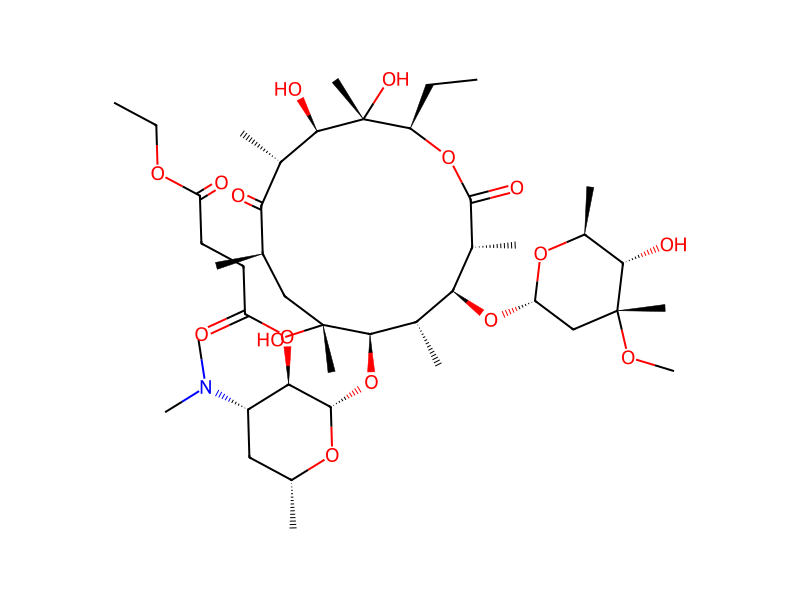
[CH3:1][CH2:2][C@H:3]1[O:18][C:16](=[O:17])[C@H:15]([CH3:19])[C@@H:14]([O:20][C@@H:21]2[O:26][C@@H:25]([CH3:27])[C@H:24]([OH:28])[C@@:23]([O:30][CH3:31])([CH3:29])[CH2:22]2)[C@H:13]([CH3:32])[C@@H:12]([O:33][C@@H:34]2[O:39][C@H:38]([CH3:40])[CH2:37][C@H:36]([N:41]([CH3:43])[CH3:42])[C@H:35]2[OH:44])[C@@:11]([OH:46])([CH3:45])[CH2:10][C@@H:9]([CH3:47])[C:7](=[O:8])[C@H:6]([CH3:48])[C@@H:5]([OH:49])[C@@:4]1([OH:51])[CH3:50].C(S)#N.CC[C@H]1OC(=O)[C@H](C)[C@@H:68]([O:74][C@@H:75]2[O:80][C@@H](C)[C@H:78]([OH:82])[C@@:77](OC)(C)[CH2:76]2)[C@H:67](C)[C@@H](O[C@@H]2O[C@H](C)C[C@H](N(C)C)[C@H]2O)[C@@](O)(C)C[C@@H](C)C(=O)[C@H](C)[C@@H](O)[C@@]1(O)C.C(=O)(O)[O-].[Na+].C(=O)([O-])[O-].[Na+].[Na+].C(=O)([O-])[O-].[K+].[K+]>CCOCC.O>[CH3:1][CH2:2][C@H:3]1[O:18][C:16](=[O:17])[C@H:15]([CH3:19])[C@@H:14]([O:20][C@@H:21]2[O:26][C@@H:25]([CH3:27])[C@H:24]([OH:28])[C@@:23]([O:30][CH3:31])([CH3:29])[CH2:22]2)[C@H:13]([CH3:32])[C@@H:12]([O:33][C@@H:34]2[O:39][C@H:38]([CH3:40])[CH2:37][C@H:36]([N:41]([CH3:42])[CH3:43])[C@H:35]2[O:44][C:78]([CH2:77][CH2:76][C:75]([O:74][CH2:68][CH3:67])=[O:80])=[O:82])[C@@:11]([OH:46])([CH3:45])[CH2:10][C@@H:9]([CH3:47])[C:7](=[O:8])[C@H:6]([CH3:48])[C@@H:5]([OH:49])[C@@:4]1([OH:51])[CH3:50]Participants







Procedure
or method B: in a reaction vessel, one or more of a C1-C6 lower alcohol, a C2-C6 lower nitrile, a C3-C8 lower ketone or C2-C8 lower ether is used as a solvent, to the solvent is added one or more of erythromycin thiocyanate or erythromycin thiocyanate hydrate, erythromycin lactate, stirred, added sodium bicarbonate or sodium carbonate or potassium carbonate, and water, allowed to react with stirring for 1-3 hours, added dropwise an aqueous solution of an acid or a base, stirred to control the pH value at about 7.0-8.5; the organic phase is precipitated and separated; to the organic phase is added sodium bicarbonate or sodium carbonate or potassium carbonate, and water, stirred, cooled to 20° C. or below, added monoethyl succinate halide, including monoethyl succinate chloride or monoethyl succinate bromide, allowed to react, monitored by TLC until the reaction is complete; to the resultant is added an acid or a base to control the pH value at about 7.0-8.5; the organic phase is precipitated and separated; to the organic phase is added water, cooled to −20° C.-10° C., upon the solid is precipitated completely, the mixture is filtered, the resulting solid is recrystalized with water and one or more of a C1-C6 lower alcohol, a C2-C6 lower nitrile, a C2-C8 lower ether, a C3-C8 lower ketone or C1-C6 lower halogenated hydrocarbons as solvent once or more times, cooled to −20° C.-10° C., filtered, dried to obtain erythromycin ethylsuccinate crystalline hydrate.
Workup
- additionis added one
- customto react
- additionadded dropwise an aqueous solution of an acid
- stirringa base, stirred
- customthe organic phase is precipitated
- customseparated
- additionto the organic phase is added sodium bicarbonate or sodium carbonate or potassium carbonate, and water
- stirringstirred
- temperaturecooled to 20° C. or below
- additionadded monoethyl succinate halide
- customto react
- additionto the resultant is added an acid
- customthe organic phase is precipitated
- customseparated
- additionto the organic phase is added water
- temperaturecooled to −20° C.-10° C., upon the solid
- customis precipitated completely
- filtrationthe mixture is filtered
- customthe resulting solid is recrystalized with water and one or more of a C1-C6 lower alcohol
- temperaturea C2-C6 lower nitrile, a C2-C8 lower ether, a C3-C8 lower ketone or C1-C6 lower halogenated hydrocarbons as solvent once or more times, cooled to −20° C.-10° C.
- filtrationfiltered
- customdried
Sources & evidence
- ORD record
- ord-e3150fef325d4fa8aa271398501c6ae5
- Source dataset
- uspto-grants-2015_12
- Patent number
- US09221862B2
Linked notes
Loading…