HomeMCPWorkbenchSkills
HomeWorkbenchNotificationsMe
llms.txt · MCP GuidePrivacy Policy · Terms of Service · Supportv1.8.3
  1. Home
  2. /Compound

Arachidonic Acid

HCID 444899
New reaction
Print
Basic informationOverviewNames & identifiersPropertiesSafety & regulationChemistry & industryRelated reactionsCompound notes
Substructure searchFind similar structures

Basic information

CAS
506-32-1
Standard SMILES
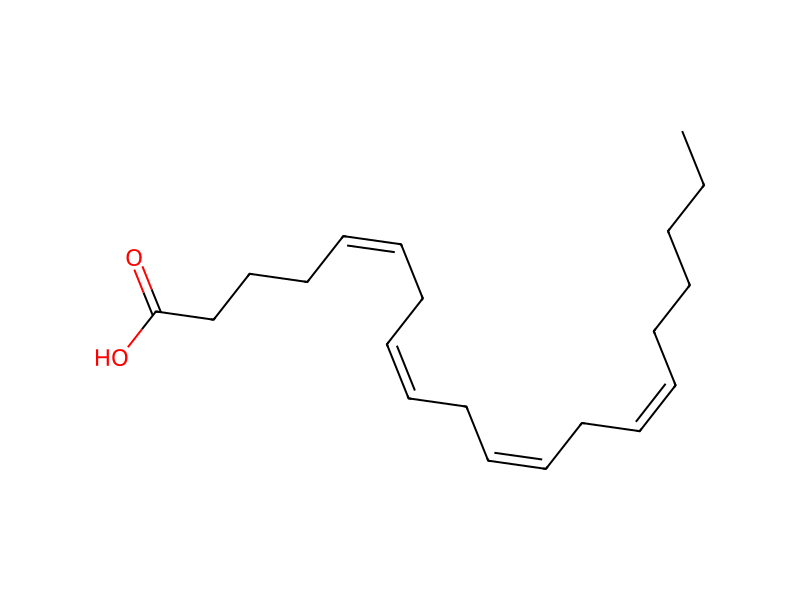
CCCCC/C=C\C/C=C\C/C=C\C/C=C\CCCC(=O)O
InChIKey
YZXBAPSDXZZRGB-DOFZRALJSA-N
Molecular formula
C20H32O2
Average molar mass
304.5 g/mol
Monoisotopic mass
304.24023026

Overview

Arachidonic acid is a long-chain fatty acid that is a C20, polyunsaturated fatty acid having four (Z)-double bonds at positions 5, 8, 11 and 14. It has a role as a mouse metabolite, a human metabolite, an EC 3.1.1.1 (carboxylesterase) inhibitor and a Daphnia galeata metabolite. It is a long-chain fatty acid, an omega-6 fatty acid and an icosa-5,8,11,14-tetraenoic acid. It is a conjugate acid of an arachidonate. It derives from a hydride of a (5Z,8Z,11Z,14Z)-icosa-5,8,11,14-tetraene.

Names & identifiers

Preferred name
Arachidonic Acid
IUPAC
(5Z,8Z,11Z,14Z)-icosa-5,8,11,14-tetraenoic acid
English name
Arachidonic acid
Molecular formula
C20H32O2
Molecular weight
304.47

Names & synonyms

arachidonic acid506-32-1(5Z,8Z,11Z,14Z)-icosa-5,8,11,14-tetraenoic acid(all-Z)-5,8,11,14-Eicosatetraenoic acidcis-5,8,11,14-Eicosatetraenoic acid5Z,8Z,11Z,14Z-eicosatetraenoic acid5,8,11,14-Eicosatetraenoic acid, (all-Z)-Arachidonate, Sodiumall-cis-5,8,11,14-eicosatetraenoic acid(5Z,8Z,11Z,14Z)-Icosatetraenoic acid27YG812J1IFatty Acid 20:4 n-6
Show more names
ARAArachidonateArachidonic5,8,11,14-EICOSATETRAENOIC ACIDicosa-5,8,11,14-tetraenoic acidArachidonic Acid (peroxide free)20:4n-6Single-Use Arachidonic Acid (peroxide free)
C20:4DTXSID4040420CHEBI:15843All-cis-icosa-5,8,11,14-tetraenoic acidRefChem:5560DTXCID2020420208-033-4Immunocytophyte

Database identifiers

CAS
506-32-1、93444-49-6
PubChem CID
444899
DTXSID
DTXSID4040420
ChEMBL
CHEMBL15594
ChEBI
CHEBI:15843
UNII
27YG812J1I
EC Number
208-033-4
Nikkaji
J12.228I

Properties

Computed structural properties

XLogP
6.3
Topological polar surface area
37.3 Ų
Hydrogen bond donors
1
Hydrogen bond acceptors
2
Rotatable bonds
14
Heavy atoms
22
Formal charge
0
Complexity
362

Experimental & physicochemical properties

Chemical ClassesBiological Agents -> Fatty Acids and Fats
Lipids · 2 items

Lipids -> Unambiguous Lipids

Fatty Acyls [FA] -> Fatty Acids and Conjugates [FA01] -> Unsaturated fatty acids [FA0103]

Cosmetics · 2 items

Cosmetic ingredients (Arachidonic Acid) -> CIR (Cosmetic Ingredient Review)

Emollient

SpringerMaterials PropertiesChemical diffusion
LogP · 2 items

6.98

6.98

Vapor Pressure0.00000015 [mmHg]
Physical Description · 2 items

Liquid; [Merck Index]

Liquid

Collision Cross Section · 5 items

182.1 Ų [M-H]- [CCS Type: DT; Buffer gas: N2; Sample Type: Human bronchoalveolar lavage fluid (BALF); Dataset: Unambiguous Lipids]

178.94 Ų [M-H]- [CCS Type: DT; Method: single field calibrated with Agilent tune mix (Agilent)]

182.21 Ų [M-H]- [CCS Type: DT; Method: stepped-field]

183.66 Ų [M-H]- [CCS Type: DT; Method: stepped-field]

183 Ų [M-H]-

Physicochemical properties

Melting point
49 °C · −49 °C (−56 °F; 224 K)
Boiling point
169 to · 169 to 171 °C (336 to 340 °F; 442 to 444 K) at 0.15 mmHg
Density
0.922 g/cm3 · 0.922 g/cm3
refractive index
1.49 · 1.49
Flash point
113 °C · 113 °C (235 °F; 386 K)
storage temp.
2 · 2-8°C
solubility
10 mg/mL · ethanol: ≥10 mg/mL
pka
4.75 · 4.75±0.10(Predicted)
form
clear liquid
color
Colorless to Light yellow to Light orange
biological source
synthetic
Water Solubility
PRACTICALLY INSOLUBLE
Merck
14 · 14,765
BRN
1713889 · 1713889
Concentration
1 mCi/ml · 1 mCi/ml
Solvent
Ethanol under argon
Specific Activity
200 · 200-240 Ci/mmol
Stability
Light Sensitive, Temperature Sensitive
Major Application
food and beverages
Cosmetics Ingredients Functions
SKIN CONDITIONINGSKIN CONDITIONING - EMOLLIENT
Cosmetic Ingredient Review (CIR)
Arachidonic acid (506-32-1)
InChI
1S/C20H32O2/c1-2-3-4-5-6-7-8-9-10-11-12-13-14-15-16-17-18-19-20(21)22/h6-7,9-10,12-13,15-16H,2-5,8,11,14,17-19H2,1H3,(H,21,22)/b7-6-,10-9-,13-12-,16-15-
InChIKey
YZXBAPSDXZZRGB-DOFZRALJSA-N
SMILES
OC(CCC/C=C\C/C=C\C/C=C\C/C=C\CCCCC)=O
LogP
6.99 · 6.99
CAS DataBase Reference
506 · 506-32-1(CAS DataBase Reference)
EWG's Food Scores
1 · 1
FDA UNII
27 YG812J1I · 27YG812J1I
NIST Chemistry Reference
Arachidonic acid(506-32-1)
Comptox DTXSID
4040420 · DTXSID4040420
UNSPSC Code
85151701 · 85151701
NACRES
77 · NA.77
Symbol(GHS)
2 · GHS02,GHS07
Signal word
Danger
Hazard statements
225 · H225-H319
Precautionary statements
210 · P210-P233-P240-P241-P242-P305+P351+P338
Risk Statements
19 · 19
Safety Statements
24 · 24/25-19
RIDADR
1170 · UN1170 - class 3 - PG 2 - Ethanol
WGK Germany
3 · 3
RTECS
6675000 · CE6675000
F
8 · 8-10-23
HS Code
29161900 · 29161900
Storage Class
10 · 10 - Combustible liquids
Hazard Classifications
2 Skin · Eye Irrit. 2Skin Irrit. 2
Toxicity
10 mg/L · dns-mus:mmr 10 mg/L CRNGDP 5,1123,84

Safety & regulation

Safety information is for reference only and does not replace the supplier’s Safety Data Sheet (SDS), applicable regulations, or professional assessment.

GHS classification

GHS Classification · 5 items

This chemical does not meet GHS hazard criteria for 10.3% (4 of 39) of reports.

Warning

H302 (84.6%): Harmful if swallowed [Warning Acute toxicity, oral]

P261, P264, P264+P265, P270, P271, P280, P301+P317, P302+P352, P304+P340, P305+P351+P338, P317, P319, P321, P330, P332+P317, P337+P317, P362+P364, P403+P233, P405, and P501 (click each P-code to see the statement)

Aggregated GHS information provided per 39 reports by companies from 6 notifications to the ECHA C&L Inventory. Each notification may be associated with multiple companies.

Hazard information

Regulatory Information · 2 items

Chemical: 5,8,11,14-Eicosatetraenoic acid, (all-Z)-

5,8,11,14-Eicosatetraenoic acid, (5Z,8Z,11Z,14Z)-: Does not have an individual approval but may be used as a component in a product covered by a group standard. It is not approved for use as a chemical in its own right.

Other Safety InformationEvaluation - Chemicals that are unlikely to require further regulation to manage risks to environment
Hazards SummaryMay form explosive peroxides; May cause irritation; Targets the female reproductive system; [Sigma-Aldrich MSDS]
Hazard Classes and CategoriesAcute Tox. 4 (84.6%)

Toxicology

Toxicity Summary · 2 items

The safety of this ingredient has not been documented and substantiated for cosmetic product use. The CIR Expert Panel cannot conclude whether Arachidonic Acid is safe for use in cosmetic products until such time that the appropriate safety data have been obtained and evaluated.

Ingredients for which the data are insufficient and their use in cosmetics is not supported

Safety data

F
8-10-23
wgk
3
rtecs
CE6675000
ridadr
UN1170 - class 3 - PG 2 - Ethanol
hs_code
29161900
Toxicity
dns-mus:mmr 10 mg/L CRNGDP 5,1123,84
risk_code
19
Signal word
Danger
Symbol(GHS)
GHS02,GHS07
safety_code
24/25-19
Storage Class
10 - Combustible liquids
Hazard statements
H225-H319
Hazard Classifications
Eye Irrit. 2Skin Irrit. 2
Precautionary statements
P210-P233-P240-P241-P242-P305+P351+P338

Chemistry & industry

Pharmacology

Metabolism/MetabolitesArachidonic acid has known human metabolites that include 8,9-EET, 5,6-EET, 20-HETE, 8-HETE, 18-HETE, 11,12-EET, 13-HETE, 7-HETE, 17-HETE, 15-HETE, 14,15-EET, 11-HETE, 12-HETE, 5-HETE, 16-HETE, 9-HETE, 19-HETE, and 10-HETE.
Tissue LocationsAdipose Tissue
Cellular LocationsCytoplasm
Metabolite PathwaysAcetaminophen Action Pathway

Uses & manufacturing

Uses · 2 items

CIR ingredient: Arachidonic Acid

Essential fatty acid for animals and humans; Used as a nutrient and for the treatment of eczema in dogs and swine; [Merck Index]

Use ClassificationCosmetics -> Emollient
Applications · 6 items

DescriptionArachidonic acid belongs to a kind of polyunsaturated omega-6 fatty acid, which is highly biologically relevant. It is abundantly distributed in brain, muscles and liver. It is the precursor for all prostaglandins, thromboxanes, and leukotrienes. Most cellular arachidonic acid is esterified in the membrane phospholipids. It is an important second messenger of cellular signalling participating in the regulation of signaling enzymes including PLC-γ, PLC-δ, and PKC-α, -β, and -γ isoforms. In addition, arachidonic acid acts as key inflammatory intermediate as well as avasodilator. Generally, the body can synthesize the arachidonic acid through linoleic acid. However, upon linoleic acid deficiency, it is necessary to supplement arachidonic acid from the diets. Food sources of arachidonic acid include meat, eggs and some fishes. Alternatively, we can also have arachidonic acid supplements.

DescriptionArachidonic acid (AA, sometimes ARA) is a polyunsaturated omega-6 fatty acid 20:4(ω-6). It is the counterpart to the saturated arachidic acid found in peanut oil, (L. arachis – peanut.).

UsesAn unsaturated omega-6 fatty acid constituent of the phospholipids of cell membranes

Usesarachidonic acid is an ingredient with skin-smoothing, emollient, and healing properties. Arachidonic acid is an omega-6 essential fatty acid naturally occurring in the skin and considered critical for appropriate skin metabolism. It is a constituent of vitamin F.

UsesArachidonic Acid is an essential fatty acid and a precursor in the biosynthesis of prostaglandins, thromboxanes, and leukotrienes. Arachidonic Acid occurs in liver, brain, glandular organs, and depot fats of animals, in small amounts in human depot fats, and Arachidonic Acid is also a constituent of animal phosphatides.

General DescriptionA Certified Spiking Solution suitable for use in mass spectrometry-based fatty acid testing applications such as assessment of cardiovascular disease risk and fatty acid deficiency, and detection and quantification of arachidonic acid in nutraceuticals and dietary supplements. Arachidonic acid (cis-5,8,11,14), sometimes referred to as AA or ARA, is a polyunsaturated omega-6 fatty acid. Studies suggests that ARA as well as other fatty acids can serve as biomarkers for cardiovascular disease, and nutritional and metabolic disorders.

Upstream & downstream products

Upstream raw materials

unsaturated fatty acidZINCMethyl arachidonateEthanolPotassium hydroxideLiquid bromineHydrochloric acidBromideEthanol-1,1,2,2-d4-amine

Downstream products

Prostaglandin E1Prostaglandin E2EPA2-AGtrans,trans-2,4-Decadien-1-alArachidonic Acid N-HydroxysucciniMidyl Ester

Additional notes

DefinitionChEBI: A long-chain fatty acid that is a C20, polyunsaturated fatty acid having four (Z)-double bonds at positions 5, 8, 11 and 14.

Related reactions

42 records
New reaction record
HRID 47253 reaction equation
HRID 47253As reactant
HRID 54719 reaction equation
HRID 54719As product
HRID 65908 reaction equation
HRID 65908As reactant
HRID 85385 reaction equation
HRID 85385As reactant
HRID 220322 reaction equation
HRID 220322As reactant
HRID 224667 reaction equation
HRID 224667As reactant
HRID 384560 reaction equation
HRID 384560As reactant
HRID 392605 reaction equation
HRID 392605As reactant
PreviousPage 1 of 6

Compound notes

On this pageBasic informationOverviewNames & identifiersPropertiesSafety & regulationChemistry & industryRelated reactionsCompound notes