
HRID 479264As product
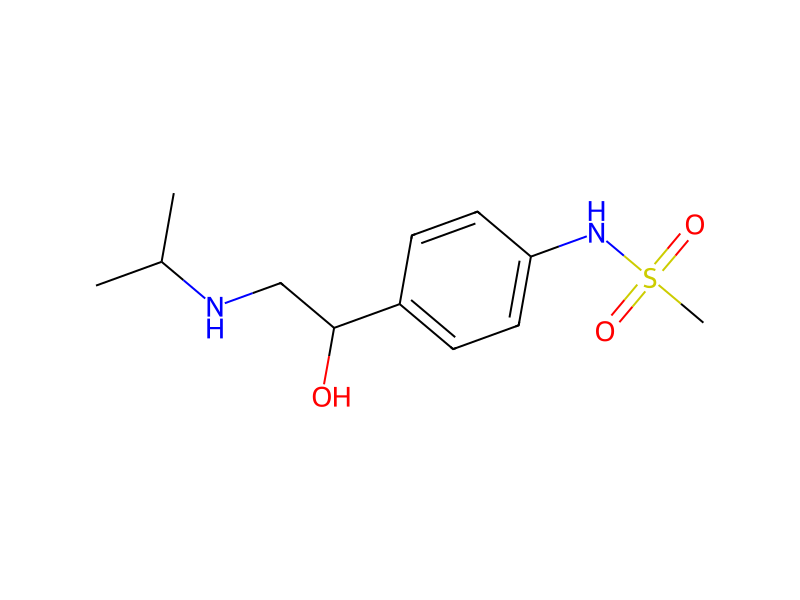
3930-20-9CC(C)NCC(O)c1ccc(NS(C)(=O)=O)cc1ZBMZVLHSJCTVON-UHFFFAOYSA-NSotalol is a sulfonamide that is N-phenylmethanesulfonamide in which the phenyl group is substituted at position 4 by a 1-hydroxy-2-(isopropylamino)ethyl group. It has both beta-adrenoreceptor blocking (Vaughan Williams Class II) and cardiac action potential duration prolongation (Vaughan Williams Class III) antiarrhythmic properties. It is used (usually as the hydrochloride salt) for the management of ventricular and supraventricular arrhythmias. It has a role as a beta-adrenergic antagonist, a xenobiotic, an anti-arrhythmia drug and an environmental contaminant. It is a member of ethanolamines, a sulfonamide, a secondary alcohol and a secondary amino compound. It is a conjugate base of a sotalol(1+).
3930-20-9Pharmaceuticals
Pharmaceuticals -> Used in Switzerland
1.1
0.53
Breast Feeding; Lactation; Milk, Human; Antihypertensive Agents; Adrenergic Beta-Antagonists; Antiarrhythmics
Pharmaceuticals
Safety information is for reference only and does not replace the supplier’s Safety Data Sheet (SDS), applicable regulations, or professional assessment.
Danger
H315 (100%): Causes skin irritation [Warning Skin corrosion/irritation]
P203, P260, P263, P264, P264+P265, P270, P280, P302+P352, P305+P351+P338, P318, P319, P321, P332+P317, P337+P317, P362+P364, and P501 (click each P-code to see the statement)
The GHS information provided by 1 company from 1 notification to the ECHA C&L Inventory.
Mild-to-moderate elevations in serum aminotransferase levels occur in less than 2% of patients on sotalol and are usually transient and asymptomatic, resolving even with continuation of therapy. Sotalol has been linked to a single case of clinically apparent liver injury, with onset of an acute hepatitis-like syndrome with prolonged jaundice 12 weeks after sotalol was initiated. The injury improved but did not resolve with discontinuation of sotalol. In large case series of drug induced liver disease and acute liver failure, sotalol has not been listed as a cause. Other beta-blockers have been linked to rare instances of acute clinically apparent liver injury with a latency to onset ranging from 4 to 24 weeks, a hepatocellular pattern of serum enzyme elevations and a mild, self-limiting course without evidence of hypersensitivity or autoimmune reactions.
Sotalol's adverse effect profile is inherent in the mechanisms of action as both a potassium channel blocker and a non-cardioselective β-blocker. The potassium channel blockade, primarily in phase 3 of the cardiac action potential, prolongs the QTc. Thus, the electrocardiogram (ECG) must be monitored upon initiating sotalol or adding other QTc-prolonging medications. Prolongation of the QT interval occurs in 1% to 2% of cases, which could lead to torsades de pointes or new ventricular tachycardia/ventricular fibrillation.
C07AA07
C - Cardiovascular system
QC - Cardiovascular system
Sotalol is a competitive inhibitor of the rapid potassium channel. This inhibition lengthens the duration of action potentials and the refractory period in the atria and ventricles. The inhibition of rapid potassium channels is increases as heart rate decreases, which is why adverse effects like torsades de points is more likely to be seen at lower heart rates. L-sotalol also has beta adrenergic receptor blocking activity seen above plasma concentrations of 800ng/L. The beta blocking ability of sotalol further prolongs action potentials. D-sotalol does not have beta blocking activity but also reduces a patient's heart rate while standing or exercising. These actions combine to produce a negative inotropic effect that reduces the strength of contractility of muscle cells in the heart. Extension of the QT interval is also adversely associated with the induction of arrhythmia in patients. Hyperglycemia is a greater risk for non insulin dependant diabetics than insulin dependant diabetics. Beta blockers inhibit insulin secretion which may cause hyperglycemia in type II diabetes mellitus. The risk of hypoglycemia is higher in insulin dependant diabetes than non insulin dependant diabetics. Beta blockers decrease secretion of insulin, which may mask hypoglycemia in an insulin dependant patient. Beta blockers also increase glucose uptake into cells which may prolong or potentiate hypoglycemia. Further information regarding adverse reactions can be found here.
Sotalol inhibits beta-1 adrenoceptors in the myocardium as well as rapid potassium channels to slow repolarization, lengthen the QT interval, and slow and shorten conduction of action potentials through the atria. The action of sotalol on beta adrenergic receptors lengthens the sinus node cycle, conduction time through the atrioventricular node, refractory period, and duration of action potentials.
The terminal elimination half life is 10-20 hours in healthy patients. In patients with a creatinine clearance >80mL/min, the half life is 17.5±0.97h. In patients with a creatinine clearance 30-80mL/min, the half life is 22.7±6.4h. In patients with a creatinine clearance 10-30mL/min, the half life is 64±27.2h. In patients with a creatinine clearance <10mL/min, the half life is 97.9±57.3h.


DTXSID0023589CHEMBL471CHEBI:63622Sotalol toxicity is inherent due to the mechanism of action as both a potassium channel blocker and a non-cardioselective β-blocker and mirrors the adverse effect profile. The most obvious and potentially problematic sign of toxicity is concentration-related QTc prolongation. If QTc is over 500 ms during initiation, the sotalol dose should be reduced or discontinued. If QTc exceeds 520 ms during the maintenance phase of dosing, the clinician should either reduce the dose or discontinue sotalol.
Drug-Induced Liver Injury Severity and Toxicity (DILIst)
sotalol
DILI Negative
Oral
DOI:10.1016/j.drudis.2019.09.022
Sotalol
1.9
7.9
The starting dose of sotalol hydrochloride tablets (AF) is 80 mg twice daily (b.i.d.) if the creatinine clearance is > 60 mL/min, and 80 mg once daily (q.d.) or 40 mg twice daily (b.i.d) if the creatinine clearance is 40 to 60 mL/min.
Data used to generate the benchmarks include the following: Lowest Daily Dose (LDD): 80 mg/day, Lowest Therapeutic Dose (LTD): 1.0 mg/kg-day, and Screening Dose: 0.0003 mg/kg-day.
22-Jan-07
A6D97U294I
SOTALOL
Established Pharmacologic Class [EPC] - Antiarrhythmic
Physiologic Effects [PE] - Cardiac Rhythm Alteration
Mechanisms of Action [MoA] - Adrenergic beta-Antagonists
Sotalol is an Antiarrhythmic. The mechanism of action of sotalol is as an Adrenergic beta-Antagonist. The physiologic effect of sotalol is by means of Cardiac Rhythm Alteration.
Drugs that bind to but do not activate beta-adrenergic receptors thereby blocking the actions of beta-adrenergic agonists. Adrenergic beta-antagonists are used for treatment of hypertension, cardiac arrhythmias, angina pectoris, glaucoma, migraine headaches, and anxiety.
Agents used for the treatment or prevention of cardiac arrhythmias. They may affect the polarization-repolarization phase of the action potential, its excitability or refractoriness, or impulse conduction or membrane responsiveness within cardiac fibers. Anti-arrhythmia agents are often classed into four main groups according to their mechanism of action: sodium channel blockade, beta-adrenergic blockade, repolarization prolongation, or calcium channel blockade.
Drugs that inhibit the actions of the sympathetic nervous system by any mechanism. The most common of these are the ADRENERGIC ANTAGONISTS and drugs that deplete norepinephrine or reduce the release of transmitters from adrenergic postganglionic terminals (see ADRENERGIC AGENTS). Drugs that act in the central nervous system to reduce sympathetic activity (e.g., centrally acting alpha-2 adrenergic agonists, see ADRENERGIC ALPHA-AGONISTS) are included here.
Sotalol is 90-100% bioavailable. When taken with a meal, adsorption is lowered by 18%. In patients with a creatinine clearance >80mL/min, the maximum concentration is 6.25±2.19.
80-90% of a given dose is excreted in the urine as unchanged sotalol. A small fraction of the doses is excreted in the feces as unchanged sotalol.
The apparent volume of distribution is 1.2-2.4L/kg.
In patients with a creatinine clearance >80mL/min, the plasma clearance is 6.78±2.72L/h and the renal clearance is 4.99±1.43L/h. In patients with a creatinine clearance 30-80mL/min, the plasma clearance is 2.74±0.53L/h and the renal clearance is 2.00±0.67L/h. In patients with a creatinine clearance 10-30mL/min, the plasma clearance is 1.56±0.44L/h and the renal clearance is 0.65±0.31L/h. In patients with a creatinine clearance <10mL/min, the plasma clearance is 0.65±0.20L/h and the renal clearance is 0.27±0.13L/h.
General DescriptionSotalol, 4'[1-hydroxy-2-(isopropylamino)ethyl]methylsulfonanilide (Betapace), is a relatively new antiarrhythmicdrug, characterized most often as a class IIIagent, and although it has effects that are related to the classII agents, it is not therapeutically considered a class II antiarrhythmic.It contains a chiral center and is marketed as theracemic mixture. Because of its enantiomers, its mechanismof action spans two of the antiarrhythmic drug classes. Thel(-) enantiomer has both β-blocking (class II) and potassiumchannel-blocking (class III) activities. The d(+) enantiomerhas class III properties similar to those of the (-) isomer,but its affinity for the -adrenergic receptor is 30 to 60 timeslower.
DefinitionChEBI: A sulfonamide that is N-phenylmethanesulfonamide in which the phenyl group is sustituted at position 4 by a 1-hydroxy-2-(isopropylamino)ethyl group. It has both beta-adrenoreceptor blocking (Vaughan Williams Class II) and ardiac action potential duration prolongation (Vaughan Williams Class III) antiarrhythmic properties. It is used (usually as the hydrochloride salt) for the management of ventricular and supraventricular arrhythmias.