
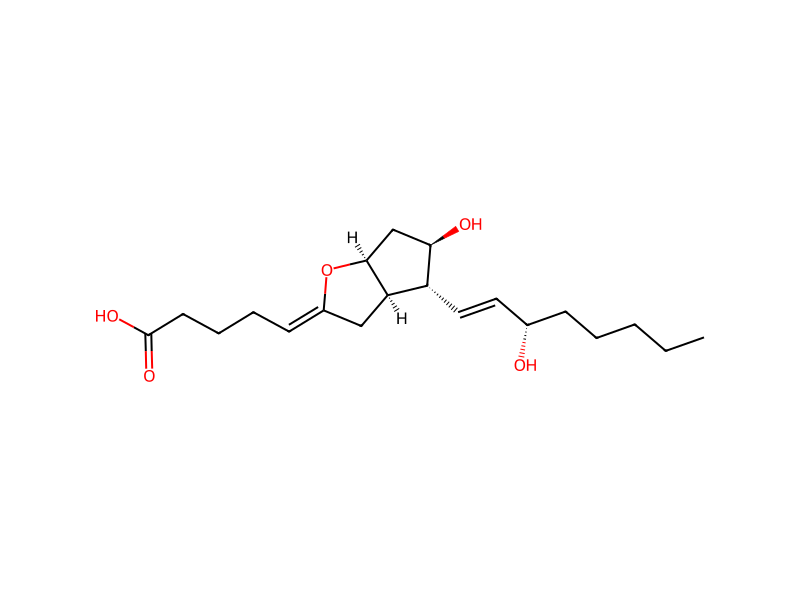
Basic information
- CAS
35121-78-9- Standard SMILES
CCCCC[C@H](O)/C=C/[C@@H]1[C@H]2C/C(=C/CCCC(=O)O)O[C@H]2C[C@H]1O- InChIKey
KAQKFAOMNZTLHT-OZUDYXHBSA-N- Molecular formula
- C20H32O5
- Average molar mass
- 352.5 g/mol
- Monoisotopic mass
- 352.22497412
Overview
Prostaglandin I2 is a prostaglandins I. It has a role as a mouse metabolite. It is a conjugate acid of a prostaglandin I2(1-).
Names & identifiers
- Preferred name
- Prostacyclin
- IUPAC
- (5Z)-5-[(3aR,4R,5R,6aS)-5-hydroxy-4-[(E,3S)-3-hydroxyoct-1-enyl]-3,3a,4,5,6,6a-hexahydrocyclopenta[b]furan-2-ylidene]pentanoic acid
- English name
- Epoprostenol
- Molecular formula
- C20H32O5
- Molecular weight
- 352.47
Names & synonyms
epoprostenolprostacyclinprostaglandin I2PGI235121-78-9VasocyclinProstaglandin XEpoprostenolumACT-385781ADCR9Z582X0U-53217(5Z,9alpha,11alpha,13E,15S)-6,9-epoxy-11,15-dihydroxyprosta-5,13-dien-1-oic acid
Show more names
PGXPGl2U 53217U-53217ACyclo-ProstinProstaglandinI(+)-AlismoxideProstaglandin l2
(5Z)-5-[(3aR,4R,5R,6aS)-5-hydroxy-4-[(E,3S)-3-hydroxyoct-1-enyl]-3,3a,4,5,6,6a-hexahydrocyclopenta[b]furan-2-ylidene]pentanoic acidU-53,217DTXSID5022988CHEBI:155526,9S-epoxy-11R,15S-dihydoxy-5Z,13E-prostadienoic acidEpoprostanol(5Z,13E)-(15S)-6,9alpha-Epoxy-11alpha,15-dihydroxyprosta-5,13-dienoateProsta-5,13-dien-1-oic acid, 6,9-epoxy-11,15-dihydroxy-, (5Z,9alpha,11alpha,13E,15S)-
Database identifiers
- CAS
35121-78-9- PubChem CID
- 5282411
- DTXSID
DTXSID5022988
Properties
Computed structural properties
- XLogP
- 2.9
- Topological polar surface area
- 87 Ų
- Hydrogen bond donors
- 3
- Hydrogen bond acceptors
- 5
- Rotatable bonds
- 10
- Heavy atoms
- 25
- Formal charge
- 0
- Complexity
- 484
Experimental & physicochemical properties
DrugsPharmaceuticals -> Listed in ZINC15
LipidsFatty Acyls [FA] -> Eicosanoids [FA03] -> Prostaglandins [FA0301]
Human DrugsBreast Feeding; Lactation; Milk, Human; Antihypertensive Agents; Cardiovascular Agents; Prostaglandins, Synthetic; Vasodilator Agents
Physical DescriptionSolid
Collision Cross Section
186.84 Ų [M-H]- [CCS Type: DT; Method: single field calibrated with Agilent tune mix (Agilent)]
196.67 Ų [M+Na]+ [CCS Type: DT; Method: stepped-field]
191.9 Ų [M-H]-
Physicochemical properties
- Boiling point
- 530.2 · 530.2±50.0 °C(Predicted)
- Density
- 1.221 · 1.221
- pka
- 4.7 · 4.70±0.10(Predicted)
- FDA UNII
- 9 Z582X0 · DCR9Z582X0
Safety & regulation
Toxicology
Effects During Pregnancy and Lactation◉ Summary of Use during Lactation
Chemistry & industry
Pharmacology
ATC Code
B01AC09
B - Blood and blood forming organs
QB - Blood and blood forming organs
Pharmacodynamics
Epoprostenol has two major pharmacological actions: (1) direct vasodilation of pulmonary and systemic arterial vascular beds, and (2) inhibition of platelet aggregation. In animals, the vasodilatory effects reduce right and left ventricular afterload and increase cardiac output and stroke volume. The effect of epoprostenol on heart rate in animals varies with dose. At low doses, there is vagally mediated brudycardia, but at higher doses, epoprostenol causes reflex tachycardia in response to direct vasodilation and hypotension. No major effects on cardiac conduction have been observed. Additional pharmacologic effects of epoprostenol in animals include bronchodilation, inhibition of gastric acid secretion, and decreased gastric emptying. No available chemical assay is sufficiently sensitive and specific to assess the in vivo human pharmacokinetics of epoprostenol.
Mechanism of Action
Prostaglandins are present in most body tissues and fluids and mediate many biological functions. Epoprostenol (PGI2) is a member of the family of prostaglandins that is derived from arachidonic acid. The major pharmacological actions of epoprostenol is ultimately inhibition of platelet aggregation. Prostacycline (PGI2) from endothelial cells activate G protein-coupled receptors on platelets and endothelial cells. This activation causes adenylate cyclase to produce cyclic AMP which inhibits further platelet activation and activates protein kinase A. Cyclic AMP also prevents coagulation by preventing an increase in intracellular calcium from thromboxane A2 binding. PKA then continues the cascade by phosphorylating and inhibiting myosin light-chain kinase which leads to smooth muscle relaxation and vasodilation. Notably, PGI2 and TXA2 work as physiological antagonists.
Biological Half-LifeThe in vitro half-life of epoprostenol in human blood at 37°C and pH 7.4 is approximately 6 minutes; the in vivo half-life of epoprostenol in humans is therefore expected to be no greater than 6 minutes.
Metabolism/Metabolites
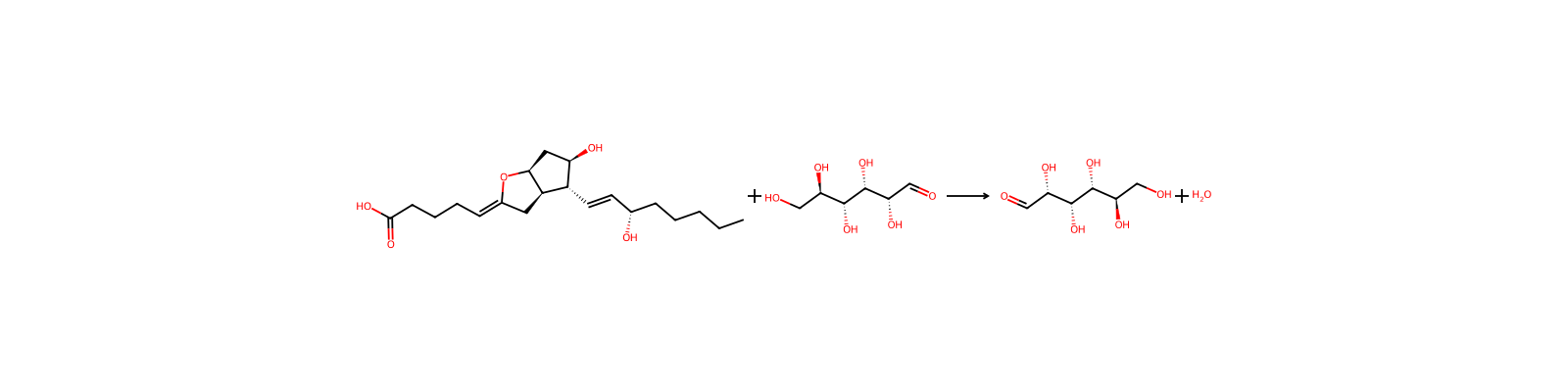
Related reactions
4 records


Compound notes
Loading…