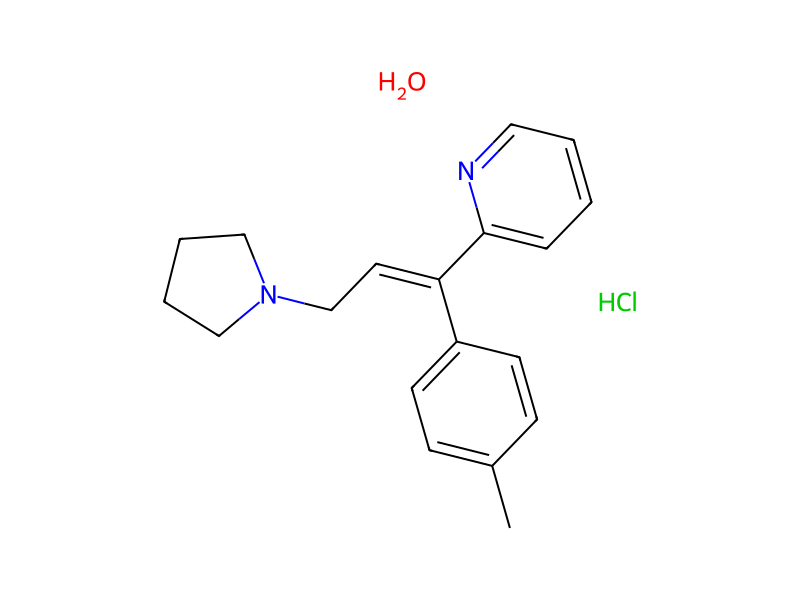
Basic information
- CAS
6138-79-0- Standard SMILES
Cc1ccc(/C(=C\CN2CCCC2)c2ccccn2)cc1.Cl.O- InChIKey
CUZMOIXUFHOLLN-UMVVUDSKSA-N- Molecular formula
- C19H22N2.ClH.H2O
- Average molar mass
- 332.9 g/mol
- Monoisotopic mass
- 332.1655411
Overview
Triprolidine hydrochloride monohydrate is an odorless white crystalline powder. Bitter taste. (NTP, 1992)
Names & identifiers
- Preferred name
- Triprolidine hydrochloride monohydrate
- IUPAC
- 2-[(E)-1-(4-methylphenyl)-3-pyrrolidin-1-ylprop-1-enyl]pyridine;hydrate;hydrochloride
- English name
- Triprolidine hydrochloride
- Molecular formula
- C19H23ClN2
- Molecular weight
- 332.87
Names & synonyms
TRIPROLIDINE HYDROCHLORIDE MONOHYDRATE6138-79-0ActidilonVenenDTXSID0021410Pro-ActidilPro-EntraDTXCID201410CHEBI:32265Pyridine, 2-(3-(1-pyrrolidinyl)-1-p-tolylpropenyl)-, monohydrochloride, monohydrate, stereoisomerRefChem:1100506Triprolidine hydrochloride hydrate
Show more names
rate,stereoisomerTRIPROLIDINE HCL USPtrans-TriprolidineHClTripolidine HydrochlorideTriprolidine hydrochlorideTriprolidine HydrochloriseTRIPROLIDINEHYDROCHLORIDE,USPTriprolidine hydrochloride (347)triprolidinesigmareferencestandard
Triprolidine.HCl monohydrateTriprolidine HCl monohydratetrans-Triprolidine hydrochloride(E)-2-(3-(1-Pyrrolidinyl)-1-p-tolylpropenyl)pyridine monohydrochloride monohydrate(E)-2-(3-(Pyrrolidin-1-yl)-1-(p-tolyl)prop-1-en-1-yl)pyridine hydrochloride hydratePyridine, 2-(1-(4-methylphenyl)-3-(1-pyrrolidinyl)-1-propenyl)-, monohydrochloride, monohydrate, (E)-Triprolidine hydrochloride hydrate (JAN)Pyridine, 2-[1-(4-methylphenyl)-3-(1-pyrrolidinyl)-1-propenyl]-, monohydrochloride, monohydrate, (E)-
Properties
Computed structural properties
- Topological polar surface area
- 17.1 Ų
- Hydrogen bond donors
- 2
- Hydrogen bond acceptors
- 3
- Rotatable bonds
- 4
- Heavy atoms
- 23
- Formal charge
- 0
- Complexity
- 335
Experimental & physicochemical properties
Solubilitygreater than or equal to 100 mg/mL at 68 °F (NTP, 1992)
Melting Point239 to 248 °F (NTP, 1992)
Physical DescriptionTriprolidine hydrochloride monohydrate is an odorless white crystalline powder. Bitter taste. (NTP, 1992)
Physicochemical properties
- Melting point
- 115 · 115-120°C
- storage temp.
- 2 · 2-8°C
- solubility
- 1 in · alcohol: soluble1 in 1.5 of solvent
- form
- Solid
- color
- White to Off-White
- Water Solubility
- 10 g/100 · >=10 g/100 mL at 20 ºC
- Merck
- 13 · 13,9817
- Stability
- Stable, but discolours in light. Incompatible with strong oxidizing agents.
- InChI
- InChI=1S/C19H22N2.ClH/c1-16-7-9-17(10-8-16)18(19-6-2-3-12-20-19)11-15-21-13-4-5-14-21;/h2-3,6-12H,4-5,13-15H2,1H3;1H/b18-11+;
Safety & regulation
Safety information is for reference only and does not replace the supplier’s Safety Data Sheet (SDS), applicable regulations, or professional assessment.
GHS classification
GHS Classification
Warning
H302 (100%): Harmful if swallowed [Warning Acute toxicity, oral]
P261, P264, P264+P265, P270, P271, P280, P301+P317, P302+P352, P304+P340, P305+P351+P338, P319, P321, P330, P332+P317, P337+P317, P362+P364, P403+P233, P405, and P501 (click each P-code to see the statement)
Aggregated GHS information provided per 96 reports by companies from 7 notifications to the ECHA C&L Inventory. Each notification may be associated with multiple companies.
Hazard information
Regulatory InformationPyridine, 2-(1E)-1-(4-methylphenyl)-3-(1-pyrrolidinyl)-1-propenyl-, monohydrochloride, monohydrate: Does not have an individual approval but may be used under an appropriate group standard
Other Safety InformationIMAP assessments - Pyridine, 2-[1-(4-methylphenyl)-3-(1-pyrrolidinyl)-1-propenyl]-, monohydrochloride, monohydrate, (E)-: Environment tier I assessment
Fire HazardsFlash point data for this chemical are not available; however, it is probably combustible. (NTP, 1992)
Health Hazards
SYMPTOMS: Symptoms of exposure to this compound may include depression to stimulation of the central nervous system, dry mouth, fixed dilated pupils, flushing, hallucinations, convulsions, urinary retention, cardiac arrhythmias and coma. Other symptoms may include excitability, drowsiness, nervousness, dizziness, high fever and sleeplessness. It can also cause sedation. It may also cause local anesthesia, dryness of the throat and nose and abdominal pain with vomiting or diarrhea. (NTP, 1992)
Reactive GroupAmines, Phosphines, and Pyridines
Reactivity Profile
Chemistry & industry
Applications
Usesanticholinergic (opthalmic)
Usestrans-Triprolidine Hydrochloride is a potent H1 receptor antagonist. Anti-histamines.
UsesTRIPROLIDINE HYDROCHLORIDE is used as bulk pharmaceutical (antihistaminic). Product Data Sheet
General DescriptionTriprolidine hydrochloride,(E)-2-[3-(1-pyrrolidinyl)-1-p-tolylpropenyl]pyridine monohydrochloridemonohydrate (Actidil), is a white crystalline powder with a slight, but unpleasant, odor. It is soluble inwater and in alcohol, and its solutions are alkaline to litmus.The antihistaminic activity is confined mainly to the geometricisomer in which the pyrrolidinomethyl group is transto the 2-pyridyl group. Pharmacological studies confirm thehigh activity of triprolidine and the superiority of (E) overcorresponding (Z) isomers as H1-antihistamines. At guineapig ileum sites, the affinity of triprolidine for H-receptorswas more than 1,000 times the affinity of its (Z) diasteromer.The relative potency of triprolidine is of the same orderas that of dexchlorpheniramine. The peak effect occursabout 3.5 hours after oral administration, and the duration ofeffect is about 12 hours.
General DescriptionOdorless white crystalline powder. Bitter taste.
Suppliers100 total
国药集团化学试剂有限公司86-21-63210123 · [email protected]
北京华美互利生物化工010-56205725 · [email protected]
成都超九八生物科技有限公司13348960310 13348960310 · [email protected]
艾吉析科技(上海)有限公司17717235263 · [email protected]
深圳市健竹科技有限公司0755-89218110 13480856786
上海腾准生物科技有限公司
Related reactions
0 records
No reaction records under the current filter.
Compound notes
Loading…