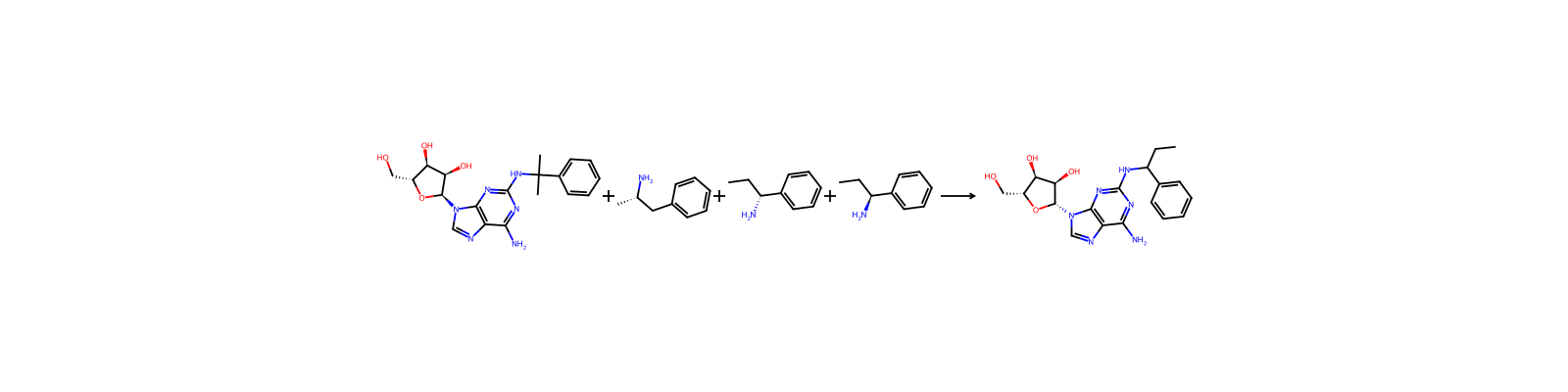
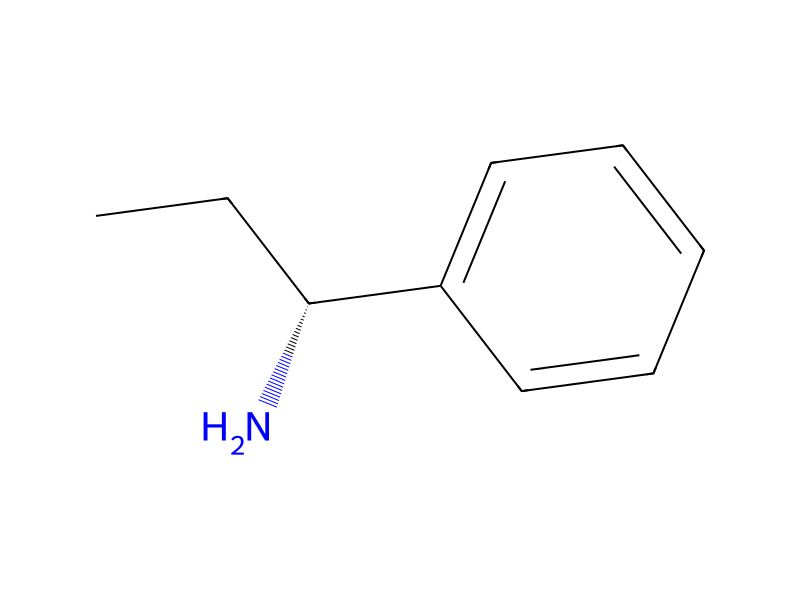
Basic information
- Standard SMILES
CC[C@@H](N)c1ccccc1- InChIKey
AQFLVLHRZFLDDV-SECBINFHSA-N- Molecular formula
- C9H13N
- Average molar mass
- 135.21 g/mol
- Monoisotopic mass
- 135.10479942
Names & identifiers
- Preferred name
- (R)-1-Phenylpropylamine
- IUPAC
- (1R)-1-phenylpropan-1-amine
- English name
- (R)-(+)-1-Phenylpropylamine
- Molecular formula
- C9H13N
- Molecular weight
- 135.21
Names & synonyms
(R)-1-Phenylpropylamine(+)-1-PhenylpropylamineRefChem:407132608-544-63082-64-2(R)-(+)-1-Phenylpropylamine(R)-1-phenylpropan-1-amine(1R)-1-phenylpropan-1-amine(R)-(+)-alpha-EthylbenzylamineMFCD00083057(R)-alpha-ethylbenzylamine(R)-(+)-1-Amino-1-phenylpropane
Show more names
R(+)-A-ETHYLBENZYLAMINE(R)-1-PhenylpropanaMineD-ALPHA-ETHYLBENZYLAMINE(R)-(+)-ETHYLBENZYLAMINE(R)-(+)-PHENYLPROPYLAMINE
(R)-(+)-alpha -Ethylbenzylamine(R)-(+)-a-Ethylbenzylamine(1R)-1-PhenylpropylamineR(+)-alpha-ethylbenzylamine(alphaR)-alpha-Ethylbenzenemethanamine(1r)-phenylpropylamine1(r)-phenylpropylamineGX79CZZ2QV
Database identifiers
- CAS
3082-64-2- PubChem CID
- 5324978
- DTXSID
DTXSID00415973- UNII
- GX79CZZ2QV
- EC Number
- 608-544-6
- Nikkaji
- J57.047H
Properties
Computed structural properties
- XLogP
- 1.7
- Topological polar surface area
- 26 Ų
- Hydrogen bond donors
- 1
- Hydrogen bond acceptors
- 1
- Rotatable bonds
- 2
- Heavy atoms
- 10
- Formal charge
- 0
- Complexity
- 84
Physicochemical properties
- Melting point
- -69 °C · -69°C
- Boiling point
- 205 °C · 205°C
- alpha
- 20 · 20 º (neat)
- Density
- 0.94 g/mL · 0.940 g/mL at 20 °C(lit.)
- vapor pressure
- 26.5 Pa · 26.5Pa at 20℃
- refractive index
- 20 · n20/D 1.520
- Flash point
- 77 °C · 77°C
- storage temp.
- 2 · under inert gas (nitrogen or Argon) at 2–8 °C
- solubility
- Chloroform, Ethyl Acetate
- form
- Oil
- pka
- 9.34 · 9.34±0.10(Predicted)
- color
- Clear Colourless
- Sensitive
- Air Sensitive
- BRN
- 3029904 · 3029904
- InChI
- 1S/C9H13N/c1-2-9(10)8-6-4-3-5-7-8/h3-7,9H,2,10H2,1H3/t9-/m1/s1
- InChIKey
- AQFLVLHRZFLDDV-SECBINFHSA-N
- SMILES
- CC[C@@H](N)c1ccccc1
- CAS DataBase Reference
- 3082 · 3082-64-2(CAS DataBase Reference)
- UNSPSC Code
- 12352116 · 12352116
- NACRES
- 22 · NA.22
- Symbol(GHS)
- 5 · GHS05,GHS07,GHS09
- Signal word
- Danger
- Hazard statements
- 227 · H227-H318-H401-H411-H302-H314
- Precautionary statements
- 280 · P280-P305+P351+P338-P310-P273-P309
- Hazard Codes
- C
- Risk Statements
- 22 · 22-34
- Safety Statements
- 26 · 26-36/37/39-45-39-37-36
- RIDADR
- 2735 · UN 2735 8/PG 2
- WGK Germany
- 3 · 3
- F
- 10 · 10-34
- HazardClass
- 8 · 8
- PackingGroup
- II
- HS Code
- 2921490090 · 2921490090
- Storage Class
- 8 A · 8A - Combustible corrosive hazardous materials
- Hazard Classifications
- 4 OralSkin · Acute Tox. 4 OralSkin Corr. 1B
- REACH Registrations
- Inactive
Safety & regulation
GHS classification
GHS Classification
Danger
H301 (70%): Toxic if swallowed [Danger Acute toxicity, oral];H302 (30%): Harmful if swallowed [Warning Acute toxicity, oral];H314 (100%): Causes severe skin burns and eye damage [Danger Skin corrosion/irritation];H318 (69.3%): Causes serious eye damage [Danger Serious eye damage/eye irritation];H411 (72.7%): Toxic to aquatic life with long lasting effects [Hazardous to the aquatic environment, long-term hazard]
P260, P264, P264+P265, P270, P273, P280, P301+P316, P301+P317, P301+P330+P331, P302+P361+P354, P304+P340, P305+P354+P338, P316, P317, P321, P330, P363, P391, P405, and P501 (click each P-code to see the statement)
Aggregated GHS information provided per 150 reports by companies from 4 notifications to the ECHA C&L Inventory. Each notification may be associated with multiple companies.;Information may vary between notifications depending on impurities, additives, and other factors. The percentage value in parenthesis indicates the notified classification ratio from companies that provide hazard codes. Only hazard codes with percentage values above 10% are shown. For more detailed information, please visit ECHA C&L website.
Hazard information
Regulatory InformationStatus: Active Update: 27-11-2012 https://echa.europa.eu/registration-dossier/-/registered-dossier/11689
Hazard Classes and CategoriesAcute Tox. 3 (70%);Acute Tox. 4 (30%);Skin Corr. 1B (100%);Eye Dam. 1 (69.3%);Aquatic Chronic 2 (72.7%)
Regulatory information
Regulatory InformationStatus: Active Update: 27-11-2012 https://echa.europa.eu/registration-dossier/-/registered-dossier/11689
Safety data
- F
- 10-34
- wgk
- 3
- ridadr
- UN 2735 8/PG 2
- hs_code
- 2921490090
- risk_code
- 22-34
- Signal word
- Danger
- Symbol(GHS)
- GHS05,GHS07,GHS09
- hazard_code
- C
- safety_code
- 26-36/37/39-45-39-37-36
- hazard_class
- 8
- Storage Class
- 8A - Combustible corrosive hazardous materials
- packing_group
- II
- Hazard statements
- H227-H318-H401-H411-H302-H314
- REACH Registrations
- Inactive
- Hazard Classifications
- Acute Tox. 4 OralSkin Corr. 1B
- Precautionary statements
- P280-P305+P351+P338-P310-P273-P309
Chemistry & industry
Applications
UsesFor synthesis of optically active products
Uses(R)-(+)-1-Phenylpropylamine is a chiral phenylalkylamine derivative used in metabolic Cytochrome P-455 nm complex formation studies.
Suppliers50 total
上海阿拉丁生化科技股份有限公司400-6206333 13167063860 · [email protected]
Hebei Chuanghai Biotechnology Co., Ltd+86-17732866630 · [email protected]
上海麦克林生化科技股份有限公司021-50706066 15221275939 · [email protected]
上海毕得医药科技股份有限公司400-1647117 13681763483 · [email protected]
北京依凯诺医药技术开发有限公司18518619637 · [email protected]
T&W GROUP021-61551611 13296011611 · [email protected]
Dayang Chem (Hangzhou) Co.,Ltd.+86-0571-88938639 17705817739 · [email protected]
郑州鸿晟医药科技有限公司0371-55695890 15637198702 · [email protected]
毕佳索(上海毕得医药科技股份有限公司)400-6005915 · [email protected]
上海迈瑞尔生化科技有限公司4006356688 18621169109 · [email protected]
北京索莱宝科技有限公司010-50973130 17801761073 · [email protected]
阿法埃莎(中国)化学有限公司400-6106006 · [email protected]
安耐吉化学&3A(安徽泽升科技股份有限公司)400-0056266 · [email protected]
梯希爱(上海)化工贸易有限公司021-61109150 · [email protected]
上海瀚鸿科技股份有限公司021-54306202 13764082696 · [email protected]
上海景颜化工科技有限公司13817811078 · [email protected]
常州市华阳科技有限公司+8615250961469 · [email protected]
上海西浦化工有限公司+86 (21) 6715-7650 · [email protected]
宝鸡缔都医药化工有限公司029-81145305 17791533577 · [email protected]
天津希恩思生化科技有限公司400 638 7771 · [email protected]
上海珂华生物科技有限公司021-60455363 18019463053 · [email protected]
上海特伯化学科技有限公司+86-21-60341587 · [email protected]
深圳振强药物研发有限公司0755-66853366 13670046396 · [email protected]
越林试剂021-62960152 · [email protected]
无锡中坤生化科技有限公司+86 0510-85629785
上海毕得医药科技股份有限公司400-164-7117 18317119277 · [email protected]
雷丁试剂0510-85629785 18013409632 · [email protected]
陕西缔都医药化工有限公司+86-029-81138252 +86-173 9270 1263 · [email protected]
杭州宇昊化工科技有限公司0571-82693216 · [email protected]
凯试(上海)科技有限公司021-50135380 · [email protected]
Sigma-Aldrich西格玛奥德里奇(上海)贸易有限公司021-61415566 800-8193336 · [email protected]
诺尔凯立科技有限公司86-(0)21-31261262 373522135 · [email protected]
常州安奈凯医药科技有限公司+86-0519-8359-8696 · [email protected]
湖北恒绿源科技有限公司027-88188016 18717196322 · [email protected]
艾吉析科技(上海)有限公司17721401538;17717235263 17721401538 · [email protected]
嘉兴市浙嘉生物科技有限公司0573-85609002 · [email protected]
上海源叶生物科技有限公司13636370518 · [email protected]
南京博米尔生物科技有限公司025-83453382-8005 · [email protected]
安泰精细化工技术有限公司18503026267 · [email protected]
成都华纯科技有限公司400-1166-196 15982826727 · [email protected]
山东小野化学股份有限公司0539-6362799 20)
上海贤鼎生物科技有限公司021-021-52271985 17721149837 · [email protected]
Shanghai Acmec Biochemical Technology Co., Ltd.+86-18621343501 · [email protected]
杭州洁汉化工有限公司+86-571-86217390; +8618058761490 · [email protected]
河北博新生物科技有限公司19131160546 · [email protected]
上海百舜生物科技有限公司021-37581181 · [email protected]
米诺化工有限公司0086-15313090952
上海臻励生物科技有限公司021-16621358918; 18516310516;16621358918;13045646768 · [email protected]
江苏艾康生物医药研发有限公司025-66061636 19370895928 · [email protected]
武汉峰耀同辉化学制品有限公司027-87466105 15377573527 · [email protected]
Related reactions
25 records


Linked notes
Loading…