
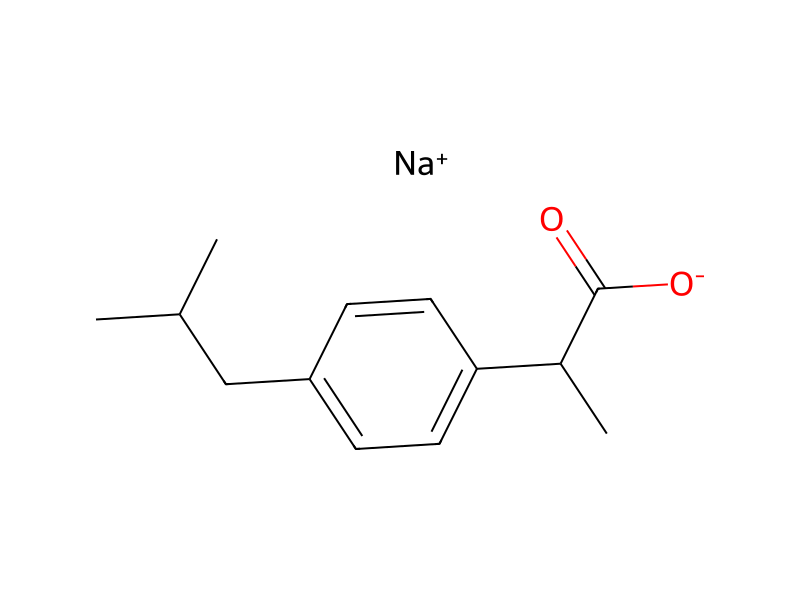
Basic information
- Standard SMILES
CC(C)Cc1ccc(C(C)C(=O)[O-])cc1.[Na+]- InChIKey
PTTPUWGBPLLBKW-UHFFFAOYSA-M- Molecular formula
- C13H17NaO2
- Average molar mass
- 228.26 g/mol
- Monoisotopic mass
- 228.11262406
Names & identifiers
- Preferred name
- Ibuprofen, Sodium Salt
- IUPAC
- sodium 2-[4-(2-methylpropyl)phenyl]propanoate
- English name
- IBUPROFEN SODIUM SALT
- Molecular formula
- C13H17NaO2
- Molecular weight
- 228.26
Names & synonyms
Ibuprofen, Sodium SaltRefChem:5538631121-93-4Ibuprofen sodium saltSodium ibuprofenSodium 2-(4-isobutylphenyl)propanoateSodium 2-(4-isobutylphenyl)propionateIbuprofen sodium anhydrousEINECS 250-477-6p-Isobutylhydratropic acid sodium saltsodium 2-[4-(2-methylpropyl)phenyl]propanoateIbuprofen (sodium)
Show more names
ibuprofensodium(±)-Ibuprofen-d3, SodiuM Salt(±)-Ibuprofen-d3 (sodium salt)p-isobutylhydratropicacidsodiumsaltp-isobutyl-hydratropicacisodiumsalt
sodium;2-[4-(2-methylpropyl)phenyl]propanoateO0PJ4UZ01UHydratropic acid, p-isobutyl-, sodium saltBenzeneacetic acid, alpha-methyl-4-(2-methylpropyl)-, sodium saltMFCD00133414AKOS0159946272-(p-isobutylphenyl)propionic acid sodium saltC13H17NaO2
Database identifiers
- CAS
31121-93-4- PubChem CID
- 5338317
- DTXSID
DTXSID4040501- ChEMBL
CHEMBL1241153- UNII
- O0PJ4UZ01U
- EC Number
- 250-477-6
- Nikkaji
- J27.647B
Properties
Computed structural properties
- Topological polar surface area
- 40.1 Ų
- Hydrogen bond donors
- 0
- Hydrogen bond acceptors
- 2
- Rotatable bonds
- 4
- Heavy atoms
- 16
- Formal charge
- 0
- Complexity
- 208
Physicochemical properties
- Melting point
- 110 · 110-112 °C
- storage temp.
- -20 °C · Hygroscopic, -20°C Freezer, Under inert atmosphere
- solubility
- 2 O: · H2O: 100 mg/mL, may be clear to slightly hazy
- form
- Solid
- color
- White to Off-White
- Water Solubility
- 2 O: · H2O: 100mg/mL, clear to slightly hazy
- Stability
- Stable. Incompatible with strong oxidizing agents
- Major Application
- forensics and toxicologypharmaceutical (small molecule)
- InChI
- 1S/C13H18O2.Na/c1-9(2)8-11-4-6-12(7-5-11)10(3)13(14)15;/h4-7,9-10H,8H2,1-3H3,(H,14,15);/q;+1/p-1
- InChIKey
- PTTPUWGBPLLBKW-UHFFFAOYSA-M
- SMILES
- [Na+].CC(C)Cc1ccc(cc1)C(C)C([O-])=O
- CAS DataBase Reference
- 31121 · 31121-93-4
- EWG's Food Scores
- 1 · 1
- FDA UNII
- 0 PJ4UZ01U · O0PJ4UZ01U
- UNSPSC Code
- 41116107 · 41116107
- NACRES
- 24 · NA.24
- Symbol(GHS)
- 7 · GHS07
- Signal word
- Warning
- Hazard statements
- 319 · H319-H302-H335
- Precautionary statements
- 264 · P264-P270-P301+P312-P330-P501-P264-P280-P305+P351+P338-P337+P313P
- PPE
- 95 · Eyeshields, Gloves, type N95 (US)
- Safety Statements
- 22 · 22-24/25
- WGK Germany
- 3 · 3
- RTECS
- 6641000 · MU6641000
- Storage Class
- 11 · 11 - Combustible Solids
Safety & regulation
GHS classification
GHS Classification
This chemical does not meet GHS hazard criteria for 1% (2 of 210) of reports.
Danger
H302 (99%): Harmful if swallowed [Warning Acute toxicity, oral]
P203, P261, P264, P264+P265, P270, P271, P280, P301+P317, P302+P352, P304+P340, P305+P351+P338, P305+P354+P338, P317, P318, P319, P321, P330, P337+P317, P362+P364, P403+P233, P405, and P501 (click each P-code to see the statement)
Aggregated GHS information provided per 210 reports by companies from 5 notifications to the ECHA C&L Inventory. Each notification may be associated with multiple companies.
Hazard information
Other Safety InformationIMAP assessments - Benzeneacetic acid, .alpha.-methyl-4-(2-methylpropyl)-, sodium salt: Environment tier I assessment
Hazard Classes and CategoriesAcute Tox. 4 (99%)
Safety data
- PPE
- Eyeshields, Gloves, type N95 (US)
- wgk
- 3
- rtecs
- MU6641000
- Signal word
- Warning
- Symbol(GHS)
- GHS07
- safety_code
- 22-24/25
- Storage Class
- 11 - Combustible Solids
- Hazard statements
- H319-H302-H335
- Precautionary statements
- P264-P270-P301+P312-P330-P501-P264-P280-P305+P351+P338-P337+P313P
Chemistry & industry
Pharmacology
MeSH Pharmacological Classification
Anti-inflammatory agents that are non-steroidal in nature. In addition to anti-inflammatory actions, they have analgesic, antipyretic, and platelet-inhibitory actions. They act by blocking the synthesis of prostaglandins by inhibiting cyclooxygenase, which converts arachidonic acid to cyclic endoperoxides, precursors of prostaglandins. Inhibition of prostaglandin synthesis accounts for their analgesic, antipyretic, and platelet-inhibitory actions; other mechanisms may contribute to their anti-inflammatory effects.
Compounds or agents that combine with cyclooxygenase (PROSTAGLANDIN-ENDOPEROXIDE SYNTHASES) and thereby prevent its substrate-enzyme combination with arachidonic acid and the formation of eicosanoids, prostaglandins, and thromboxanes.
A subclass of analgesic agents that typically do not bind to OPIOID RECEPTORS and are not addictive. Many non-narcotic analgesics are offered as NONPRESCRIPTION DRUGS.
Applications
UsesIbuprofen ((±)-Ibuprofen) sodium is an orally active, selective COX-1 inhibitor with an IC50 value of 13 μM. Ibuprofen sodium inhibits cell proliferation, angiogenesis, and induces cell apoptosis. Ibuprofen sodium is a nonsteroidal anti-inflammatory agent and a nitric oxide (NO) donor. Ibuprofen sodium can be used in the research of pain, swelling, inflammation, infection, immunology, cancers[1][2][5][8].
Upstream & downstream products
Downstream products
Suppliers50 total
盐城通铭生物科技有限公司15195160625 · [email protected]
杭州品高化工有限公司0571-87658025 · [email protected]
上海毕得医药科技股份有限公司400-1647117 13681763483 · [email protected]
Shandong Hanjiang Chemical Co., Ltd+86-0533-2066820 +8618369939125 · [email protected]
Aladdin Scientific[email protected]
Nantong HI-FUTURE Biology Co., Ltd.+86-18051384581 · [email protected]
湖北辰心化工有限公司18696113233 · [email protected]
Syntechem Co.,Ltd[email protected]
安耐吉化学&3A(安徽泽升科技有限公司)021-58432009 400-005-6266 · [email protected]
梯希爱(上海)化工贸易有限公司021-61109150 · [email protected]
广东云星生物技术有限公司0751-18902340975/189023400307 18902340307 · [email protected]
淄博容纳生物科技有限公司+86-86-13583358881 +8618560316533 · [email protected]
西安泽邦生物科技有限公司[email protected]
銳迪國際科技有限公司18024082417 · [email protected]
斯百全化学(上海)有限公司021-021-021-67601398-809-809-809 15221380277 · [email protected]
Clearsynth Labs Limited+91-22-26355700 · [email protected]
广州爱纯医药科技有限公司020-39119399 18927568969 · [email protected]
南京生利德生物科技有限公司025-57798810 18652991625 · [email protected]
陕西缔都医药化工有限公司+86-029-81138252 +86-173 9270 1263 · [email protected]
天津普西唐生物医药科技有限公司010-60605840 · [email protected]
上海麦克林生化科技股份有限公司15221275939 15221275939 · [email protected]
江苏艾康生物医药研发有限公司025-66028182 17714375163 · [email protected]
陕西缔都医药化工有限公司029-81024372 17792795018 · [email protected]
Chongqing jooe co., ltd+86-15223382610 · [email protected]
武汉贝乐叶生物医药科技有限公司18086118078 · [email protected]
Alfa Chemistry1-516-6625404 · [email protected]
Alfa Chemistry+1-5166625404 · [email protected]
Dingwang Technology (Wuhan) Co., Ltd.+undefined-27-2786652399 +undefined13627115097 · [email protected]
艾吉析科技(上海)有限公司17721401538;17717235263 17721401538 · [email protected]
南通全益生物科技有限公司0513-66337626 18051384581 · [email protected]
上海阿拉丁生化科技股份有限公司6206333 13167063860 · [email protected]
上海源叶生物科技有限公司13636370518 · [email protected]
上海陶术生物科技股份有限公司13564774135 · [email protected]
湖南瑞威尔生物科技有限公司18502762003
上海颖心实验室设备有限公司021-021-59178156 15300768757 · [email protected]
南京罗迈美生物科技有限公司[email protected]
广东翁江化学试剂有限公司0751-2886750 13927877953 · [email protected]
安徽酷尔生物工程有限公司0551-65171243 13856024262 · [email protected]
武汉研哲科技有限公司15527250409 · [email protected]
南通全益生物科技有限公司+86-0513; 18051384581 · [email protected]
Shanghai Acmec Biochemical Technology Co., Ltd.+86-18621343501 · [email protected]
上海泰坦科技股份有限公司18616708014 · [email protected]
河南天孚化工有限公司+86-0371-55170693 +86-19937530512 · [email protected]
广东翁江化学试剂有限公司0751-2815688 13927872512 · [email protected]
TargetMol中国(陶术生物)4008200310 15002144251 · [email protected]
上海迈瑞尔生化科技有限公司18621169109 · [email protected]
SHANGHAI KEAN TECHNOLOGY CO., LTD.+8613817748580 · [email protected]
上海捷世凯生物科技有限公司021-57520305 13795461237 · [email protected]
上海相辉医药科技有限公司13611835272 13611835272 · [email protected]
HANGZHOU LEAP CHEM CO., LTD.+86-571-87711850 +8619957148339 · [email protected]
Related reactions
9 records


Linked notes
Loading…