Reaction equation

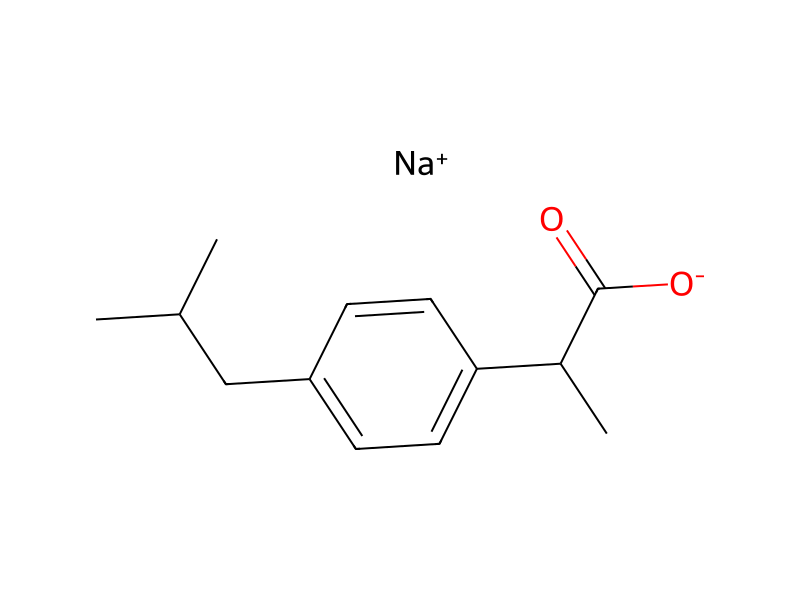
Br[CH:2]1[C:11]2[C:6](=[CH:7][CH:8]=[CH:9][CH:10]=2)[C:4](=[O:5])[O:3]1.[CH2:12]([C:16]1[CH:21]=[CH:20][C:19]([CH:22]([CH3:26])[C:23]([O-:25])=[O:24])=[CH:18][CH:17]=1)[CH:13]([CH3:15])[CH3:14].[Na+]>CN(C)C=O>[CH2:12]([C:16]1[CH:17]=[CH:18][C:19]([CH:22]([CH3:26])[C:23]([O:25][CH:2]2[C:11]3[C:6](=[CH:7][CH:8]=[CH:9][CH:10]=3)[C:4](=[O:5])[O:3]2)=[O:24])=[CH:20][CH:21]=1)[CH:13]([CH3:15])[CH3:14]Participants
4
Reactant 2

Product 1

Reagents, catalysts & solvents 1

Procedure
To a solution of 10.65 g of 3-bromophthalide in 100 ml of dimethylformamide, 11.5 g of sodium 2-(4-isobutylphenyl)propionate is added under stirring at room temperature. The reaction mixture is stirred 24 hours at room temperature, and it is then poured into 500 ml of ice water. After extraction with chloroform, the organic phase is washed with an aqueous solution of sodium bicarbonate, then with water and finally it is dried on anhydrous sodium sulfate and evaporated to dryness. The residue, crystallized from petroleum ether, yields 12.3 g of phthalidyl 2-(4-isobutylphenyl)propionate, having the same physico-chemical characteristics of the compounds of Example 1.
Workup
- stirringThe reaction mixture is stirred 24 hours at room temperature
- extractionAfter extraction with chloroform
- washthe organic phase is washed with an aqueous solution of sodium bicarbonate
- dry with materialwith water and finally it is dried on anhydrous sodium sulfate
- customevaporated to dryness
- customThe residue, crystallized from petroleum ether
Sources & evidence
- ORD record
- ord-98155d8092aa46d49bd0d7003efbfb66
- Source dataset
- uspto-grants-1985_07
- Patent number
- US04529737
Linked notes
Loading…